
The Clean Air Act: Environmental Justice, Public Health, and Federal Power
Students examine how citizen activism, scientific evidence, and unequal exposure to air pollution shaped the Clean Air Act and debates over federal environmental regulation.

Illustrations are auto-generated and may be placeholders. They can be refreshed to match the narration.
Industrial Growth and Urban Air Pollution
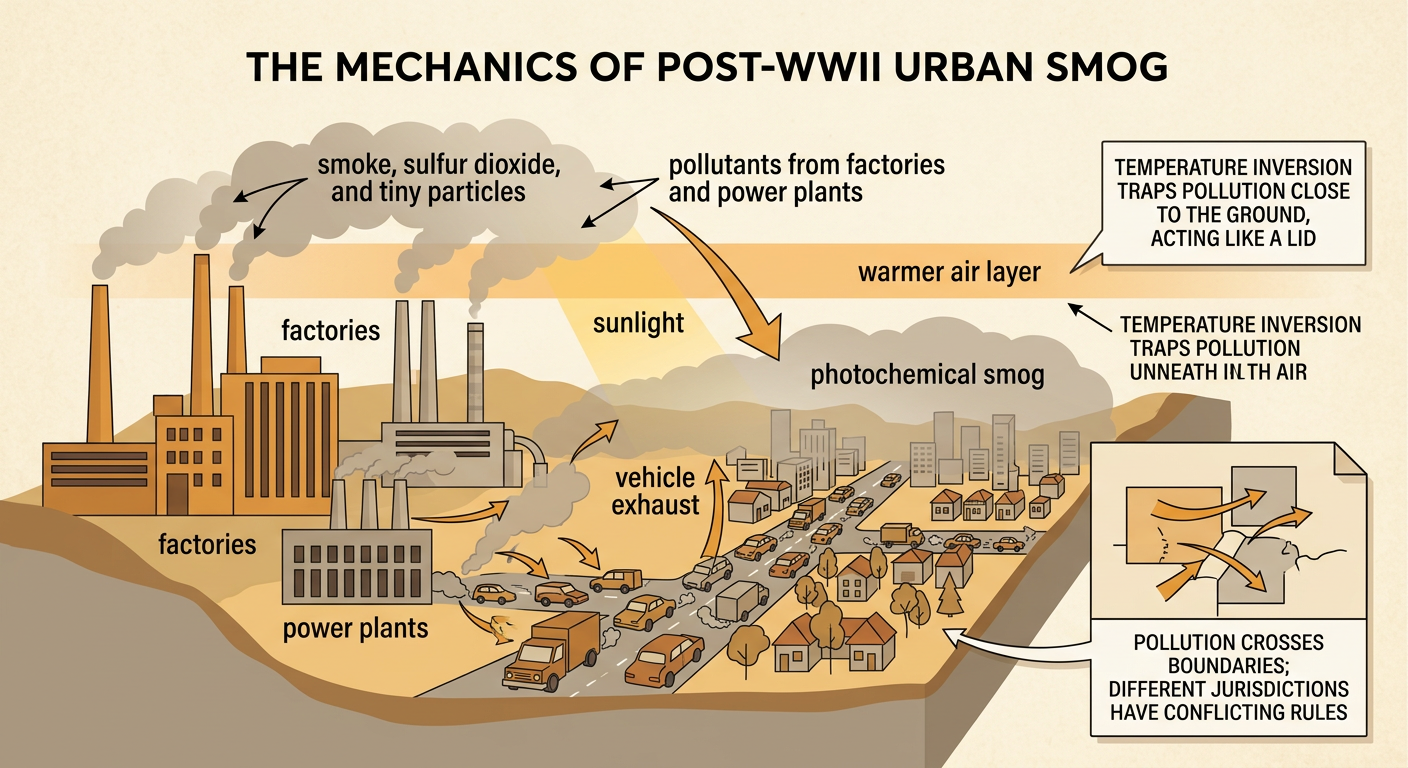
After World War II, rapid industrial growth, automobile use, and fossil-fuel consumption increased air pollution in many U.S. cities. Factories and power plants released smoke, sulfur dioxide, and particles, while vehicle exhaust helped create photochemical smog. Geography and weather could trap these pollutants near the ground. In Los Angeles, sunlight reacted with vehicle emissions to produce thick smog that irritated eyes, damaged crops, and reduced visibility. Local governments tried smoke-control rules, but pollution crossed city and state boundaries, and standards varied widely. Public frustration grew as residents experienced smog alerts and health warnings. These conditions encouraged demands for national research, consistent air-quality standards, and stronger enforcement, helping turn air pollution from a local nuisance into a federal public issue.
Scientific Evidence and Public Health
Scientific research helped establish that air pollution was not merely unpleasant but dangerous to human health. Researchers combined air-monitoring data, hospital records, mortality statistics, laboratory studies, and comparisons among communities. The 1948 Donora, Pennsylvania, smog disaster provided a powerful example: a weather inversion trapped industrial pollution, sickening thousands and contributing to 20 deaths during the episode. Evidence from Donora and later studies connected particulate matter, sulfur dioxide, ozone, carbon monoxide, nitrogen dioxide, and lead with respiratory, cardiovascular, and neurological harm. Scientists also identified groups at higher risk, including children, older adults, outdoor workers, and people with asthma. This evidence supported national ambient air-quality standards. Policymakers still had to evaluate uncertainty, but repeated findings across different sources strengthened the case for preventive regulation.

Environmental Inequality and Citizen Activism
Air pollution does not affect all communities equally. Highways, ports, refineries, power plants, and waste facilities have often been located near low-income communities and communities of color. Residents may experience several pollution sources at once while having less access to health care or political influence. Citizen groups have responded by collecting testimony, attending hearings, filing lawsuits, organizing demonstrations, and conducting community air monitoring. For example, West Harlem Environmental Action, later known as WE ACT for Environmental Justice, challenged diesel pollution and other environmental hazards in northern Manhattan beginning in the late 1980s. Such activism helped make unequal exposure a national policy concern and pressed agencies to consider cumulative risks and fair enforcement. Citizens can therefore use environmental laws as tools while also challenging agencies when legal protections are applied unevenly.

The Clean Air Act and Federal Authority
The Clean Air Act Amendments of 1970 created a stronger national system for controlling air pollution. Congress authorized the Environmental Protection Agency to set national ambient air-quality standards for widespread pollutants and national limits for emissions from new motor vehicles and certain industrial sources. States generally develop state implementation plans explaining how they will meet federal air standards. This structure combines federal minimum requirements with state administration. The law also allows citizen suits under specified conditions, giving people a way to challenge violations or failures to perform required duties. Federal authority became especially important because pollution can travel across state borders. At the same time, disputes continue over agency power, economic effects, and state flexibility. For example, California may request a federal waiver to adopt stricter vehicle-emission standards, and qualifying states may choose to follow California’s standards.

Evaluating Costs, Benefits, and Policy Trade-Offs
Environmental policy requires choices among competing goals. Policymakers can evaluate a proposal using criteria such as health protection, cost, technical feasibility, fairness, enforceability, and speed of implementation. Installing scrubbers at power plants or catalytic converters in vehicles raises costs for companies and consumers, but these technologies can reduce illness, missed workdays, environmental damage, and premature deaths. The 1990 Clean Air Act Amendments used a cap-and-trade program to reduce sulfur dioxide emissions linked to acid rain. The program set an overall emissions limit while allowing electric utilities to trade allowances, giving them flexibility in how to comply. Students evaluating such a solution should compare measurable benefits and costs while asking who pays and who benefits. A low-cost policy may still be unjust if heavily polluted communities remain insufficiently protected.
