The Cold War Nuclear Arms Race: Deterrence, Technology, and Global Risk
Students analyze nuclear stockpile data, the science underlying nuclear weapons, and primary sources to evaluate how deterrence shaped Cold War decisions and global tensions.

Illustrations are auto-generated and may be placeholders. They can be refreshed to match the narration.
Origins of the Cold War
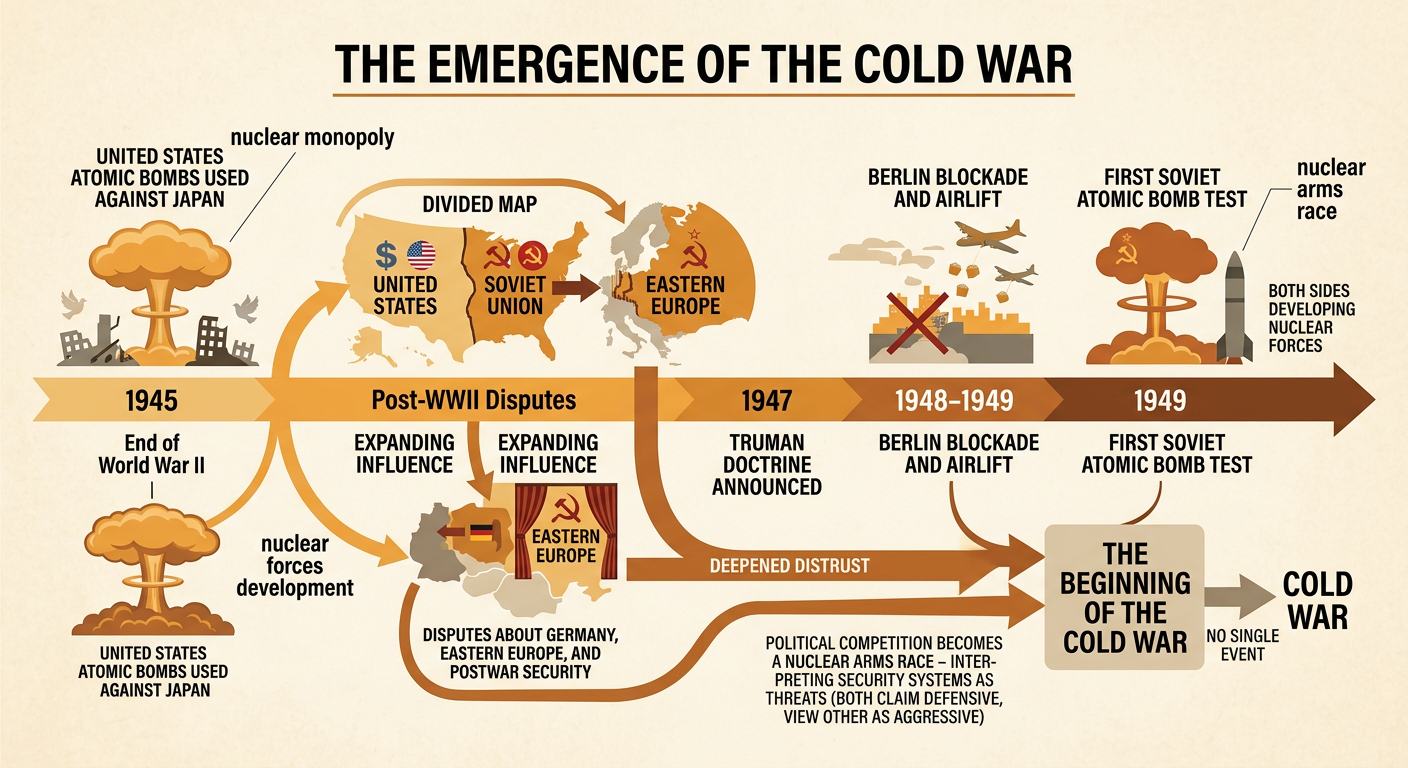
The Cold War emerged after World War II from several connected causes. The United States and the Soviet Union had opposing political and economic systems, and each feared the expansion of the other’s influence. Disagreements over Germany, Eastern Europe, and postwar security deepened distrust. In 1945, the United States used atomic bombs against Japan and briefly held a nuclear monopoly. The Soviet Union tested its first atomic bomb in 1949, turning political rivalry into a nuclear competition. For example, the United States viewed the Soviet-backed governments of Eastern Europe as forced expansion, while Soviet leaders viewed Western alliances and U.S. nuclear power as threats. No single event caused the Cold War; ideology, security concerns, wartime decisions, and new military technology interacted to divide Europe and create a global struggle for influence.
How Nuclear Weapons Release Energy
Nuclear weapons release energy through changes in atomic nuclei rather than through ordinary chemical reactions. In nuclear fission, the nucleus of a heavy atom, such as uranium-235, splits into smaller nuclei after absorbing a neutron. This process releases energy and additional neutrons, which can cause more fissions in a chain reaction. In nuclear fusion, light nuclei combine to form a heavier nucleus, releasing even more energy per unit of mass under extremely high temperature and pressure. In both processes, a small amount of mass becomes energy, represented by Einstein’s equation E = mc². For example, when a uranium nucleus splits, the total mass of the products is slightly less than the original mass. That small mass difference corresponds to a very large energy release because the speed of light squared is an enormous number.

Reading the Nuclear Stockpile Data
Stockpile data reveal how the arms race changed over time. Historical estimates show that the United States had about 300 nuclear warheads in 1950, while the Soviet Union had only a few. By 1960, the United States had more than 18,000 and the Soviet Union had roughly 1,600. The gap later narrowed and reversed: during the 1980s, the Soviet stockpile exceeded the U.S. stockpile, and the combined global total reached its highest level. On a line graph, year is the explanatory variable on the horizontal axis, and estimated number of warheads is the response variable on the vertical axis. Students should examine slopes, peaks, intersections, and unusual changes rather than assuming a constant growth rate. The figures are estimates because governments used secrecy and different counting methods, so sources and definitions must be checked before drawing conclusions.

Deterrence and Mutually Assured Destruction
Deterrence is the attempt to prevent an attack by convincing an opponent that the costs will be unacceptable. During the Cold War, both superpowers developed forces that could survive a first strike and then retaliate. This second-strike capability supported the idea of mutually assured destruction, often shortened to MAD: if either side launched a large nuclear attack, both societies could be devastated. For example, land-based missiles, submarine-launched missiles, and strategic bombers formed a “nuclear triad,” making it difficult to eliminate every retaliatory weapon. Deterrence may have discouraged direct war between the superpowers, but it also created risks. False warnings, miscommunication, accidents, or leaders’ miscalculations could have triggered escalation. The 1962 Cuban Missile Crisis demonstrated both sides of deterrence: nuclear danger increased pressure, but fear of catastrophic retaliation also encouraged compromise and withdrawal.

Primary Sources from the Arms Race
Primary sources reveal how people at the time explained nuclear policy, but each source reflects a particular purpose and point of view. In the 1950 NSC-68 report, U.S. officials described Soviet power as a major threat and recommended a rapid military buildup. In his 1961 farewell address, President Dwight D. Eisenhower warned that the “military-industrial complex” could gain excessive influence. During the Cuban Missile Crisis, President John F. Kennedy publicly called Soviet missiles in Cuba a threat, while private communications showed leaders searching for a way to avoid nuclear war. To analyze these sources, identify the author, audience, date, historical context, claim, and supporting evidence. Then compare the words with stockpile data and later outcomes. A public speech may emphasize national resolve, while a private letter may reveal uncertainty or willingness to compromise. Both can be useful without being fully neutral.

Evaluating the Costs of Nuclear Competition
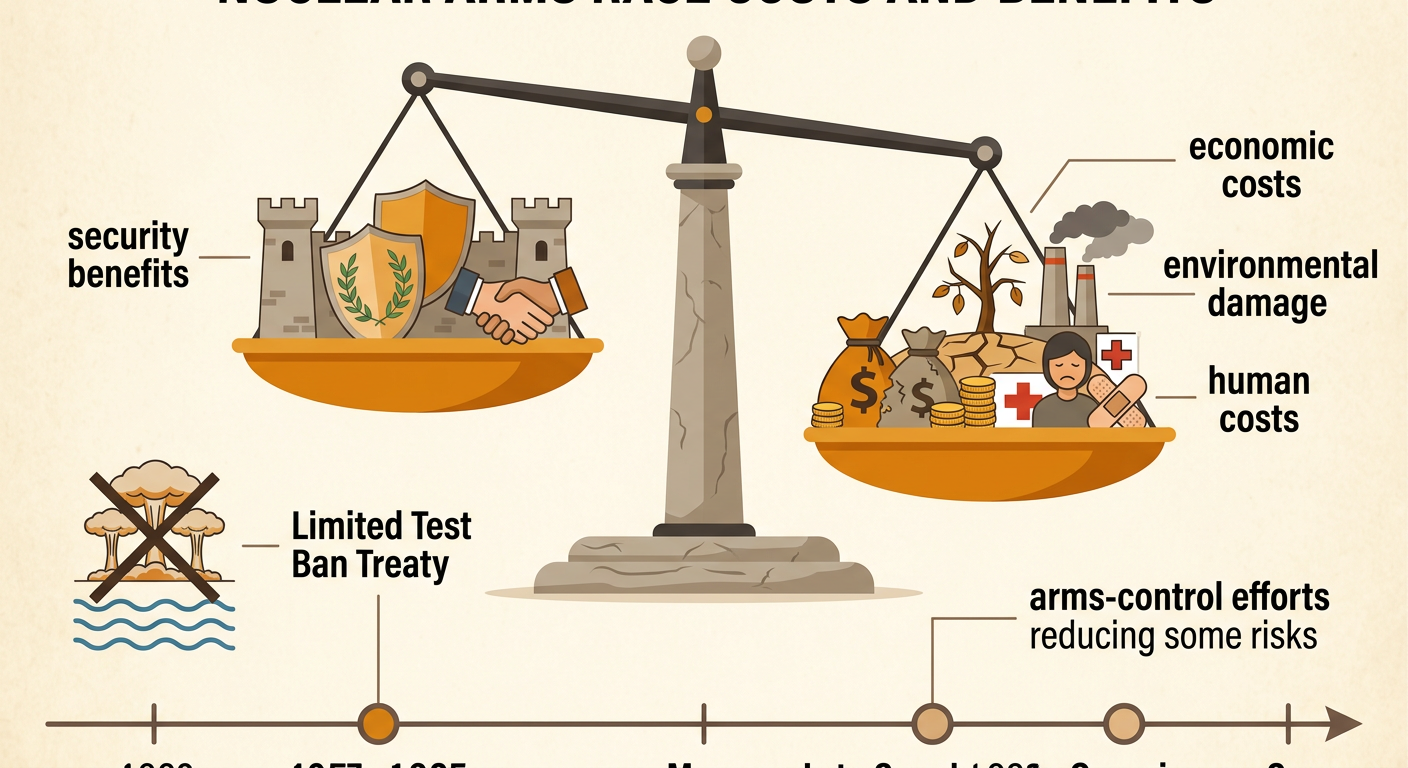
The nuclear arms race produced military, economic, environmental, political, and human costs. Governments spent large sums on warheads, delivery systems, warning networks, testing, and cleanup. Nuclear testing exposed some workers and nearby communities to radioactive fallout, while uranium mining and weapons production contaminated certain locations. The arms race also increased public anxiety and encouraged civil defense drills, shelters, and protest movements. Supporters argued that nuclear forces deterred a major war and protected alliances. Critics responded that excessive arsenals diverted resources from civilian needs and created dangers that no government could fully control. For example, the 1963 Limited Test Ban Treaty prohibited nuclear tests in the atmosphere, outer space, and underwater, reducing some fallout while leaving underground testing permitted. A strong evaluation weighs claimed security benefits against measurable expenses, environmental damage, unequal impacts, diplomatic effects, and the continuing risk of accidental or intentional use.