The Columbian Exchange: Ecological and Demographic Change
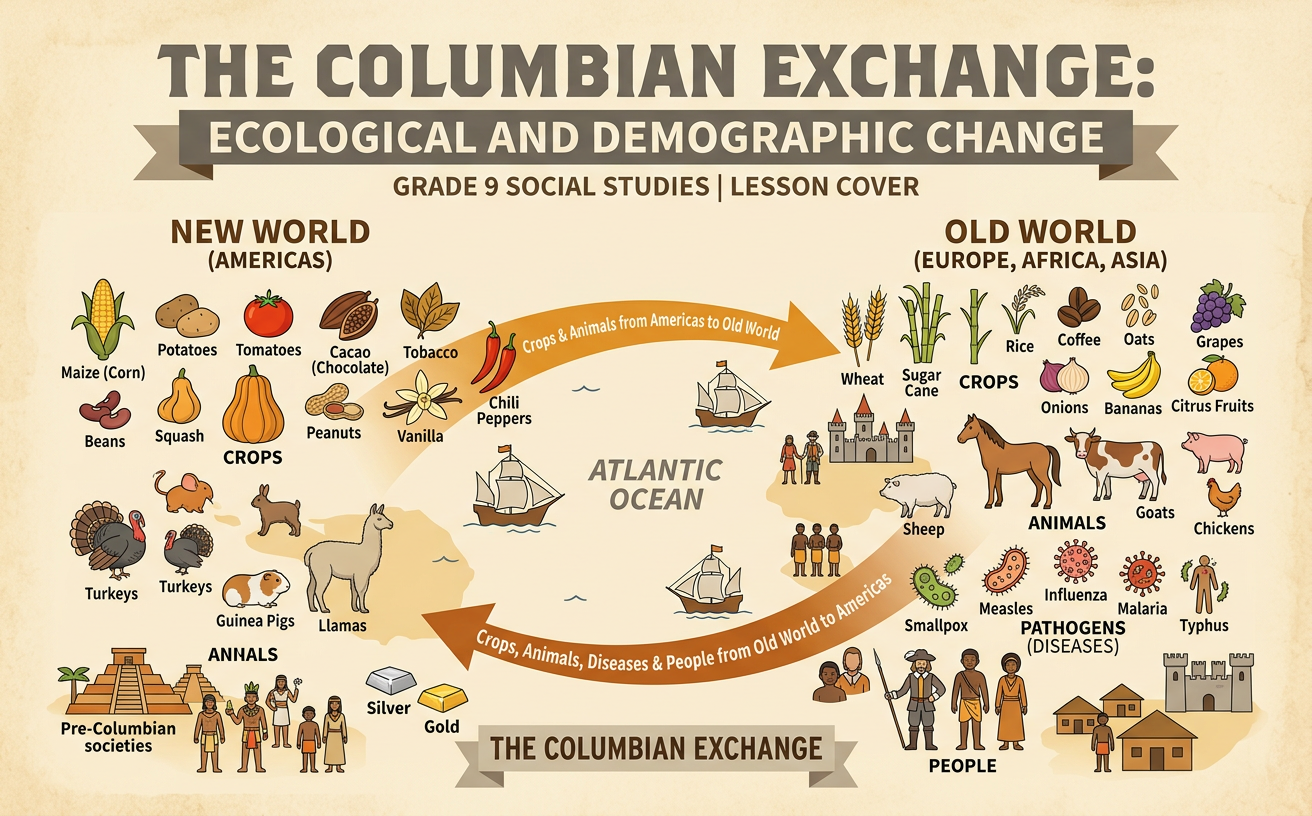
Students analyze historical sources and population data to explain how the exchange of crops, animals, pathogens, and people transformed societies and ecosystems across the Atlantic world.
Illustrations are auto-generated and may be placeholders. They can be refreshed to match the narration.
Atlantic Worlds Before Contact
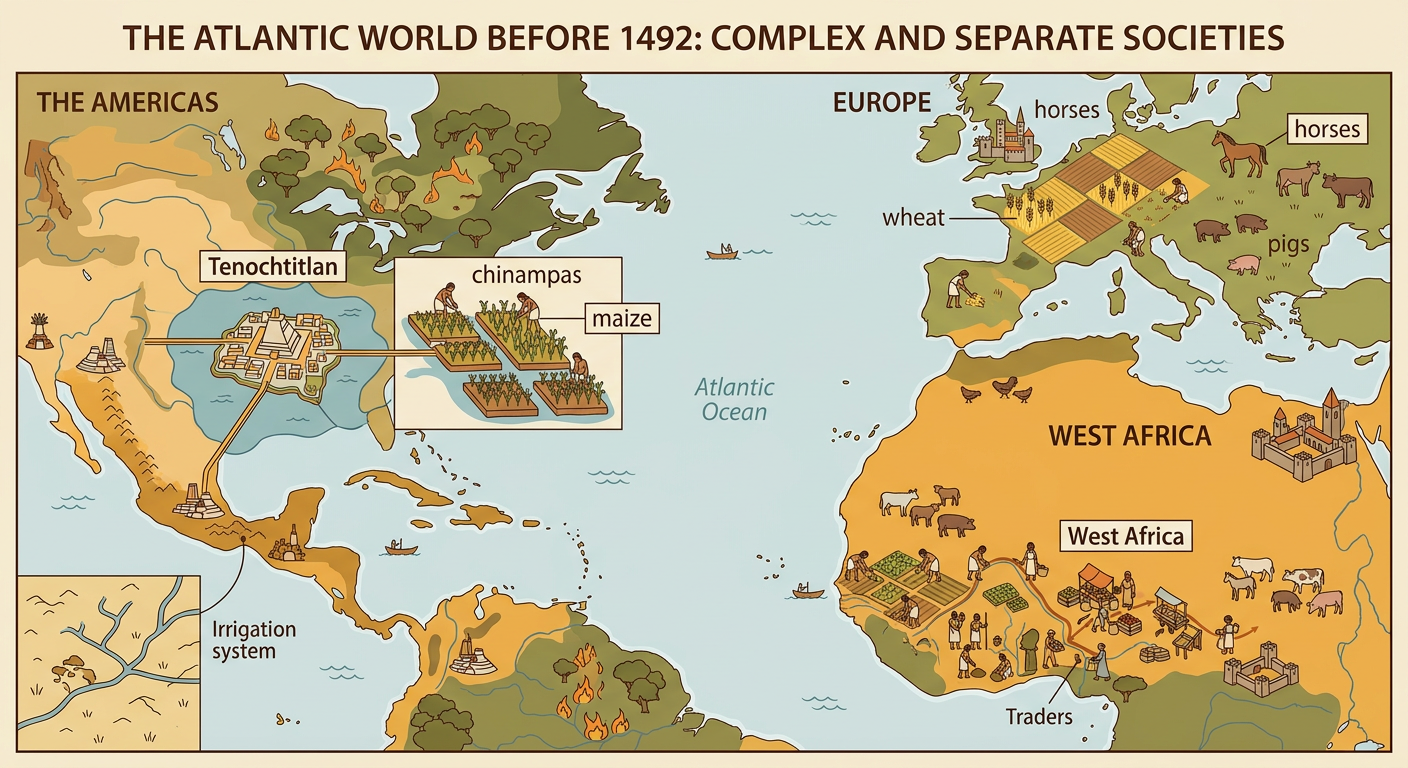
Before 1492, the Atlantic connected several distinct worlds, each with its own societies and ecosystems. Indigenous peoples in the Americas built cities, farmed crops such as maize and potatoes, and managed landscapes through irrigation and controlled burning. Europeans raised animals including horses, cattle, and pigs and cultivated wheat and other grains. West African societies developed extensive farming, herding, trade, and political networks. Geographic separation meant that many American plants, animals, and pathogens were unknown in Africa and Europe, and the reverse was also true. For example, the Mexica capital of Tenochtitlan supported a large population using chinampas, highly productive raised agricultural fields. Understanding these conditions prevents the mistaken idea that the Americas were empty or unchanged before European arrival.
Movement of Crops and Animals
After 1492, ships carried crops and domesticated animals across the Atlantic in both directions. Maize, potatoes, tomatoes, and cassava traveled from the Americas to Europe, Africa, and Asia. Wheat, sugarcane, coffee, horses, cattle, pigs, and sheep moved into the Americas. These transfers changed diets, farming, transportation, and land use. For example, the potato produced many calories in cool European climates and helped support population growth in several regions. In the Americas, horses increased mobility for some Indigenous nations, especially on the Great Plains, while cattle and pigs sometimes damaged fields and native vegetation. The effects were not equally beneficial. A crop might improve food security in one place while plantation production of that crop depended on land seizure and forced labor elsewhere.

Disease and Population Data
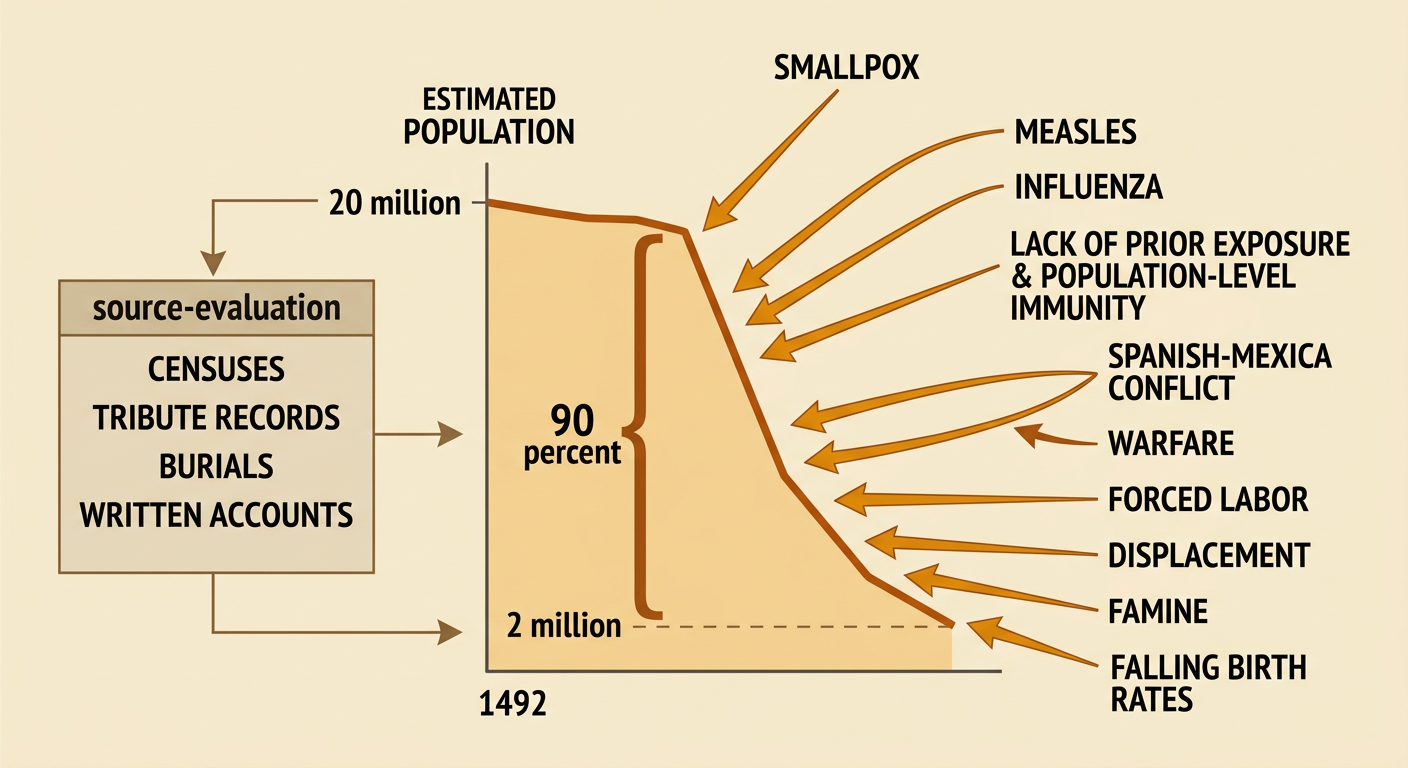
Pathogens carried across the Atlantic caused catastrophic population loss among Indigenous peoples, who had not experienced diseases such as smallpox, measles, and influenza in the same historical patterns as Eurasian populations. Historians evaluate this change using censuses, tribute records, burial evidence, written accounts, and population estimates. Suppose a model estimates that a region declined from 20 million people to 2 million. The estimated decrease is 18 million, or 90 percent. However, researchers must examine how both figures were produced rather than treating the percentage as exact. Disease was a major cause, but warfare, forced labor, displacement, famine, and declining birth rates also contributed. For example, the smallpox epidemic that reached central Mexico in 1520 weakened communities during the Spanish-Mexica conflict, showing how biological and military causes interacted.
Environmental Transformation
Introduced species and new forms of production transformed ecosystems throughout the Atlantic world. Cattle and sheep grazed native plants, compacted soil, and encouraged the expansion of grasslands in parts of the Americas. Free-ranging pigs consumed crops and disturbed forest floors. Plantation farming often replaced diverse habitats with large fields of a single export crop, such as sugarcane. These changes affected food webs, soil fertility, water use, and biodiversity. For example, on Caribbean islands, forests were cleared for sugar plantations, while mills required large supplies of wood and water. The resulting habitat loss changed which organisms could survive there. Ecological change was not caused by one species alone; it resulted from interactions among introduced organisms, human labor systems, markets, climate, and local conditions. Scientists assess such claims by comparing evidence from pollen, sediments, historical maps, and written records.

Economic and Social Consequences
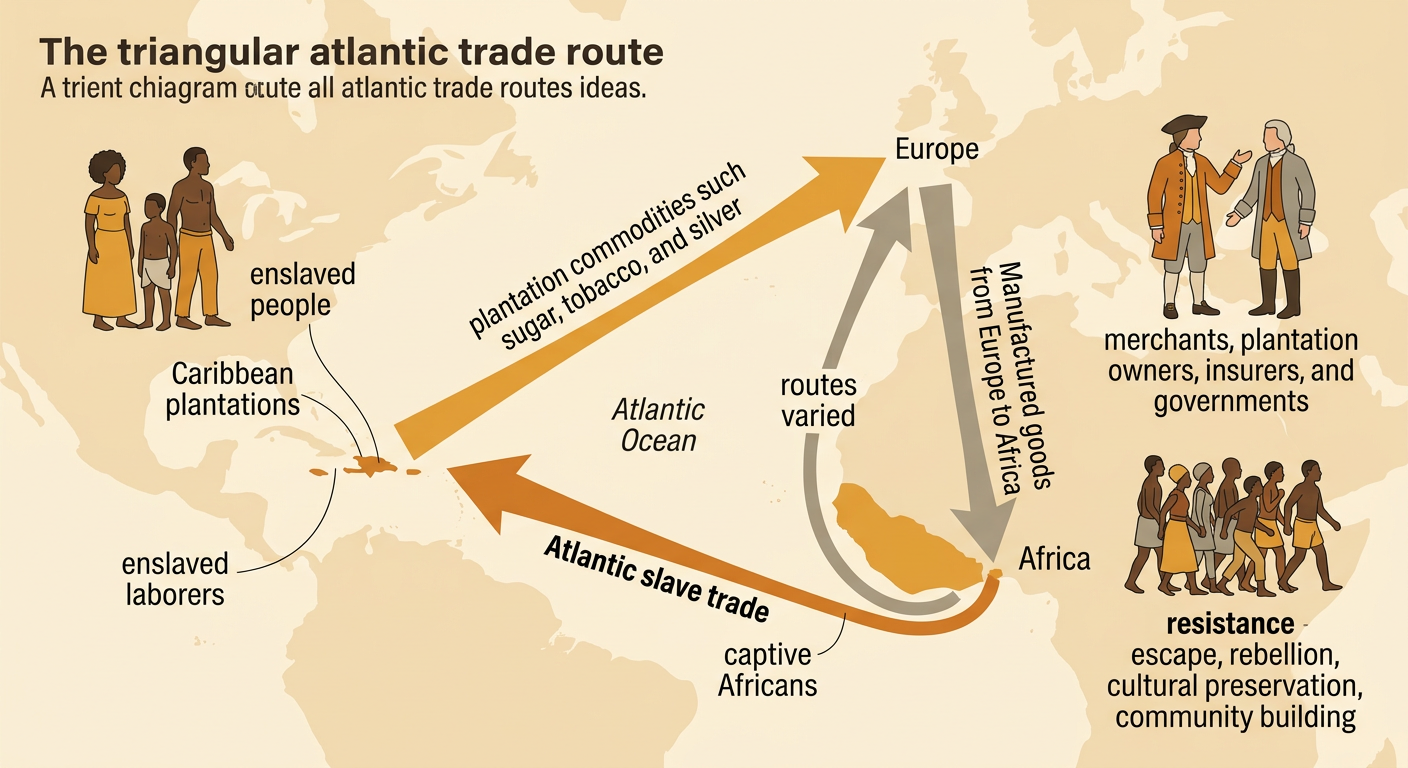
The Columbian Exchange created new wealth and new inequalities. European merchants and empires earned profits from commodities such as sugar, tobacco, and silver, while Indigenous and African people often bore the greatest human costs. As Indigenous populations declined and plantation agriculture expanded, European colonizers increased the forced migration and enslavement of Africans. The Atlantic slave trade separated families, exposed people to deadly conditions, and created racial systems whose effects lasted for centuries. Economic changes also reshaped daily life across continents. For example, rising European demand for sugar encouraged the growth of Caribbean plantations worked by enslaved laborers. Merchants, plantation owners, insurers, and governments gained revenue from this trade, while enslaved people resisted through escape, rebellion, cultural preservation, and community building. Thus, economic growth for some depended on coercion and loss for others.
Evidence-Based Historical Conclusions
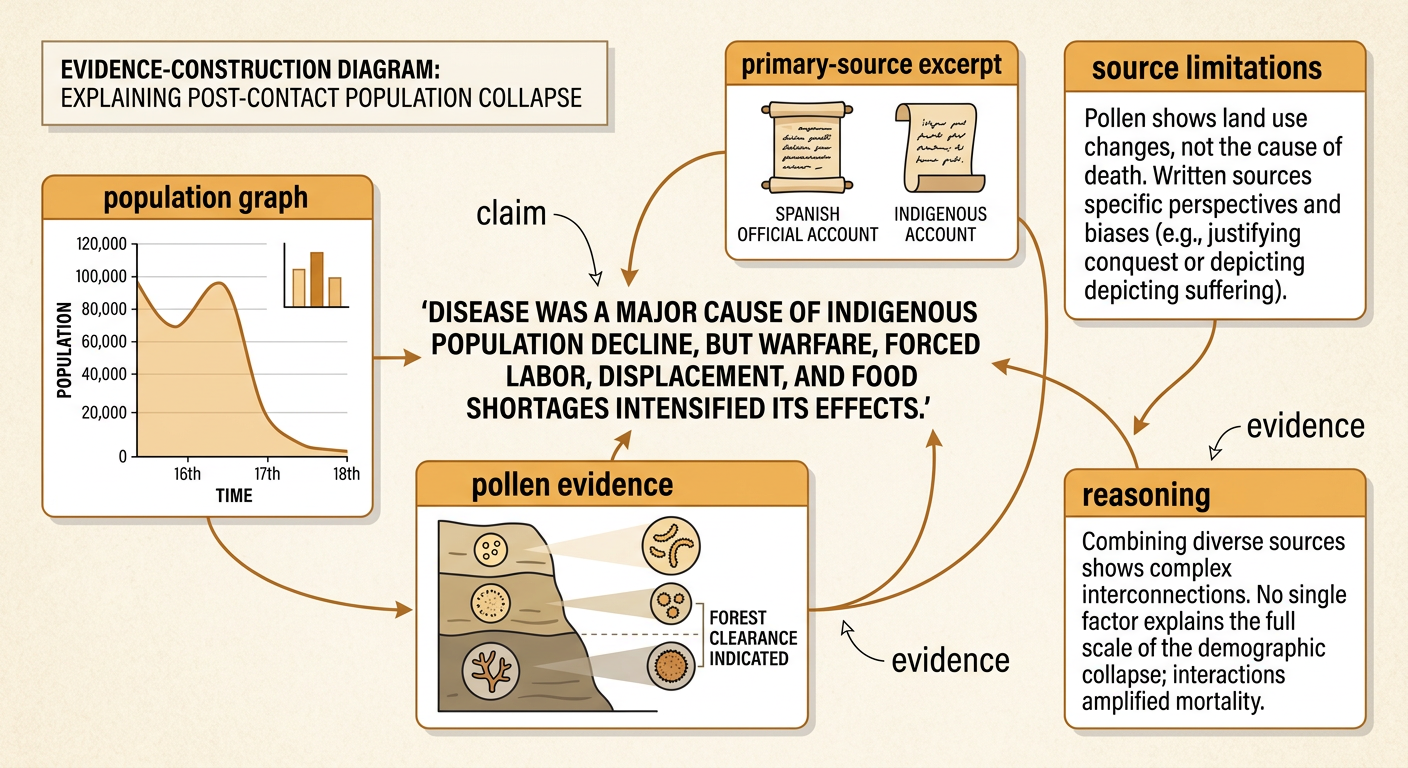
A strong historical conclusion answers a question with a clear claim, specific evidence, and reasoning that connects the evidence to the claim. Students should compare sources because each source has a perspective and limitations. A Spanish official might describe a smallpox epidemic, while an Indigenous account might emphasize suffering, disrupted leadership, or resistance. Population graphs can show the scale and timing of decline, but they cannot by themselves explain every cause. Ecological evidence, such as pollen showing forest clearance, can help test claims about land-use change. For example, a supported conclusion might state that disease was a major cause of Indigenous population decline, but its effects were intensified by warfare, forced labor, displacement, and food shortages. This conclusion is stronger than a single-cause explanation because it combines textual, demographic, and environmental evidence and acknowledges uncertainty.