
The Columbian Exchange: Transformation Across the Atlantic
Students examine how the movement of crops, animals, diseases, and people after 1492 transformed Indigenous societies, European economies, African communities, and environments across the Atlantic world.

Illustrations are auto-generated and may be placeholders. They can be refreshed to match the narration.
Atlantic Worlds Before 1492
Before 1492, the peoples of the Americas, Africa, and Europe lived in complex societies connected by regional trade networks. Indigenous communities exchanged crops, tools, knowledge, and ideas across North, Central, and South America. Maize first domesticated in Mexico, for example, spread northward and southward over thousands of years. African merchants traded gold, salt, textiles, and enslaved people across the Sahara and Indian Ocean. European and Asian trade routes moved goods such as silk and spices. Although earlier voyages occurred, including Norse settlement in Newfoundland, no lasting transatlantic network regularly connected these regions. Each region therefore developed with different crops, animals, diseases, and ecosystems. Columbus’s 1492 voyage began sustained contact among these worlds, creating the large-scale movement later called the Columbian Exchange.

New Crops and Animals
After 1492, plants and animals moved across the Atlantic in both directions. From the Americas, Europeans carried maize, potatoes, tomatoes, cacao, and cassava to Europe, Africa, and Asia. Potatoes produced many calories in cool climates and helped support population growth in parts of Europe. Cassava became an important food in parts of Africa because it could grow in poor soils and withstand drought. Europeans brought wheat, sugarcane, coffee, horses, cattle, pigs, and sheep to the Americas. Horses transformed travel, hunting, and warfare for many Indigenous peoples, especially on the Great Plains, although these changes developed over generations. Introduced livestock also damaged some fields and native plant communities through grazing and trampling. These exchanges changed diets and economies while also altering relationships among organisms and their environments.

Disease and Population Loss
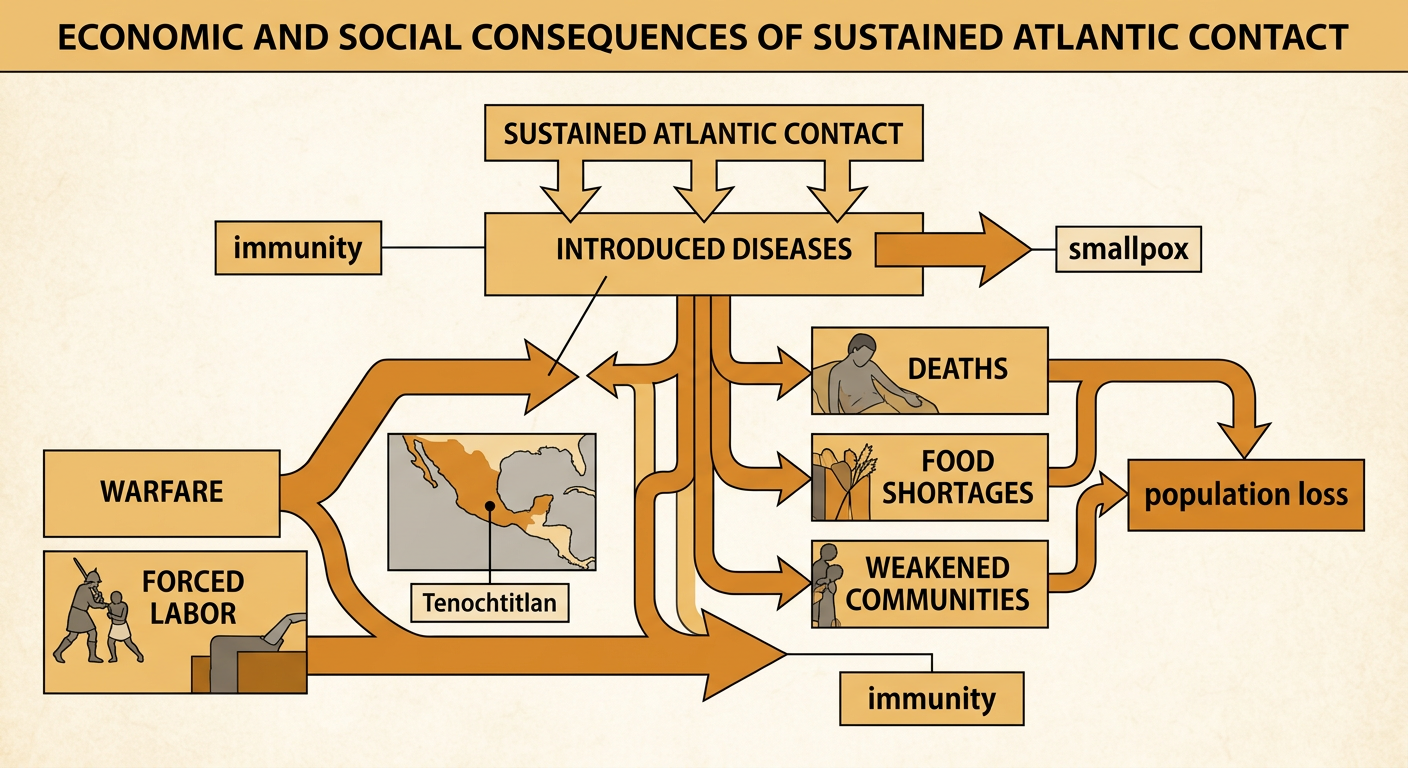
Diseases carried across the Atlantic caused catastrophic population loss among Indigenous peoples. Europeans, Africans, and Asians had long lived with illnesses such as smallpox, measles, and influenza, so some survivors had acquired immunity. Because these diseases had not circulated widely in the Americas, Indigenous populations generally lacked previous exposure and immunity. Smallpox spread through central Mexico in 1520 and 1521, killing many people during the Spanish-led war against Tenochtitlan. Epidemics weakened communities by taking farmers, leaders, caregivers, and knowledge holders. Warfare, displacement, food shortages, and forced labor made the effects even worse. Population estimates differ by place and source, but historians agree that disease contributed to enormous losses. This shows how a change in an ecosystem’s biological components can sharply affect human populations and social systems.
Forced Migration and Enslavement
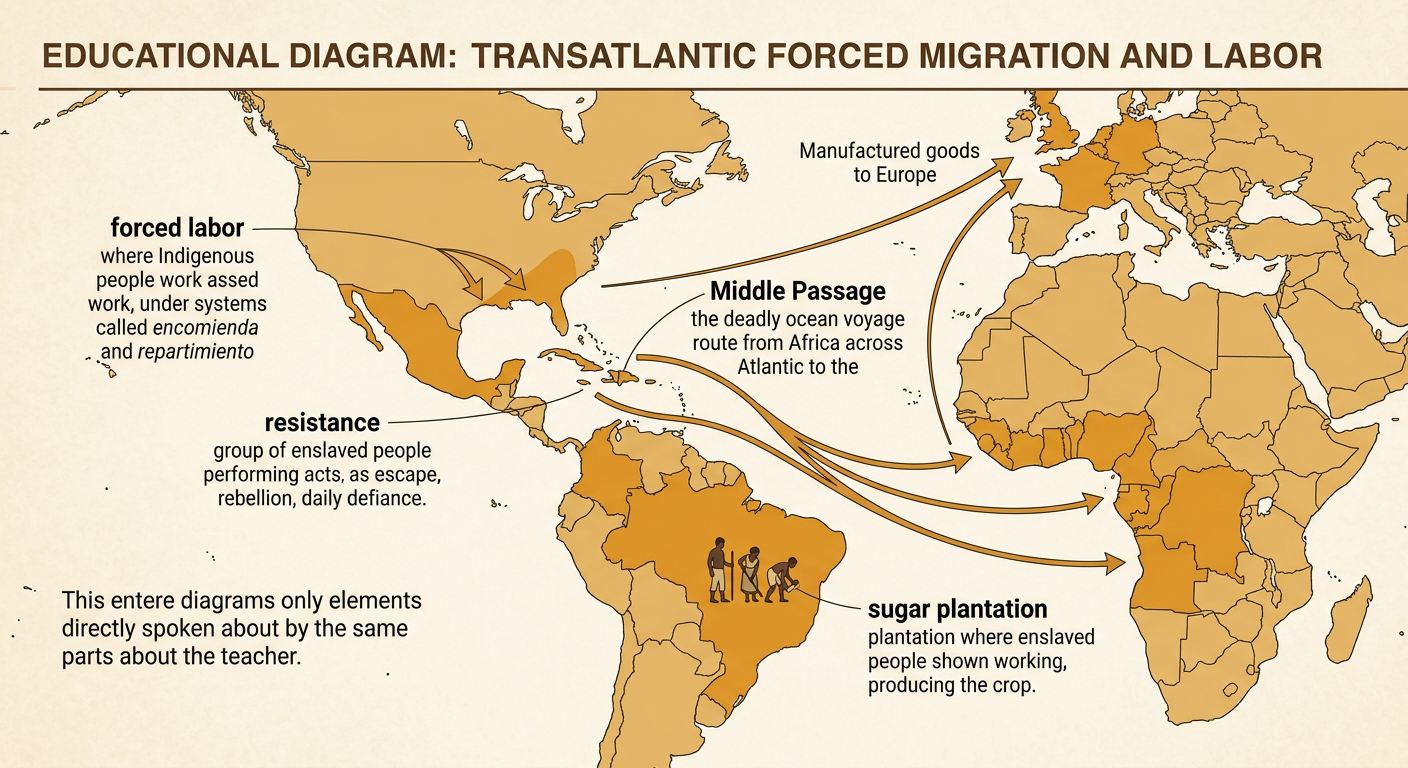
The Columbian Exchange included the forced movement of millions of people. European colonizers compelled many Indigenous people to work through systems such as encomienda and repartimiento. As Indigenous populations declined and plantation production expanded, European merchants transported increasing numbers of enslaved Africans across the Atlantic. The Middle Passage was the deadly ocean voyage from Africa to the Americas. Captives endured confinement, violence, disease, and inadequate food and water. In Brazil and the Caribbean, enslaved Africans were forced to grow and process sugar, a highly profitable crop in European markets. The Atlantic slave trade disrupted African families and communities, encouraged warfare and raiding in some regions, and strengthened states and merchants involved in the trade. In the Americas, enslaved people resisted oppression and preserved and created cultural traditions that shaped language, religion, music, food, and society.
Economic and Environmental Changes
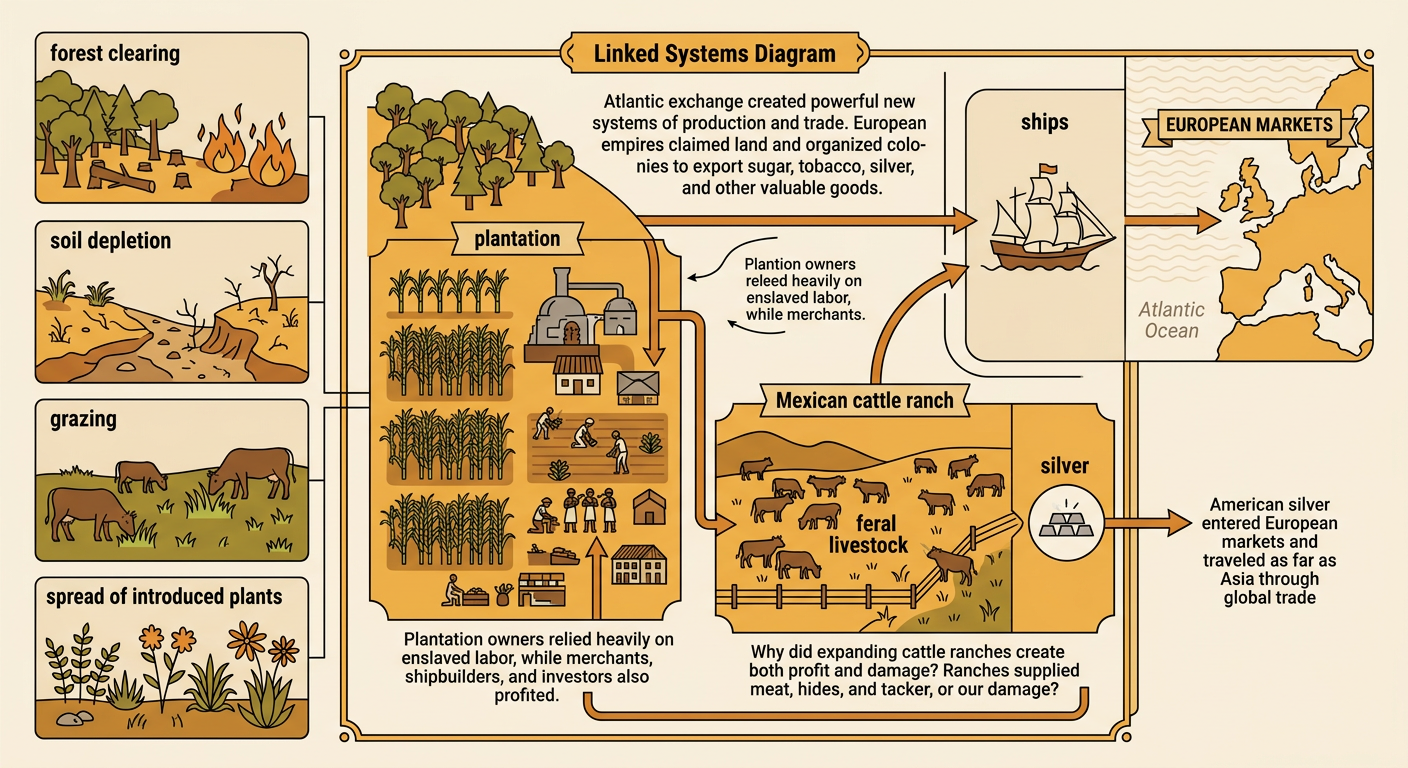
Atlantic exchange created new systems of production, trade, and environmental change. European empires claimed land and organized colonies to export sugar, tobacco, silver, and other valuable goods. Plantation owners relied heavily on enslaved labor, while merchants, shipbuilders, and investors profited from Atlantic commerce. American silver entered European markets and also reached Asia through global trade. Producing these goods transformed ecosystems. In the Caribbean, forests were cleared to create sugar plantations, and repeated planting exhausted soils. Cattle, pigs, and sheep consumed native vegetation, trampled fields, and sometimes became feral. European weeds and grasses spread in disturbed areas. These biological and physical changes affected both human and nonhuman populations. For example, expanding cattle ranches in parts of Mexico occupied large areas, damaged some Indigenous farmland, and supported a colonial market for meat, hides, and tallow.
Evaluating Lasting Consequences
The Columbian Exchange produced lasting benefits, harms, and unequal outcomes. Crops such as maize, potatoes, and cassava improved food supplies in many regions, while new trade networks connected distant economies. At the same time, disease, conquest, land seizure, and slavery caused immense suffering and created inequalities that continued for centuries. Its environmental effects remain visible in the global distribution of crops, livestock, weeds, and pathogens. To evaluate these consequences, historians compare evidence from different sources. A ship’s cargo list may document goods or captives, while an Indigenous account may describe invasion, epidemic disease, or environmental disruption. Population records, maps, and ecological evidence can test or complicate those accounts. For example, a strong argument about plantation expansion could cite export records alongside evidence of forest clearing. Good historical conclusions explain multiple causes and effects, identify each source’s perspective, and acknowledge uncertainty where evidence is incomplete.
