
The Columbian Exchange: Transforming Societies and Ecosystems
Students examine how the movement of crops, animals, diseases, and people across the Atlantic reshaped populations, economies, cultures, and environments after 1492.
Illustrations are auto-generated and may be placeholders. They can be refreshed to match the narration.
Atlantic Worlds Before 1492
Before 1492, the societies on both sides of the Atlantic were diverse and connected within their own regions. In the Americas, millions of people lived in communities ranging from small villages to large states such as the Aztec and Inca empires. Indigenous peoples developed crops including maize, potatoes, and beans, and shaped ecosystems through farming, irrigation, and controlled burning. In Europe, Africa, and Asia, long-distance trade networks moved goods, technologies, people, and diseases. Europeans raised animals such as horses, cattle, pigs, and sheep, which were not present in the Americas at that time. West African kingdoms traded gold and other goods across the Sahara and along the Atlantic coast. These worlds were not isolated or unchanged, but sustained contact across the Atlantic began only after Columbus's 1492 voyage.

What Moved Across the Atlantic?
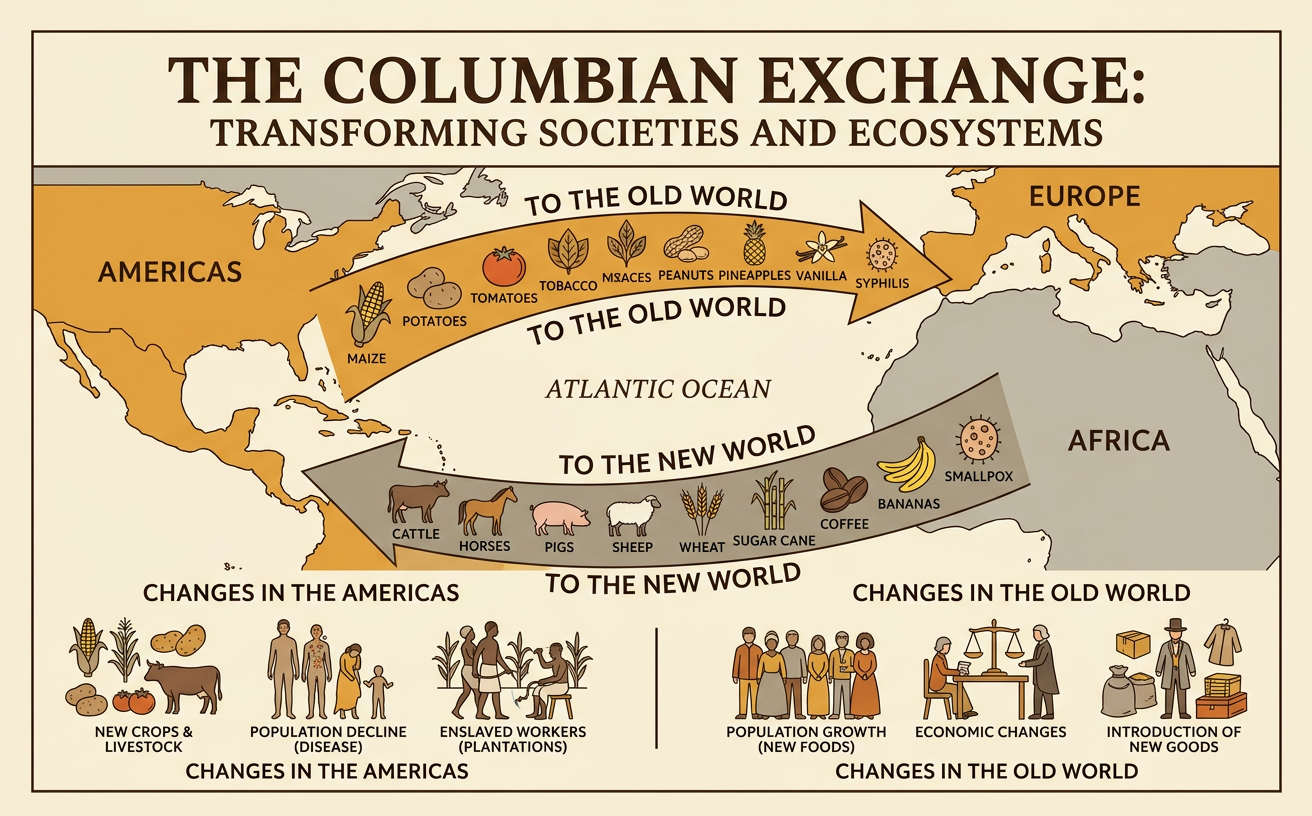
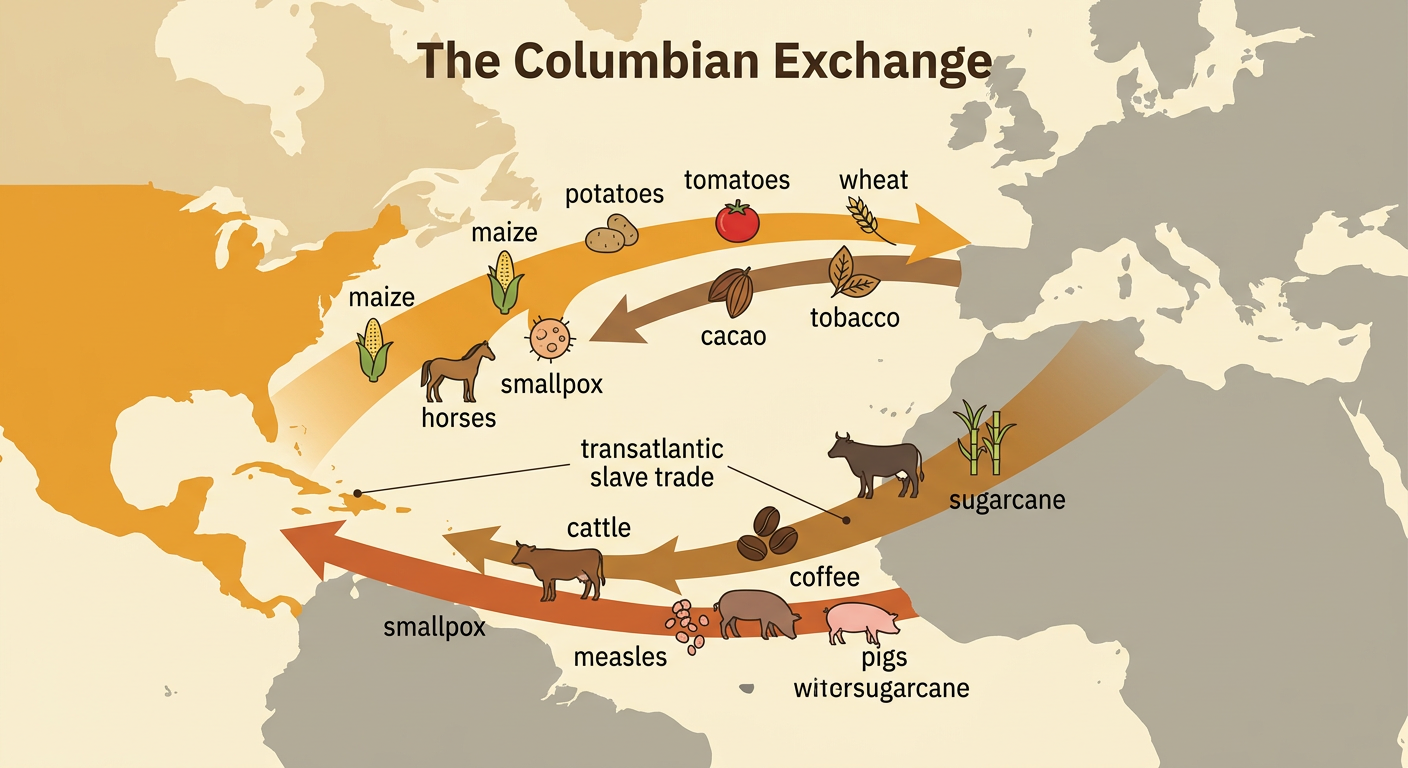
The Columbian Exchange was the large-scale movement of living things, people, and ideas between the Americas and the Eastern Hemisphere after 1492. From the Americas, crops such as maize, potatoes, tomatoes, cacao, and tobacco traveled eastward. From Europe, Africa, and Asia came wheat, sugarcane, coffee, horses, cattle, pigs, and diseases including smallpox and measles. People also crossed the ocean. European colonists migrated voluntarily or under government direction, while millions of Africans were transported by force through the transatlantic slave trade. The exchange did not affect everyone equally. Potatoes helped support population growth in parts of Europe, while smallpox caused catastrophic losses among Indigenous American populations. A useful summary must therefore identify both movement and unequal consequences rather than describe the exchange as a simple trade of useful goods.
Crops, Animals, and Environmental Change
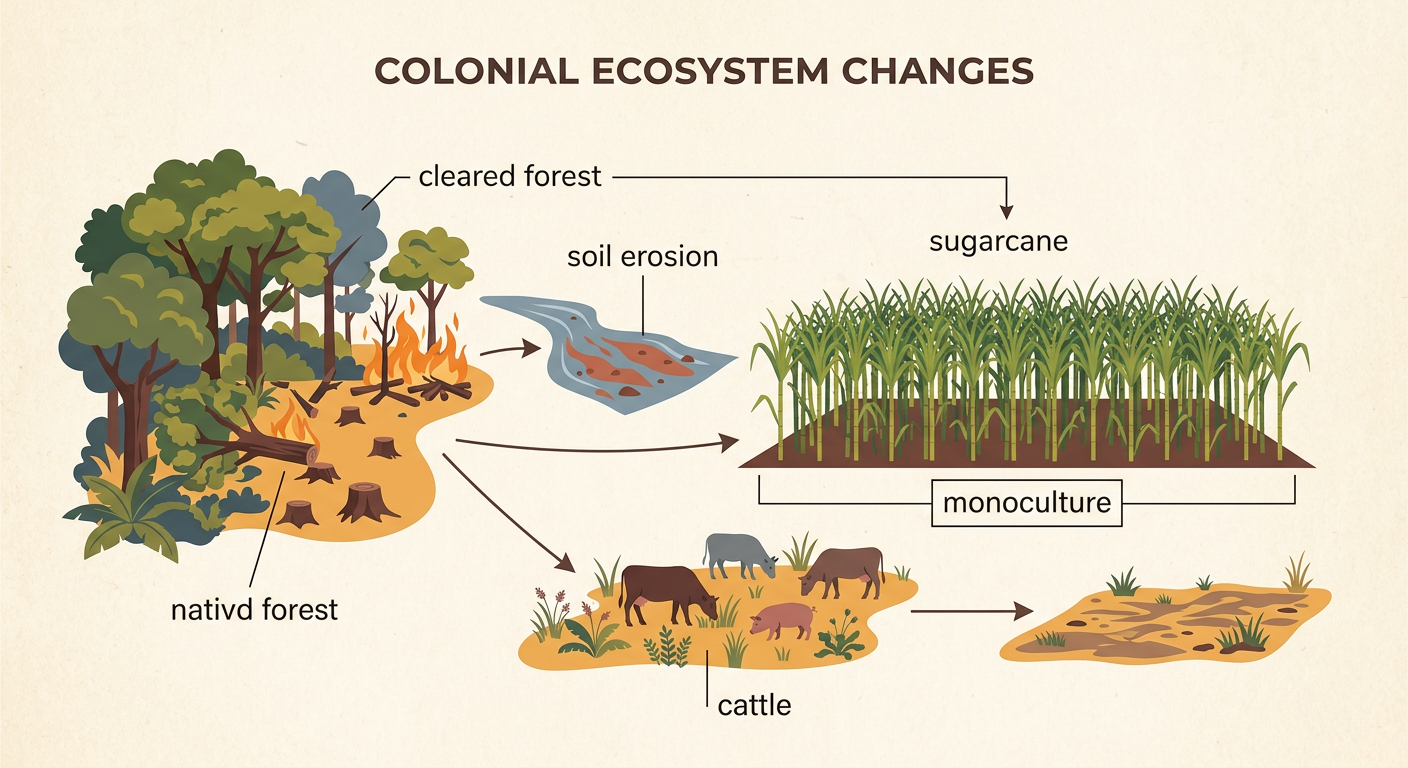
New crops and animals changed both human diets and ecosystems. American crops such as maize and potatoes grew well in parts of Europe, Africa, and Asia, increasing available food and helping some populations grow. In the Americas, Europeans established sugar plantations and introduced cattle, horses, pigs, and sheep. These animals could trample crops, consume native plants, compact soil, and spread into new habitats. Plantation owners often cleared forests to create fields, reducing habitat diversity and increasing soil erosion. Sugarcane provides a clear example: growing it on Caribbean islands required large areas of land, heavy labor, and processing facilities. The resulting plantations transformed local landscapes and economies. In ecosystem terms, changing one component, such as adding grazing animals or replacing forests with a single crop, affected plant populations, soil, water, and the people who depended on those resources.
Disease and Population Loss
Diseases brought from the Eastern Hemisphere caused one of the most devastating effects of Atlantic contact. Smallpox, measles, and influenza spread among Indigenous peoples who had no previous exposure to these particular diseases and therefore little population-level immunity. Epidemics killed large numbers of people, although exact totals vary by place and source. Disease often combined with warfare, forced labor, displacement, hunger, and social disruption, making survival even more difficult. In central Mexico, a major smallpox epidemic began in 1520 during the Spanish invasion of the Aztec Empire. The illness weakened communities and leaders as fighting continued. Population loss disrupted farming, family networks, political authority, and the transfer of knowledge. Disease was therefore both a biological event and a historical force. Historians compare written accounts, population estimates, archaeology, and other evidence to explain its causes and consequences.

Forced Migration and Enslavement
The Columbian Exchange included the forced movement of people, not only the transfer of plants and animals. As European colonies expanded, colonizers demanded labor for mines, farms, and plantations. They forced many Indigenous people to work under violent colonial systems. Population losses and growing plantation economies also contributed to European reliance on the transatlantic slave trade. From the 1500s through the 1800s, about 12.5 million captive Africans were placed on ships bound for the Americas, and about 10.7 million survived the Atlantic crossing. Enslaved people faced brutal conditions, family separation, and treatment as property. At the same time, Africans and their descendants preserved and created languages, beliefs, foods, music, agricultural knowledge, and forms of resistance. For example, skilled African farmers contributed knowledge used in rice-growing regions of the Americas. Forced migration reshaped the populations, economies, and cultures of several continents.
Evaluating the Exchange's Lasting Effects
The Columbian Exchange created lasting benefits for some groups and severe harms for others. New crops expanded diets and global food supplies. Horses changed transportation and hunting for some Indigenous nations, especially on the Great Plains. However, conquest, disease, enslavement, and land seizure caused enormous suffering and unequal access to wealth and power. Plantation systems connected continents through trade but also encouraged forced labor, monoculture, deforestation, and soil damage. To evaluate the exchange, students should identify a source's central idea, examine its evidence, and ask whose experience it represents. They can then build an argument that includes multiple causes and effects. For example, an argument might state that sugarcane transformed Caribbean societies because European demand encouraged forest clearing, plantation growth, and the forced migration of Africans. A strong conclusion recognizes that the exchange was not one single positive or negative event; its effects differed across peoples, places, and ecosystems.
