
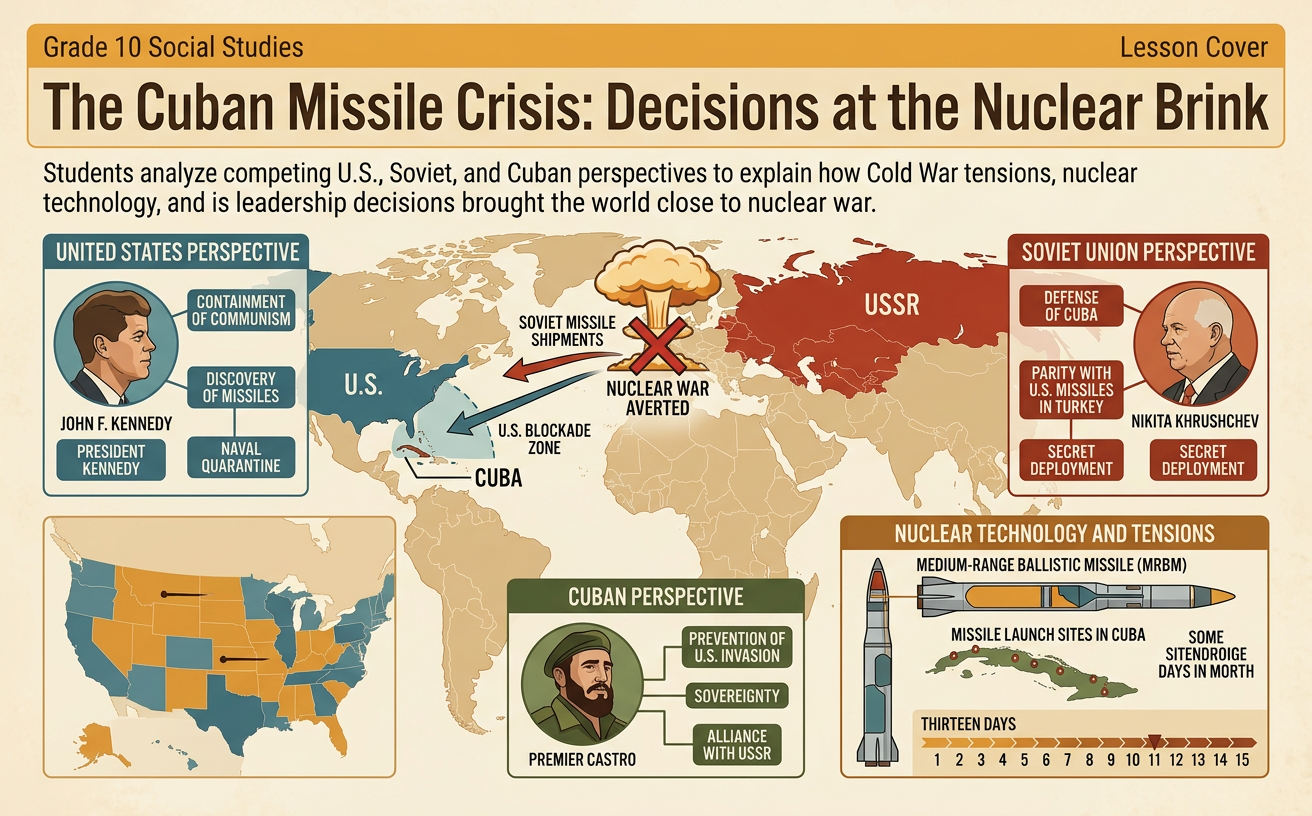
The Cuban Missile Crisis: Decisions at the Nuclear Brink
Students analyze competing U.S., Soviet, and Cuban perspectives to explain how Cold War tensions, nuclear technology, and leadership decisions brought the world close to nuclear war.
Illustrations are auto-generated and may be placeholders. They can be refreshed to match the narration.
Cold War Context
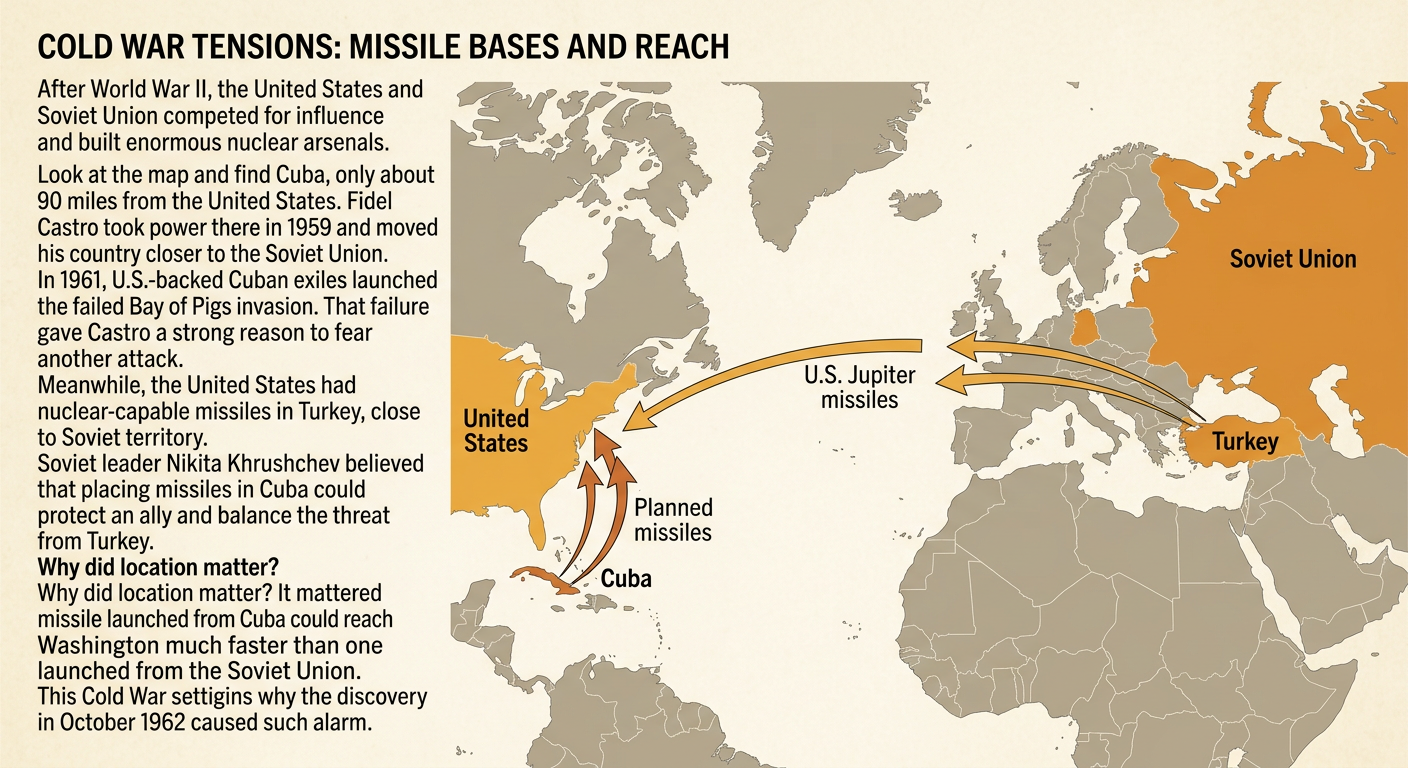
After World War II, the United States and Soviet Union competed for global influence while building large nuclear arsenals. Cuba became part of this rivalry after Fidel Castro’s 1959 revolution overthrew a U.S.-supported government and moved Cuba toward the Soviet Union. In April 1961, Cuban exiles backed by the United States attempted an invasion at the Bay of Pigs. Its failure strengthened Castro’s fear of another U.S. attack. Meanwhile, the United States had nuclear-capable Jupiter missiles in Turkey, near the Soviet Union. Soviet leader Nikita Khrushchev saw placing missiles in Cuba as a way to protect an ally and reduce the strategic imbalance. For example, a Soviet missile in Cuba could reach Washington, D.C., much faster than a missile launched from the Soviet Union.
Discovery of the Missiles
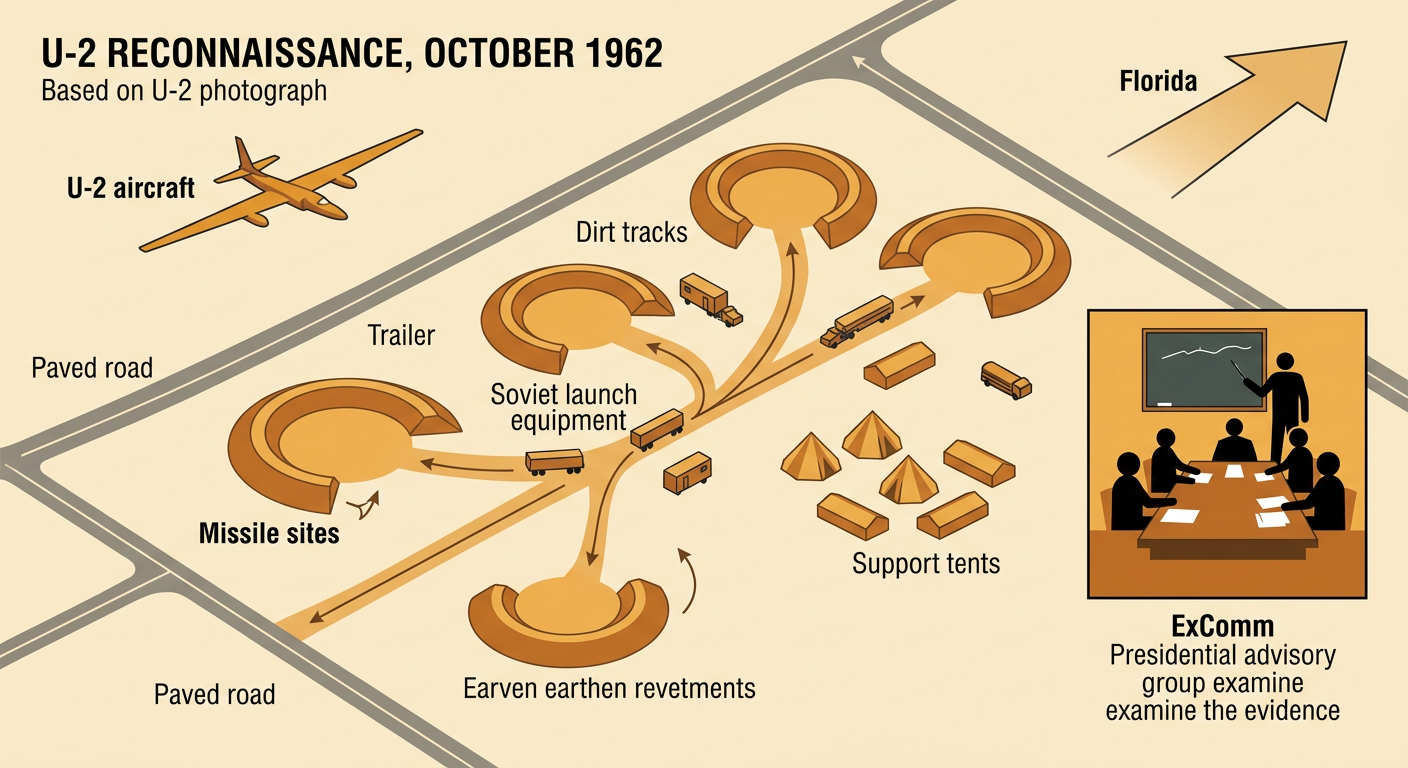
On October 14, 1962, a U.S. U-2 reconnaissance aircraft photographed Soviet missile sites under construction near San Cristóbal, Cuba. Photo analysts compared visible launch equipment, missile trailers, and site arrangements with known Soviet facilities. On October 16, President John F. Kennedy was informed that medium-range ballistic missiles were being installed only about 90 miles from Florida. Kennedy formed the Executive Committee of the National Security Council, called ExComm, to study the evidence and recommend a response. The photographs were important primary-source evidence, but they did not reveal every Soviet intention or whether nuclear warheads were already present. For example, analysts could identify missile launch areas from their distinctive layout, yet leaders still had to infer why Khrushchev had secretly sent the weapons.
Kennedy’s Strategic Options
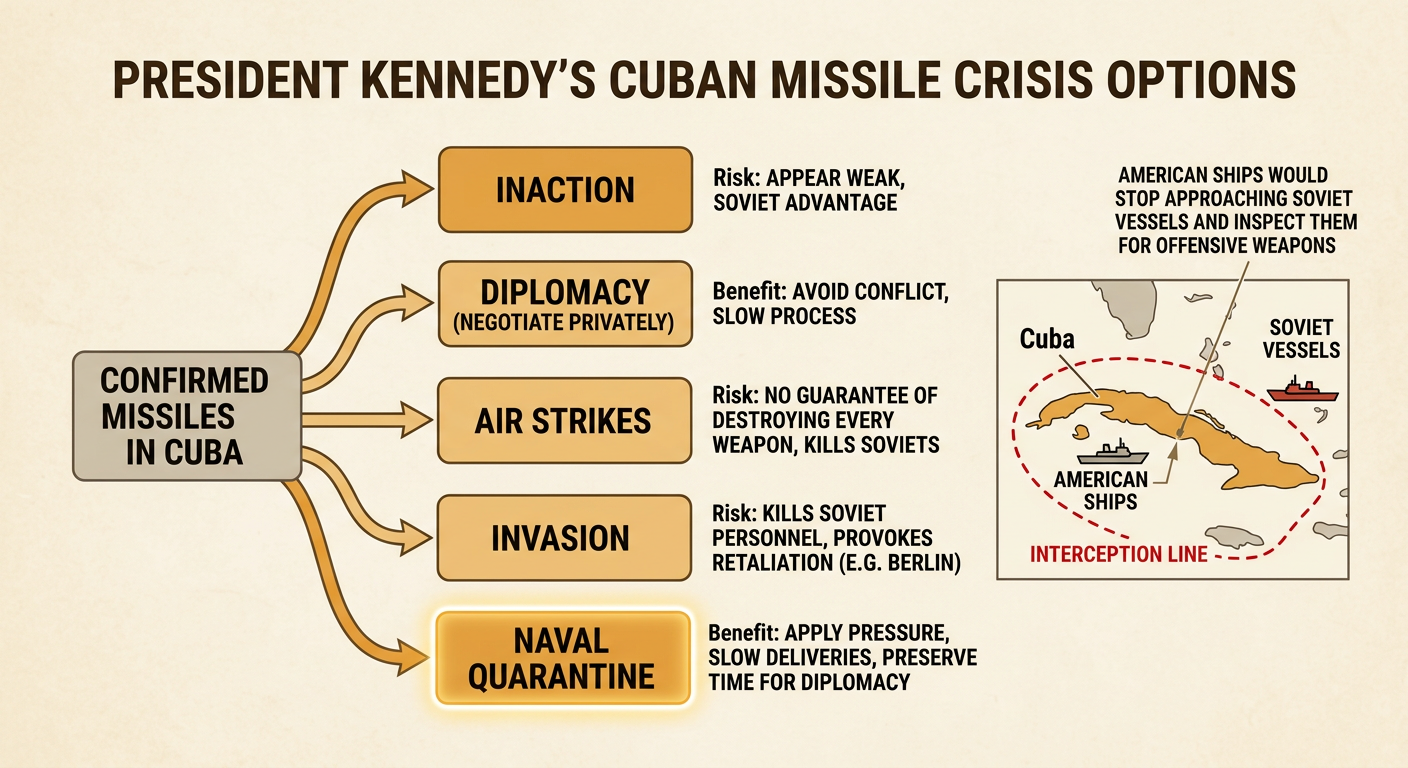
Kennedy and ExComm debated several options: do nothing, negotiate privately, launch air strikes, invade Cuba, or establish a naval blockade. Military leaders argued that air strikes could destroy the missiles, but no attack could guarantee eliminating every weapon. An invasion might remove Castro yet could kill Soviet personnel and trigger retaliation in Berlin or against the United States. Kennedy chose a naval “quarantine,” announced on October 22, to stop additional offensive weapons from reaching Cuba while allowing time for diplomacy. The term quarantine avoided calling the action a blockade, which could be considered an act of war. As a concrete example of this strategy, U.S. ships formed an interception line around Cuba and prepared to inspect approaching Soviet vessels rather than immediately bombing the missile sites.
Soviet and Cuban Perspectives
The Soviet and Cuban governments viewed the crisis differently from U.S. leaders. Khrushchev wanted to defend Cuba, strengthen the Soviet strategic position, and answer U.S. missiles near Soviet territory. He also tried to conceal the deployment, which increased U.S. suspicion when the sites were discovered. Castro believed Cuba faced a real danger of invasion after the Bay of Pigs and other U.S. covert actions. From his perspective, Soviet weapons could deter another attack and protect Cuban sovereignty. However, Cuba had limited control over decisions made by the two superpowers. For example, during the crisis Castro urged Khrushchev to respond forcefully if the United States invaded, but Khrushchev ultimately negotiated missile removal without giving Castro a central role. These perspectives show that fear, security, prestige, and alliance obligations all shaped the crisis.

Nuclear Risk and Resolution
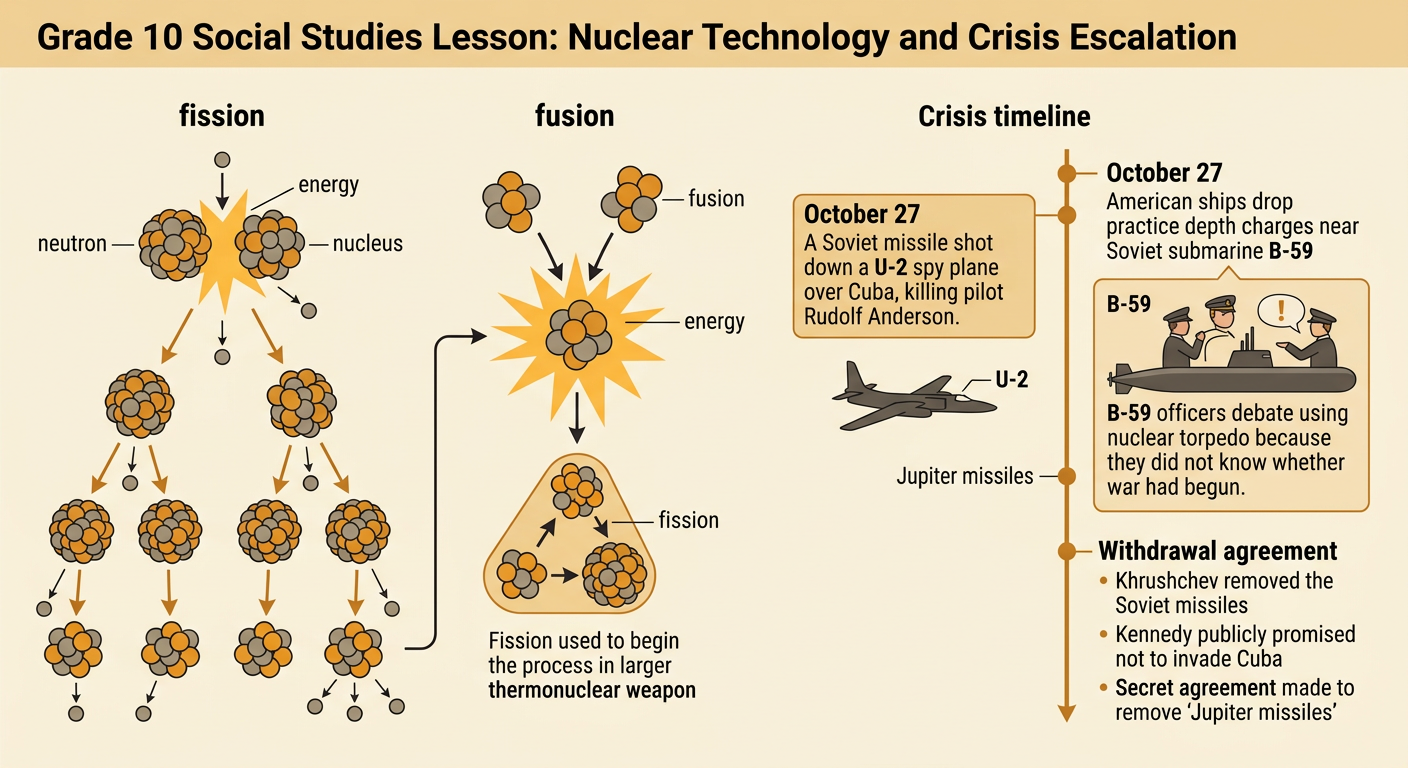
Nuclear weapons made every decision unusually dangerous. In a fission weapon, a neutron splits a heavy atomic nucleus, releasing energy and more neutrons that can continue a rapid chain reaction. Thermonuclear weapons use energy from fission to help produce fusion, releasing even greater energy. On October 27, the most dangerous day of the crisis, a Soviet missile shot down a U-2 over Cuba and killed pilot Rudolf Anderson. That same day, U.S. ships used practice depth charges near Soviet submarine B-59, whose officers debated launching a nuclear torpedo. Diplomacy prevented escalation. Khrushchev agreed to remove Soviet missiles from Cuba; Kennedy publicly promised not to invade Cuba and secretly agreed to remove U.S. Jupiter missiles from Turkey. The crisis ended without combat between the superpowers, but several incidents had nearly escaped political control.
Evaluating the Crisis
The crisis resulted from multiple connected causes: Cold War rivalry, the Cuban Revolution, the Bay of Pigs invasion, nuclear competition, missiles in Turkey, Soviet secrecy, and leaders’ fears about credibility. Its effects were also complex. Kennedy appeared to gain a political victory because the Soviet missiles left Cuba, while Khrushchev obtained a U.S. pledge not to invade Cuba and the later removal of Jupiter missiles from Turkey. Castro’s government survived, but Cuban leaders felt excluded from the final settlement. The danger encouraged both superpowers to create a direct communications hotline in 1963 and helped support the Limited Nuclear Test Ban Treaty. However, the arms race continued, and the Soviet Union expanded its long-range nuclear forces. A strong historical evaluation should cite evidence from U-2 photographs, leaders’ letters, speeches, and later records while distinguishing public claims from secret agreements.
