
The Cuban Missile Crisis: Nuclear Deterrence and Presidential Decision-Making
Students examine maps, primary sources, and basic nuclear science to evaluate how deterrence, intelligence, and diplomacy shaped the peaceful resolution of the Cuban Missile Crisis.

Illustrations are auto-generated and may be placeholders. They can be refreshed to match the narration.
Cold War Context and Cuba
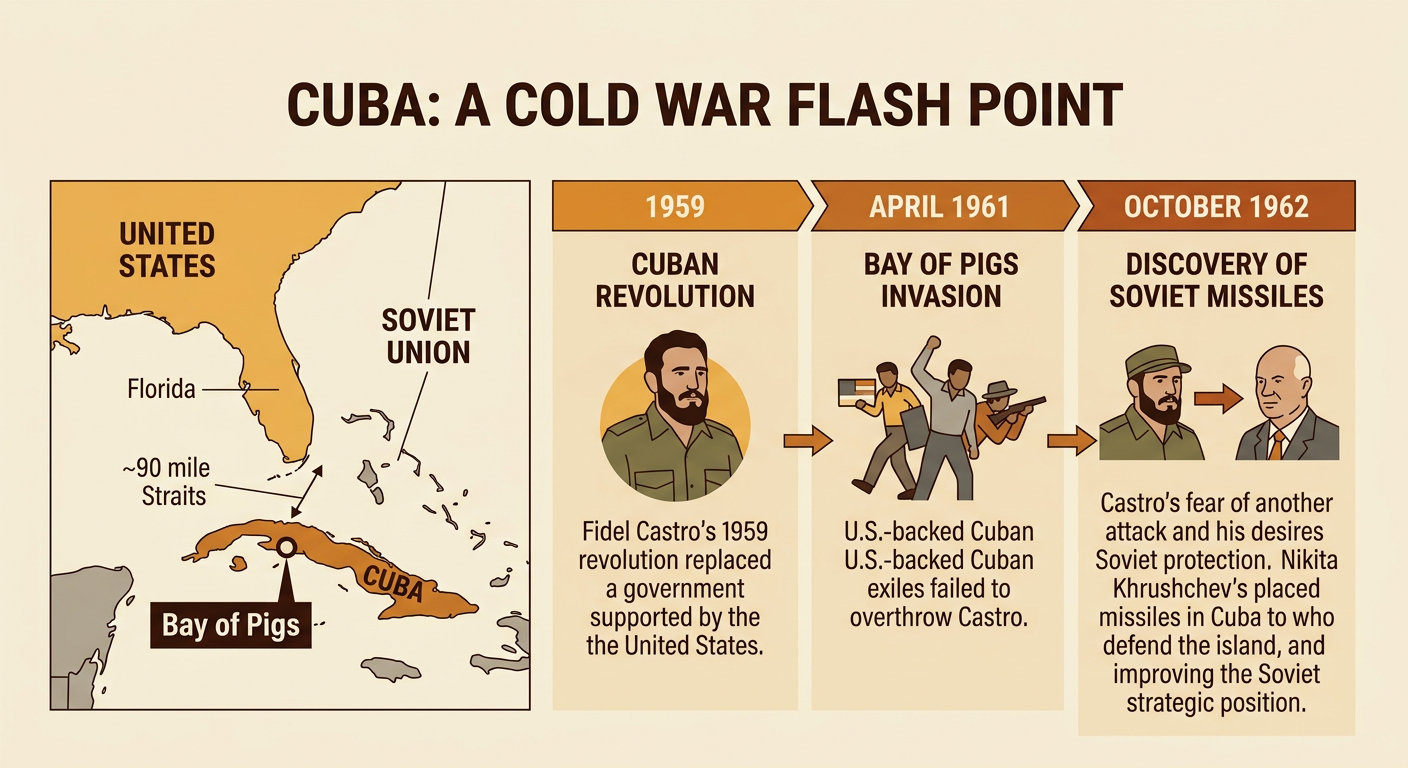
After World War II, the United States and Soviet Union competed for military power, political influence, and ideological support. Cuba became central to this rivalry after Fidel Castro’s 1959 revolution replaced a U.S.-supported government. Cuba formed close economic and military ties with the Soviet Union, only about 90 miles from Florida. In April 1961, U.S.-backed Cuban exiles attempted to overthrow Castro at the Bay of Pigs. The failed invasion strengthened Castro’s fear of another U.S. attack and encouraged greater Soviet support. Soviet leader Nikita Khrushchev later placed nuclear missiles in Cuba partly to defend the island and partly to change the strategic balance. Thus, the crisis resulted from several connected causes: Cold War competition, Cuban security concerns, earlier U.S. actions, and Soviet strategic goals.
Missile Range Maps and Strategic Risk
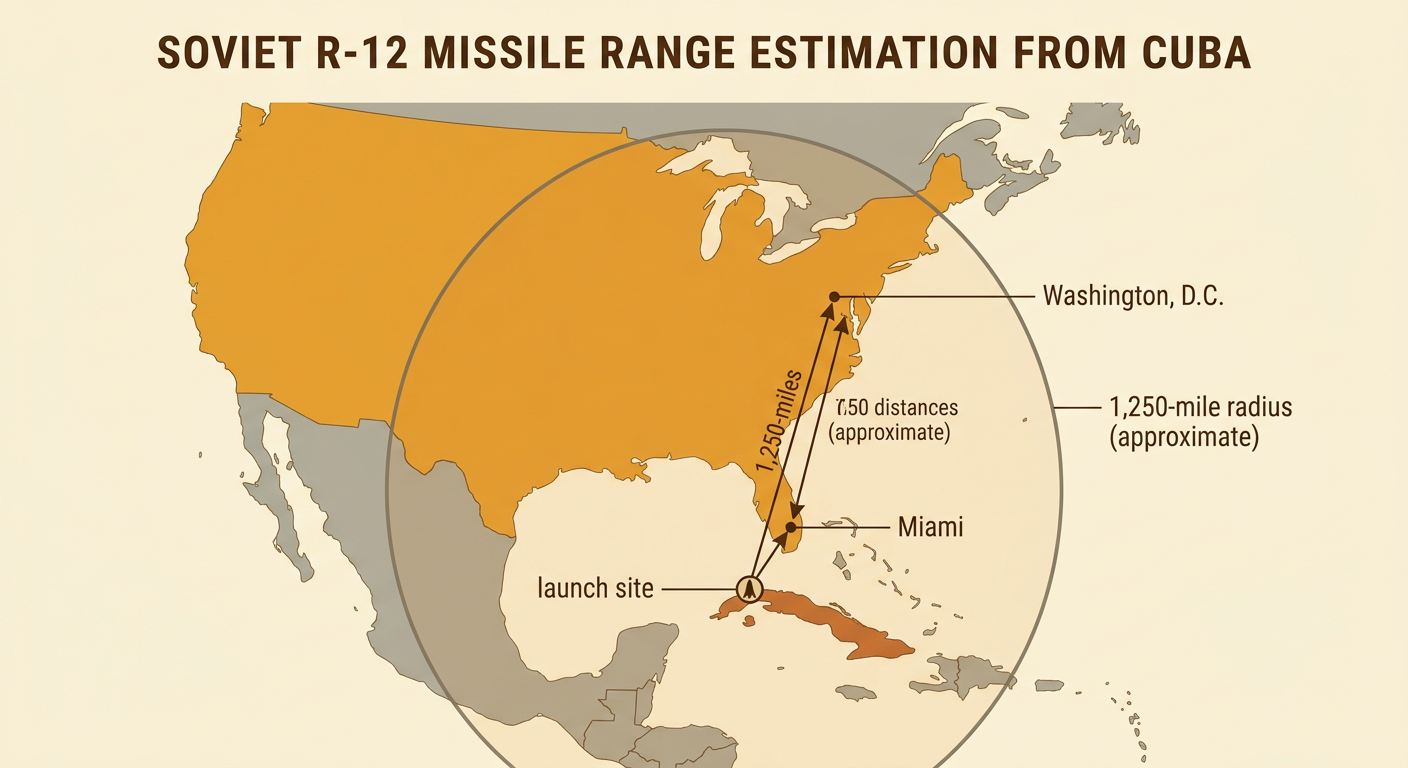
Range maps helped U.S. officials estimate which locations Soviet missiles in Cuba could reach. A Soviet R-12 medium-range ballistic missile had an approximate range of 1,250 miles, although actual performance depended on launch conditions and payload. Using a map scale, students can compare this range with distances from Cuba: Miami is roughly 230 miles from Havana, while Washington, D.C., is about 1,130 miles away. A radius drawn around a launch site represents possible reach, not a guaranteed target or exact flight path. Longer-range R-14 missiles, if made operational in Cuba, could have threatened much more of the continental United States. These measurements explain why the missiles changed warning times and perceptions of risk, even though the Soviet Union already possessed other weapons capable of striking the United States.
The Science of Nuclear Weapons
Nuclear weapons release energy through changes in atomic nuclei rather than ordinary chemical reactions. In nuclear fission, a heavy nucleus such as uranium-235 or plutonium-239 splits into smaller nuclei after absorbing a neutron. This process releases energy and additional neutrons, which can trigger more fissions in a rapidly growing chain reaction. The products have slightly less mass than the original materials; that mass difference is converted into energy, as represented by E = mc². Thermonuclear weapons use energy from an initial fission reaction to create conditions for fusion, in which light nuclei combine and release additional energy. During the Cuban Missile Crisis, leaders understood that nuclear use could cause enormous blast, heat, radiation, and radioactive fallout. This scientific reality made escalation especially dangerous and strengthened the search for a political solution.

Kennedy’s Options and Evidence
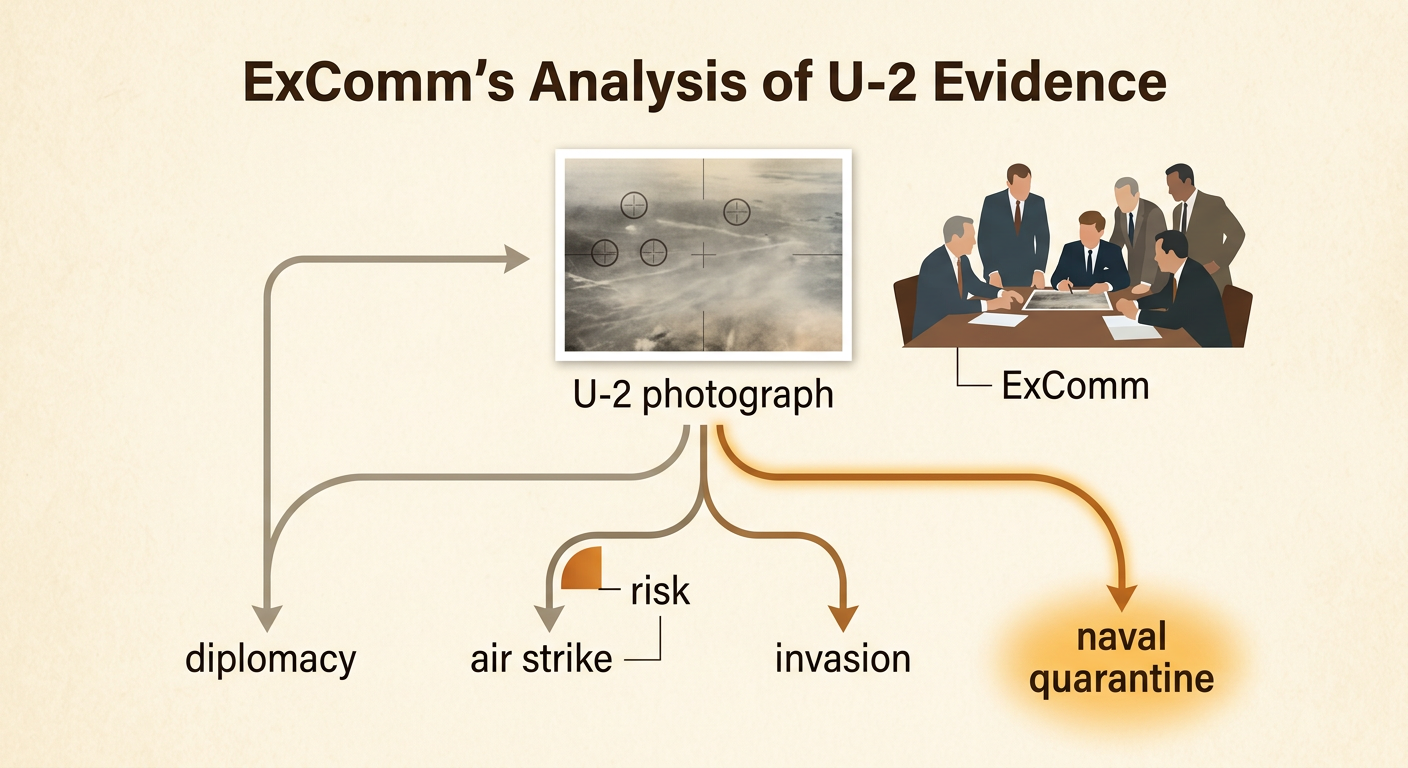
On October 14, 1962, a U-2 reconnaissance aircraft photographed Soviet missile installations under construction in Cuba. President John F. Kennedy was informed on October 16 and formed the Executive Committee, or ExComm, to evaluate the evidence and recommend action. Officials debated several choices: accept the missiles, rely on diplomacy, conduct air strikes, invade Cuba, or impose a naval quarantine. Photographs showed missile equipment and site construction, but intelligence could not answer every question, including whether all warheads were present or operational. An air strike might destroy some missiles while provoking Soviet retaliation. An invasion carried even greater risks. Kennedy selected a naval quarantine, announced on October 22, to block additional offensive military equipment while allowing time for negotiation. His decision combined visual evidence, risk estimates, military advice, and diplomatic concerns.
Diplomacy, Deterrence, and Resolution
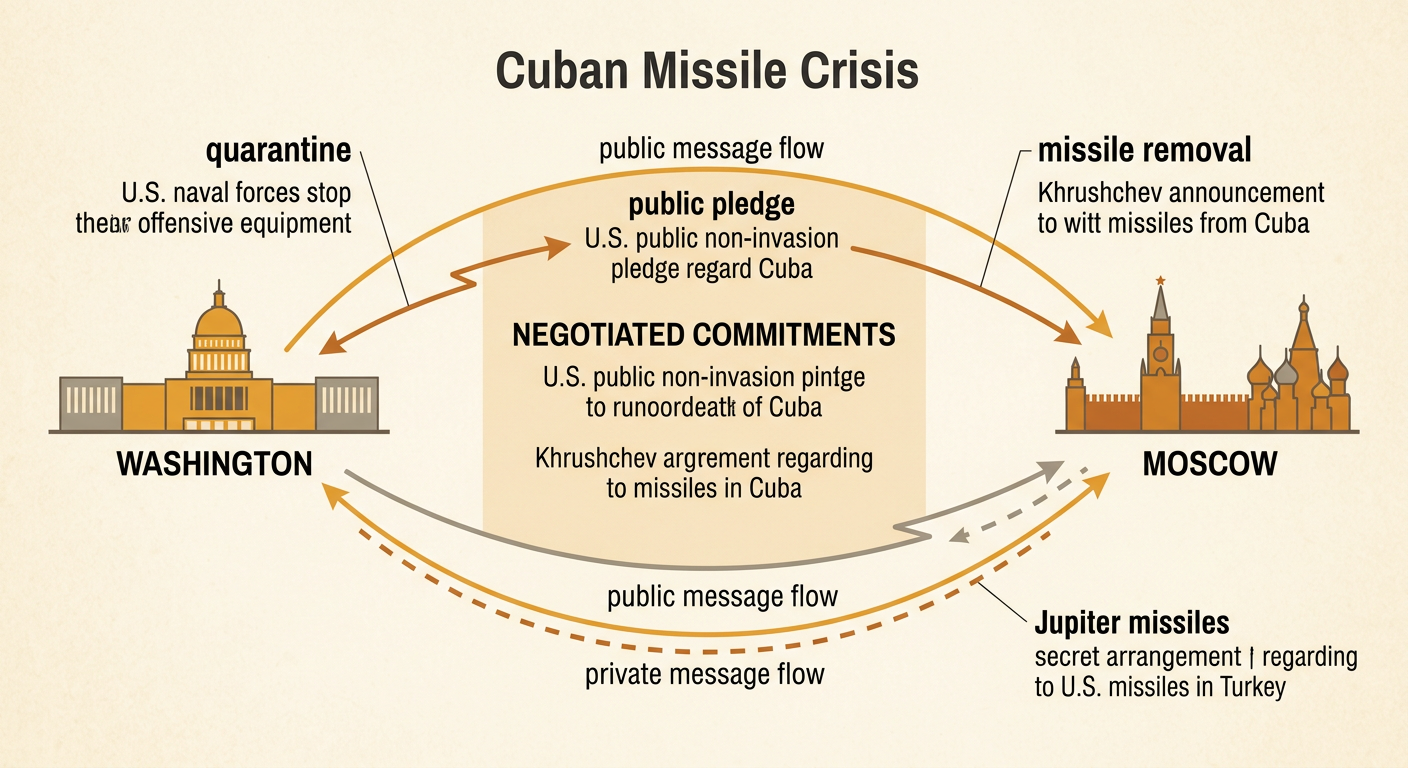
The crisis ended through a combination of pressure, deterrence, and negotiation. U.S. naval forces enforced a quarantine around Cuba, signaling determination without immediately attacking Soviet positions. At the same time, both governments exchanged public and private messages. On October 27, Kennedy responded publicly to Khrushchev’s proposal that the Soviet Union remove its missiles in return for a U.S. pledge not to invade Cuba. Privately, U.S. officials also agreed that American Jupiter missiles in Turkey would later be removed, provided that arrangement remained secret. On October 28, Khrushchev announced that the Soviet missiles would be dismantled and returned. Deterrence influenced both sides: each feared that military action could lead to retaliation and nuclear war. Diplomacy provided a way for each government to protect important interests while stepping back from direct conflict.
Evaluating the Crisis’s Consequences
The peaceful settlement prevented immediate war, but its consequences were complex. Kennedy gained political credibility because the missiles left Cuba, while Khrushchev faced criticism for withdrawing them. Castro remained in power but was frustrated that Cuba had not controlled the negotiations. The crisis also demonstrated how miscommunication, incomplete intelligence, and local military actions could push nuclear powers toward unintended conflict. In 1963, the United States and Soviet Union established a direct communications link, commonly called the hotline, and joined the Limited Nuclear Test Ban Treaty, which prohibited nuclear tests in the atmosphere, outer space, and underwater. However, the nuclear arms competition continued, and the Soviet Union expanded its strategic forces. Historians therefore identify multiple effects: improved crisis communication and some arms-control cooperation, continued reliance on deterrence, political consequences for leaders, and a lasting awareness of nuclear danger.
