
The Decline of the Classic Maya: Climate, Conflict, and Historical Evidence
Students evaluate archaeological and environmental evidence to explain how drought, warfare, resource pressures, and political instability contributed to the decline of Classic Maya city-states.

Illustrations are auto-generated and may be placeholders. They can be refreshed to match the narration.
Maya Cities and Political Organization
During the Classic Period, roughly 250 to 900 CE, the Maya lived in many independent city-states rather than one unified empire. Each city-state usually included an urban center, surrounding farmland, smaller communities, and a ruler called an ajaw. Rulers organized construction, ceremonies, tribute, trade, and warfare. Powerful cities formed alliances or competed for influence, while weaker cities sometimes became subordinate to stronger neighbors. For example, Tikal and Calakmul led rival political networks that competed across the Maya lowlands. This decentralized organization supported regional diversity, but it also made the political system vulnerable. A failed harvest, military defeat, or disputed succession could weaken one city without immediately affecting every other city. Therefore, the decline of Classic Maya political systems occurred at different times and in different ways across the region.

Evidence from Ruins and Inscriptions
Archaeologists use buildings, burials, pottery, monuments, and written inscriptions to reconstruct Maya history. Many carved stone monuments record royal births, accessions, alliances, battles, and captures. These inscriptions are primary sources, but they usually present the ruler's preferred version of events and must be compared with other evidence. At some southern lowland cities, monument construction and dated inscriptions became less frequent during the eighth and ninth centuries. Archaeologists also find unfinished buildings, damaged monuments, or reduced maintenance of public spaces. At Aguateca, for example, burned structures and valuable objects left inside buildings suggest a sudden attack and rapid departure. Such finds provide strong evidence of disruption, but they do not prove that every Maya city declined for the same reason. Researchers compare dates and evidence from multiple sites before drawing conclusions.

Drought and Environmental Data
Scientists study past climate by examining environmental proxies, or natural records that preserve evidence of earlier conditions. Cave formations, lake sediments, pollen, and oxygen isotope ratios can indicate changes in rainfall. Several records from the Maya region suggest repeated severe droughts between about 800 and 1000 CE, although timing and intensity varied by location. Students can investigate the relationship by plotting estimated rainfall against the number of dated monuments or signs of building activity. If rainfall decreases while political activity also declines, the pattern shows a correlation, not automatic proof of causation. Drought could reduce maize harvests, lower reservoirs, and make it harder to support large urban populations. For example, cities without dependable rivers relied heavily on seasonal rainfall and stored water. Environmental data therefore help explain stress, but they must be combined with archaeological and historical evidence.

Warfare and Resource Pressure
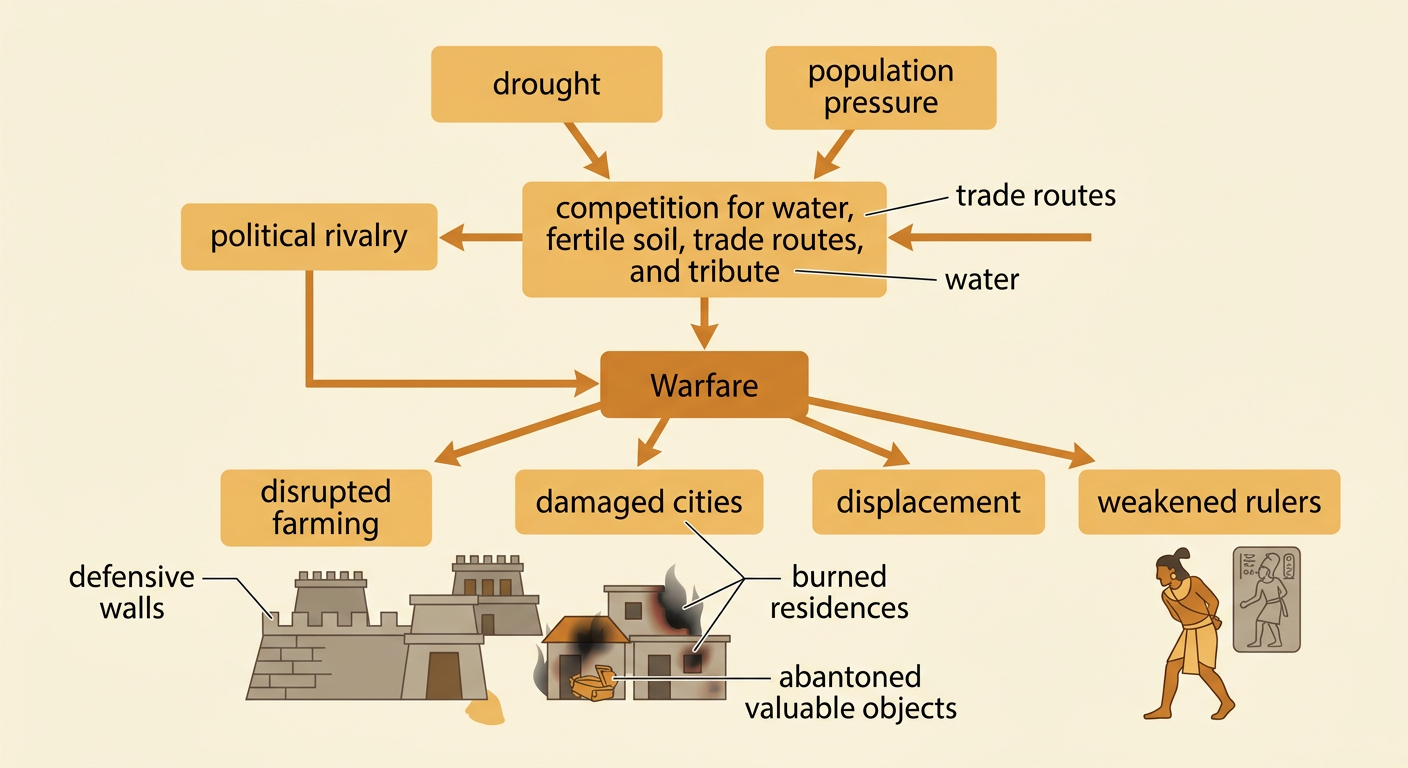
Warfare among Maya city-states existed throughout the Classic Period, but evidence suggests that conflict intensified in some places during the later centuries. Inscriptions describe captured rulers, while defensive walls, damaged buildings, and burned settlements provide archaeological evidence of violence. Drought and population pressure may have increased competition for fertile soil, water, trade routes, and tribute. At Aguateca, defensive walls were built around the city center, yet attackers entered and burned elite residences around 810 CE. This example connects military danger with political disruption and abandonment. Warfare could interrupt farming and trade, displace families, and weaken trust in rulers who claimed to maintain order and communicate with the gods. However, researchers should not assume that environmental stress always caused war. Existing rivalries, leadership struggles, and efforts to control trade or territory also contributed to conflict.
Building a Multicausal Explanation
A strong historical explanation connects several causes and supports each claim with specific evidence. The decline of many southern lowland city-states was not a single event and should not be described as the disappearance of the Maya people. A useful explanation might argue that repeated droughts reduced food and water supplies, while warfare disrupted trade and farming. Resource shortages then increased political pressure on rulers, and military defeats weakened their authority. Climate records, defensive structures, burned buildings, and the decline of dated royal monuments support different parts of this explanation. Sequence also matters: students should compare when droughts, attacks, and political changes occurred at each site. Regional differences provide an important test. Some northern cities, including Chichén Itzá, remained influential after many southern centers declined. The best conclusion therefore recognizes interacting causes, varied local outcomes, and the continued survival of Maya communities and culture.
