
The Dust Bowl: Causes, Migration, and Conservation
Students examine how drought, farming practices, and economic hardship contributed to the Dust Bowl and led families and governments to pursue migration and soil-conservation solutions.

Illustrations are auto-generated and may be placeholders. They can be refreshed to match the narration.
Life on the Great Plains
The Great Plains stretch across the central United States. Before large-scale farming, deep-rooted prairie grasses held the soil in place and helped it retain water. During the late 1800s and early 1900s, settlers turned more grassland into farms and ranches. New tractors and plows allowed farmers to cultivate larger areas. Demand for wheat during World War I encouraged many farmers to plant even more land. In wet years, farms could produce large harvests and support growing communities. However, many families borrowed money to purchase land and equipment. For example, a farmer might take out a loan for a tractor, expecting future wheat sales to cover the payments. This system depended on good weather, healthy soil, and strong crop prices. When those conditions changed, families faced serious risks.

How Drought and Farming Exposed the Soil
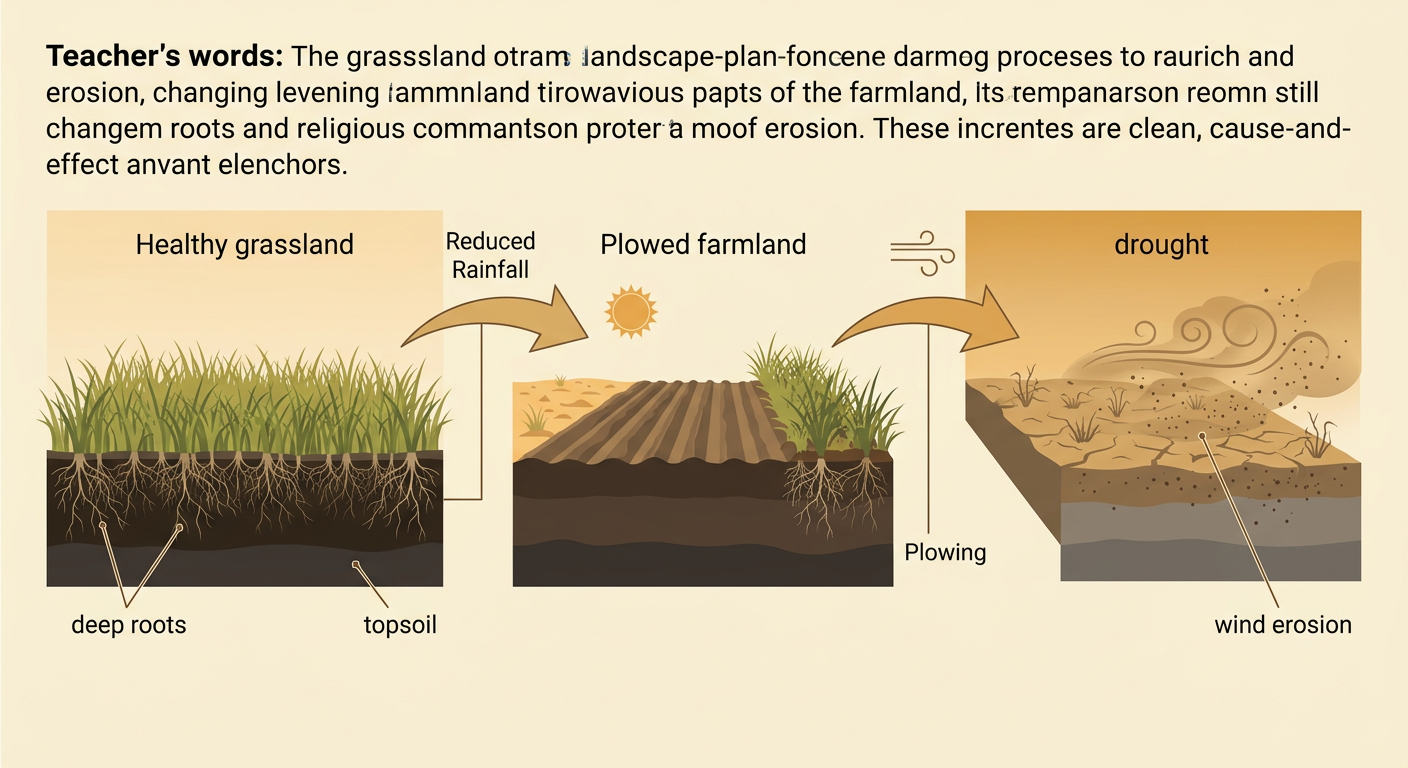
In the early 1930s, a severe drought struck much of the Great Plains. Rainfall decreased, temperatures were often high, and crops struggled to grow. Drought alone did not create the Dust Bowl. Years of plowing had removed many native grasses whose deep roots once anchored the soil. Overgrazing also reduced protective plant cover in some places. When crops failed, fields were left dry, loose, and exposed. Strong Plains winds could then lift the unprotected topsoil and carry it away. For example, wind blowing across an unplanted field could remove fertile soil, while nearby land covered with rooted grass lost much less soil. Drought, land use, and wind therefore worked together: drought weakened plants, farming had reduced natural protection, and wind eroded the bare ground.
Dust Storms and Economic Hardship
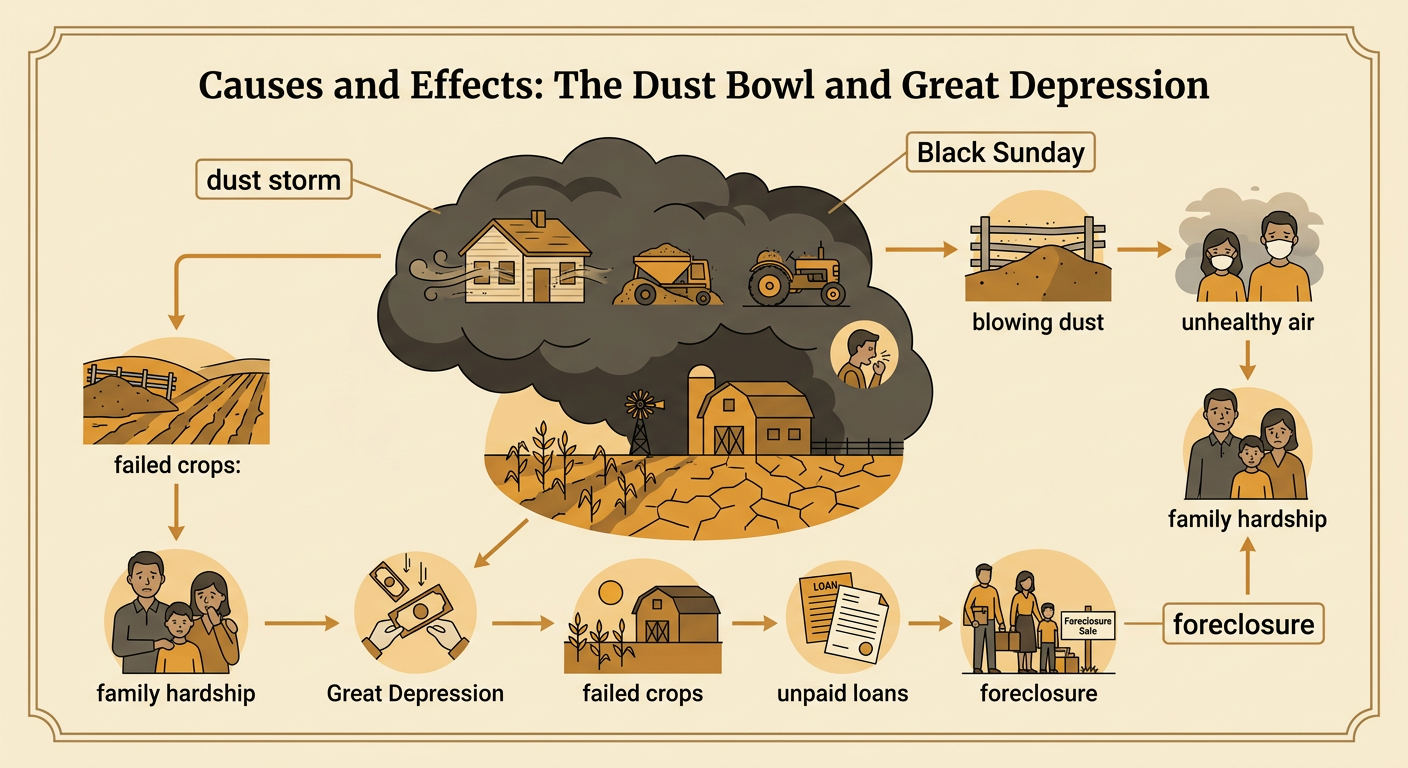
As wind lifted dry soil, enormous dust storms swept across the Plains. Dark clouds of dust could block sunlight, enter homes, damage machinery, bury fences, and make breathing difficult. One famous storm occurred on April 14, 1935, a day later called Black Sunday. Dust rolled across parts of the southern Plains and turned daytime skies nearly black. At the same time, the Great Depression had reduced crop prices and employment. Farmers whose crops failed earned little money but still owed taxes, rent, or loan payments. Some lost their farms through foreclosure. For example, a family might harvest almost no wheat, be unable to make a bank payment, and then have to sell equipment or leave its land. The environmental disaster and the economic crisis reinforced each other, making recovery difficult for many communities.
Migration During the Dust Bowl
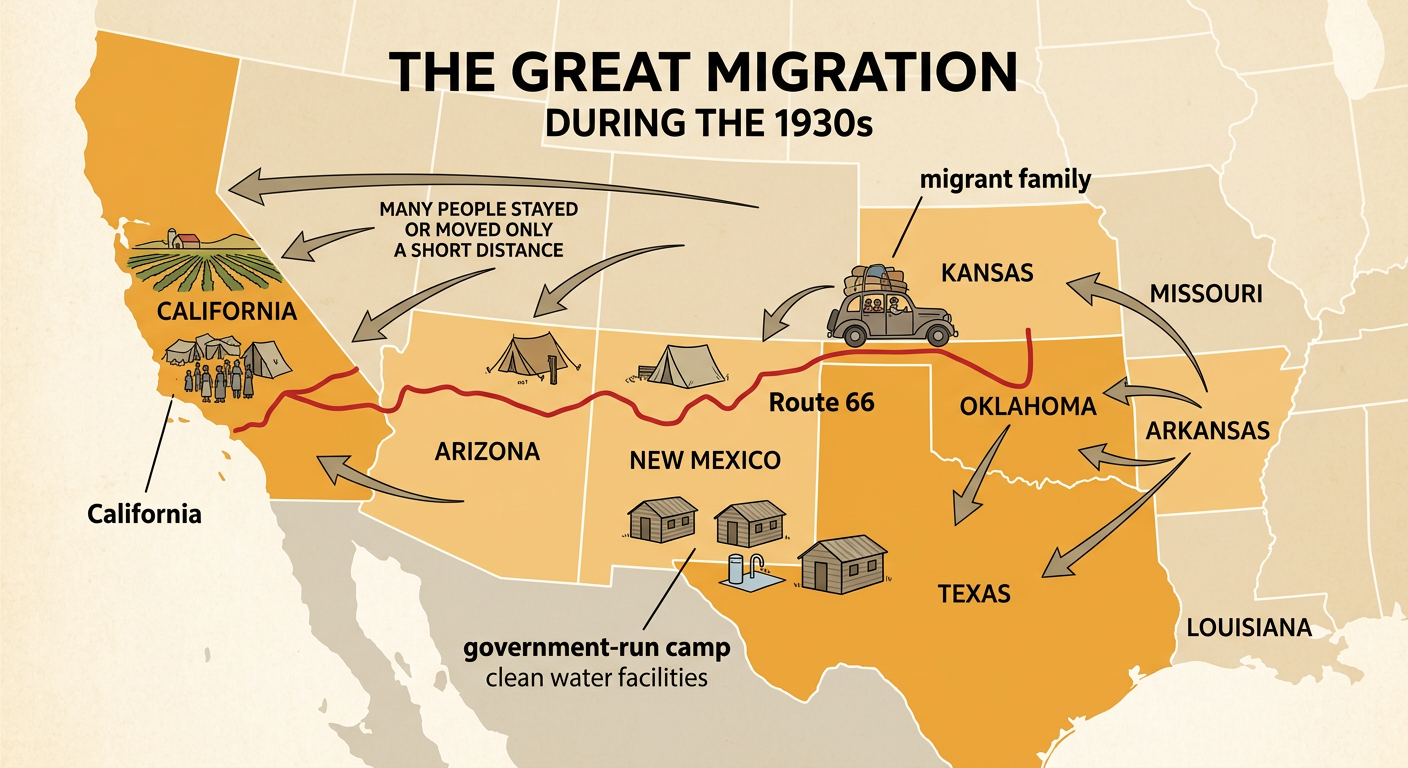
Economic hardship and damaged farmland pushed many families to move during the 1930s. People migrated from Oklahoma, Texas, Arkansas, Kansas, and other states, although many Plains residents stayed or moved only a short distance. Some traveled west to California after hearing about farm jobs and milder weather. Route 66 became a major path for migrants. A family from Oklahoma, for example, might load clothing, tools, and bedding onto a car and drive west in search of paid work. The journey was difficult, and jobs were often temporary and poorly paid. Migrants sometimes lived in crowded camps and faced unfair treatment from local residents. Government-run camps later provided cleaner water and safer living conditions for some workers. Migration was both an effect of the Dust Bowl and an attempt by families to find safety, income, and a new start.
Government Action and Soil Conservation
Farmers and government officials developed ways to reduce erosion and restore damaged land. In 1935, the federal government created the Soil Conservation Service to teach and support better land management. Farmers planted shelterbelts, or rows of trees, to slow strong winds. They used contour plowing to follow the curves of the land instead of plowing straight downhill. Strip cropping placed different crops or grasses in alternating bands, helping keep soil from blowing or washing away. Crop rotation and leaving plant residue on fields also improved soil protection. For example, a farmer could plant strips of wheat beside grass, leave stalks after harvest, and add a line of trees along the field’s windy edge. These methods did not end drought, but they helped communities use scientific knowledge about roots, wind, water, and soil to conserve an essential natural resource.
