The Dust Bowl: Environment, Migration, and Government Response
Students analyze how drought, farming practices, and economic hardship caused the Dust Bowl, displaced families, and prompted new government conservation policies.
Illustrations are auto-generated and may be placeholders. They can be refreshed to match the narration.
Great Plains Farming Before the Dust Bowl
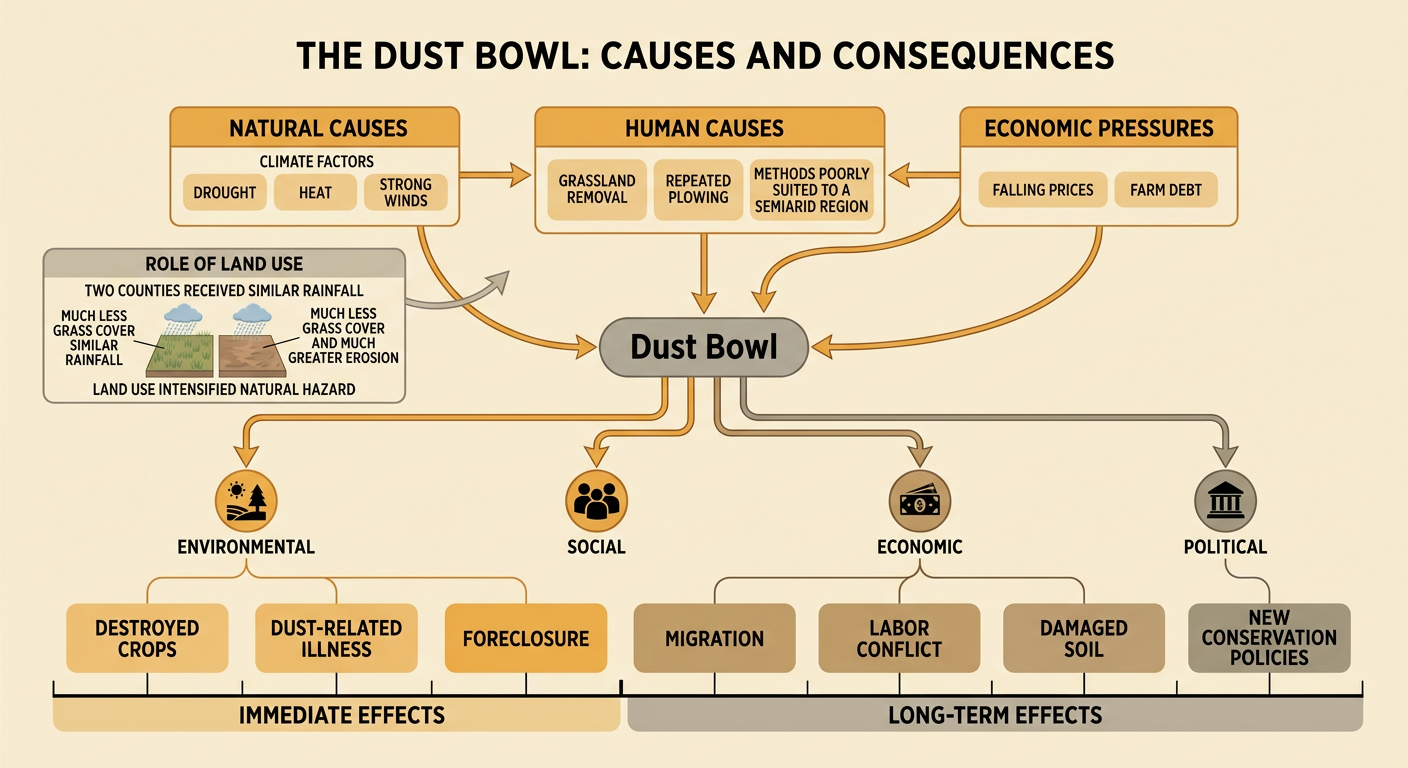
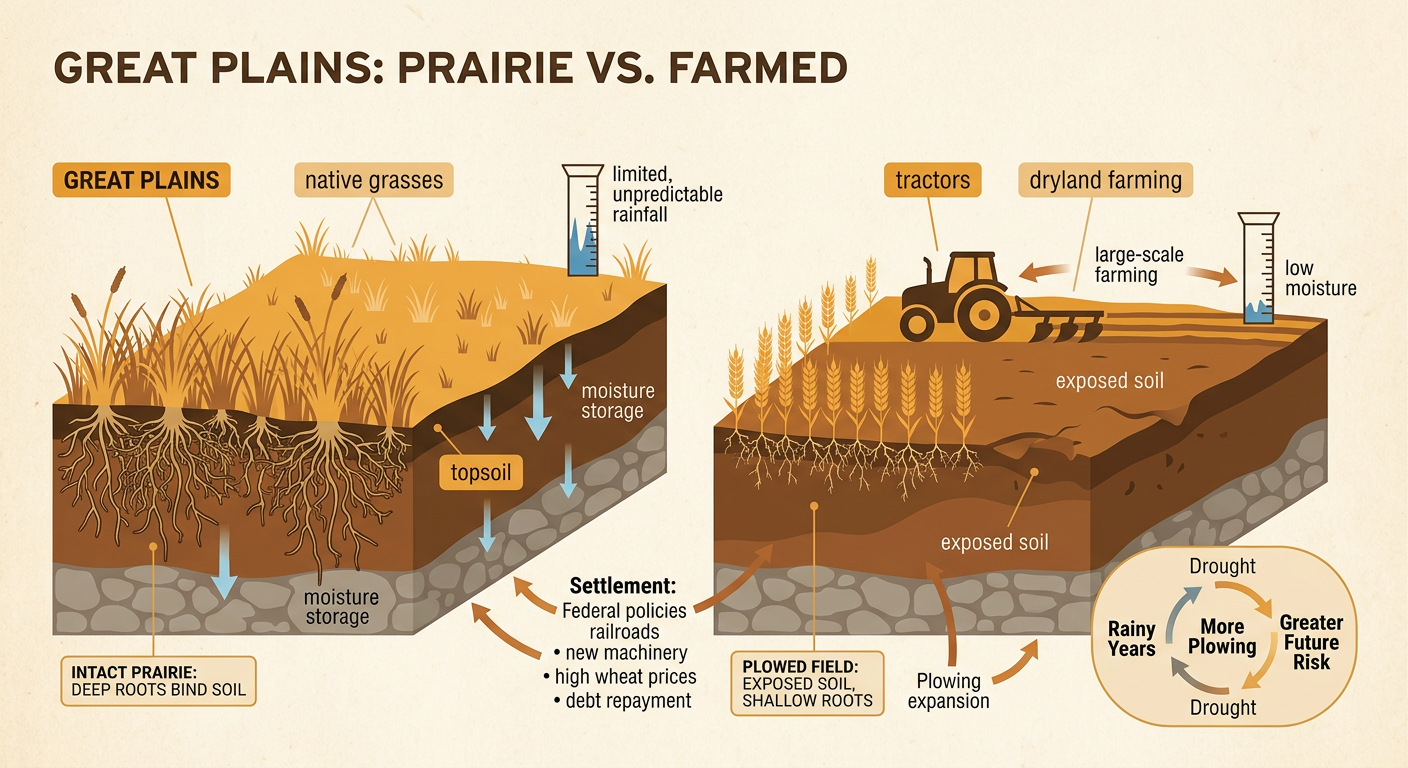
Before the Dust Bowl, the Great Plains was a semiarid grassland with deep-rooted native grasses that held soil in place. During the late 1800s and early 1900s, federal land policies, railroads, and new machinery encouraged settlement and large-scale farming. High wheat prices during World War I led farmers to plow millions of acres of prairie. Tractors made cultivation faster, but they also allowed farmers to remove grass across larger areas. Many farmers practiced dryland farming, which depended on stored soil moisture because rainfall was limited and unpredictable. In wet years, wheat harvests could be profitable, encouraging even more planting. For example, a farmer who earned money from wheat during several rainy seasons might plow additional grassland without expecting a long drought. By the late 1920s, falling crop prices also pushed many farmers to plant more acres to pay debts, increasing pressure on the soil.
Drought, Soil Erosion, and Human Choices
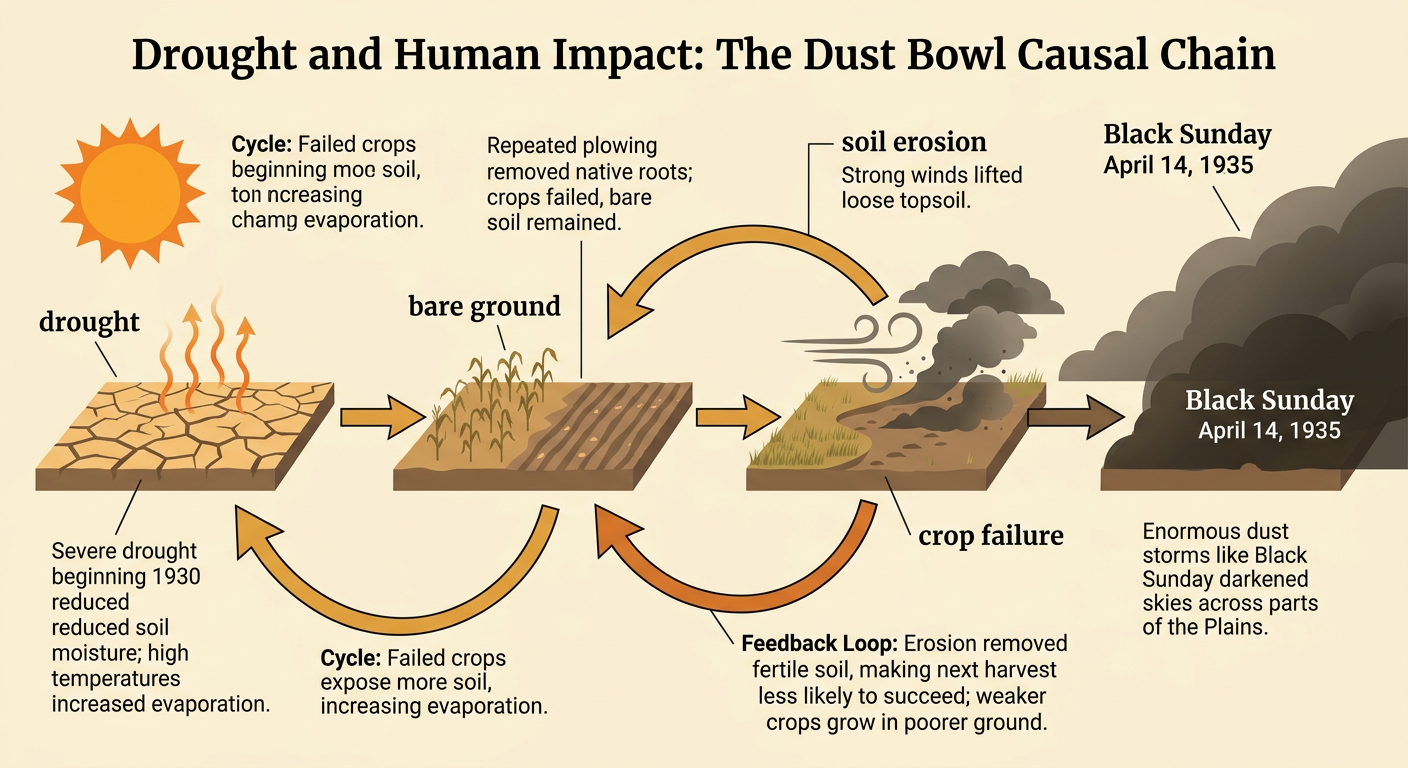
The Dust Bowl resulted from both natural conditions and human choices. Beginning in 1930, severe drought reduced soil moisture across much of the Great Plains. High temperatures increased evaporation, and crops failed to cover the ground. Because farmers had removed native grasses and repeatedly plowed the soil, few roots remained to hold dry topsoil in place. Strong winds then lifted loose particles into the air, creating dust storms and removing fertile soil. On April 14, 1935, a massive storm known as Black Sunday darkened skies across parts of the Plains. Drought alone did not fully explain the disaster: grass-covered land generally resisted erosion better than heavily cultivated fields. The process also formed a feedback loop. Crop failure left more bare ground, erosion reduced soil fertility, and poorer soil made future crops harder to grow. The Dust Bowl was therefore a natural hazard intensified by land-use decisions.
Reading Maps, Data, and Photographs
Historians combine quantitative and qualitative evidence to understand the Dust Bowl. A drought map can show where rainfall was far below normal, while an erosion map can identify counties with severe soil loss. Tables of crop yields, farm income, or population change provide numerical evidence about economic and demographic effects. Photographs, letters, and oral histories reveal experiences that numbers may not capture, such as fear during a dust storm or humiliation while seeking relief. For example, a map might show severe erosion in the Oklahoma Panhandle, census data might show population decline, and a migrant’s photograph might show a family traveling with its belongings. Together, these sources support a stronger explanation than any one source alone. Students should also examine source limitations. A photograph records one moment and may be framed for a particular purpose, while county-level data can hide differences among individual communities and families.

Migration and Life for Displaced Families
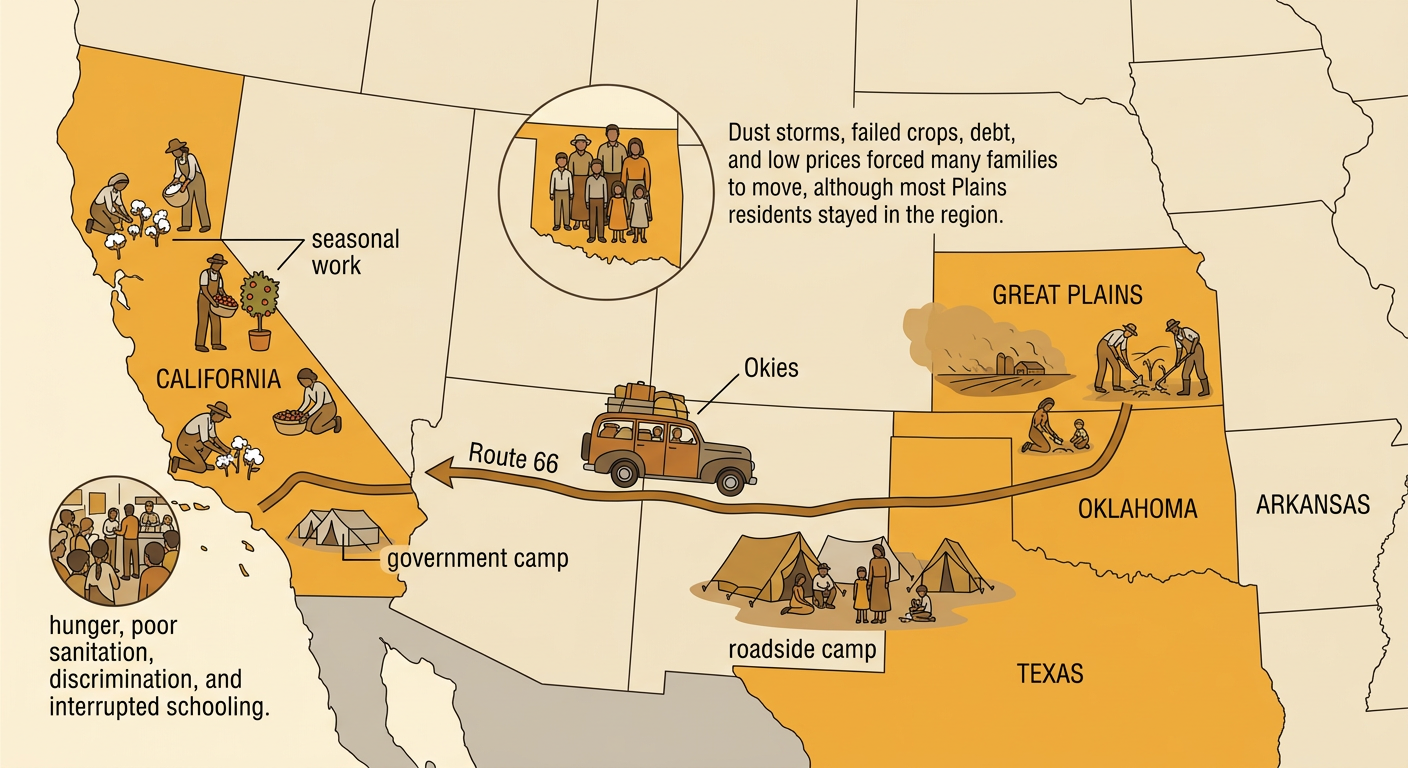
Dust storms, crop failures, debt, and low farm prices forced many families to leave their homes, although most Plains residents remained in the region. Migrants came from Oklahoma, Texas, Arkansas, Kansas, and other states. Many traveled west on U.S. Route 66 toward California, where advertisements and rumors promised agricultural work. The term “Okies” was often applied to these migrants regardless of their actual home state and was sometimes used as an insult. Families commonly carried their possessions in cars or trucks and lived in roadside camps after arriving. Work was seasonal, wages were low, and too many laborers competed for too few jobs. For example, a family might pick cotton during one season and then travel to another county for fruit harvesting. Migrants faced poor sanitation, hunger, discrimination, and interrupted schooling, but they also formed communities, shared resources, organized workers, and sought assistance from government camps.
New Deal Conservation Responses
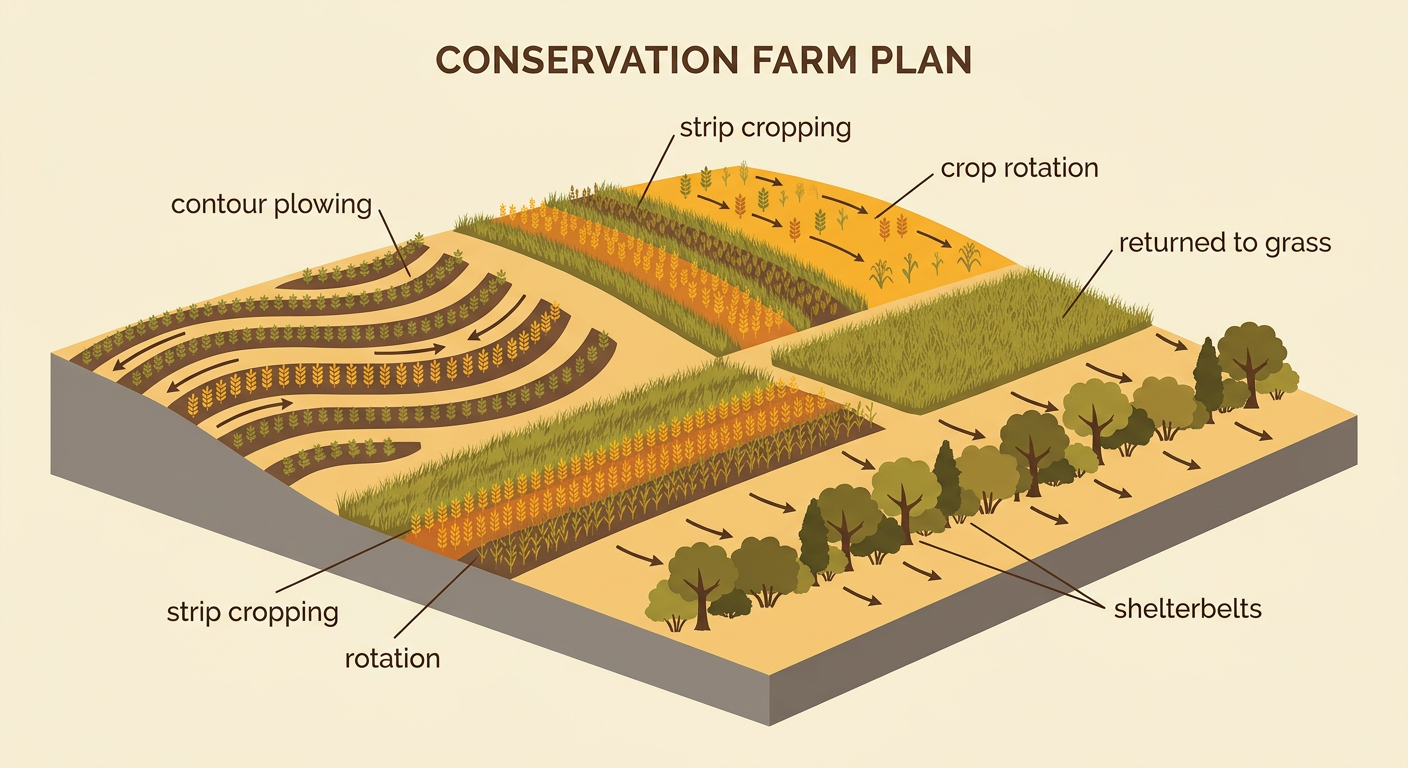
The federal government expanded its role in soil conservation during the New Deal. In 1935, Congress created the Soil Conservation Service, which worked with farmers to reduce erosion and improve land management. Experts promoted contour plowing, in which farmers plowed across slopes rather than directly downhill, slowing water runoff. Strip cropping alternated rows of crops with protective vegetation, while crop rotation helped maintain soil health. Farmers also returned severely damaged fields to grass. Through the Prairie States Forestry Project, workers planted long rows of trees called shelterbelts to reduce wind speed near fields and farm buildings. For example, a shelterbelt planted perpendicular to prevailing winds could trap blowing soil before it crossed a farm. Government programs provided research, demonstrations, labor, and financial incentives, but participation and results varied. These policies did not end the drought, yet they reduced erosion and established a lasting federal commitment to conserving soil as a shared natural resource.
Evaluating Causes and Consequences
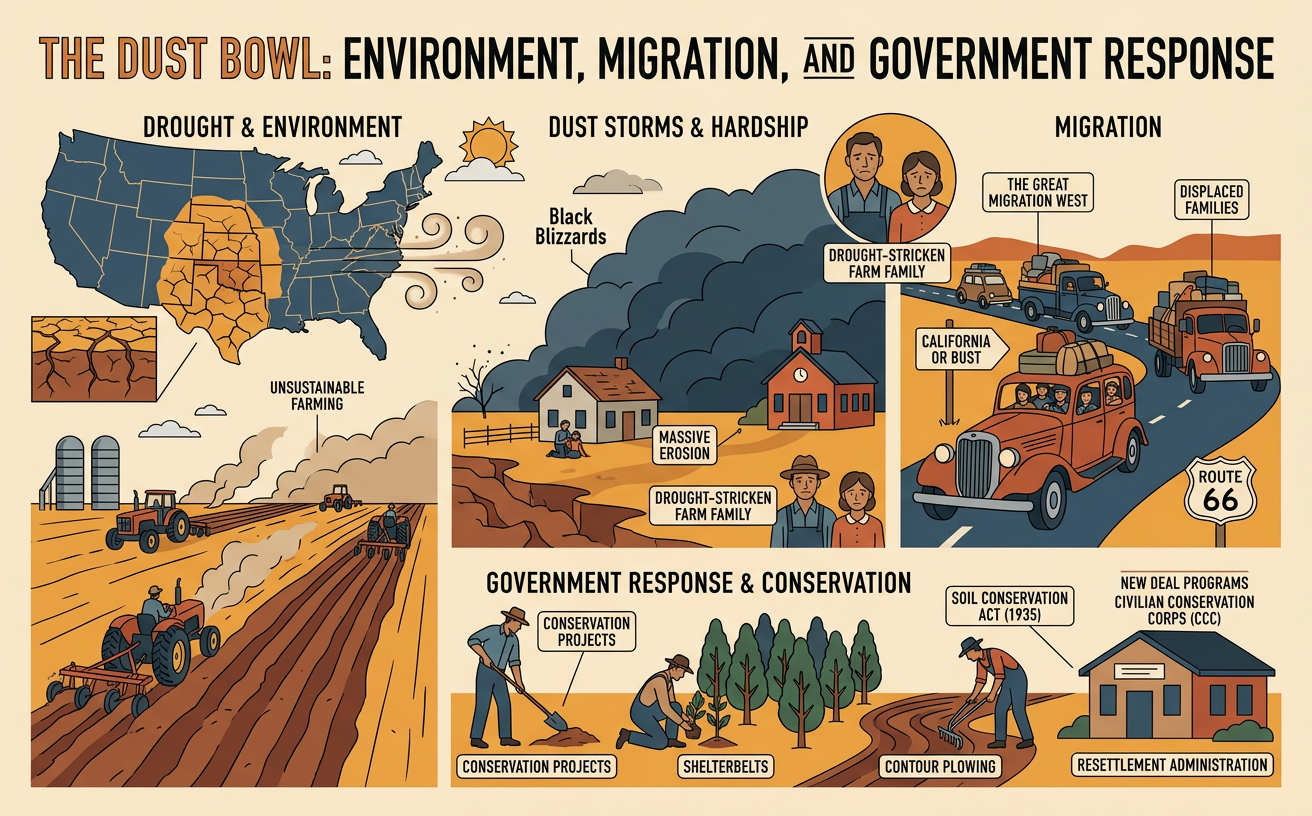
A strong historical explanation ranks evidence and connects multiple causes to multiple effects. The Dust Bowl’s natural causes included prolonged drought, heat, and strong winds. Human causes included widespread grassland removal, repeated plowing, and farming methods poorly suited to semiarid conditions. Economic pressures also mattered: falling crop prices and farm debt encouraged some farmers to cultivate more land even when profits declined. These causes interacted rather than operating separately. One useful comparison is to examine two counties with similar rainfall but different amounts of grass cover. If the more heavily plowed county experienced greater erosion, the evidence supports the claim that land use intensified the hazard. Consequences included lost topsoil, farm foreclosures, health problems, migration, labor conflict, and new conservation policies. Some effects were immediate, such as a destroyed crop, while others lasted for decades. Evaluating the Dust Bowl requires distinguishing evidence-supported relationships from claims that rely only on coincidence or a single source.