
The Erie Canal: Connecting Markets and Transforming New York
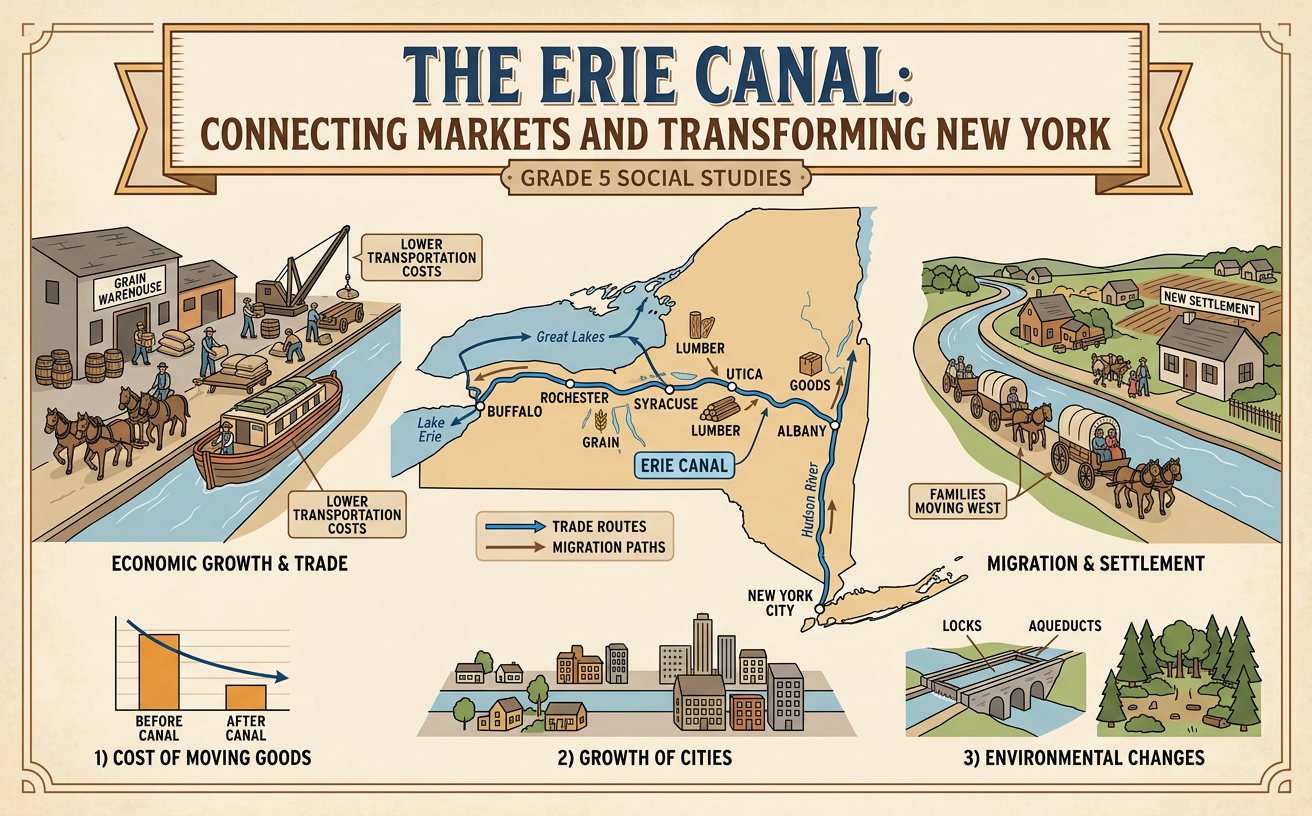
Students examine how the Erie Canal reduced transportation costs, expanded trade and migration, and affected communities and environments along its route.
Illustrations are auto-generated and may be placeholders. They can be refreshed to match the narration.
The Transportation Challenge
In the early 1800s, moving people and goods across New York was slow and expensive. Roads were often rough, muddy, or blocked by snow. Wagons could carry only limited loads, and mountains made travel between the Hudson River and the Great Lakes difficult. Farmers in western New York sometimes could not afford to send crops to eastern markets because transportation cost more than the crops were worth. New York leaders wanted a water route linking Albany on the Hudson River with Buffalo on Lake Erie. Such a route needed to carry heavy cargo, reduce costs, and operate across changing elevations. For example, a wagon might struggle to move several barrels of flour, while a canal boat pulled by horses could carry many tons at once.

Designing and Building the Canal
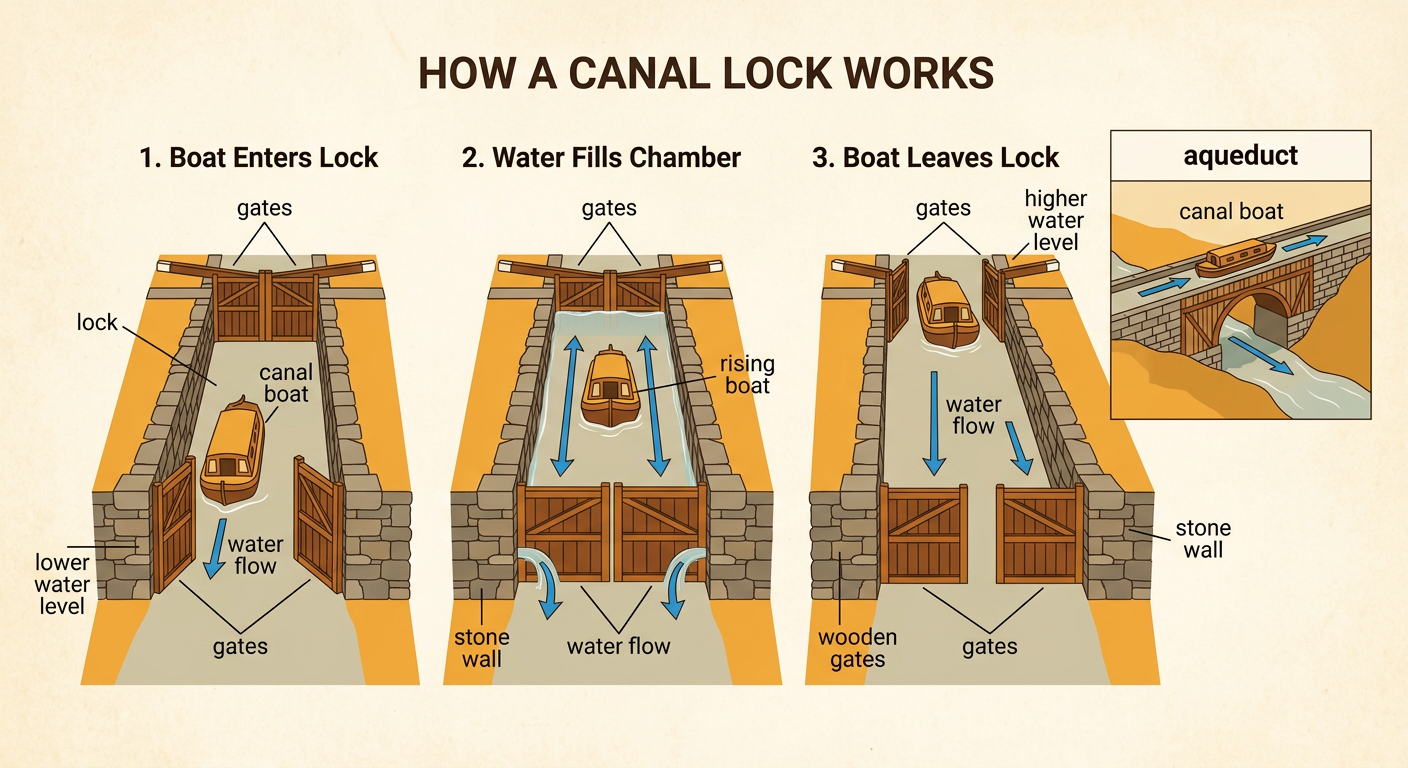
Construction of the Erie Canal began in 1817 and ended in 1825. The original canal stretched about 363 miles from Albany to Buffalo. Engineers had to solve several problems: the land rose hundreds of feet from the Hudson River to Lake Erie, rivers crossed the route, and workers had limited machinery. Their criteria included making the canal deep and wide enough for boats and keeping water at usable levels. Constraints included cost, available tools, difficult terrain, and cold winters. Builders used locks to raise and lower boats between different water levels. They also built aqueducts to carry the canal over rivers. For example, when a boat entered a lock, gates closed and water flowed in, lifting the boat before the upper gate opened.
Comparing Travel Time and Cost
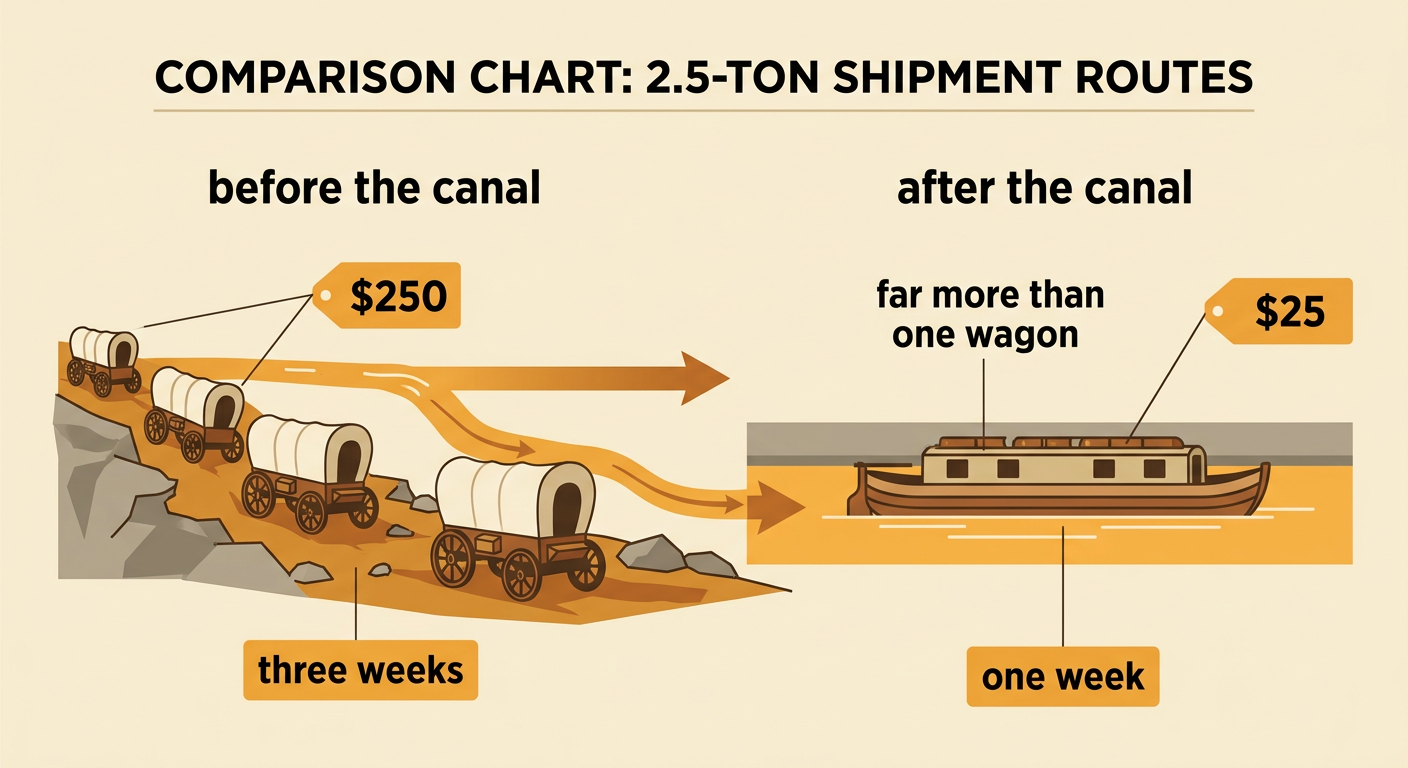
The Erie Canal made transportation faster and less expensive because one boat could carry far more cargo than one wagon. Historical estimates vary, but the cost of shipping a ton of goods between Buffalo and New York City fell from about $100 before the canal to about $10 after it opened. The savings were $100.00 minus $10.00, or $90.00 per ton. For a 2.5-ton shipment, canal shipping at $10.00 per ton would cost $25.00 because 2.5 times 10.00 equals 25.00. At $100.00 per ton, the same shipment would cost $250.00 by the earlier method. Travel from Buffalo to New York City also dropped from roughly three weeks to about one week, although exact times depended on weather and conditions.
Trade, Migration, and Growing Cities
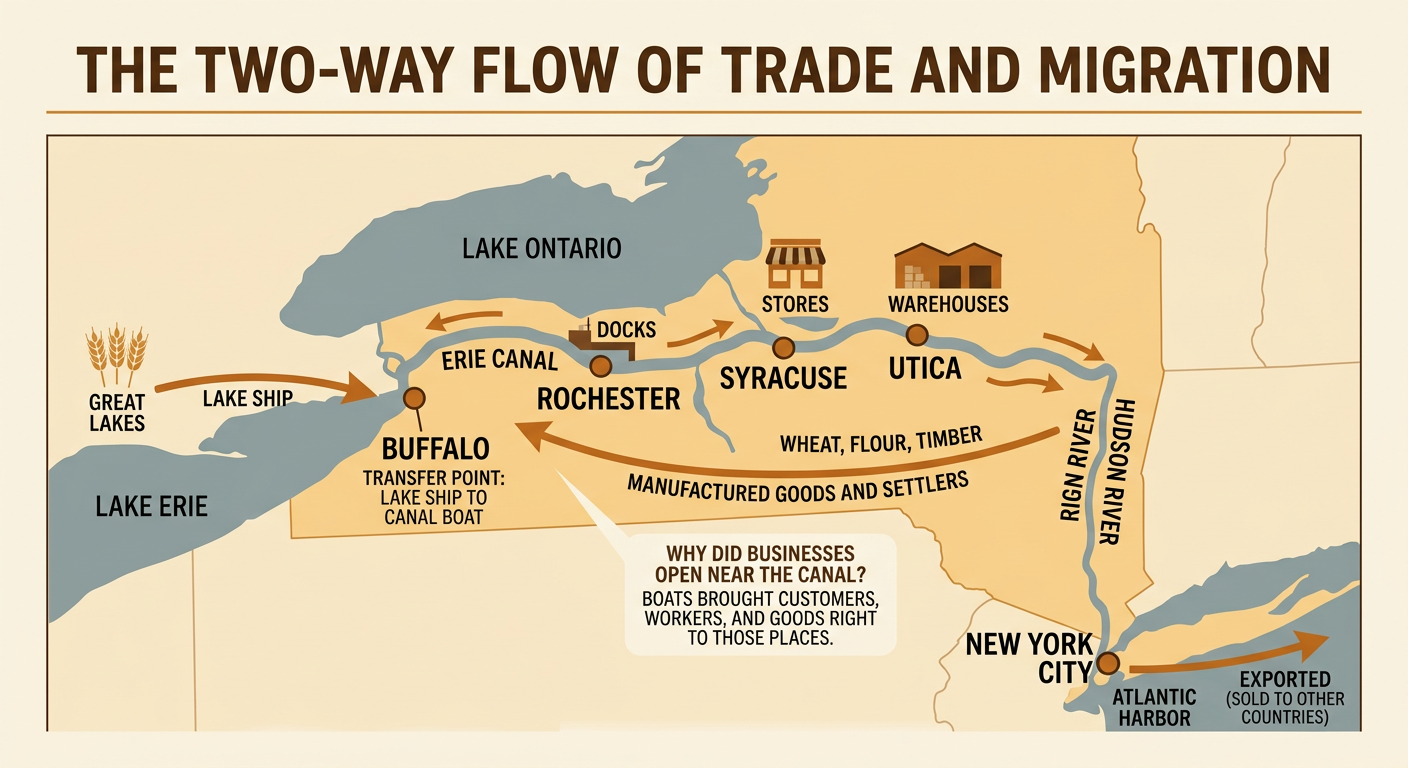
Lower transportation costs expanded trade between the Midwest, New York, and overseas markets. Farmers could ship wheat, flour, timber, and other products eastward. Boats carried manufactured goods and new settlers westward. This two-way movement connected Great Lakes communities with New York City, whose harbor linked American trade to the Atlantic Ocean. Towns along the canal, including Rochester, Syracuse, and Utica, grew as businesses opened near docks and warehouses. Buffalo became an important transfer point where goods moved between lake ships and canal boats. For example, wheat grown near the Great Lakes could travel by boat to Buffalo, cross New York on the canal, move down the Hudson River, and reach New York City for sale or export. The canal therefore influenced migration, jobs, and urban growth.
Effects on Communities and the Environment
The Erie Canal brought jobs, trade, and new residents to many communities, but its effects were not equally beneficial. Construction and settlement crossed lands connected to Haudenosaunee nations, adding pressure to earlier land loss and disrupting Indigenous communities. Canal towns gained stores, mills, docks, and warehouses, while some places away from the route attracted less trade. Building the canal also changed the environment. Workers cut forests, dug through soil, redirected water, and altered wetlands and stream habitats. Connecting waterways allowed some plants and animals to move into places where they had not lived before. Pollution from boats, industries, and growing towns later affected canal water. For example, a wetland drained for construction might provide space for a towpath but remove habitat used by birds, fish, and other wildlife.

Cause-and-Effect Evidence Check
Historians use evidence to explain how developments are connected. One cause of the Erie Canal was the need for a cheaper route across New York. The canal’s design, including locks, made that route possible. A direct effect was lower shipping cost, which encouraged more trade. Increased trade then helped canal cities grow and attracted migrants. Growth also caused more construction and environmental change. Evidence supports each link: shipping estimates show a decline from about $100 to about $10 per ton, maps show cities along the route, and population and business records show rapid growth. Consider this example: because flour became cheaper to ship, more farmers sent it east; because more cargo arrived, merchants built additional warehouses. A strong explanation identifies the cause, names the effect, and cites evidence connecting them.
