
The Family Trait Detective Game
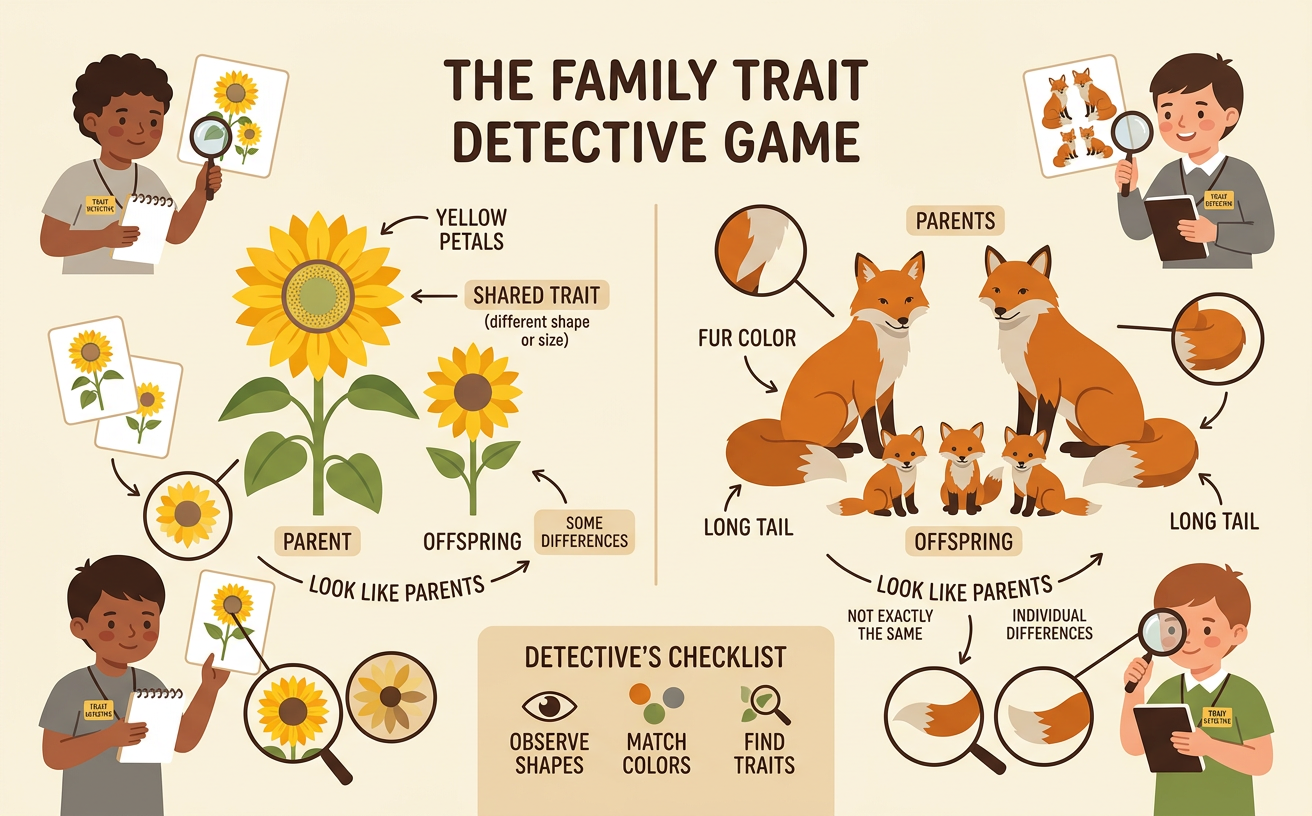
Students become trait detectives by observing pictures of plant and animal families, matching shared features, and discovering that young organisms can look like—but are not exactly the same as—their parents.
Illustrations are auto-generated and may be placeholders. They can be refreshed to match the narration.
Meet the Trait Detectives
A trait is a feature you can observe, such as fur color, leaf shape, or the number of legs. A trait detective looks closely, notices details, and uses those details as evidence. Evidence is information that helps answer a question. Imagine a brown adult rabbit and its young rabbit. Both have long ears, four legs, and soft fur. These shared traits are clues that the rabbits belong to the same animal family. The young rabbit is smaller and may have a lighter patch of fur. Your job is not to guess quickly. Look carefully, name what you see, and listen to what other detectives notice. Together, you can explain how a young plant or animal is like its parent but not exactly the same.
Spot the Shared Features
Shared features are traits found in both a parent and its young. Study an adult sunflower and a young sunflower plant. Both have green stems and broad green leaves. These shared traits are evidence that the plants are alike. However, the adult plant is tall and has a large yellow flower. The young plant is short and may not have a flower yet. Size and stage of growth can change as a living thing grows. When you compare pictures, look at one feature at a time. You might say, “Both plants have green leaves, but only the adult has a flower.” Ask a partner what they notice. Then compare your observations. Good detectives use clear words and point to visible evidence in the pictures.
Parent-and-Young Matching Game
In this game, match each young organism card to a possible parent card. First, place the adult cards in one row and the young cards in another row. Next, choose one young organism and observe its traits. A duckling, for example, has a bill, two webbed feet, wings, and feathers. An adult duck has these features too, even though its feathers may have a different color. Match the duckling with the adult duck and explain your evidence aloud. You can say, “I matched these because both have bills, webbed feet, wings, and feathers.” Take turns speaking, listening, and asking questions. If classmates disagree, look at the cards again and discuss the visible clues. A strong match uses several shared traits, not just one.
Same Family, Unique Look
Young organisms are like their parents, but they are not exact copies. A kitten may have the same pointed ears, whiskers, tail, and four legs as its parent. Yet the kitten may have a white paw while the parent has four gray paws. It may also be smaller because it is still growing. These differences do not mean the kitten belongs to a different kind of animal. They show that members of a family can have unique looks. People across generations also share some visible traits and differ in others. A child and a grandparent might both have curly hair, but their hair color or height may differ. When comparing people, use respectful words and remember that every family can look different.
Draw and Share the Evidence
Now create your own trait detective record. Choose one parent-and-young pair from the class pictures, such as a hen and chick or an oak tree and seedling. Draw both organisms side by side. Include details you can observe instead of details you only imagine. Circle two shared traits in the same color. Then mark one difference with another color. Under your drawing, complete this evidence statement: “The young is like the parent because both have ____. They are not exactly the same because ____.” Share your drawing with a partner or the class. Speak clearly, point to your evidence, and listen while others share. You may add a new observation after the discussion. Your drawing and words together form an evidence-based account.