The Flint Water Crisis: Infrastructure, Federalism, and Environmental Justice
Students investigate how government decisions, aging infrastructure, scientific evidence, and citizen activism shaped the Flint water crisis and debates over public accountability.
Illustrations are auto-generated and may be placeholders. They can be refreshed to match the narration.
Why Flint Changed Its Water Source
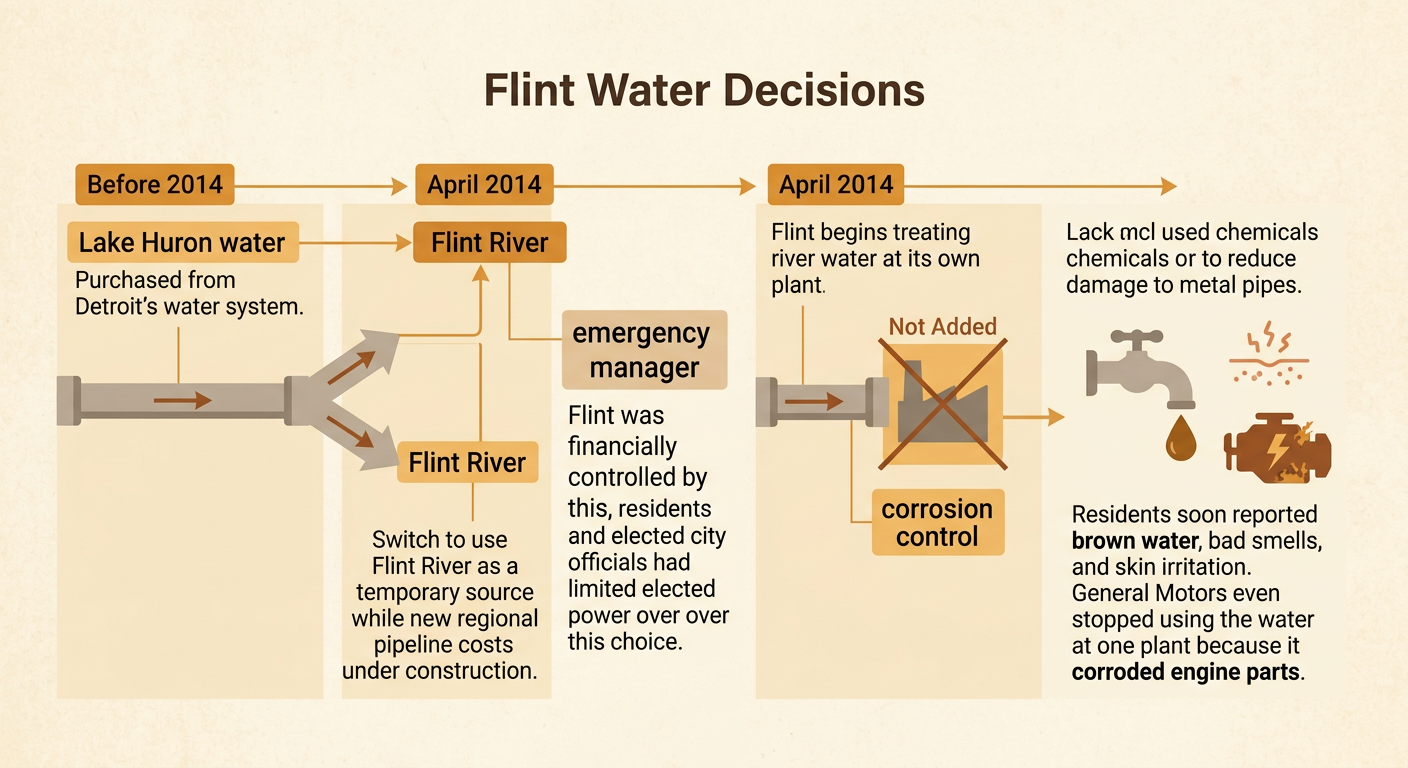
Before 2014, Flint purchased treated Lake Huron water from the Detroit water system. While a new regional pipeline was being built, state and local officials decided to use the Flint River as a temporary source, partly to reduce costs. Flint was under the authority of a state-appointed emergency manager, so residents and elected city officials had limited influence over the decision. In April 2014, the city began treating river water at its own plant. However, the treatment process did not include corrosion control that would protect metal pipes. Residents soon reported discolored water, unpleasant smells, and skin irritation. For example, General Motors stopped using Flint water at one plant because it corroded engine parts. That warning demonstrated that changing a water source requires careful testing, treatment planning, and public oversight.
Lead Contamination and Scientific Evidence
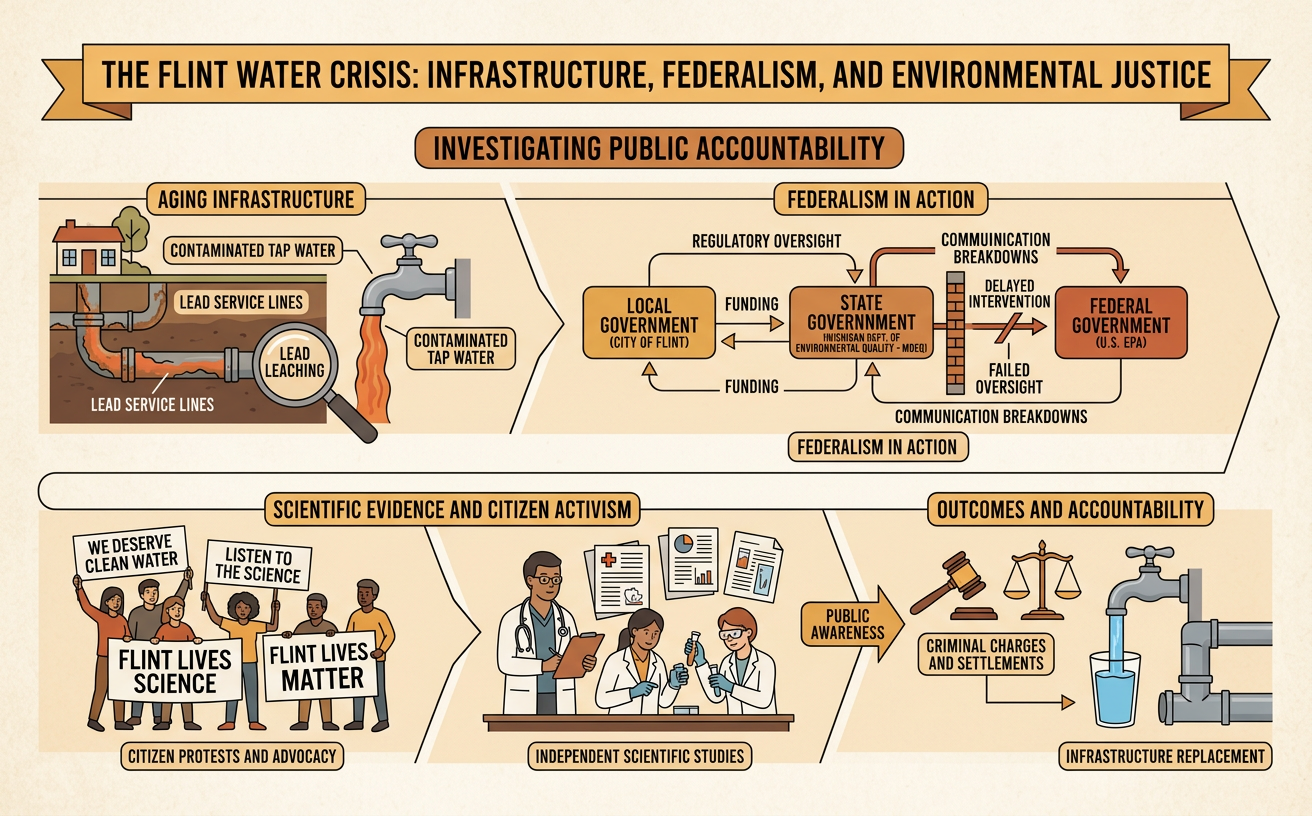
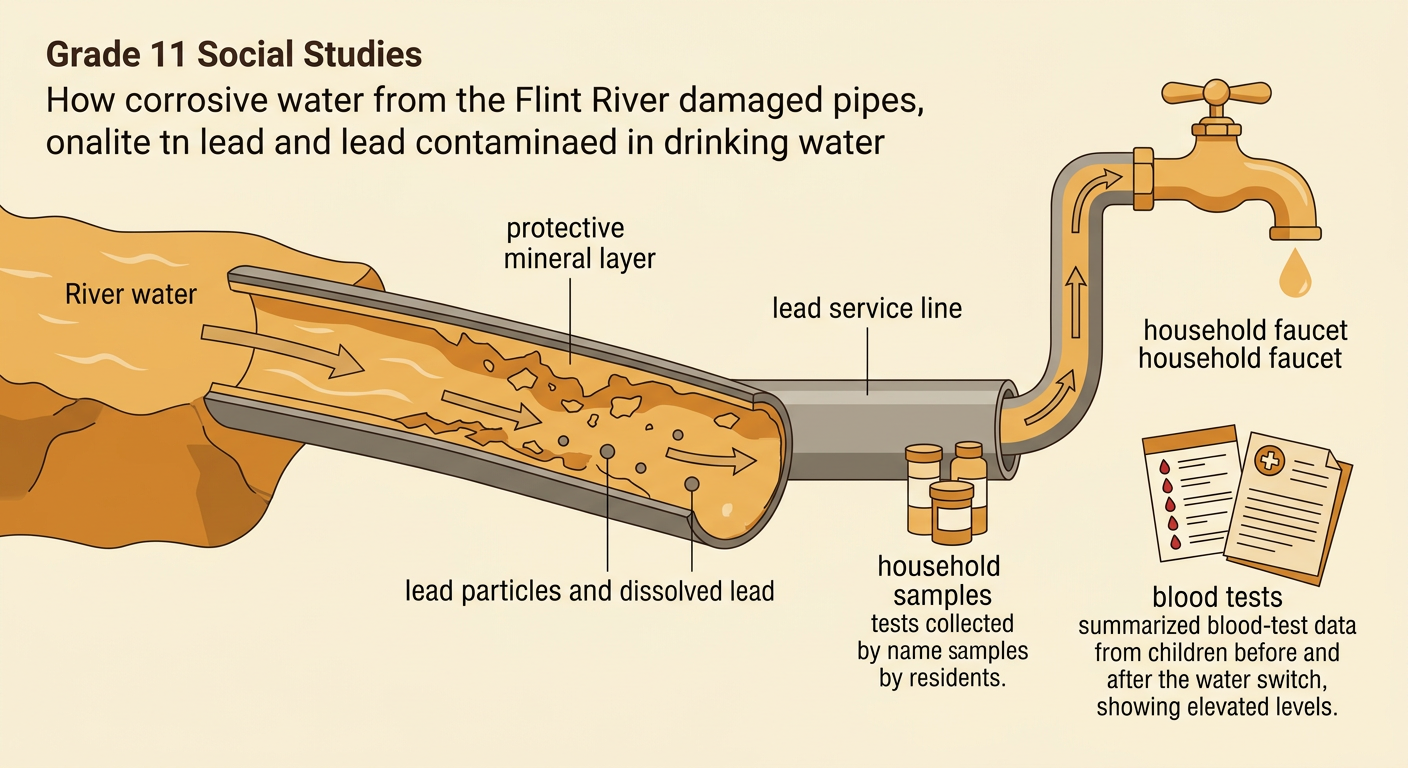
The Flint River water was more corrosive than the previously treated water, and the city did not apply required corrosion-control treatment. As water moved through the distribution system, it damaged protective mineral layers inside some pipes and plumbing. Lead then entered drinking water from lead service lines, solder, and fixtures. There is no known safe level of lead exposure for children because it can harm brain development and affect learning and behavior. Residents collected water samples, and researchers from Virginia Tech documented elevated lead levels in many homes. Pediatrician Mona Hanna-Attisha also compared children’s blood tests and found an increase in elevated blood lead levels after the switch. Together, household samples, medical records, and pipe chemistry provided independent lines of evidence that challenged earlier government assurances that the water was safe.
Federalism and Government Accountability
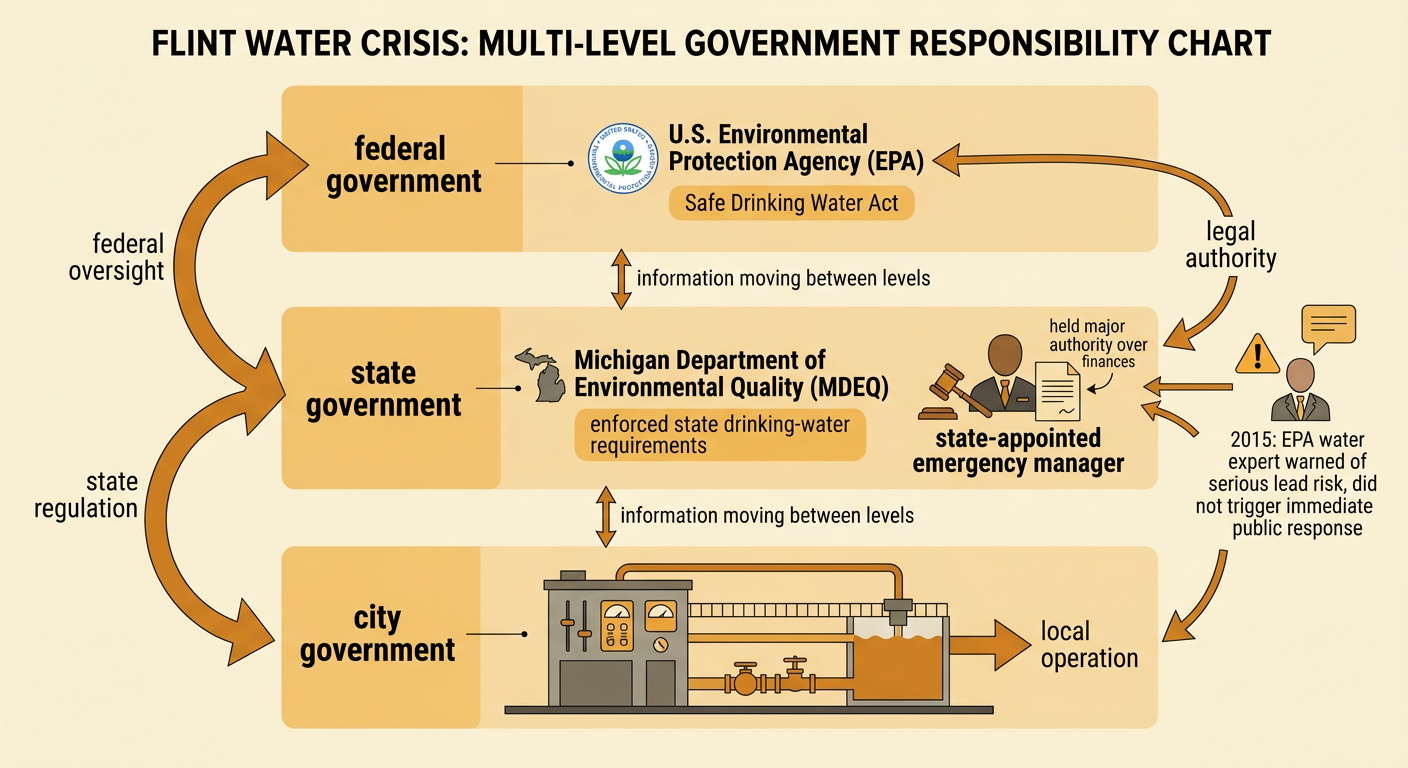
The crisis involved overlapping responsibilities among city, state, and federal governments. Flint operated the treatment plant, but a state-appointed emergency manager had major authority over city finances and contracts. The Michigan Department of Environmental Quality was responsible for enforcing state drinking-water requirements, while the U.S. Environmental Protection Agency oversaw the federal Safe Drinking Water Act and could intervene when state enforcement failed. Confusion, delayed action, and disputed interpretations of testing rules weakened accountability. For example, an EPA water expert warned in 2015 that the lack of corrosion control created a serious lead risk, but the warning did not produce an immediate public response. Federalism can provide multiple layers of protection, yet it can also make responsibility difficult to trace. Students can evaluate accountability by asking which agency had legal authority, what evidence it possessed, and when it acted.
Environmental Justice and Unequal Risk
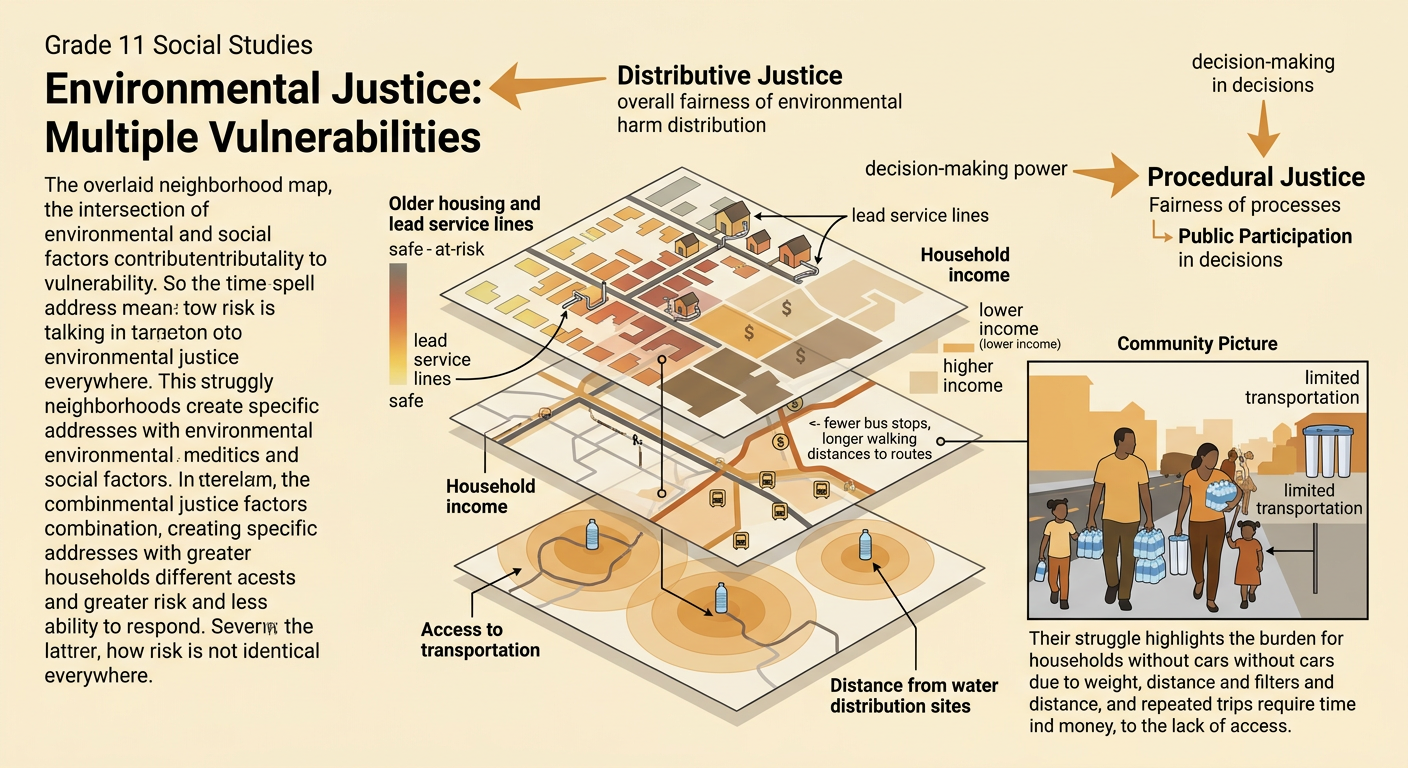
Environmental justice examines whether environmental harms and decision-making power are distributed fairly. Flint is a majority-Black city with a high poverty rate, and many residents lacked the political and financial resources available in wealthier communities. Aging housing, lead service lines, limited transportation, and the cost of bottled water increased some households’ risks and burdens. Exposure was not identical across the city because pipe materials, water use, and building conditions varied by address. However, residents broadly experienced delayed warnings and limited influence over major decisions. For example, families without cars had greater difficulty collecting large quantities of bottled water or replacement filters from distribution sites. The crisis therefore involved both distributive justice, meaning who experienced the harm, and procedural justice, meaning whose concerns were heard. An environmental justice analysis compares exposure, resources, public participation, and government response.
Citizen Activism and Policy Responses
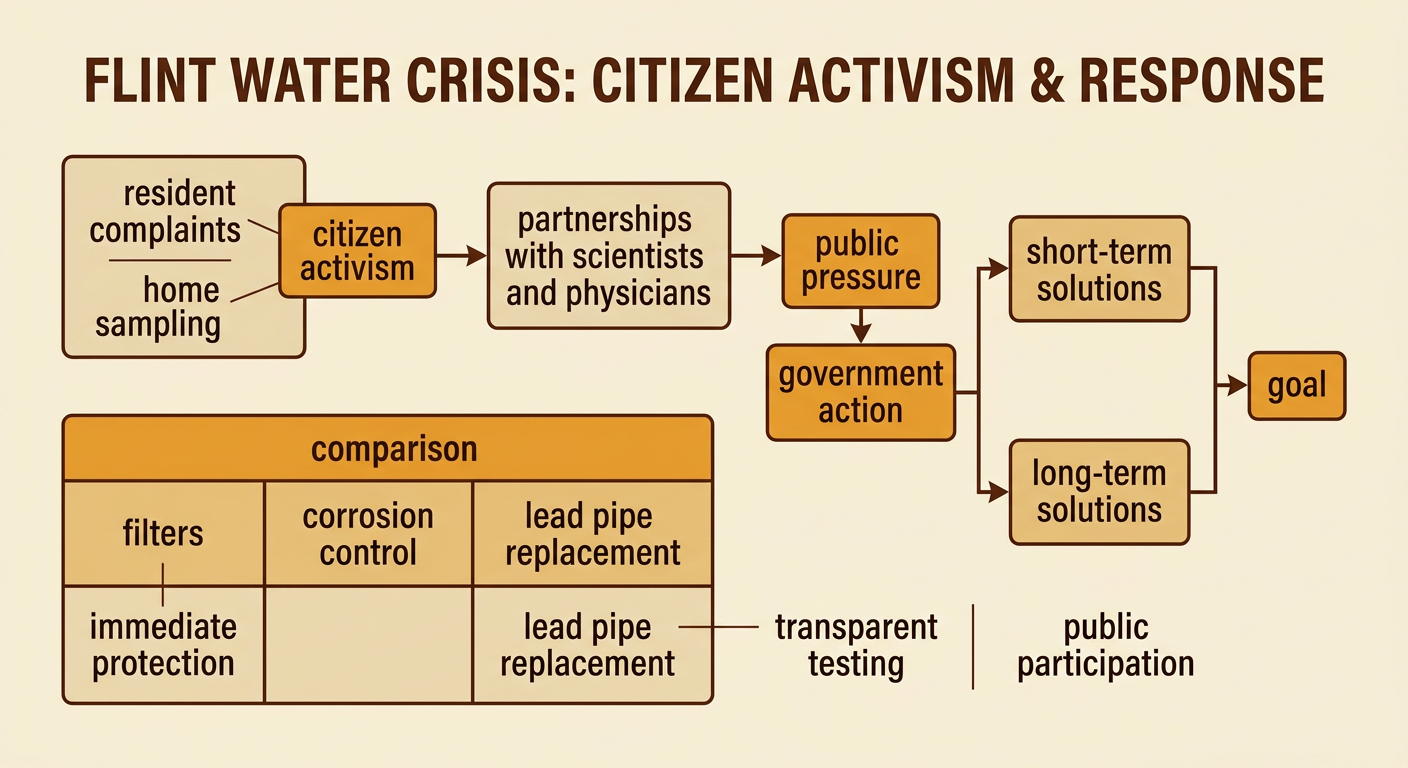
Flint residents gathered evidence, organized meetings, contacted journalists, and challenged official statements. Resident LeeAnne Walters collected water samples and worked with Virginia Tech researchers, while community groups and physicians helped publicize health concerns. This activism connected personal experiences to scientific data and legal claims. Flint switched back to Detroit-supplied water in October 2015, and state and federal emergency declarations followed in January 2016. Later responses included filters, bottled water, health programs, court cases, infrastructure funding, and replacement of lead service lines. Each solution has limits. Filters can reduce lead quickly but require correct installation and replacement; corrosion control protects the system but does not remove lead pipes; full service-line replacement is more durable but costly and disruptive. A strong policy response therefore combines immediate protection, long-term infrastructure repair, transparent testing, public participation, and enforceable accountability.