
The Green Revolution: Food Security, Technology, and Social Change
Students examine how high-yield crops, irrigation, fertilizers, and government policies increased food production while creating uneven social and environmental consequences.
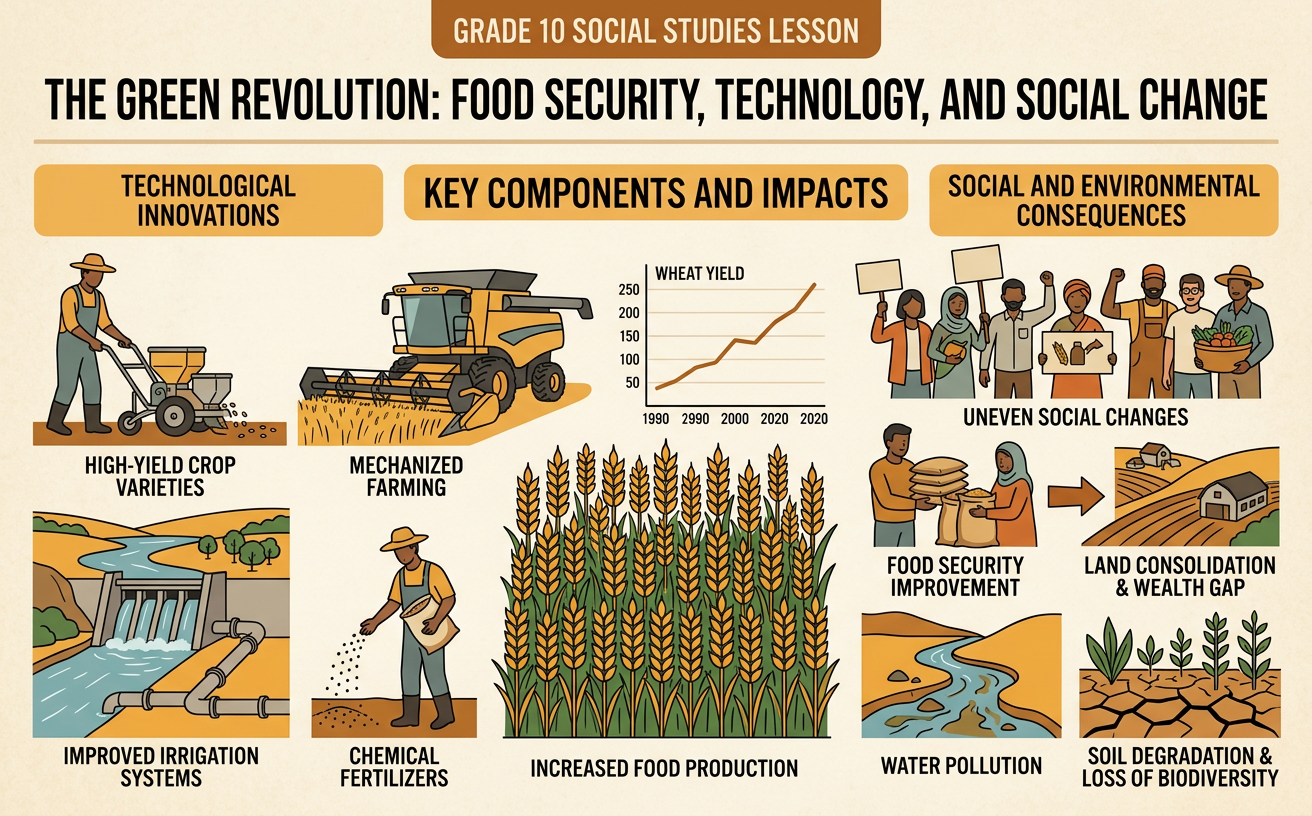
Illustrations are auto-generated and may be placeholders. They can be refreshed to match the narration.
Origins of the Green Revolution
The Green Revolution began as an effort to increase harvests in countries facing rapid population growth, poverty, and food shortages. During the 1940s, Mexico’s government worked with the Rockefeller Foundation to support agricultural research. Scientists, including Norman Borlaug, bred wheat varieties that produced more grain and resisted disease. In the 1960s, similar programs expanded into South and Southeast Asia with support from governments and international organizations. India, for example, adopted new wheat varieties after droughts and poor harvests increased its dependence on imported grain. The Green Revolution was therefore not a single invention. It resulted from several connected causes: scientific research, public funding, irrigation projects, international cooperation, and government concern about political stability and hunger. Historical sources such as government reports and farmers’ accounts help explain why different groups supported or questioned these changes.

New Seeds and Farming Technologies
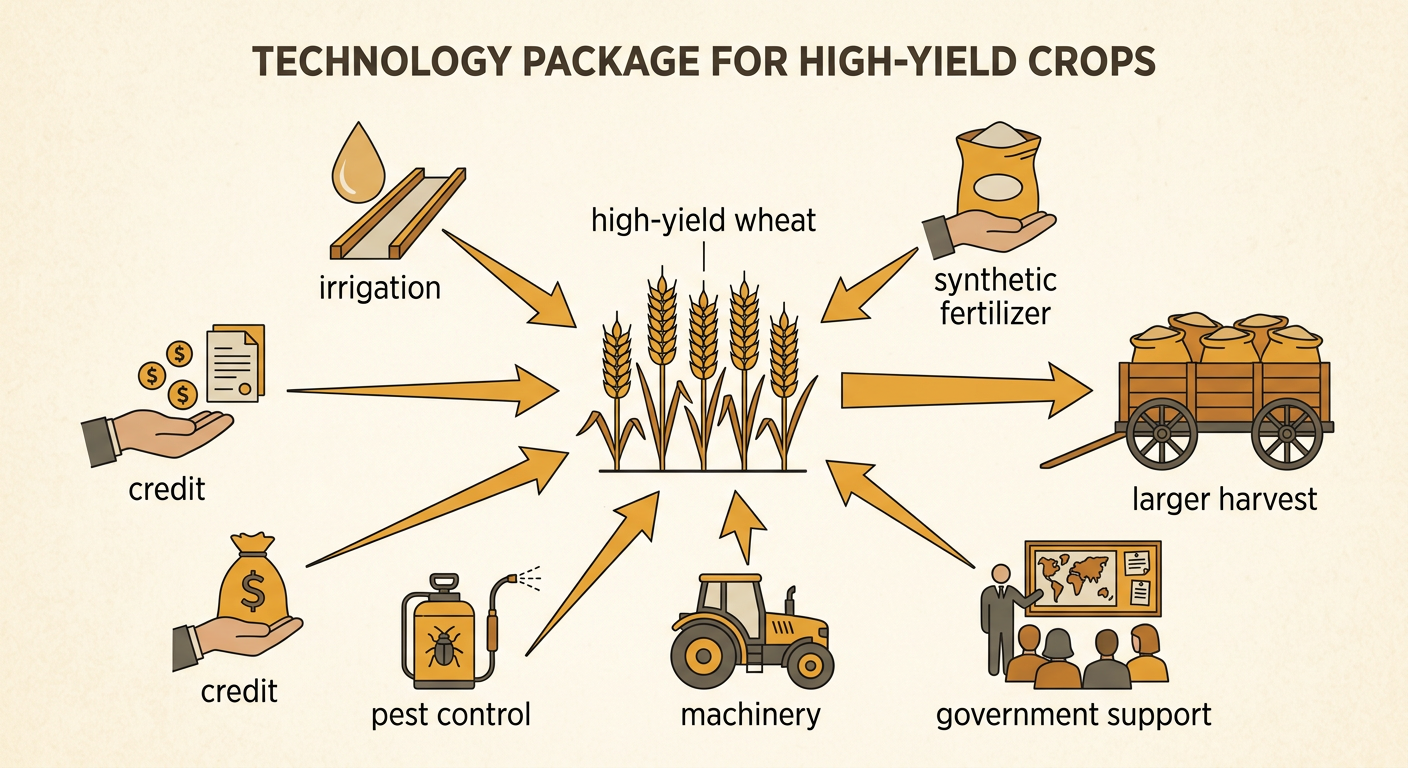
Green Revolution crops were designed to produce high yields when supplied with enough water and nutrients. Short-stemmed, or dwarf, wheat plants could hold heavier heads of grain without falling over. The rice variety IR8, released by the International Rice Research Institute in 1966, also produced large harvests under favorable conditions. However, improved seeds were only one part of a larger technology package. Farmers often needed irrigation, synthetic fertilizer, pesticides, machinery, and access to credit. Governments supported adoption by building dams and canals, subsidizing farm supplies, and guaranteeing prices for some crops. In India’s Punjab region, farmers combined high-yield wheat with tube wells and fertilizers to grow more grain, sometimes planting more than one crop each year. Results varied because not every farmer had equal access to land, water, money, or technical assistance.
Reading Food-Production Data
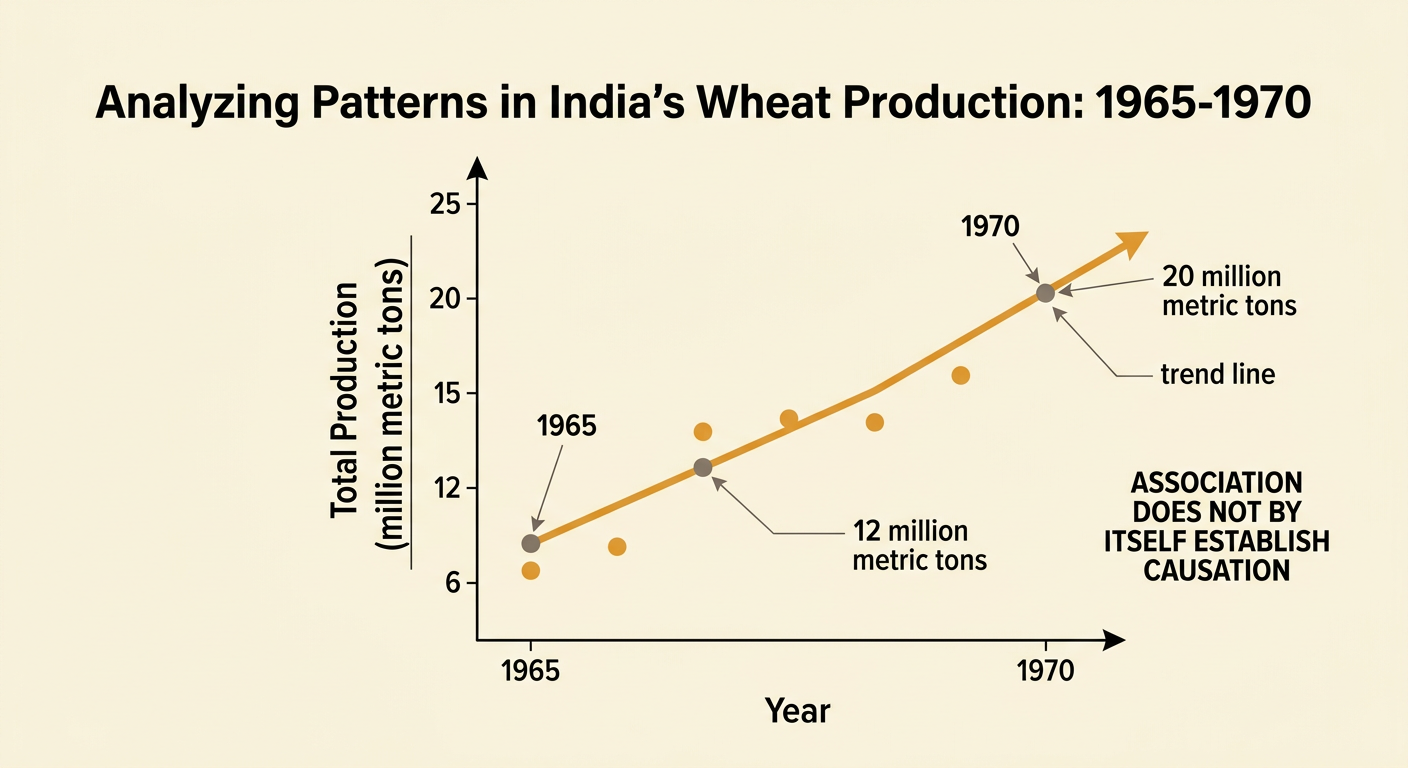
Quantitative data can reveal patterns in agricultural change, but it must be interpreted carefully. FAOSTAT records indicate that India’s wheat production rose from about 12 million metric tons in 1965 to about 20 million metric tons in 1970. Students can place year on the horizontal axis and production on the vertical axis, then draw a trend line through the data. The upward association suggests that wheat output increased during the early adoption of high-yield varieties. It does not prove that seeds alone caused the increase. Expanded irrigation, greater fertilizer use, favorable weather, government prices, and additional planted land may also have contributed. Researchers should check the source, units, time span, and whether values show total production or yield per acre. Comparing production with population data also helps determine whether food availability per person actually improved.
Benefits for Population and Food Security
The Green Revolution increased the supply of staple foods in many countries and reduced the immediate danger of widespread famine. Larger harvests could lower grain prices, increase national food reserves, and reduce dependence on imports. India provides a clear example: wheat production grew rapidly after the mid-1960s, and the country became more capable of meeting its own grain needs. Greater productivity also allowed some farmers to earn more income and created jobs in transportation, milling, fertilizer sales, and equipment repair. These changes mattered as populations and cities expanded. Food security, however, means more than producing enough calories nationally. People must also have reliable physical and economic access to safe, nutritious food. A country can harvest abundant wheat or rice while low-income families still experience hunger because of unemployment, unequal distribution, conflict, or high prices. Production gains improved food security, but they did not automatically end malnutrition.

Social and Environmental Costs
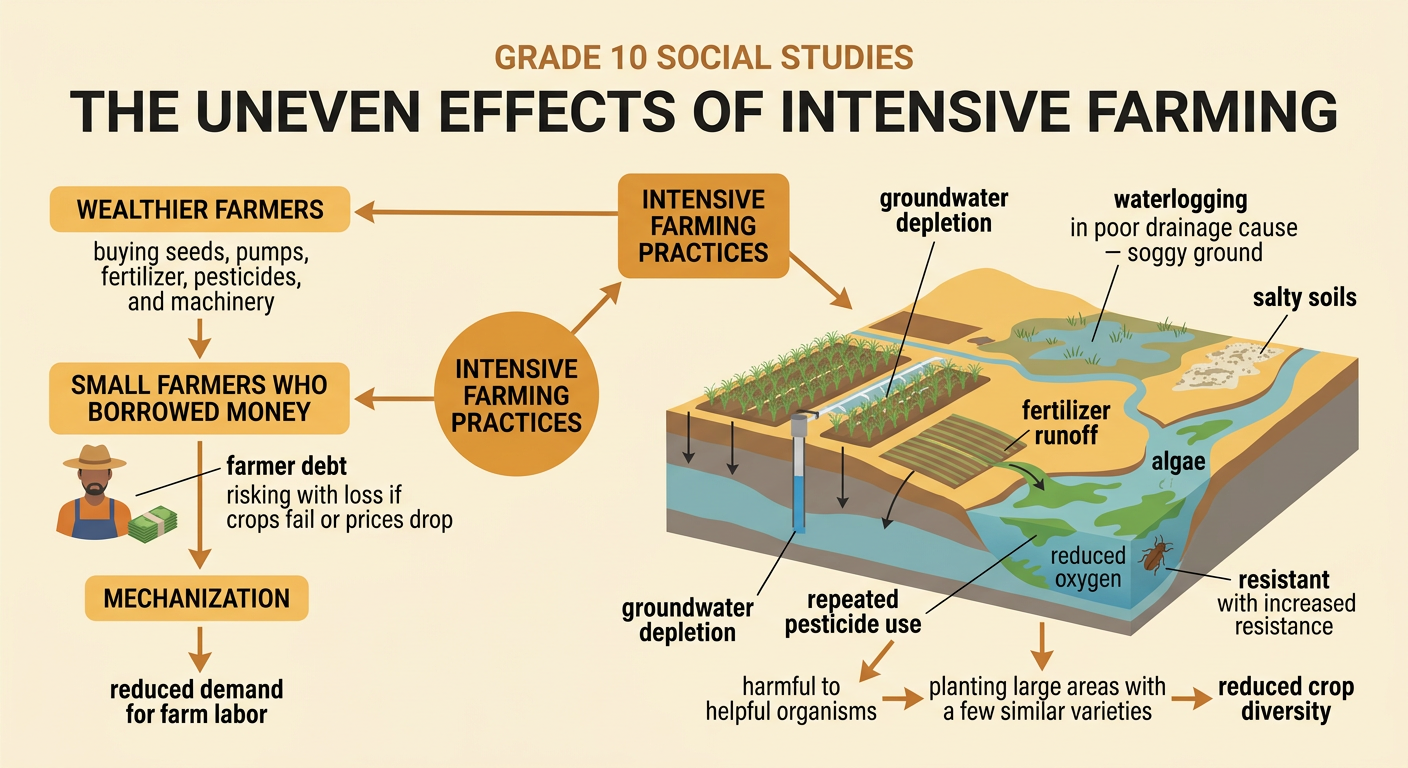
The Green Revolution’s benefits and costs were distributed unevenly. Wealthier farmers were often better able to purchase seeds, pumps, fertilizer, pesticides, and machinery. Small farmers who borrowed money could face debt if crops failed or prices fell. Mechanization sometimes reduced demand for agricultural labor, while successful farming regions attracted migrant workers under difficult conditions. Environmental effects also appeared over time. Heavy irrigation lowered groundwater levels in parts of India’s Punjab region, while poor drainage caused waterlogging and salty soils elsewhere. Excess fertilizer could enter rivers and lakes, contributing to algal growth and low-oxygen conditions. Repeated pesticide use harmed some helpful organisms and encouraged resistant pests. Large areas planted with a few genetically similar varieties also reduced crop diversity. These outcomes were not caused by seeds alone; they resulted from how technologies, markets, land ownership, and resource policies interacted.
Evaluating the Green Revolution’s Legacy
Evaluating the Green Revolution requires weighing multiple causes, perspectives, and effects. Supporters point to higher grain production, reduced famine risk, stronger national food reserves, and new farm-related industries. Critics emphasize unequal access, farmer debt, groundwater depletion, pollution, and dependence on purchased inputs. Both claims can be supported by evidence, depending on the place, period, crop, and group being studied. For example, a large irrigated farmer in Punjab might describe rising wheat profits, while a landless laborer or a farmer in a dry region might report fewer benefits. A strong historical judgment should cite specific evidence from production records, government policies, scientific studies, and firsthand accounts. The legacy also shapes current choices. Plant breeding, efficient irrigation, soil conservation, crop diversity, and targeted public support may increase food production while limiting harm. The central question is not simply whether the Green Revolution succeeded, but for whom, where, and at what cost.
