The Mole and Molar Mass
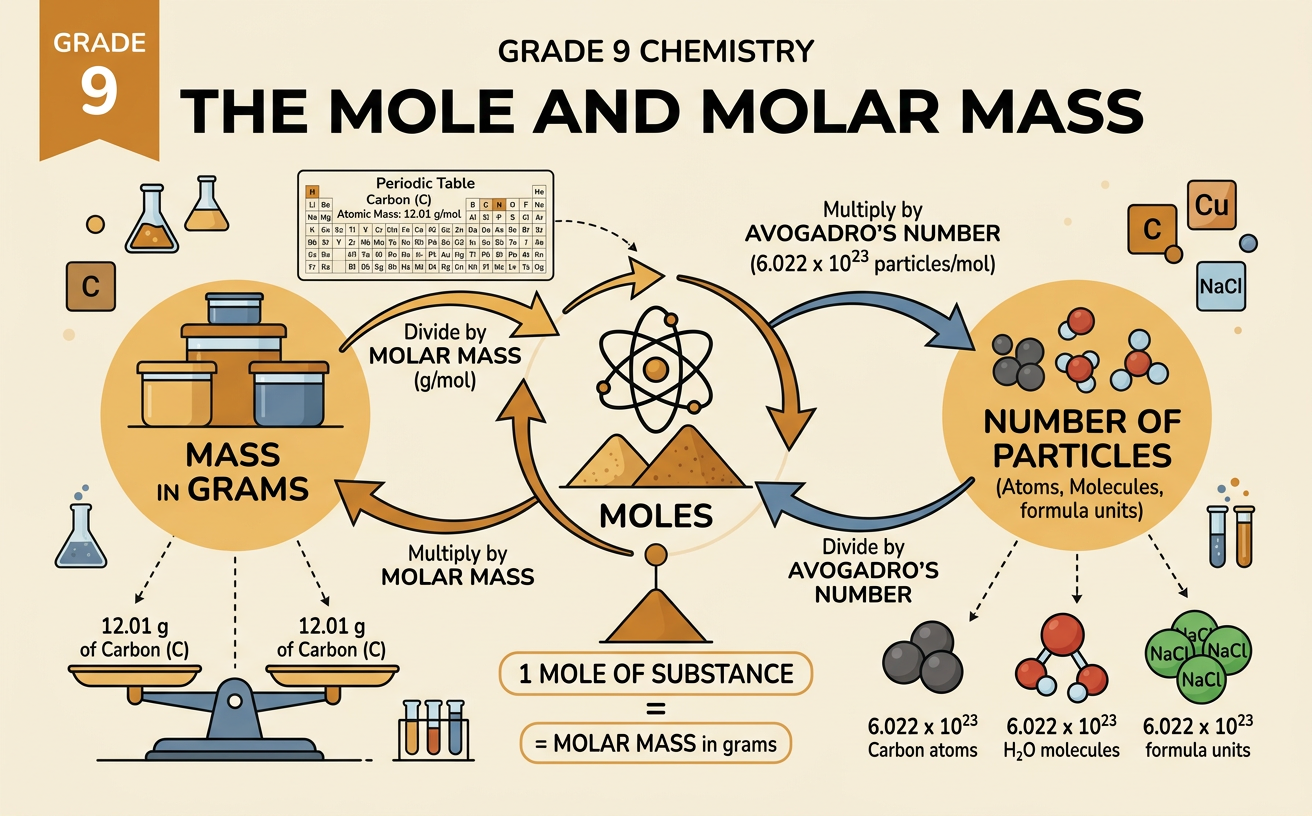
Students use Avogadro’s number and periodic-table data to convert among moles, numbers of particles, and mass in grams.
Illustrations are auto-generated and may be placeholders. They can be refreshed to match the narration.
Why Chemists Use the Mole
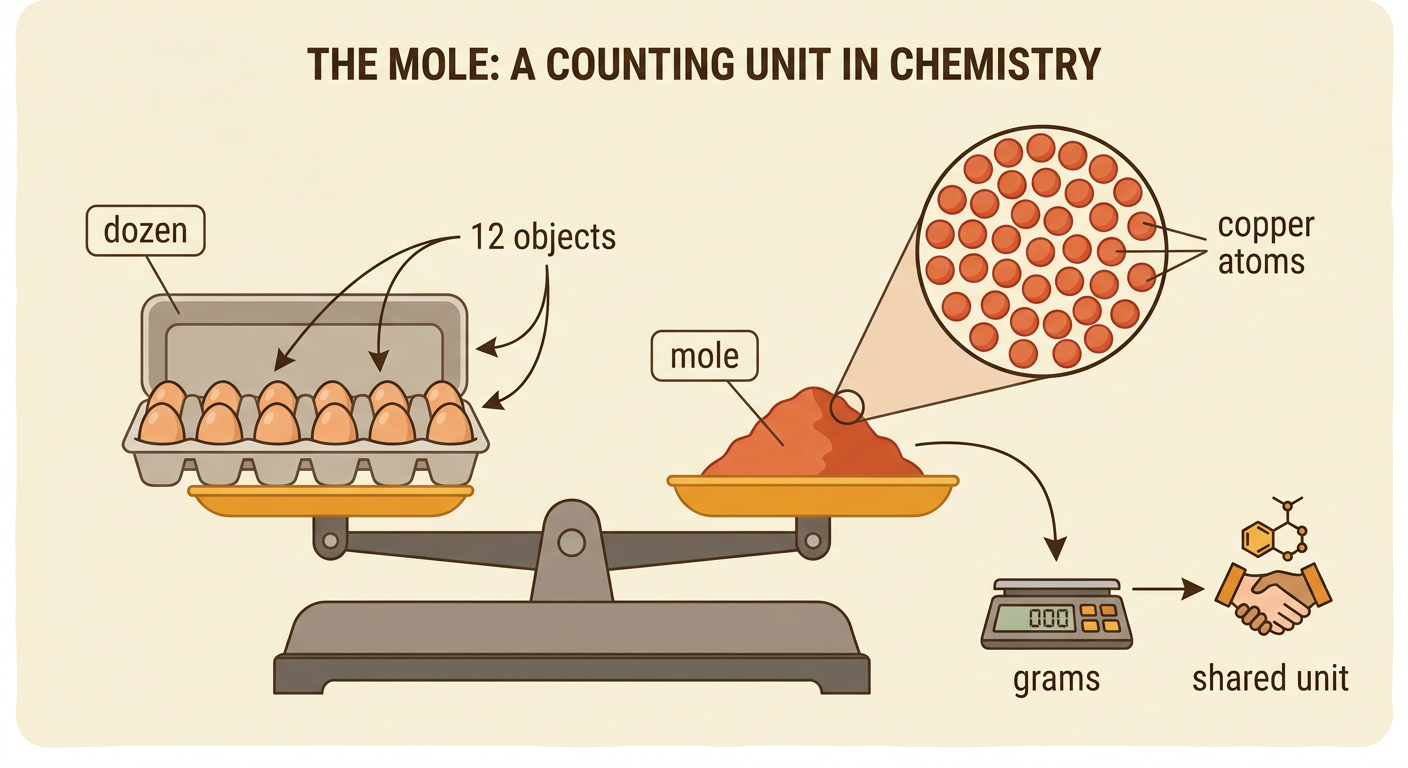
Atoms, molecules, and ions are far too small to count one at a time in a laboratory. Chemists solve this problem by counting particles in groups called moles. A mole is similar to a dozen: a dozen always means 12 objects, while a mole always means 6.02214076 × 10^23 specified particles. For example, one mole of copper contains 6.02214076 × 10^23 copper atoms. The mole connects the microscopic world of particles to measurable laboratory quantities such as grams. It also lets chemists interpret chemical equations as ratios of amounts. Standardizing the mole gave scientists, manufacturers, and nations a common measurement system. Although laboratory tools and industrial processes have changed, this shared unit has allowed chemical measurements and recipes to remain consistent, comparable, and reproducible.
Avogadro’s Number
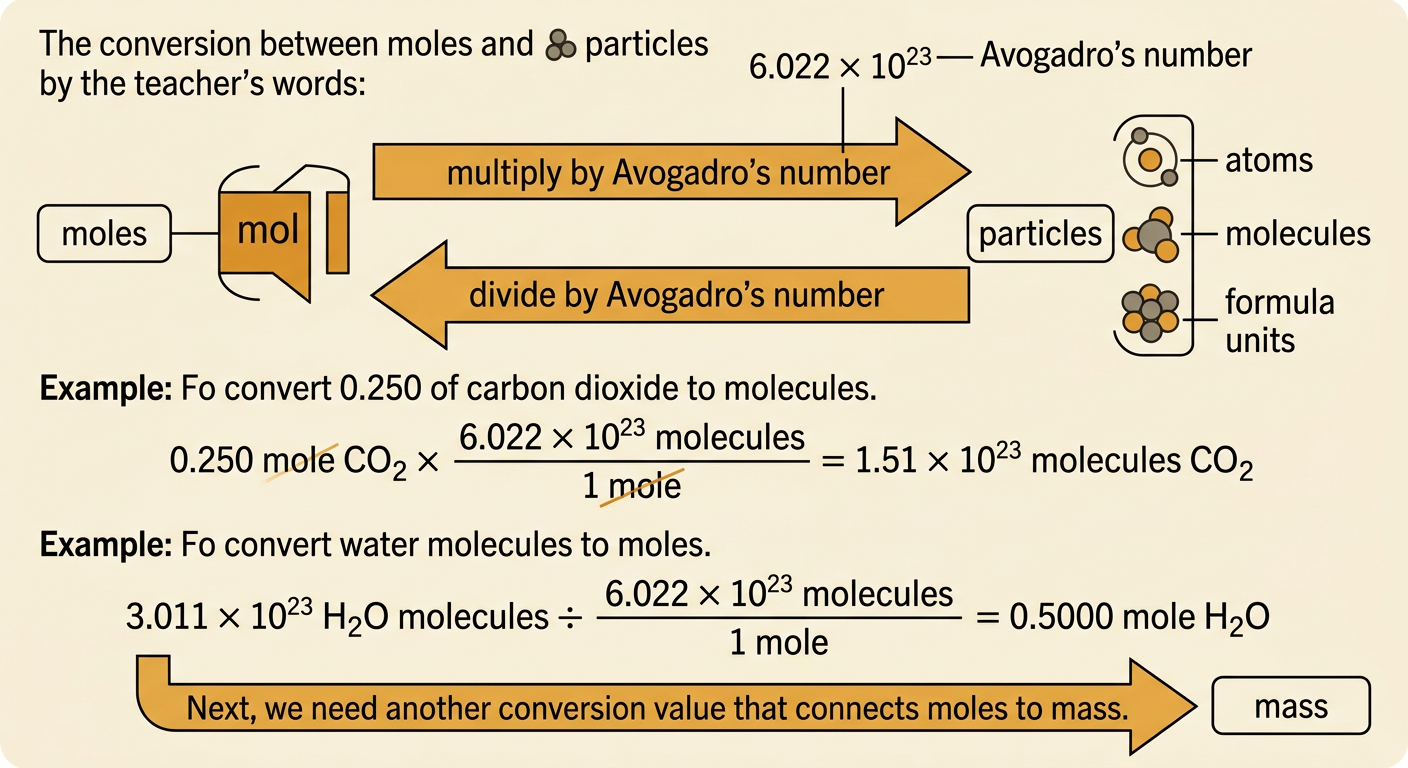
Avogadro’s number is the number of specified particles in exactly one mole: 6.02214076 × 10^23 particles per mole. For most classroom calculations, it is rounded to 6.022 × 10^23 particles per mole. The word particles must be interpreted correctly. It can mean atoms for an element, molecules for a molecular substance, formula units for an ionic compound, or other stated entities. To find particles, multiply moles by Avogadro’s number. For example, 0.250 mol of carbon dioxide contains 0.250 mol × 6.022 × 10^23 molecules/mol = 1.51 × 10^23 CO2 molecules. The mole units cancel, leaving molecules. In reverse, divide a particle count by Avogadro’s number. Thus, 3.011 × 10^23 water molecules equal 0.5000 mol of water.
Calculating Molar Mass
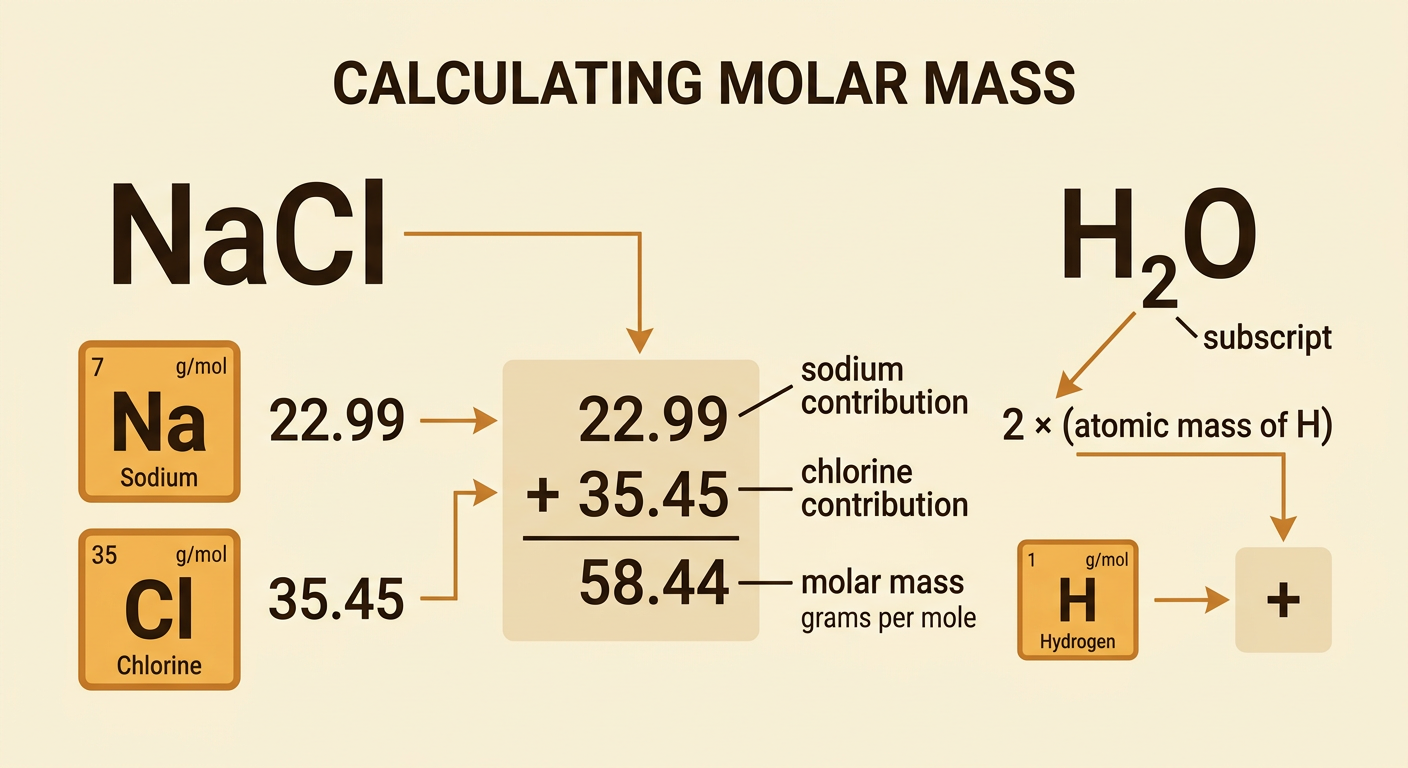
Molar mass is the mass of one mole of a substance, expressed in grams per mole. The periodic table lists average atomic masses in atomic mass units, but those same numerical values are used as molar masses in grams per mole. To calculate a compound’s molar mass, multiply each element’s atomic mass by its subscript and then add the results. For sodium chloride, NaCl, there is one sodium atom and one chlorine atom per formula unit. Sodium contributes 22.99 g/mol, and chlorine contributes 35.45 g/mol. Therefore, the molar mass of NaCl is 22.99 + 35.45 = 58.44 g/mol. For H2O, the subscript 2 means two hydrogen atoms contribute to the total. Parentheses and their subscripts must also be included when working with more complex formulas.
Converting Moles and Particles
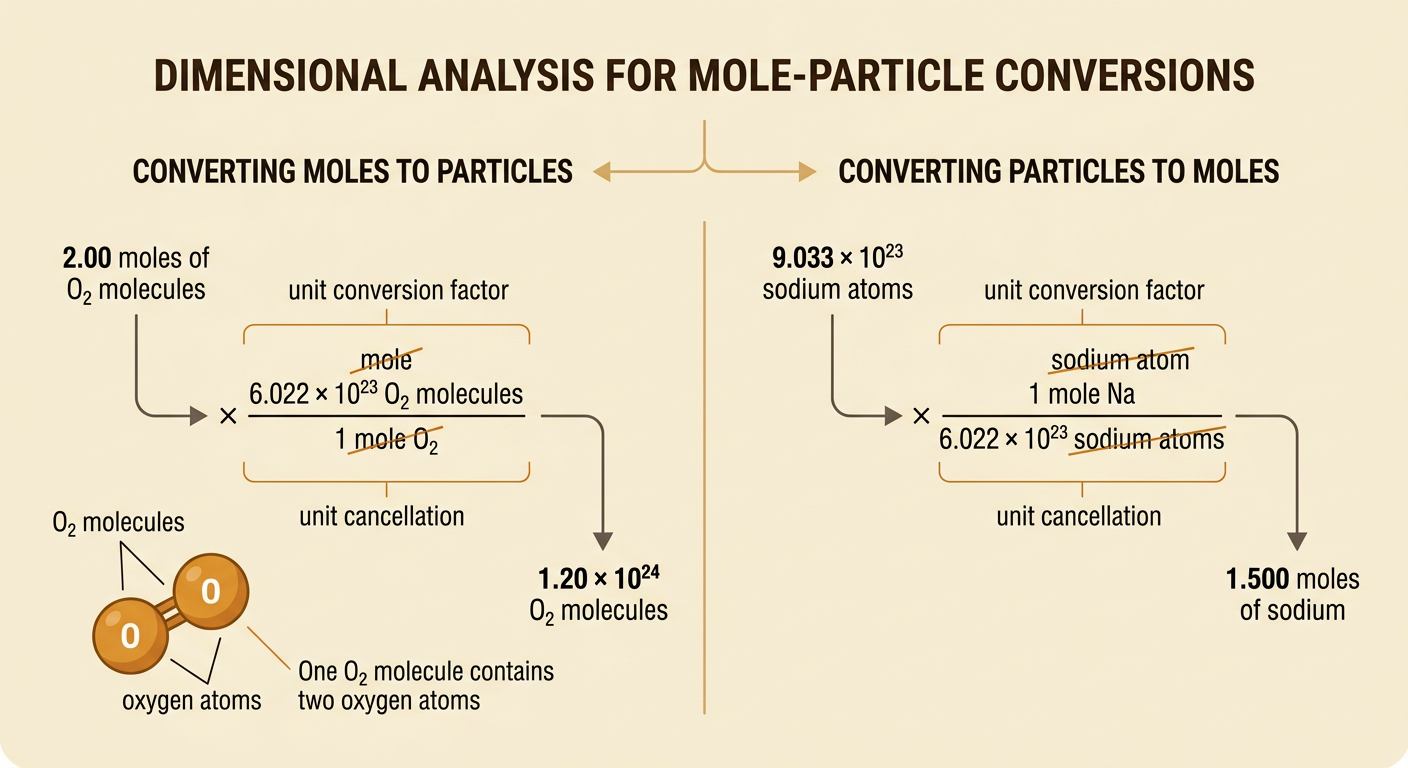
Conversions between moles and particles use Avogadro’s number as a unit conversion factor. Begin by identifying the given unit and the desired unit. Arrange the factor so the unwanted unit cancels. To convert 2.00 mol of oxygen molecules to molecules, calculate 2.00 mol O2 × (6.022 × 10^23 O2 molecules/1 mol O2) = 1.20 × 10^24 O2 molecules. To convert in the opposite direction, place moles in the numerator. For example, 9.033 × 10^23 sodium atoms × (1 mol Na/6.022 × 10^23 Na atoms) = 1.500 mol Na. Always name the type of particle. One O2 molecule contains two oxygen atoms, so 2.00 mol of O2 molecules would also contain 4.00 mol of oxygen atoms.
Converting Moles and Grams
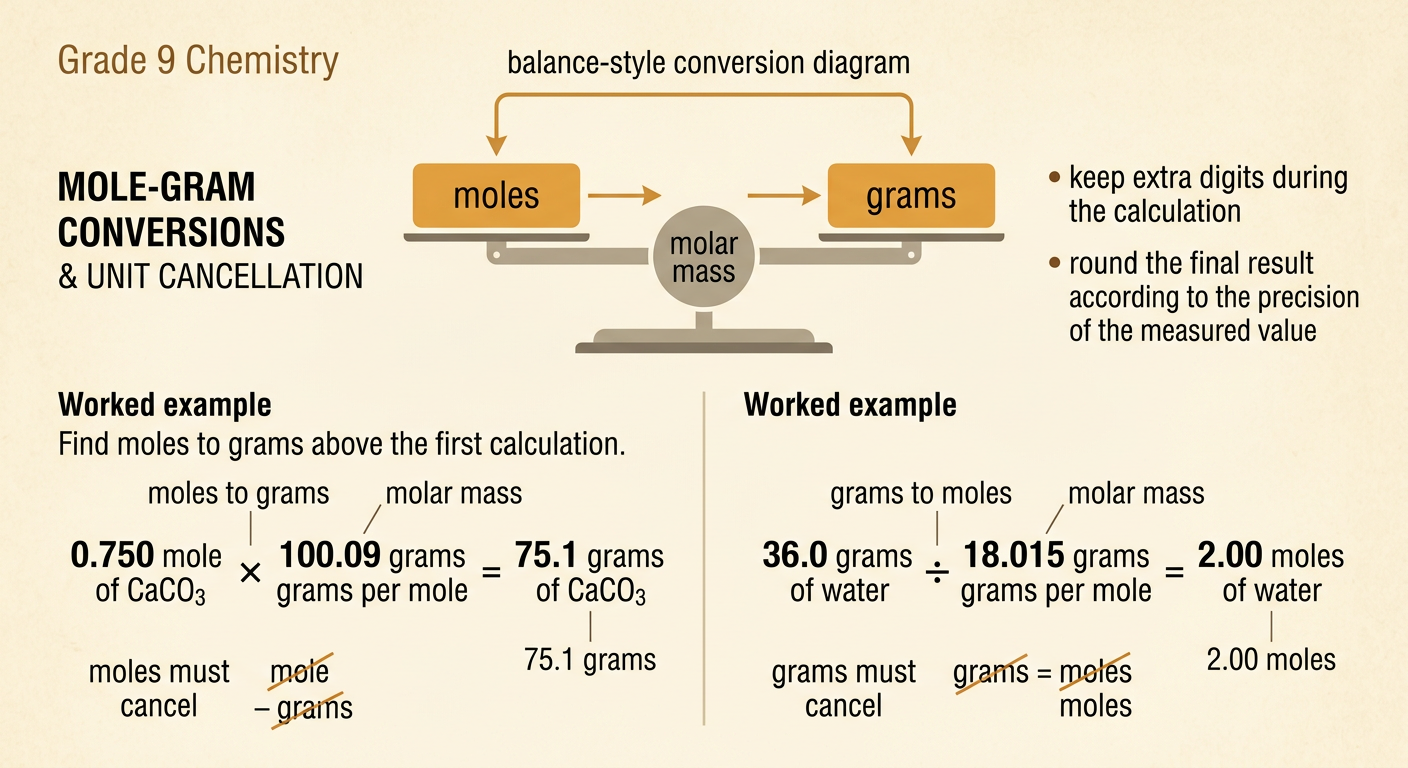
Molar mass is the conversion factor between moles and grams. To convert moles to grams, multiply by molar mass. Calcium carbonate, CaCO3, has a molar mass of about 100.09 g/mol. Therefore, 0.750 mol CaCO3 × (100.09 g CaCO3/1 mol CaCO3) = 75.1 g CaCO3. To convert grams to moles, divide by molar mass. For example, water has a molar mass of 18.015 g/mol, so 36.0 g H2O × (1 mol H2O/18.015 g H2O) = 2.00 mol H2O. Units show whether the conversion factor is arranged correctly. Grams must cancel when the answer is in moles, and moles must cancel when the answer is in grams. Round the final result according to the precision of the measured value.
Quick Practice and Check
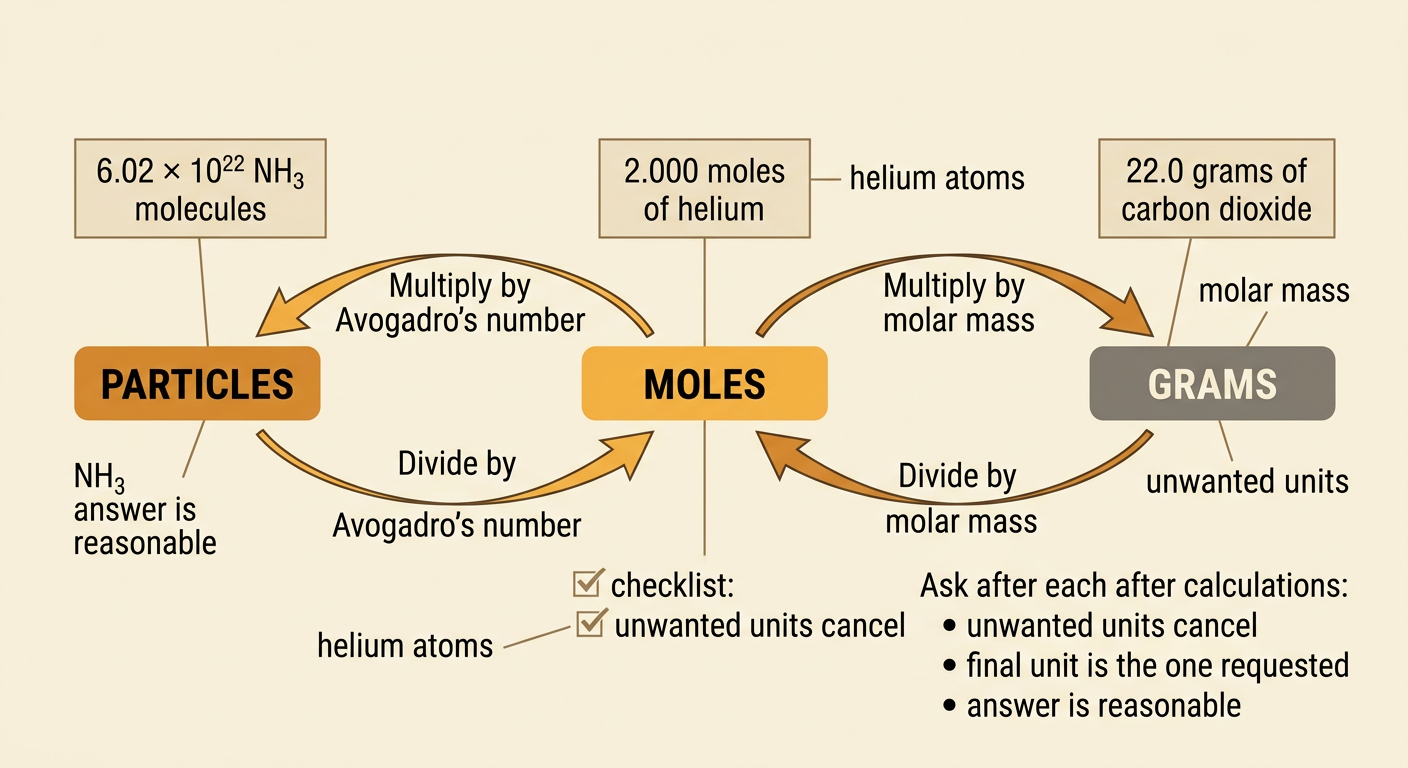
Use units to decide which conversion factor belongs in each calculation. First, how many molecules are in 0.100 mol NH3? Multiply by Avogadro’s number to obtain 6.02 × 10^22 NH3 molecules. Second, how many moles are represented by 1.2044 × 10^24 helium atoms? Divide by Avogadro’s number to obtain 2.000 mol He. Third, what is the mass of 0.500 mol CO2? Its molar mass is 12.01 + 2(16.00) = 44.01 g/mol, so the mass is 22.0 g CO2. Check every answer by asking three questions: Did the unwanted units cancel? Is the final unit the one requested? Is the size of the answer reasonable? Multiplying by Avogadro’s number should produce a very large particle count, while multiplying by molar mass should produce grams.