
The Mole, Molar Mass, and Chemical Equations
Students connect microscopic particles to measurable amounts by using the mole and molar mass. They then balance chemical equations and interpret coefficients as particle and mole relationships.
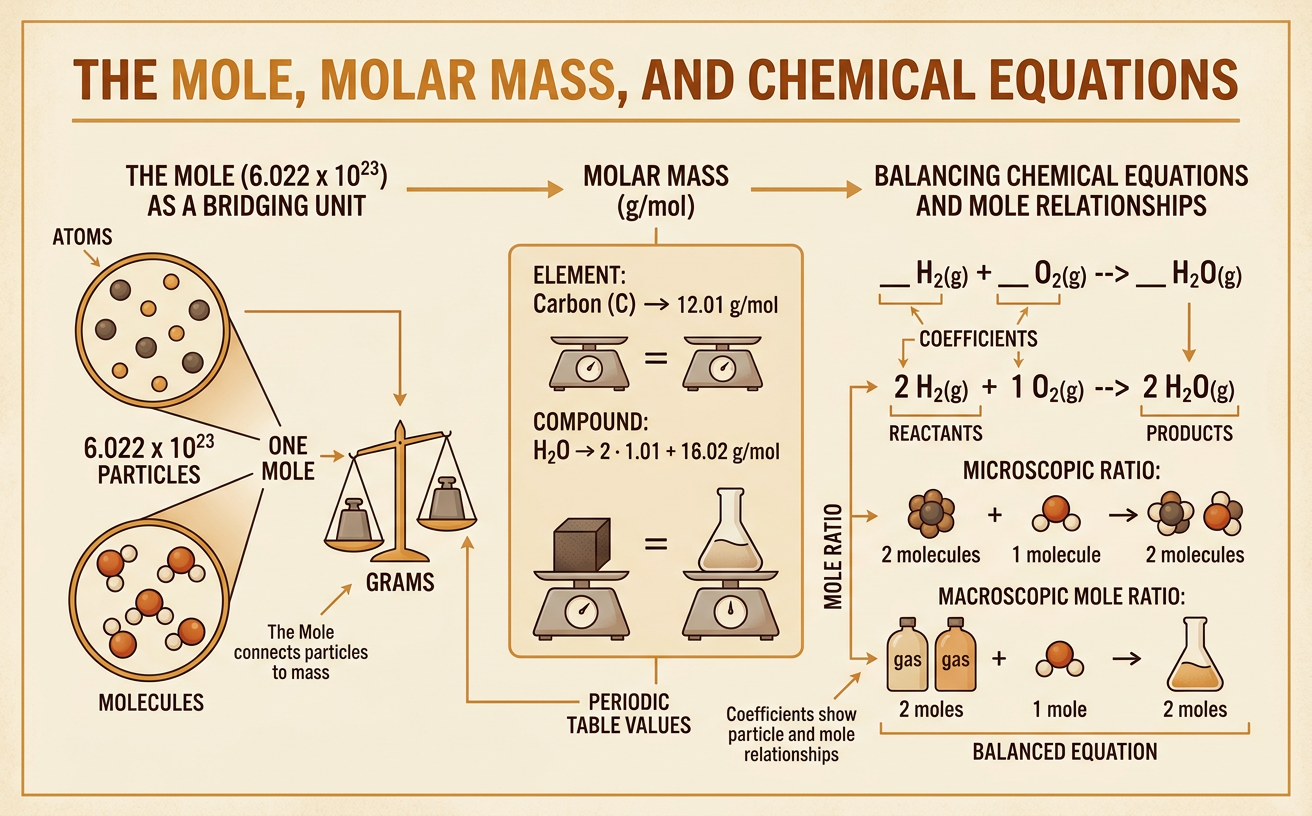
Illustrations are auto-generated and may be placeholders. They can be refreshed to match the narration.
The Mole as a Counting Unit
Atoms and molecules are too small to count individually, so chemists use the mole as a counting unit. One mole contains 6.022 × 10^23 representative particles, a number called Avogadro’s number. The representative particle may be an atom, molecule, formula unit, or ion, depending on the substance. For example, one mole of helium contains 6.022 × 10^23 helium atoms, while one mole of water contains 6.022 × 10^23 water molecules. Because each water molecule has two hydrogen atoms, that sample also contains 1.2044 × 10^24 hydrogen atoms. The mole allows chemists to describe enormous numbers of particles with manageable values, much as the word dozen represents twelve objects.
Calculating Molar Mass
Molar mass is the mass of one mole of a substance, expressed in grams per mole. To calculate it, add the atomic masses of all atoms shown in the chemical formula. For carbon dioxide, CO2, the molar mass is 12.01 grams per mole for carbon plus two times 16.00 grams per mole for oxygen. The result is 44.01 grams per mole. Subscripts are essential because they state how many atoms of each element occur in one particle. For calcium nitrate, Ca(NO3)2, the parentheses mean that the nitrate group appears twice. Its molar mass includes one calcium atom, two nitrogen atoms, and six oxygen atoms. Careful interpretation of formulas prevents calculation errors.
Converting Among Mass, Moles, and Particles
Molar mass and Avogadro’s number act as conversion factors. To convert grams to moles, divide by molar mass. To convert moles to particles, multiply by 6.022 × 10^23. For example, 36.0 grams of water can be converted to moles using its molar mass of 18.02 grams per mole. The result is approximately 2.00 moles of water. Multiplying 2.00 moles by Avogadro’s number gives about 1.20 × 10^24 water molecules. Units should be written throughout the calculation so unwanted units cancel. This dimensional-analysis method also works in reverse: particles can be converted to moles, and moles can then be converted to grams.
Balancing and Interpreting Chemical Equations
A balanced chemical equation follows the law of conservation of mass: atoms are rearranged during a reaction, but they are not created or destroyed. Only coefficients may be changed when balancing; changing a subscript would change the identity of a substance. Consider hydrogen reacting with oxygen: 2H2 + O2 → 2H2O. The equation has four hydrogen atoms and two oxygen atoms on each side. The coefficients also give relative amounts. Two molecules or two moles of hydrogen react with one molecule or one mole of oxygen to form two molecules or two moles of water. These ratios are not mass ratios. Two moles of hydrogen have a much smaller mass than one mole of oxygen because their molar masses differ.