
The Mystery of the Mixed-Up Creature Families
Students become genetics detectives who analyze illustrated parent-and-offspring trait data to discover that inherited traits show patterns while offspring still vary from their parents and siblings.
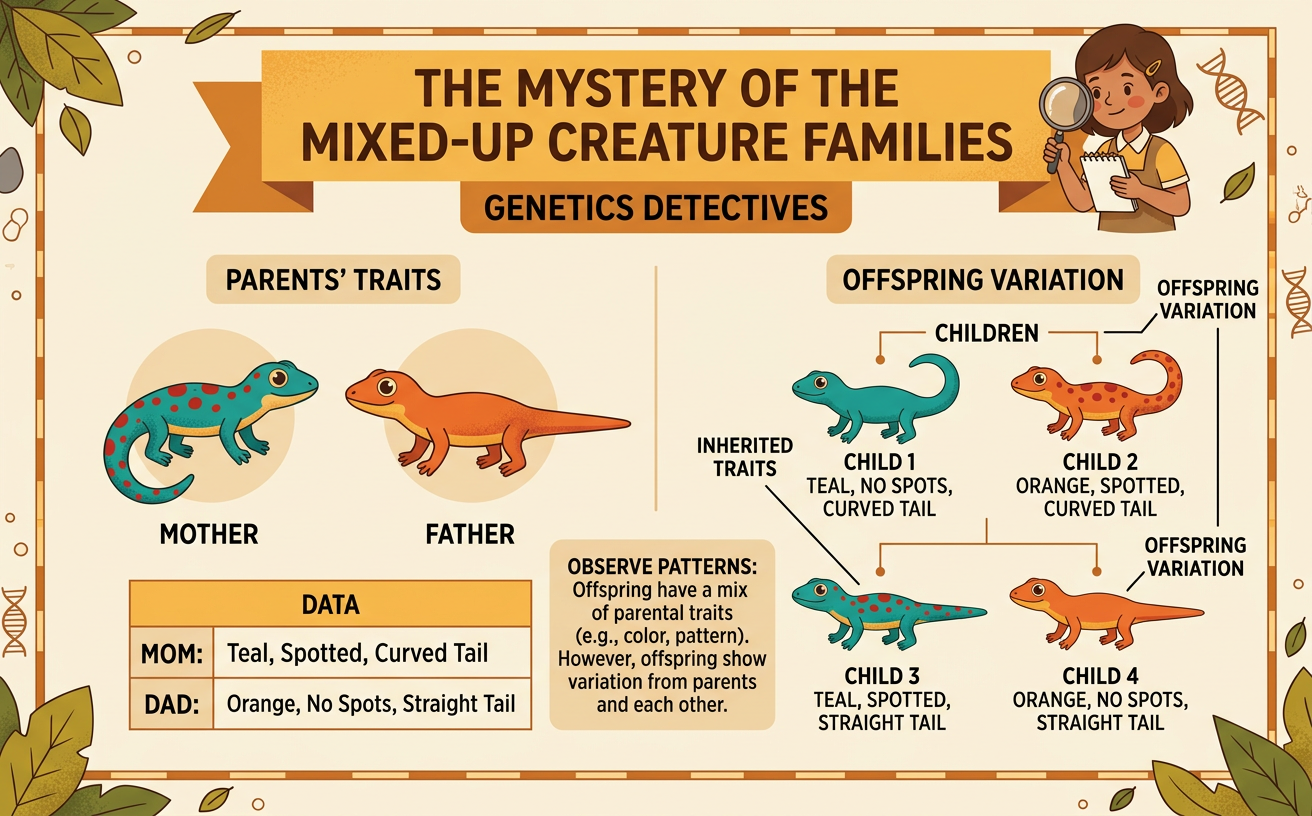
Illustrations are auto-generated and may be placeholders. They can be refreshed to match the narration.
Meet the Mixed-Up Creature Families
Imagine that three families of gentle, furry creatures have wandered away from their nests. Your job is to study their visible traits and help sort the offspring into family groups. A trait is a feature of an organism, such as striped fur, plain fur, pointed ears, or rounded ears. Many traits are inherited, meaning they are passed from parents to offspring. However, offspring are not exact copies of either parent. For example, two striped parents may have three striped offspring and one plain offspring. Brothers and sisters can also differ from one another. Look for repeated patterns across the entire family rather than deciding from one trait or one creature alone.
Inherited, Environmental, or Learned?
Not every feature or behavior comes from parents. An inherited trait is a body feature passed from parents, such as natural fur color or ear shape. An environmental trait develops because of surroundings or life events. A creature may have a scar after an injury, or its fur may become muddy after playing near a pond. A learned behavior is something an organism gains through experience or teaching. For example, a creature might learn to follow a whistle to find food. Muddy fur is not inherited because offspring are not born muddy just because a parent is muddy. When classifying evidence, ask whether the feature was present naturally, caused by the environment, or learned through experience.
Genetics Detective Data Challenge
Detectives use data instead of guessing from a single picture. Study the records for striped and plain fur. Family A has two striped parents; three of its four offspring are striped, and one is plain. Family B has two plain parents; all four offspring are plain. Family C has one striped parent and one plain parent; two offspring are striped, and two are plain. These data show that offspring traits are connected to parent traits, but variation still occurs. For example, 3 out of 4 Family A offspring share the parents’ striped fur, while 1 out of 4 differs. Compare the counts, calculate simple fractions, and record what the evidence supports before making a family claim.
Graph the Family Trait Patterns
A graph turns the family table into a mathematical model that is easier to compare. Create a double bar graph with Family A, Family B, and Family C along the horizontal axis. Label the vertical axis Number of Offspring and mark equal intervals from 0 through 4. For each family, draw one bar for striped fur and one for plain fur. Family A’s bars reach 3 and 1, Family B’s reach 0 and 4, and Family C’s both reach 2. The graph quickly shows that striped fur is most common in Family A, while plain fur is most common in Family B. Equal scales, accurate bar heights, and a clear key make the model trustworthy.
Evidence Jury: Match the Offspring
Now act as an evidence jury. A mixed-up offspring has striped fur and rounded ears. Source one, the fur graph, shows striped offspring in Families A and C but none in Family B. Source two, the ear records, shows rounded ears in 1 of 4 Family A offspring, 4 of 4 Family B offspring, and 3 of 4 Family C offspring. Family C is the best-supported match because its offspring group includes both striped fur and rounded ears more often than the other possible groups. This is evidence, not absolute proof. Each jury member should state a claim, cite numbers from both sources, listen to other explanations, and agree on the most reasonable judgment. Revise the claim if another group presents stronger evidence.
Celebrate Variation Exit Ticket
Variation means that individuals in a group of similar organisms have differences. These differences are normal, even among offspring with the same parents. Before leaving, complete three statements: name one likely inherited trait, identify one example of variation, and cite one number from the data as evidence. For example: “Fur pattern is inherited because striped parents in Family A had 3 striped offspring out of 4. The one plain offspring shows variation within the family.” Then add one reminder about careful reasoning, such as “A matching trait provides evidence, but it does not prove a family connection by itself.” Every organism has a combination of traits, so detectives should notice both shared patterns and individual differences.