
The Mystery Trait Lab: Crack the Genetic Code
Students become genetics detectives who model chromosome inheritance, predict offspring traits with Punnett squares, analyze a fictional family pedigree, and consider the privacy implications of genetic information.
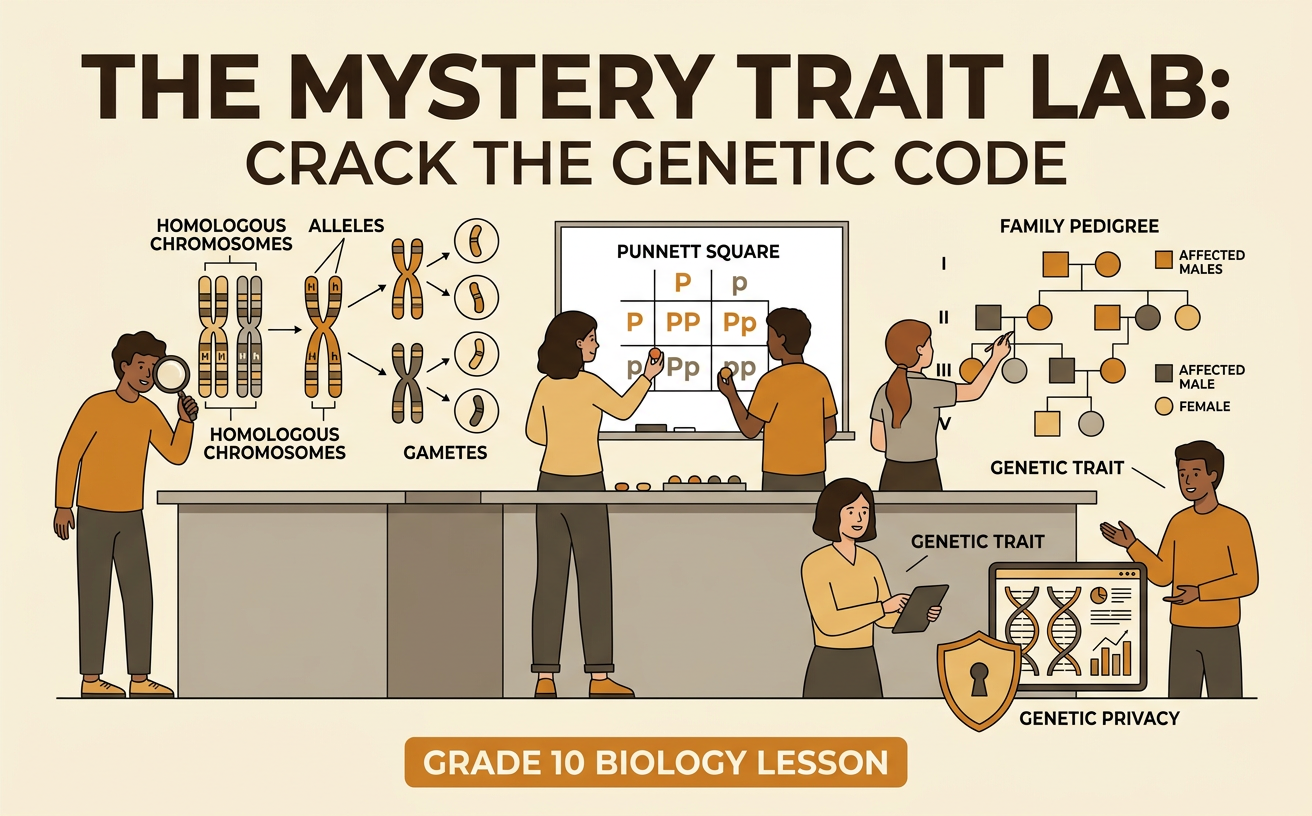
Illustrations are auto-generated and may be placeholders. They can be refreshed to match the narration.
Hook: The Mystery Trait Case
A fictional family has asked your genetics team to investigate a silver hair streak that appears from birth. In this model, the trait is controlled by one autosomal gene with complete penetrance. The dominant allele S produces the streak, while the recessive allele s does not. Your job is to determine how the trait may pass from parents to children without assuming that appearance alone reveals a person’s exact genotype. Begin by asking evidence-focused questions: Which relatives show the trait? Can two people with the streak have a child without it? Where is the gene located, and how do chromosomes carry it? You will connect a DNA-level explanation to chromosome models, Punnett-square probabilities, and a family pedigree. Remember that this is a simplified fictional trait; most human characteristics are influenced by multiple genes, environmental factors, or both.
Model Genes, Alleles, and Chromosomes
A gene is a segment of DNA that contributes instructions for a functional product, often a protein. Different DNA versions of a gene are called alleles. In the mystery model, S and s occupy the same locus on a pair of homologous autosomes. One homolog came from the biological mother and the other from the biological father. A person with genotype Ss has two different alleles and shows the silver streak because S is dominant. During meiosis, homologous chromosomes separate, so each egg or sperm receives only one allele for this gene. An Ss individual therefore produces gametes carrying S or s, typically with an equal probability of one-half. This chromosome model explains why offspring receive one allele from each biological parent and why siblings can inherit different allele combinations even when they have the same parents.
Build and Solve Punnett Squares
A Punnett square organizes possible allele combinations; it does not guarantee the traits of individual children. Cross two heterozygous parents, Ss × Ss. Place one parent’s gametes, S and s, across the top and the other parent’s gametes along the side. Combining the alleles produces SS, Ss, Ss, and ss. Each outcome has probability one-fourth. Because S is dominant, three of the four boxes predict the silver-streak phenotype, giving P(streak) = 3/4, or 75 percent. The probability of no streak is 1/4, or 25 percent. Conditional probability answers a question using added information. If a child from this cross has the streak, the possible genotypes are SS, Ss, and Ss. Only one of those three is SS, so P(SS given streak) = 1/3. Each birth is a new probability event.
Crack the Family Pedigree
A pedigree translates written family information into a visual inheritance record. Squares represent males, circles represent females, shaded symbols represent people with the silver streak, and horizontal and vertical lines show biological relationships. Suppose two shaded parents in generation I have three children: two shaded and one unshaded. The unshaded child must be ss because the trait is dominant. Therefore, each shaded parent must have contributed an s allele, proving that both parents are Ss rather than SS. If one shaded Ss child later has children with an unshaded ss partner, each child has a one-half probability of inheriting S and showing the streak. Check the entire pedigree rather than deciding from one person. Also consider whether incomplete family records, adoption, uncertain biological relationships, or a trait with incomplete penetrance could limit a conclusion in a real investigation.
Genetic Privacy Lightning Debate
Genetic information can reveal health risks, biological relationships, and details that also affect relatives, so collecting it creates questions about rights and responsibilities. Consider this scenario: a school research team offers students a voluntary genetic test connected to a classroom trait study. One student values learning about personal ancestry and wants access to the results. Another worries that stored data could be shared, stolen, or used without meaningful consent. In a lightning debate, one side proposes safeguards such as informed consent, the right to decline, limited data collection, secure storage, and deletion after the activity. The other side asks whether minors can fully consent and whether the test is necessary at all. Evaluate each perspective rather than treating privacy and science as automatic opposites. A fair policy should explain who controls the data, who may access it, how long it is kept, and what happens if someone withdraws.
Exit Challenge: Explain the Evidence
Complete the case by writing a claim, evidence, and reasoning explanation. Claim: The two shaded generation-I parents are most likely Ss. Evidence: They show the dominant silver-streak phenotype, but they also have an unshaded child whose genotype must be ss. Reasoning: The child received one s allele from each parent, so both parents carry s; because they show the trait, each must also carry S. Then translate the pedigree evidence into a Punnett square for Ss × Ss and report P(no streak) = 1/4. Add one limitation: the conclusion depends on the fictional assumptions that one autosomal gene controls the trait and that S has complete penetrance. Finish with a privacy statement explaining that pedigree or genotype results should be shared only with informed permission. Strong scientific explanations connect chromosome behavior, allele combinations, mathematical probability, observed family patterns, and ethical limits.