
The New Deal: Expanding the Federal Government’s Role
Students evaluate how New Deal programs responded to the Great Depression and transformed the federal government’s relationship with citizens, labor, infrastructure, and natural resources.

Illustrations are auto-generated and may be placeholders. They can be refreshed to match the narration.
The Great Depression and Demands for Action
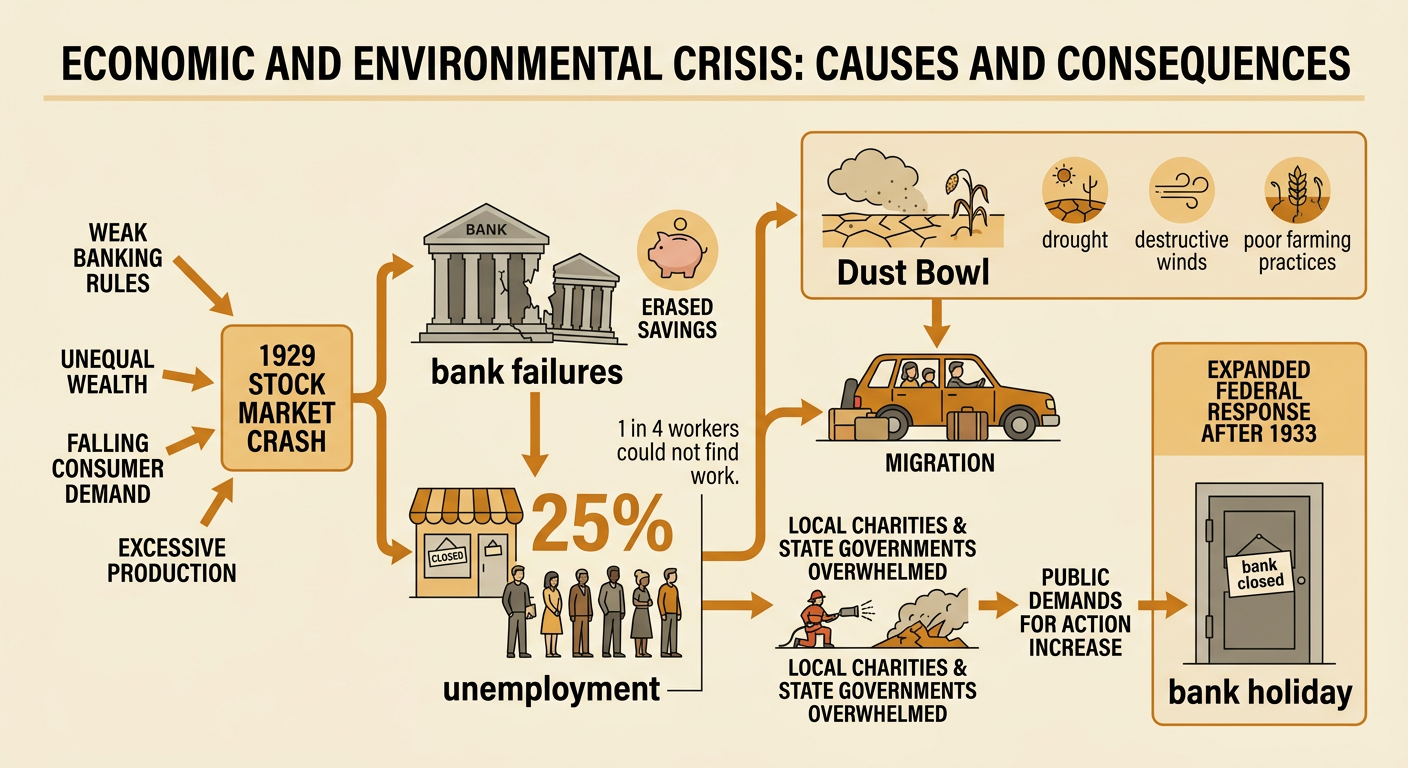
The Great Depression began after the 1929 stock market crash, but its causes also included weak banking rules, unequal wealth, falling consumer demand, and excessive production. Bank failures erased savings, businesses closed, and unemployment reached about 25 percent in 1933. Local charities and state governments could not meet the enormous need. Environmental disaster made conditions worse: drought, high winds, and damaging farming practices created the Dust Bowl, forcing many Great Plains families to migrate. President Herbert Hoover favored limited federal action, but growing hardship increased demands for direct national leadership. After Franklin D. Roosevelt took office in 1933, he declared a bank holiday and supported emergency banking legislation. These actions illustrate a major change: citizens increasingly expected the federal government to stabilize the economy and provide assistance during a national crisis.
Relief, Recovery, and Reform
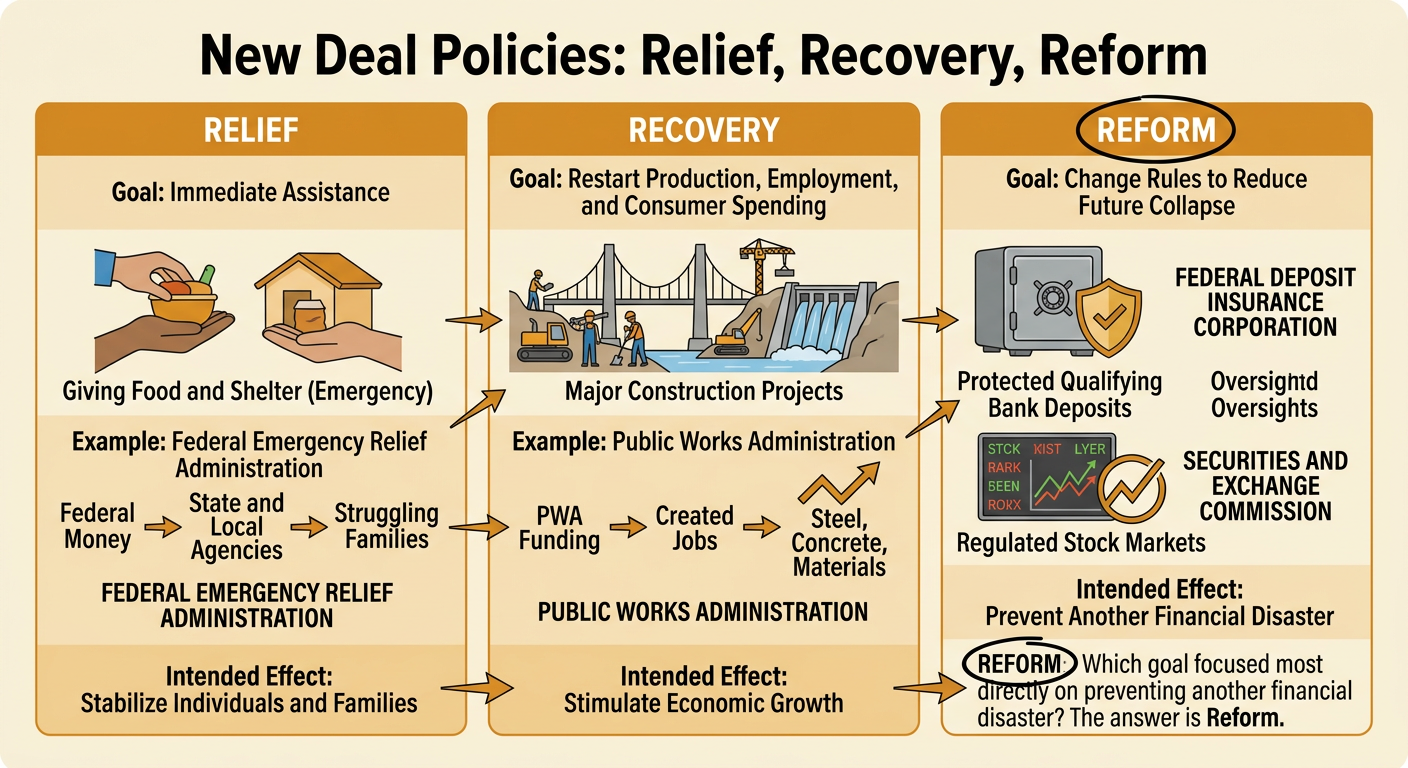
New Deal policies are often grouped into three goals: relief, recovery, and reform. Relief programs provided immediate help to unemployed or struggling Americans. For example, the Federal Emergency Relief Administration gave federal funds to state and local relief agencies. Recovery programs attempted to restart production, employment, and consumer spending. The Public Works Administration supported large construction projects that created jobs and increased demand for materials. Reform measures changed economic rules to reduce the risk of another collapse. The Federal Deposit Insurance Corporation protected qualifying bank deposits, while the Securities and Exchange Commission regulated stock markets. These categories sometimes overlapped because a single program could create jobs, improve infrastructure, and stimulate spending. Together, the policies established a broader federal responsibility for economic security, although they did not fully end unemployment or distribute benefits equally among all groups.
Major New Deal Programs
New Deal agencies connected the federal government more directly to workers, families, businesses, and communities. The Civilian Conservation Corps employed young men in forestry, soil conservation, and park projects. The Works Progress Administration hired millions of people to build roads, schools, airports, and public buildings and also supported artists and writers. The Social Security Act of 1935 created old-age pensions, unemployment insurance, and assistance for some vulnerable people. The National Labor Relations Act protected private-sector workers’ right to organize unions and bargain collectively, and it created the National Labor Relations Board. Agricultural programs paid some farmers to reduce production in an effort to raise crop prices. Each program addressed a particular crisis, but access was unequal. Agricultural and domestic workers, many of whom were Black or Latino, were initially excluded from major Social Security protections, while local discrimination also shaped who received jobs and benefits.

Infrastructure and Natural Resource Management
The New Deal linked economic recovery with federal management of land, water, forests, and energy. The Tennessee Valley Authority built dams that reduced some flooding, generated hydroelectric power, improved navigation, and encouraged regional development. However, reservoirs also displaced communities and transformed river ecosystems. The Civilian Conservation Corps planted trees, improved parks, and worked to control soil erosion. In the Great Plains, severe drought combined with strong winds and the removal of native grasses to produce destructive dust storms. Federal soil conservation programs encouraged contour plowing, crop rotation, shelterbelts, and other practices that reduced erosion. This history shows how climate, natural hazards, and resource availability influence human decisions. Drought pushed families to migrate, while access to rivers made dam construction and electricity generation possible. Federal projects created jobs, but they also expanded national authority over local landscapes and natural resources.

Debating the New Deal’s Impact
Historians debate the New Deal because its effects were significant but uneven. Supporters argue that it restored confidence in banks, provided jobs, strengthened labor rights, built lasting infrastructure, and created a social safety net. Critics on the political right claimed that federal spending and regulation gave Washington too much power and interfered with private enterprise. Critics on the left argued that the programs did not redistribute enough wealth or guarantee economic security for everyone. The Supreme Court struck down some early measures, including the National Industrial Recovery Act, leading Roosevelt to propose adding more justices to the Court in 1937. Congress rejected that plan. New Deal benefits were also limited by racial discrimination, gender assumptions, and occupational exclusions. Although unemployment declined, it remained high until wartime mobilization. A balanced judgment must therefore distinguish between immediate relief, lasting institutional change, and the program’s serious limitations.

Evidence-Based Historical Judgment
A strong historical judgment begins with a focused question, a clear claim, and evidence from multiple sources. Students should examine primary sources such as laws, speeches, photographs, employment records, and letters, while also using secondary sources written by historians. Each source must be evaluated for author, audience, purpose, context, and limitations. For example, a Works Progress Administration photograph can document a completed school, but it may have been selected to promote the agency. Employment data can reveal the program’s scale, while a worker’s letter can show an individual experience. Corroborating these sources supports a more reliable conclusion. A defensible claim might state that the New Deal permanently expanded federal responsibility for economic security, even though it did not end the Depression or provide equal benefits. Specific evidence and careful reasoning should connect every example to that judgment.
