The Nuclear Arms Race and Cold War Deterrence
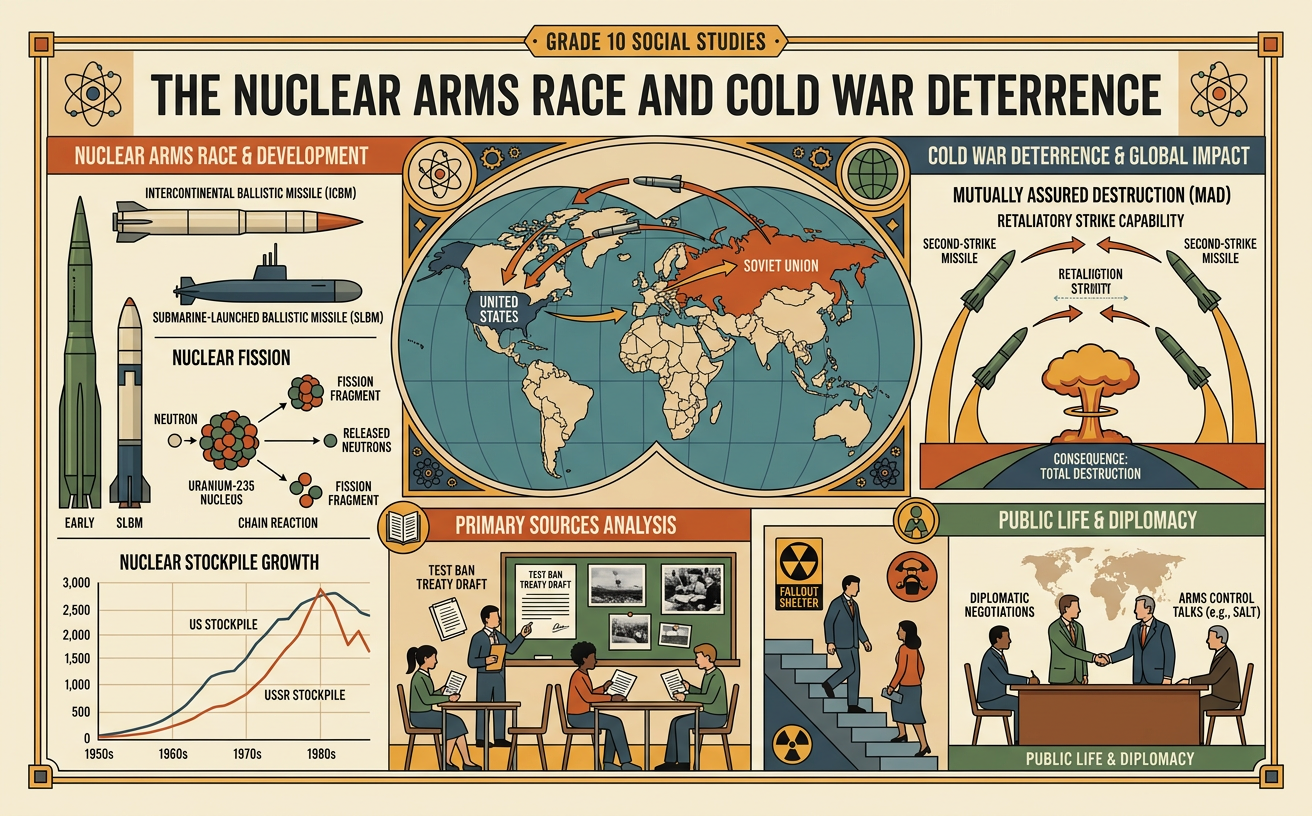
Students analyze primary sources, nuclear stockpile data, and the basic science of fission to explain how mutually assured destruction shaped Cold War diplomacy and public life.
Illustrations are auto-generated and may be placeholders. They can be refreshed to match the narration.
Origins of the Nuclear Arms Race
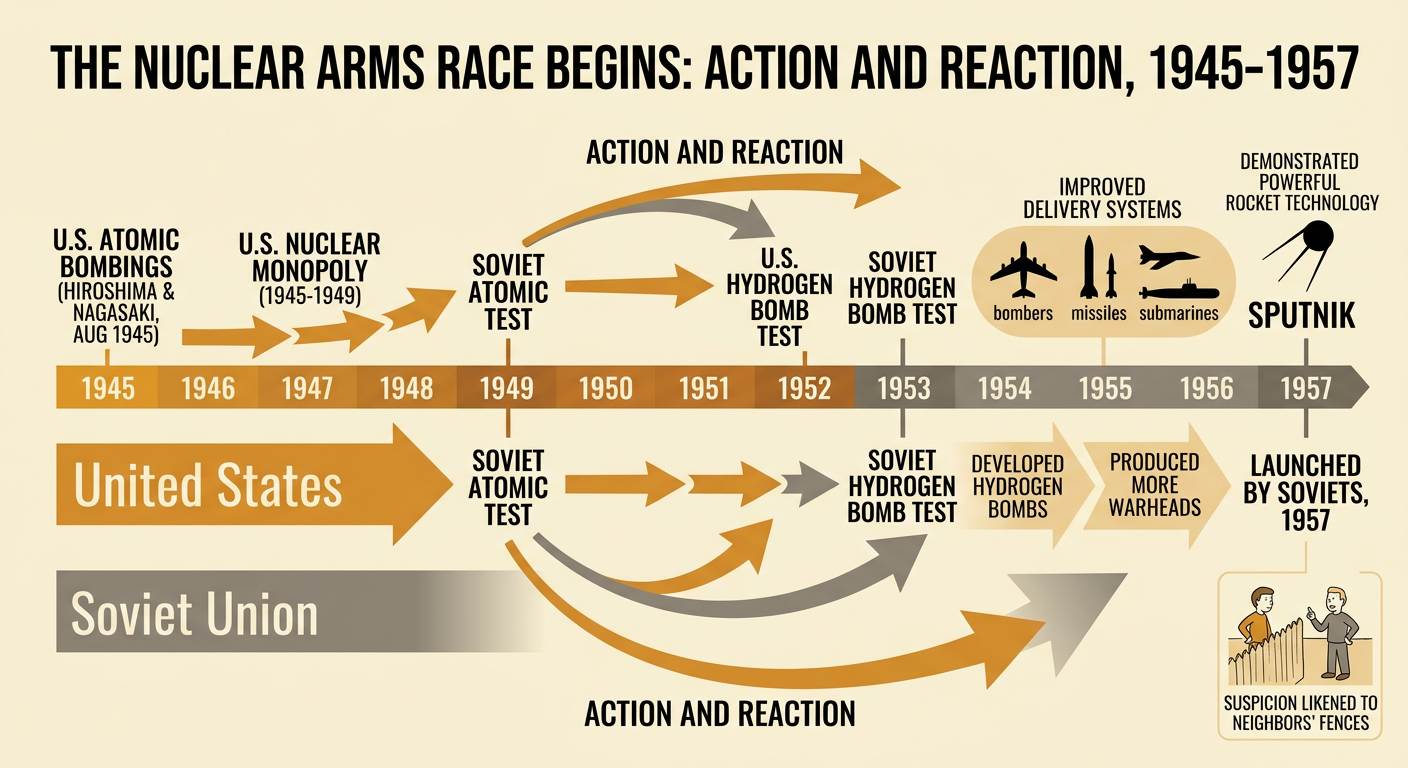
The nuclear arms race grew from World War II, postwar rivalry, and fear that an opponent might gain a decisive advantage. The United States used atomic bombs against Hiroshima and Nagasaki in August 1945. At first, it was the only country with nuclear weapons, but the Soviet Union tested its first atomic bomb in 1949. Each government then increased production and developed more powerful hydrogen bombs. Military planners also improved bombers, missiles, and submarines that could deliver warheads. Security fears created a cycle: one side's attempt to feel safer made the other side feel threatened. For example, after the Soviet launch of Sputnik in 1957 demonstrated powerful rocket technology, many Americans feared that Soviet missiles could reach the United States. Political distrust, technological competition, military planning, and national prestige all contributed to the race.
How Nuclear Fission Releases Energy
Nuclear fission occurs when the nucleus of a heavy atom, such as uranium-235, absorbs a neutron and becomes unstable. The nucleus splits into two smaller nuclei, releases two or three additional neutrons, and produces radiation. The products have slightly less mass than the original nucleus and neutron. According to Einstein's equation E = mc², this small loss of mass becomes a large amount of energy, mainly as the kinetic energy of fast-moving particles. Those particles collide with surrounding matter and produce heat. In a chain reaction, released neutrons strike other uranium-235 nuclei and cause more fissions. For example, if one fission leads to several more fissions, the number of reactions can rise rapidly. Nuclear reactors control this process, while a nuclear weapon is designed to release energy extremely quickly. The model explains the energy process without describing weapon construction.

Reading the Stockpile Data
A line graph of nuclear stockpiles shows change over time, but it must be read carefully. The horizontal axis represents years, while the vertical axis represents estimated numbers of warheads. The U.S. stockpile rose quickly during the 1950s and early 1960s, reaching about 31,255 warheads in 1967 before declining. The Soviet stockpile grew later and reached roughly 40,000 warheads in 1986. These peaks are maximum points, not yearly rates of growth. The slopes reveal that growth was not constant: a steep upward segment indicates rapid expansion, while a downward segment indicates reductions. For example, the United States began reducing its total even while the Soviet total continued to rise. The graph supports the claim that the race changed direction at different times for each country. Because historical totals are estimates and definitions vary, students should identify the graph's source and measurement method.

Mutually Assured Destruction
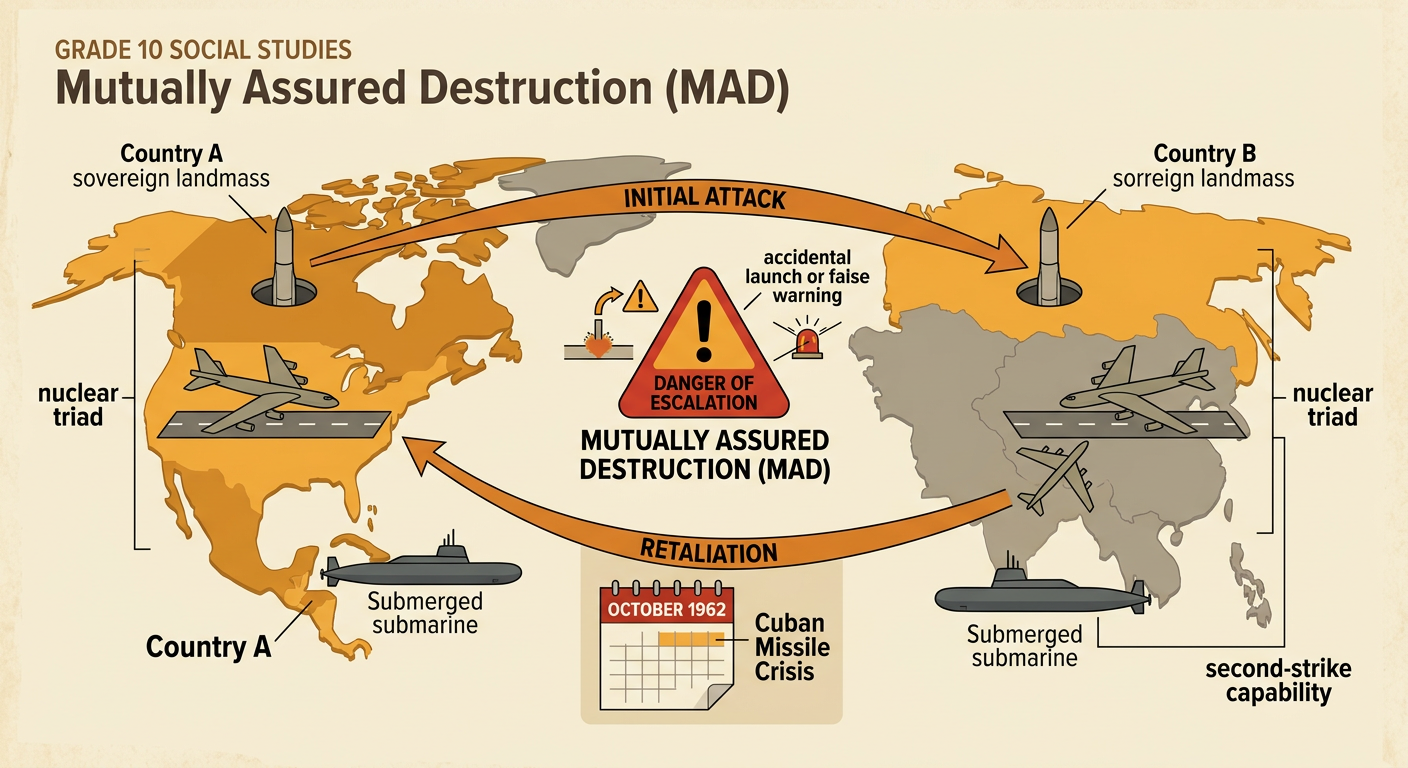
Mutually assured destruction, commonly called MAD, was the idea that neither superpower could launch a nuclear attack without facing devastating retaliation. Deterrence depended on a credible second-strike capability: enough weapons had to survive an initial attack and still reach the attacker. Bombers, land-based missiles, and submarine-launched missiles formed the nuclear triad and made complete destruction of an opponent's forces unlikely. MAD did not guarantee peace. Accidents, false warnings, misunderstanding, or uncontrolled escalation could still produce catastrophe. During the Cuban Missile Crisis of October 1962, U.S. and Soviet leaders recognized that military action around Cuba might escalate into nuclear war. They combined pressure with negotiation, and the Soviet Union removed its missiles from Cuba after a secret and public diplomatic settlement. The crisis illustrates both sides of deterrence: fear of retaliation discouraged direct war, but the same weapons made every miscalculation extraordinarily dangerous.
Primary Sources on Deterrence
Primary sources reveal what leaders said, but historians must examine audience, purpose, and context. On August 6, 1945, President Harry Truman described the atomic bomb as “a harnessing of the basic power of the universe.” His announcement emphasized American scientific power while defending the use of the bomb during wartime. On October 22, 1962, President John F. Kennedy warned that a nuclear missile launched from Cuba would require “a full retaliatory response upon the Soviet Union.” This televised statement publicly communicated a deterrent threat during the Cuban Missile Crisis. The quotations provide evidence that leaders used both technological claims and threatened retaliation to shape public understanding and enemy calculations. However, one statement alone cannot explain policy. Students should compare the words with private records, military plans, and Soviet sources. Differences between public and private language can reveal uncertainty, political pressure, or attempts to influence an opponent.

Cold War Consequences
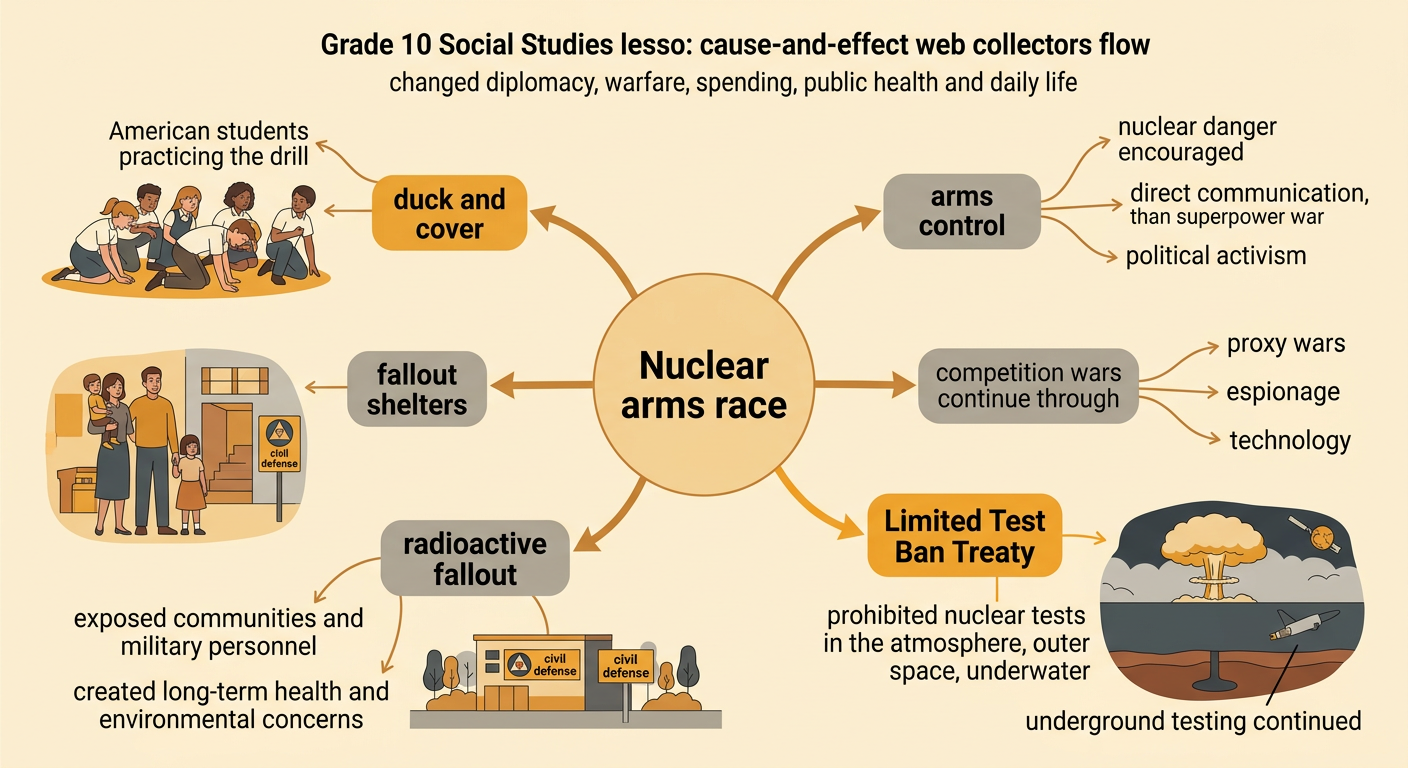
The arms race affected diplomacy, warfare, public life, government spending, and the environment. Nuclear danger encouraged direct communication and arms-control agreements, but it also shifted competition into proxy wars, espionage, and technological rivalry. In the United States, students practiced “duck and cover” drills, families considered fallout shelters, and civil defense officials marked public shelters. Nuclear testing exposed some communities and military personnel to radioactive fallout, creating long-term health and environmental concerns. The consequences also produced political activism, including campaigns for disarmament and limits on testing. For example, the 1963 Limited Test Ban Treaty prohibited nuclear tests in the atmosphere, outer space, and underwater, although underground tests continued. This agreement resulted from several connected causes: public concern about fallout, scientific evidence, the shock of the Cuban Missile Crisis, and leaders' desire to reduce risk. Deterrence therefore shaped daily fears while also encouraging negotiations intended to control the competition.