
The Printing Press and the Spread of Reformation Ideas
Students examine how movable-type printing made texts more accessible and accelerated the spread of religious reform ideas across Europe.
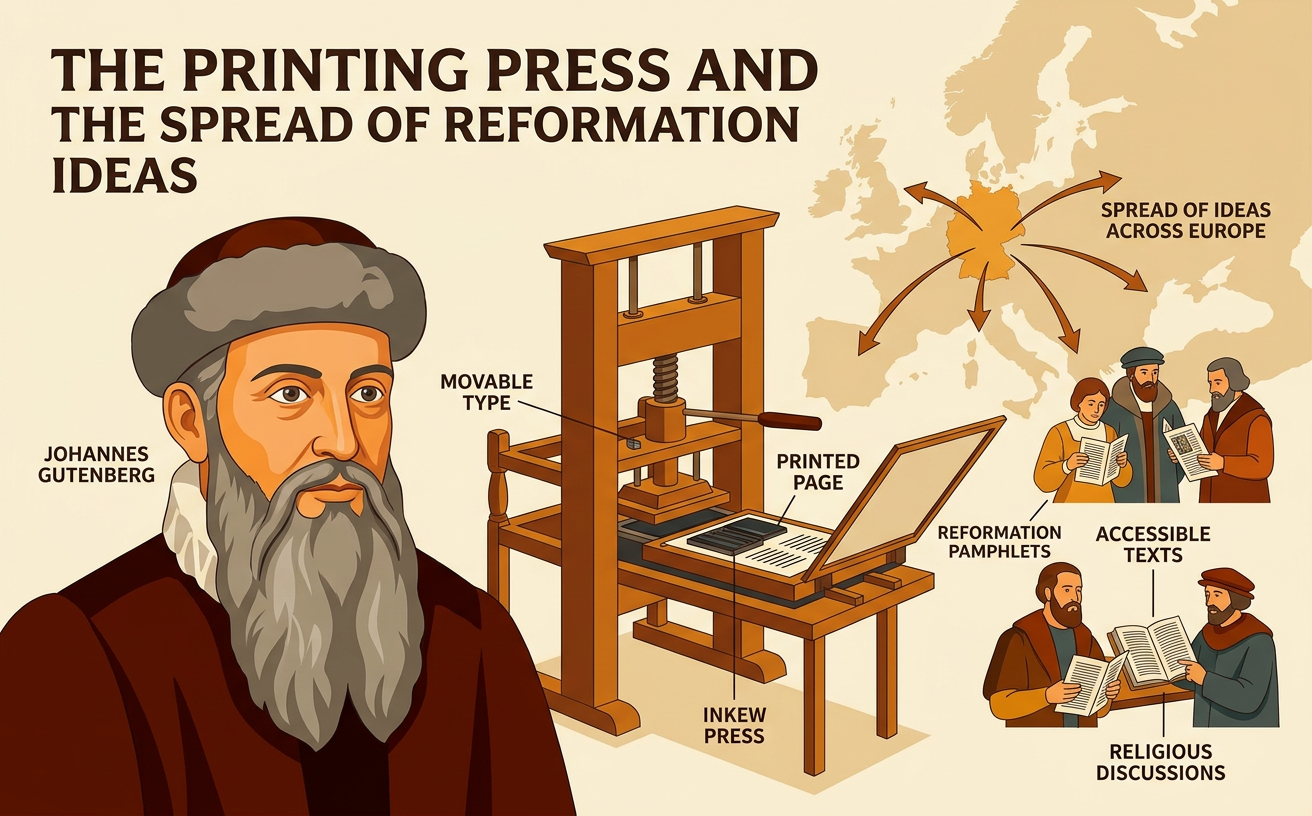
Illustrations are auto-generated and may be placeholders. They can be refreshed to match the narration.
Communication Before the Printing Press
Before printing became common in Europe, most books were copied by hand. Scribes working in monasteries, universities, or workshops carefully reproduced each page. This process required time, skill, parchment or paper, and money, so books were expensive and relatively scarce. People also shared information through sermons, public speeches, songs, letters, and handwritten notices. Woodblock printing could produce repeated pages or images, but an entirely new block usually had to be carved for each page. For example, a university student might borrow a teacher’s book and copy only the sections needed for study. Hand copying preserved religious and classical writings, showing continuity in the transmission of knowledge. However, slow production and limited distribution constrained how quickly a new idea could reach distant audiences.

Gutenberg and Movable Type
Around 1450, Johannes Gutenberg developed an effective movable-type printing system in Mainz, in present-day Germany. Movable type had been used earlier in East Asia, but Gutenberg combined several technologies in a way that worked well for European alphabetic texts. Workers cast reusable metal letters, arranged them into lines, covered them with oil-based ink, and pressed paper against the type. After printing a page, they could rearrange the letters for another page. Gutenberg’s Bible, produced in the 1450s, demonstrated that printed books could be both readable and carefully designed. The system met important criteria: it produced many similar copies, reused materials, and worked faster than hand copying. Its constraints included the cost of equipment, the need for trained workers, and the time required to set each page correctly.

Comparing Methods of Producing Books
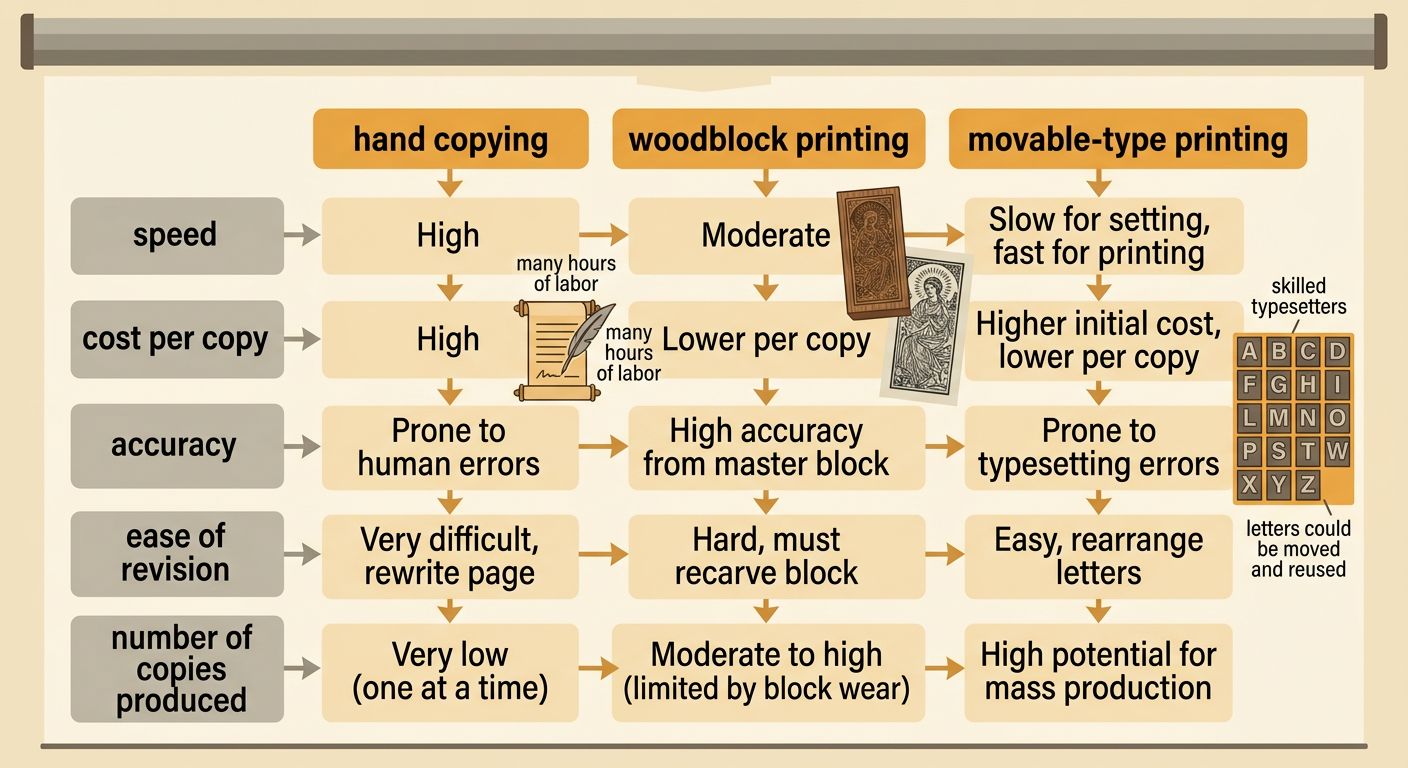
Hand copying, woodblock printing, and movable-type printing offered different solutions to the problem of producing texts. A systematic comparison uses the same criteria for each method: speed, cost per copy, accuracy, ability to make revisions, and number of copies needed. Hand copying required little specialized machinery, but every copy demanded many hours of labor and could introduce new errors. Woodblocks could make repeated copies of a page or image, but carving each complete page took time, and revisions required recarving. Movable type had high start-up costs and required skilled typesetters, yet its letters could be rearranged and reused. For example, if a workshop needed 100 copies of a new pamphlet, movable type would usually be more efficient than copying each one by hand. The best method depended on the producer’s goals and constraints.
Printing Reformation Ideas
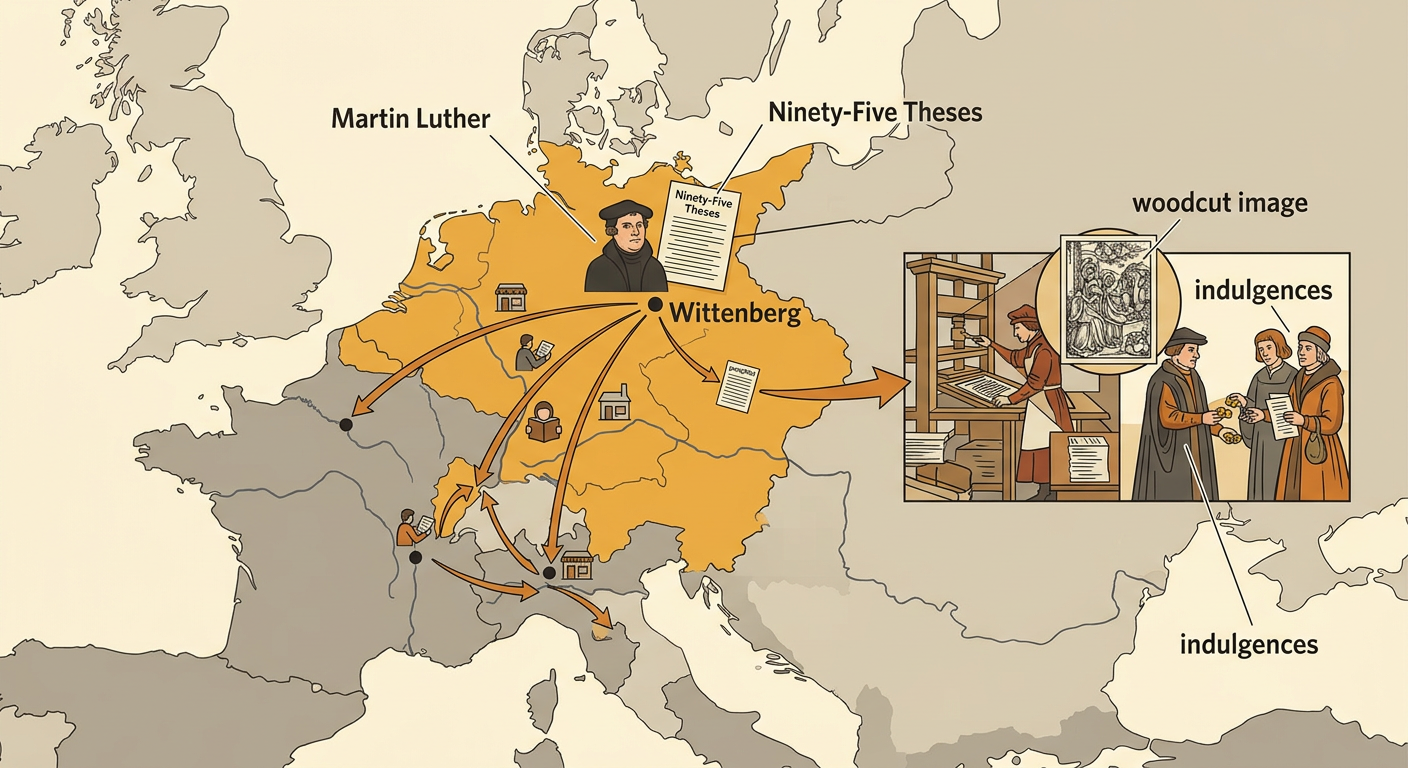
Printing helped religious reform ideas travel rapidly across Europe during the 1500s. In 1517, Martin Luther circulated arguments criticizing certain Church practices, including the sale of indulgences. His Ninety-Five Theses was written in Latin, but printers soon produced Luther’s sermons and pamphlets in German and other languages for wider audiences. Printers also included woodcut images that communicated ideas to people with limited reading skills. Merchants, students, clergy members, and travelers carried printed works between towns. Printing did not cause the Reformation by itself; political conflicts, religious concerns, and demands for reform already existed. It did, however, accelerate debate by producing many copies quickly. Catholic writers and other opponents used the same technology to answer reformers. A surviving pamphlet’s title, date, language, and printing location provide specific primary-source evidence about how an idea was presented and distributed.
Evidence of Historical Change
Historians classify the spread of printing as both change and continuity. A major change was the growing speed and scale of text production. More readers could encounter the same argument, and writers could respond to one another across long distances. Continuity remained because sermons, handwritten letters, public debates, and face-to-face teaching still shaped religious belief. To support an analysis, historians cite specific evidence rather than making broad claims. For example, a student might compare a handwritten sermon with a dated printed pamphlet and note that the pamphlet names a printer, a city, and a publication year. Those details show organized production and help trace distribution. A secondary source may explain broader patterns, but its claims should be checked against primary sources such as books, letters, laws, or print-shop records. Strong conclusions identify what changed, what continued, and what evidence supports each classification.
