
The Rock Cycle and Earth's Changing Materials
Students identify major rock groups and use the rock cycle to explain how Earth's materials are transformed by internal and surface processes.
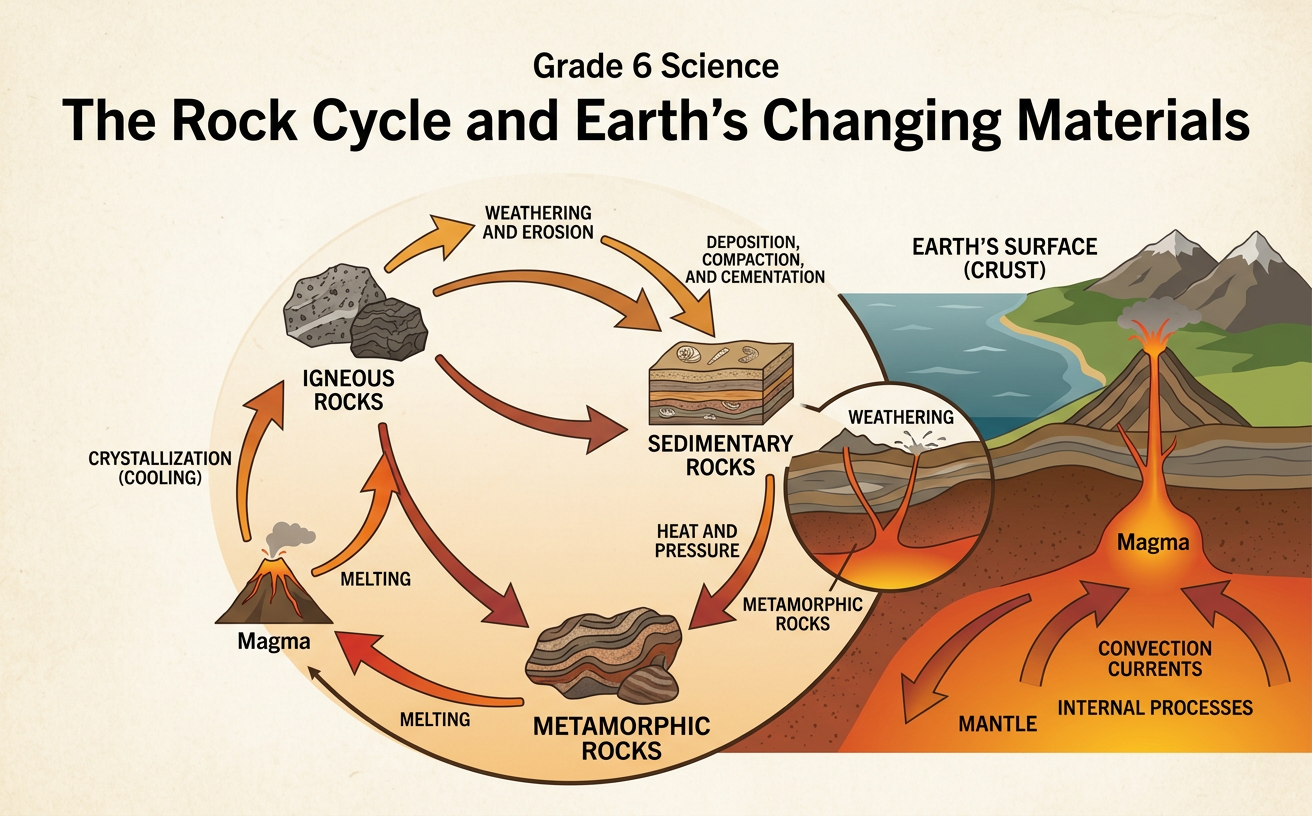
Illustrations are auto-generated and may be placeholders. They can be refreshed to match the narration.
Minerals and Rocks
A mineral is a naturally occurring, nonliving solid with a definite chemical composition and an orderly internal structure. Minerals are identified using properties such as color, streak, hardness, luster, and cleavage. A rock is a naturally formed solid mixture of one or more minerals or pieces of other material. Granite, for example, commonly contains quartz, feldspar, and mica. Because it is a mixture, different pieces of granite may contain different amounts of these minerals. Rocks are grouped according to how they form rather than only by appearance. The three major groups are igneous, sedimentary, and metamorphic. Identifying a rock's texture and composition can provide evidence about the conditions under which it formed.
Igneous and Sedimentary Rocks
Igneous rock forms when molten material cools and solidifies. Magma cools below Earth's surface, while lava cools at the surface. Slow cooling underground allows large crystals to grow, as seen in granite. Rapid cooling at the surface produces small crystals or glassy textures, as seen in basalt or obsidian. Sedimentary rock forms when sediments are deposited, compacted, and cemented together or when minerals crystallize from water. Sandstone can form from layers of sand that become pressed and cemented over time. Sedimentary rocks often contain visible layers and may preserve fossils. These features provide clues about past environments, such as ancient beaches, river channels, lakes, or shallow seas.
Metamorphic Rocks
Metamorphic rock forms when existing rock is changed by heat, pressure, and chemically active fluids without completely melting. The original rock may be igneous, sedimentary, or another metamorphic rock. Deep burial can expose rock to intense pressure and high temperatures. These conditions cause minerals to recrystallize or line up in bands. For example, shale can change into slate, and limestone can change into marble. If the rock melts, it becomes magma and is no longer undergoing metamorphism. Metamorphic rocks help scientists infer conditions below Earth's surface. Their mineral patterns and textures can show that mountain building, plate movement, or deep burial affected the region where the rocks formed.
Cycling Earth's Materials
The rock cycle is a model showing how rocks can change from one type into another. Weathering and erosion break exposed rocks into sediment. Deposition, compaction, and cementation can turn sediment into sedimentary rock. Heat and pressure can transform any rock into metamorphic rock. Melting produces magma, and cooling magma or lava forms igneous rock. Uplift may then expose buried rocks at the surface, where weathering begins again. For example, granite in a mountain can weather into sand, become sandstone, change into metamorphic quartzite, melt into magma, and later cool into new igneous rock. Solar energy, gravity, and Earth's internal heat drive these processes over long periods.