The Scientific Revolution: Evidence, Authority, and the Heliocentric Model
Students examine how evidence supporting the heliocentric model challenged traditional authority and transformed European approaches to scientific knowledge.

Illustrations are auto-generated and may be placeholders. They can be refreshed to match the narration.
The Geocentric Worldview
For many centuries, European scholars generally accepted a geocentric model inherited from ancient Greek thinkers, especially Aristotle and Ptolemy. In this model, a stationary Earth stood at the center of the universe while the Moon, Sun, planets, and stars moved around it. The model agreed with everyday appearances: from Earth, the Sun seems to cross the sky, and people do not feel Earth moving. Ptolemy used circles and smaller circles called epicycles to predict planetary positions, including retrograde motion, when a planet appears to move backward against the stars. Medieval universities studied this mathematical system alongside Christian teachings that many scholars interpreted as supporting Earth’s central position. Although imperfect, the model remained authoritative because it combined respected ancient writings, useful predictions, and familiar observations.

Copernicus and the Heliocentric Model
In 1543, Polish astronomer Nicolaus Copernicus published a model that placed the Sun near the center of the planetary system. Earth became a moving planet that rotates once each day and travels around the Sun once each year. This heliocentric arrangement explained apparent retrograde motion as an effect of planets moving at different speeds. For example, when faster-moving Earth passes Mars, Mars temporarily appears to move backward against the distant stars, much as a slower wagon seems to move backward when viewed from a faster wagon. Copernicus still used circular orbits and epicycles, so his predictions were not always more accurate than Ptolemy’s. However, his model reorganized the heavens around a powerful new idea: Earth was not the unmoving center. It challenged established assumptions and encouraged scholars to compare competing explanations mathematically.

Galileo’s Observations and Evidence
Beginning in 1609, Galileo Galilei improved the telescope and aimed it at the sky. His observations weakened important claims associated with the traditional geocentric worldview. He saw mountains and craters on the Moon, showing that heavenly bodies were not perfectly smooth. He discovered four moons orbiting Jupiter, proving that not everything revolved around Earth. Most importantly, he observed Venus passing through a nearly complete set of phases, from crescent to nearly full. In Ptolemy’s geocentric model, Venus always remained between Earth and the Sun, so it could not display the full observed range. The heliocentric model explained the phases because Venus orbited the Sun and could lie on either its near or far side. Galileo’s evidence did not answer every question about planetary motion, but it showed how instruments and repeated observations could test an accepted model.

Conflict with Religious Authority
The conflict over heliocentrism involved evidence, biblical interpretation, institutional authority, and personal politics. Some Catholic and Protestant thinkers accepted mathematical astronomy, but many objected when heliocentrism was presented as physical truth rather than a calculating tool. Galileo argued that observations should guide explanations of nature and that biblical passages about the heavens should not always be read literally. Church officials feared that this approach challenged their authority to interpret Scripture, especially during the religious conflicts of the Reformation. In 1633, the Roman Inquisition tried Galileo for defending heliocentrism after he had been ordered not to hold or teach it as fact. He was forced to recant and spent the rest of his life under house arrest. The episode was not simply “science versus religion”; it reflected disagreement within religious and scholarly communities about evidence, interpretation, and who could define reliable knowledge.

How Scientific Knowledge Changes
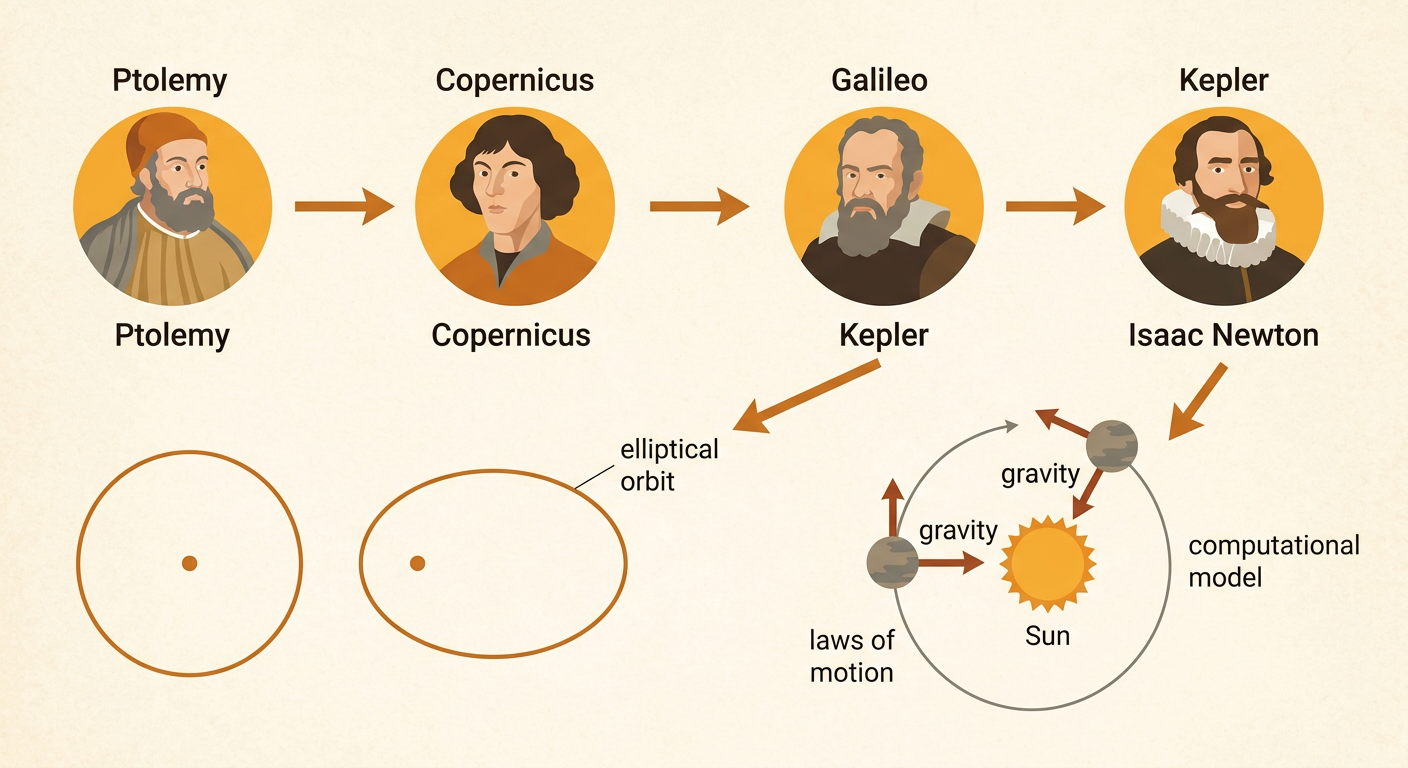
The Scientific Revolution changed European astronomy through both continuity and change. Scholars continued to use ancient mathematics, careful calculation, and earlier records, but they increasingly tested explanations against precise observations. Johannes Kepler used Tycho Brahe’s data to conclude that planets move in ellipses rather than perfect circles. Later, Isaac Newton explained orbital motion through gravity and laws of motion. A computational model can predict an orbit by combining an object’s speed, direction, distance, and gravitational attraction. For example, a planet moving sideways fast enough continually falls toward the Sun without crashing into it, producing an orbit. Scientific knowledge therefore changes when new evidence exposes limits in an older model and a new model explains more observations with greater accuracy. Authority still matters, but scientific claims gain strength through transparent methods, mathematical predictions, repeated testing, and review by other investigators.