The Space Race: Cold War Competition and Technological Change
Students examine how Cold War rivalry shaped the goals, investments, engineering challenges, and lasting effects of the United States–Soviet space race.

Illustrations are auto-generated and may be placeholders. They can be refreshed to match the narration.
Cold War Rivalry Beyond Earth
After World War II, the United States and the Soviet Union became rival superpowers. Each promoted a different political and economic system, built nuclear weapons, and competed for influence around the world. Spaceflight became another way to demonstrate national strength without fighting a direct war. A rocket that could carry a spacecraft also showed knowledge related to long-range missile technology. Success in space could build national pride, impress other countries, and suggest that one system produced better science and education. For example, when Soviet cosmonaut Yuri Gagarin became the first person to orbit Earth in 1961, Soviet leaders presented his flight as evidence of their country’s progress. Cold War rivalry therefore caused governments to invest money, workers, and research in ambitious space programs.

Sputnik and the American Response
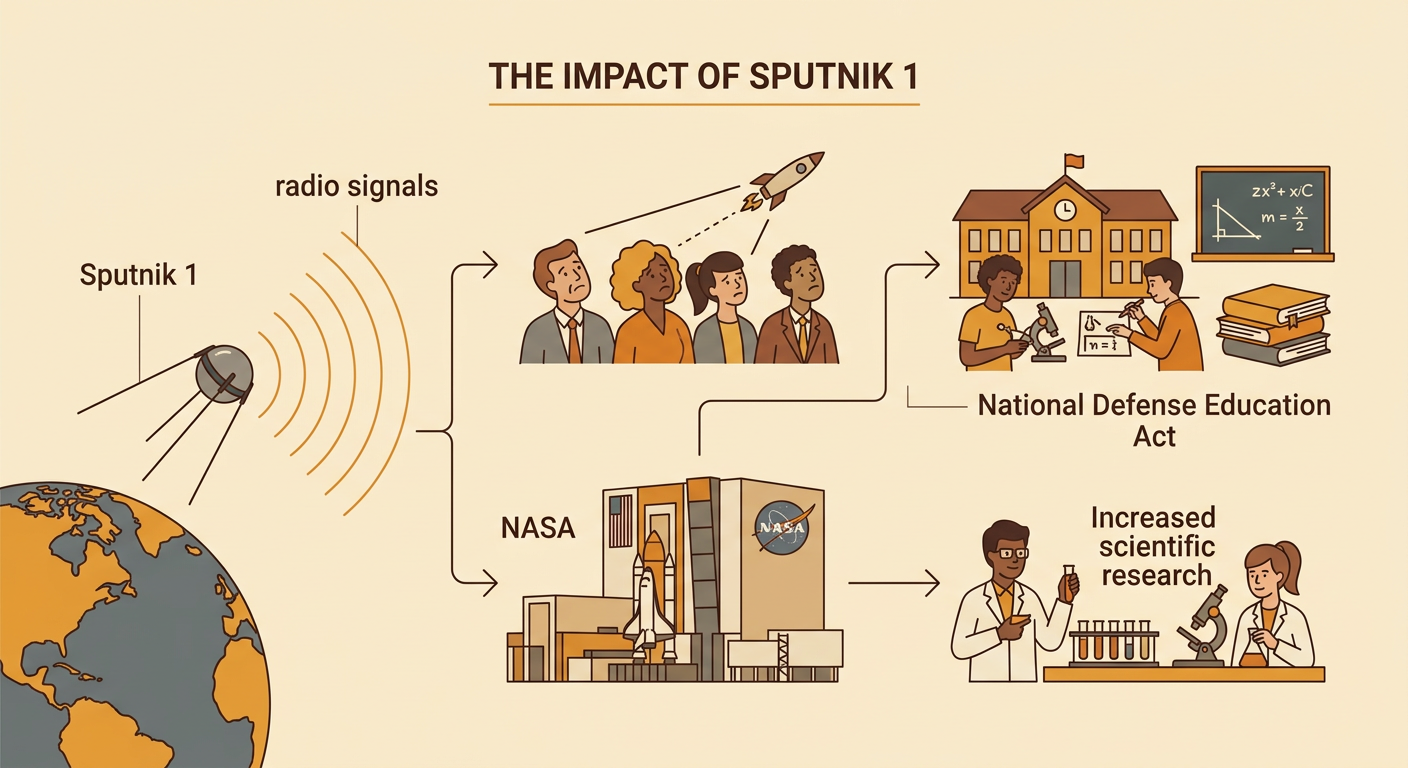
On October 4, 1957, the Soviet Union launched Sputnik 1, the first artificial satellite to orbit Earth. The small satellite transmitted radio signals, but its political effect was much larger than its size. Many Americans feared that a nation able to place a satellite in orbit might also be able to deliver weapons across great distances. Sputnik also raised concerns about American science and mathematics education. In response, the United States increased federal support for research and education, created NASA in 1958, and passed the National Defense Education Act. That law supported instruction in areas such as mathematics, science, and foreign languages. Sputnik did not cause every change by itself, but it intensified existing Cold War fears and accelerated government action. This sequence illustrates how one event can produce political, educational, and technological effects.
Goals and Constraints of Spaceflight
A space mission is an engineering design problem with clear criteria and constraints. Criteria describe what a successful design must accomplish, while constraints are limits that designers must work within. For a crewed Moon mission, major criteria included carrying astronauts to lunar orbit, landing safely, supporting life, launching from the Moon, and returning the crew to Earth. Constraints included limited fuel, spacecraft mass, available materials, computing power, time, money, and danger to human life. Engineers also had to manage intense launch forces, extreme temperatures, radiation, and the vacuum of space. For example, every extra pound of equipment required additional fuel, which could increase the rocket’s total mass. Engineers tested components, studied failures, and revised designs to balance competing needs. Precisely defining these criteria and constraints made successful spaceflight more achievable.

The Moon Landing
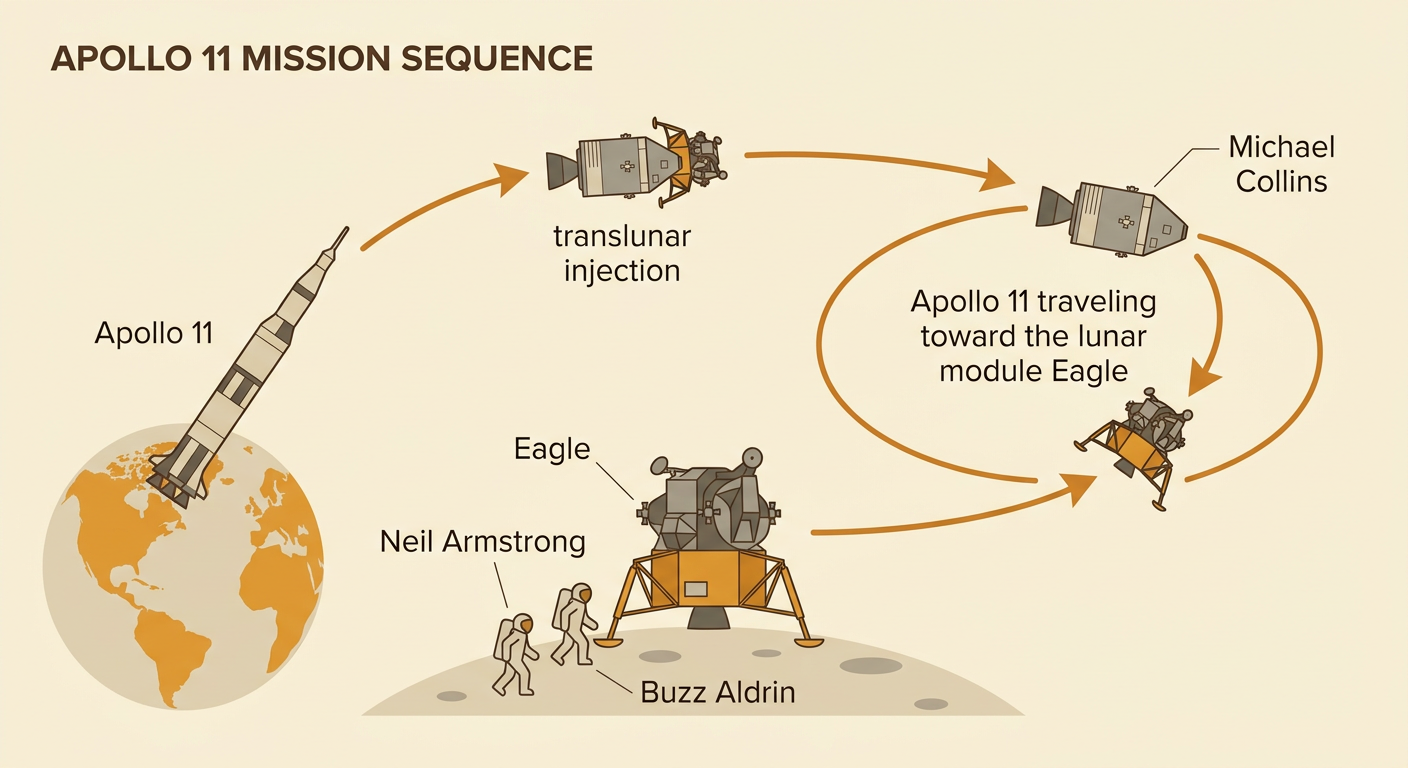
In 1961, President John F. Kennedy asked Congress to commit the nation to landing a person on the Moon and returning that person safely to Earth “before this decade is out.” This statement is primary-source evidence that the goal included both a deadline and a safe return, not merely reaching the Moon. The Apollo program required large public investments, thousands of workers, extensive testing, and cooperation among government, universities, and private companies. On July 20, 1969, Apollo 11’s lunar module Eagle landed on the Moon. Neil Armstrong and Buzz Aldrin walked on the surface while Michael Collins remained in lunar orbit. The landing achieved Kennedy’s goal and gave the United States a major Cold War prestige victory. It also demonstrated how political goals can set engineering criteria, deadlines, and funding priorities.
Political and Technological Legacies
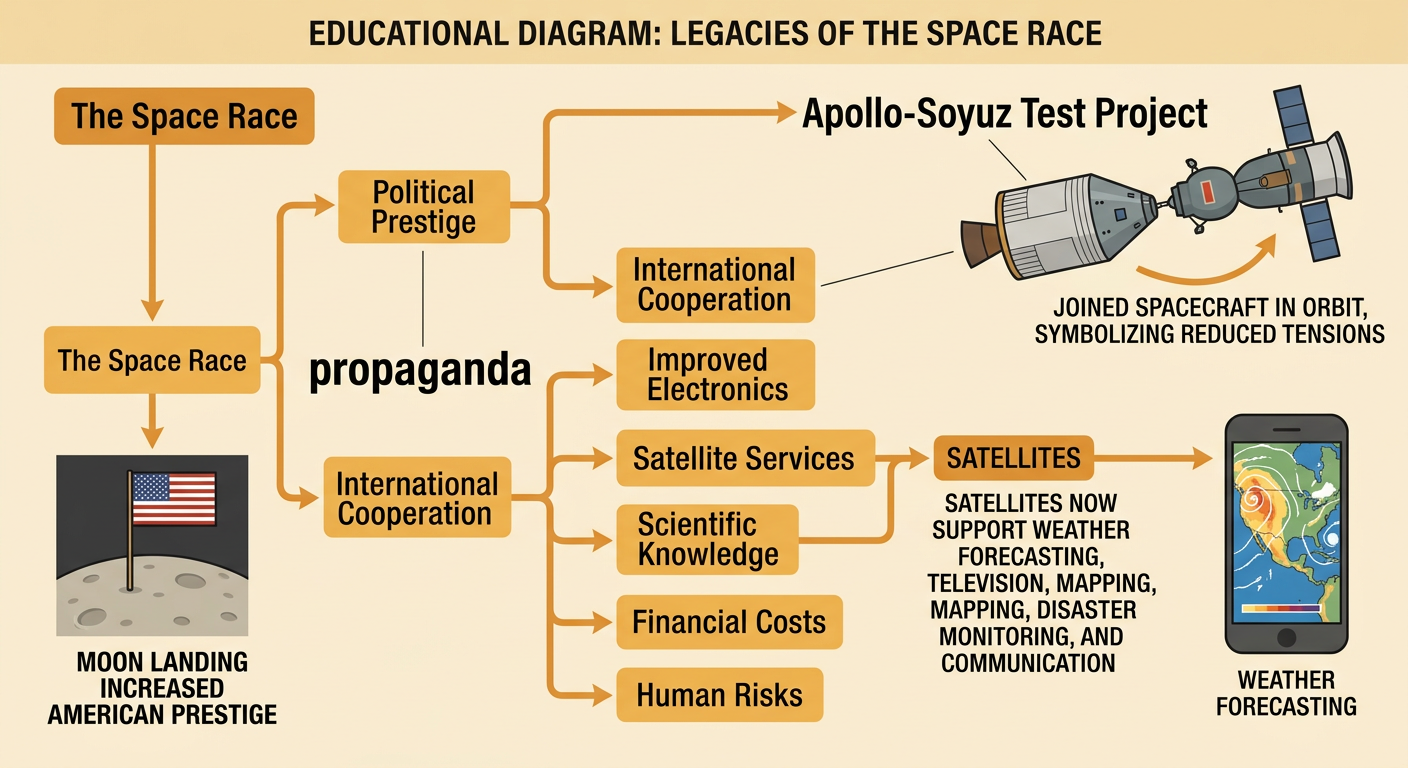
The space race had lasting political, scientific, and technological effects. Politically, the Moon landing strengthened American prestige, while later projects showed that rivals could also cooperate. In 1975, American astronauts and Soviet cosmonauts docked during the Apollo-Soyuz Test Project, symbolizing reduced tensions. Technologically, space programs increased demand for smaller computers, reliable electronics, advanced materials, precise navigation, and global communication systems. NASA did not invent every related technology, but its contracts, testing requirements, and purchases helped improve and expand many of them. Satellites now support weather forecasting, television, mapping, disaster monitoring, and communication. The competition also had costs: both nations spent enormous sums, accepted serious risks, and used achievements as propaganda. Its legacy therefore came from multiple causes and included both benefits and trade-offs in politics, engineering, education, and everyday life.