The Space Race: Cold War Competition, Technology, and Public Investment
Analyze how Cold War rivalry drove the Space Race and assess the political, technological, and social consequences of the Apollo program.

Illustrations are auto-generated and may be placeholders. They can be refreshed to match the narration.
Sputnik and the Cold War Context
On October 4, 1957, the Soviet Union launched Sputnik 1, the first artificial satellite to orbit Earth. Its radio signal provided visible evidence of Soviet rocket capability. Because rockets that carried satellites could also support long-range missiles, many Americans viewed Sputnik as both a scientific achievement and a national security threat. The event intensified an existing Cold War rivalry shaped by nuclear competition, ideological conflict, and fear of falling behind technologically. The United States responded by creating NASA in 1958 and increasing federal support for science and mathematics education through the National Defense Education Act. Newspaper reports, government statements, and Sputnik’s recorded signal are primary sources that reveal public reactions. Historians’ later analyses are secondary sources that help explain how military concerns, national pride, and scientific ambition combined to accelerate the Space Race.

Kennedy’s Moon Challenge
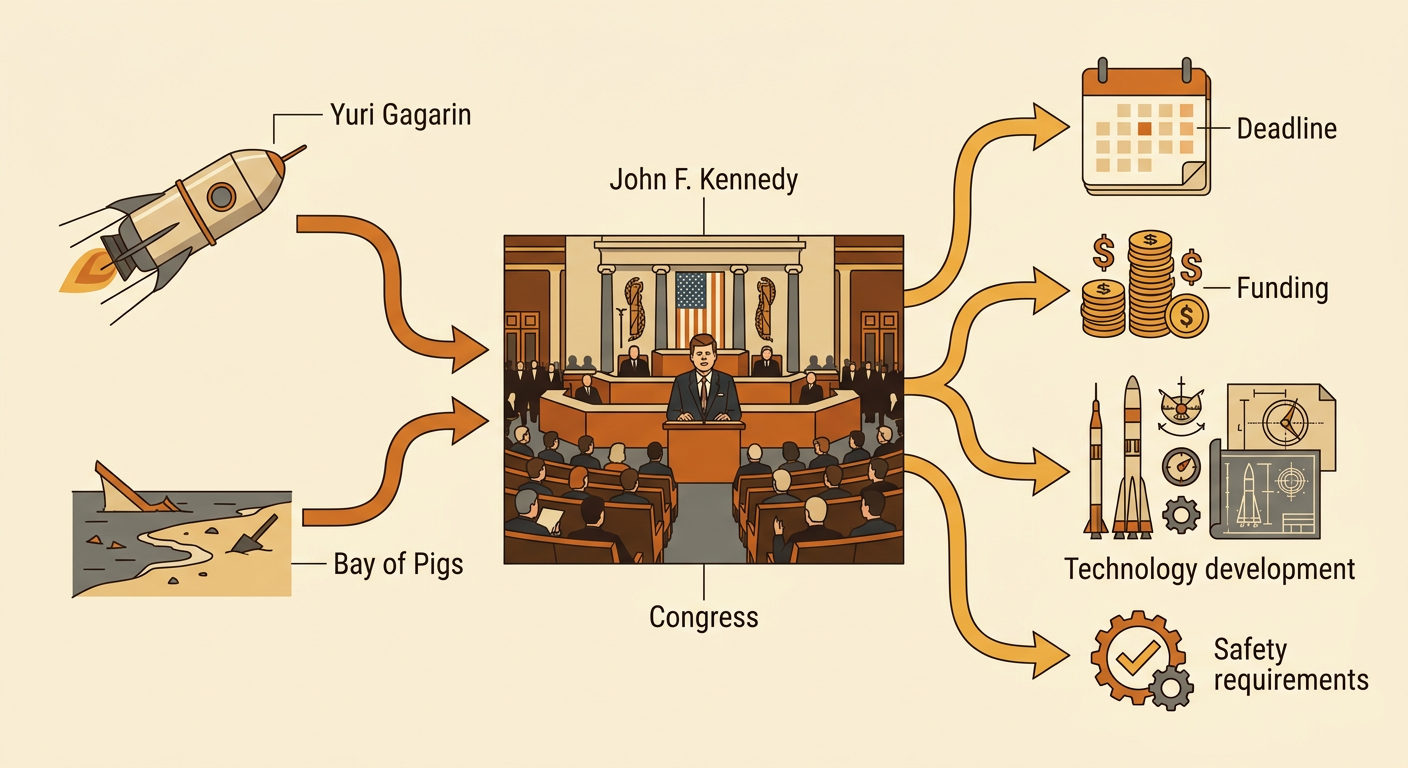
On May 25, 1961, President John F. Kennedy asked Congress to commit the nation to landing a person on the Moon and returning that person safely to Earth before the decade ended. His challenge followed Soviet successes, including Yuri Gagarin’s April 1961 flight as the first human in space, and came soon after the failed Bay of Pigs invasion damaged United States prestige. Kennedy’s speech is a primary source showing that the Moon goal was political as well as scientific. The proposal offered a clear deadline and a visible measure of success, but it required enormous funding, untested technology, and acceptance of serious risk. Policymakers judged the program using several criteria: national security, international influence, technical feasibility, cost, and astronaut safety. The challenge turned spaceflight into a public demonstration of governmental capacity and democratic strength.
NASA, Innovation, and Public Investment
Achieving Kennedy’s goal required cooperation among NASA centers, universities, private contractors, military researchers, and hundreds of thousands of workers. Public funding allowed these organizations to test technologies that private firms might have considered too expensive or risky to develop alone. For example, the Apollo Guidance Computer used compact integrated circuits to help astronauts navigate and control the spacecraft. NASA did not invent the integrated circuit, but its large purchases encouraged improved production and reliability. Engineers also advanced systems engineering, telecommunications, materials testing, and quality control. This innovation network illustrates a trade-off: centralized public investment could coordinate a difficult national project, yet it also directed money and skilled labor away from other possible priorities. To evaluate the program fairly, students should compare evidence about technical performance, spending, employment, and alternative uses of federal resources rather than assuming every later technology was a direct Apollo invention.

The Apollo 11 Moon Landing
Apollo 11 launched from Florida on July 16, 1969, using a Saturn V rocket. Four days later, the lunar module Eagle carried Neil Armstrong and Edwin “Buzz” Aldrin to the Moon while Michael Collins remained in lunar orbit aboard the command module Columbia. Armstrong’s first step and statement were broadcast to a worldwide audience, making the mission a powerful symbol of United States technological achievement. The astronauts collected about 47.5 pounds of lunar material, placed scientific instruments, photographed the surface, and returned safely on July 24. Mission transcripts, photographs, television footage, and collected samples are primary evidence of what occurred. The landing met Kennedy’s deadline, but it resulted from years of earlier Gemini and Apollo tests, engineering corrections, and astronaut training. Apollo 11 therefore shows how a dramatic event can have multiple technical, political, and institutional causes.

Costs, Benefits, and Trade-Offs
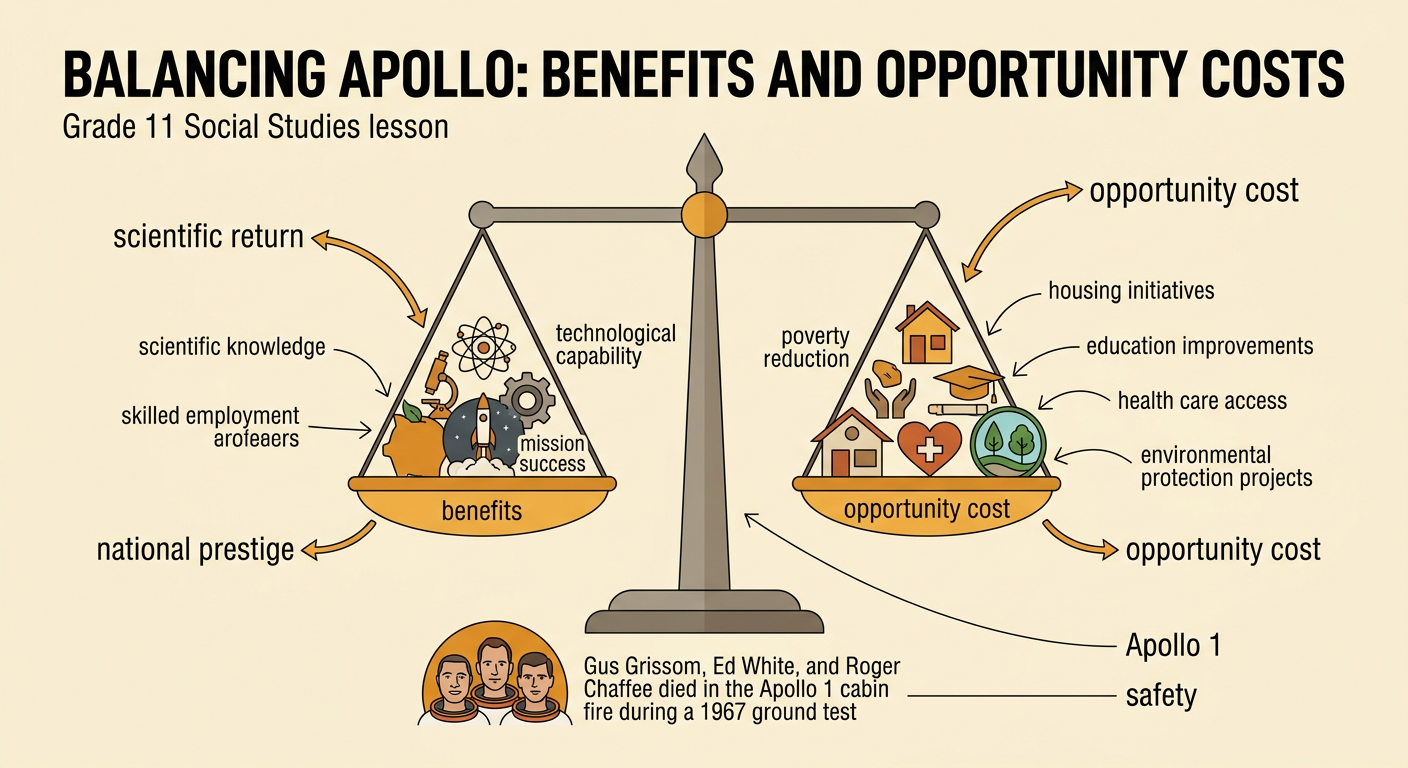
The Apollo program produced major benefits, but it also demanded difficult choices. NASA spending reached about 4.4 percent of the federal budget in 1966, and Apollo cost roughly $25.8 billion in the dollars reported at the time. Supporters emphasized scientific knowledge, skilled employment, technological capability, national prestige, and evidence that a complex mission could be completed. Critics argued that federal funds could instead address poverty, housing, education, health care, or environmental problems. Human costs mattered as well: astronauts Gus Grissom, Ed White, and Roger Chaffee died in the Apollo 1 cabin fire during a 1967 ground test. A balanced evaluation should use criteria such as mission success, safety, scientific return, international influence, economic effects, and opportunity cost. Different groups can weigh these criteria differently, so evidence may support more than one reasonable judgment about whether Apollo’s benefits justified its costs.
The Space Race’s Lasting Legacy
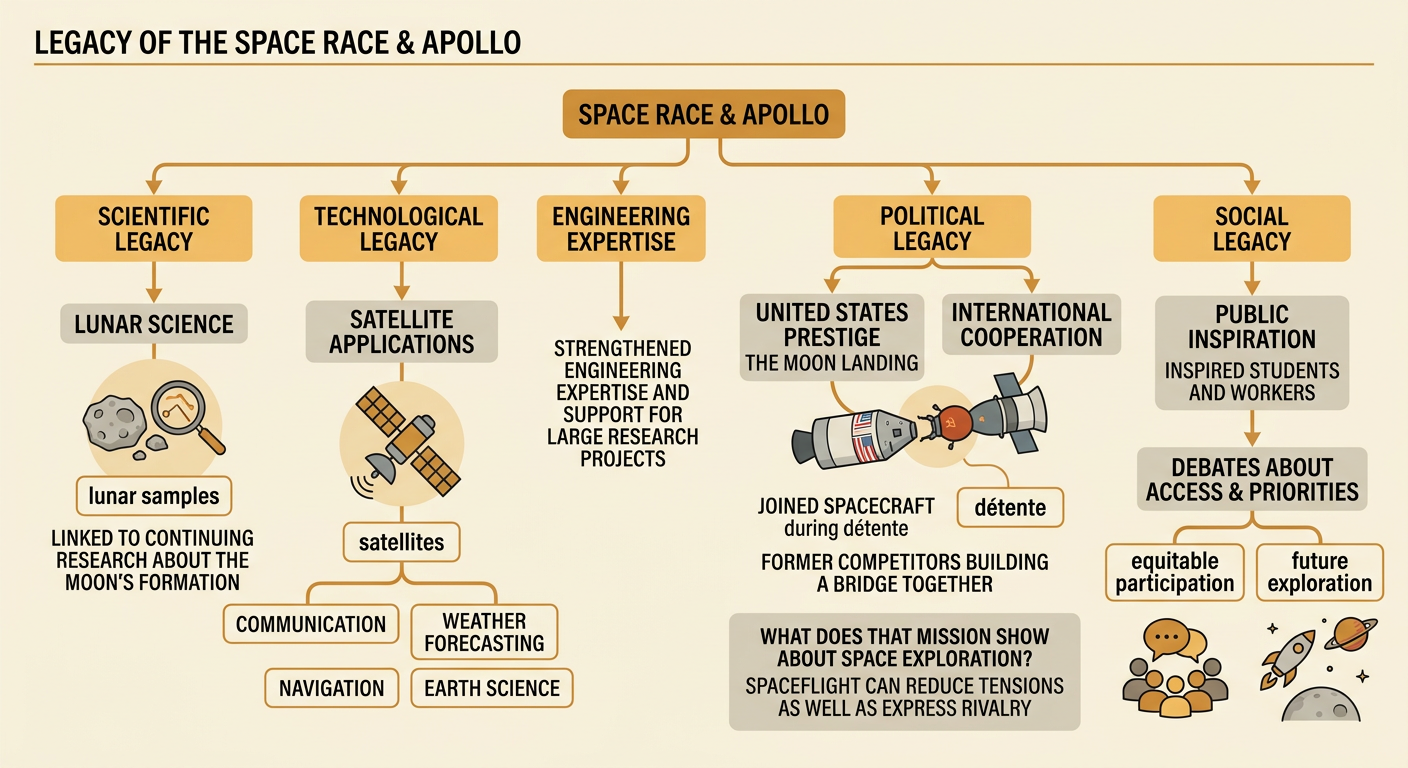
The Space Race left political, technological, scientific, and social legacies. Apollo missions returned lunar samples that continue to support research about the Moon’s formation, while satellites and space-based observation became increasingly important for communication, weather forecasting, navigation, and Earth science. Not all of these technologies were created by Apollo, but the program strengthened engineering expertise and public support for large research projects. Politically, the Moon landing increased United States prestige, yet later cooperation showed that spaceflight could also reduce tensions. The 1975 Apollo-Soyuz Test Project joined American and Soviet spacecraft in orbit during détente. Apollo also inspired students and workers, although opportunities within the space program reflected wider inequalities in race and gender. Its legacy remains contested: it demonstrates what sustained public investment can accomplish while raising continuing questions about national priorities, equitable participation, environmental responsibility, and the goals of future exploration.