
The Telegraph: Transforming Communication Across America
Students examine how the telegraph used electrical signals to send messages quickly and changed communication, business, and daily life in the United States.

Illustrations are auto-generated and may be placeholders. They can be refreshed to match the narration.
Communication Before the Telegraph
Before the telegraph, information could travel only as fast as a person, horse, train, or ship could carry it. People sent handwritten letters through the mail. Newspapers also carried news, but reports were often days or weeks old by the time readers saw them. Bad weather, rough roads, and great distances could cause delays. For example, in the 1830s, a letter sent from New York City to Washington, D.C., might take several days to arrive. A reply required another long trip. Families waited for personal news, while merchants waited to learn about prices and shipments. Compared with email, texting, and phone calls today, communication before the telegraph was much slower and less predictable.

Samuel Morse and a New Invention
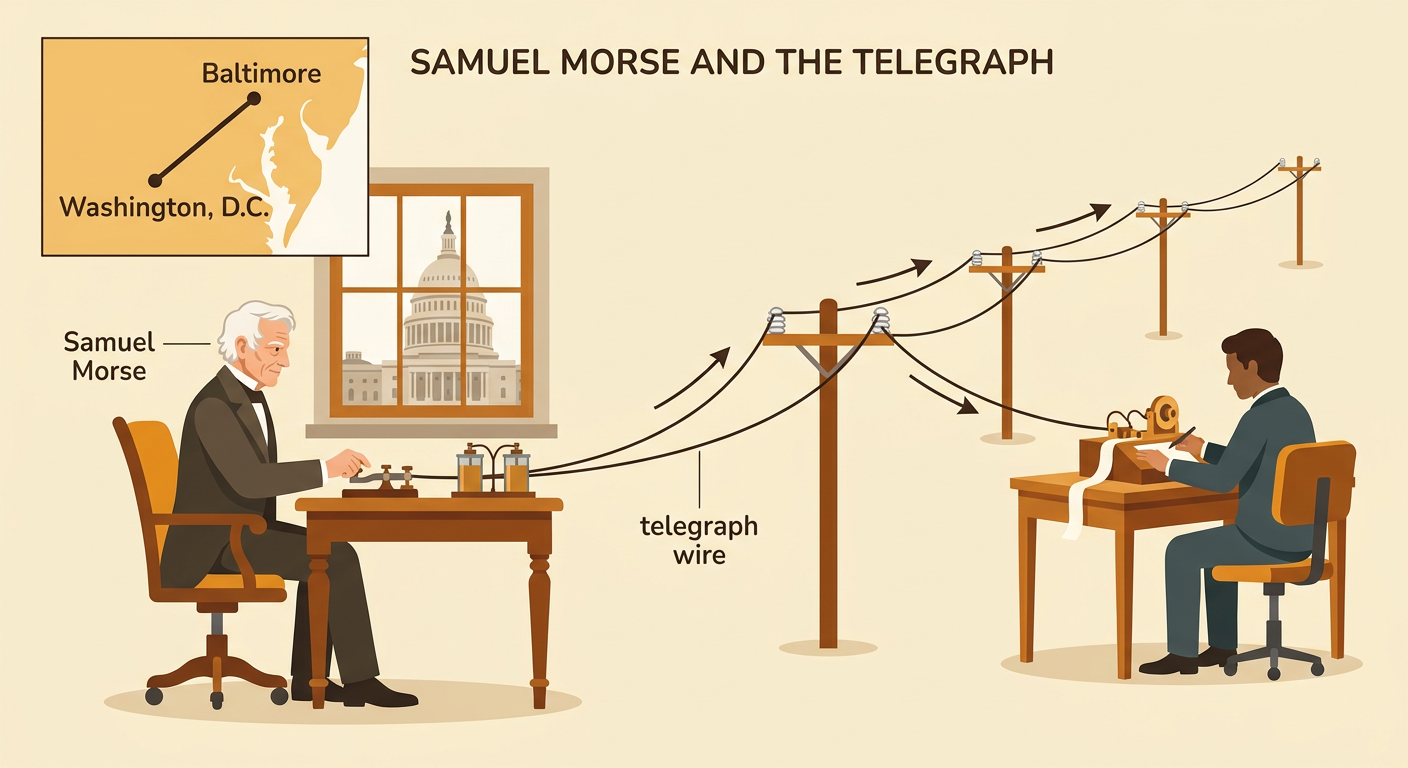
Samuel Morse was an American artist and inventor who helped develop a practical electric telegraph during the 1830s and 1840s. He worked with others, including Alfred Vail, to improve the machine and its signaling system. The telegraph sent electrical signals through a wire. In 1843, Congress provided money to build an experimental telegraph line between Washington, D.C., and Baltimore, Maryland. On May 24, 1844, Morse sent the famous message “What hath God wrought” over the completed line. The message reached Baltimore almost immediately, showing that information could travel much faster than a horse or train. This successful demonstration helped convince people that the telegraph could transform long-distance communication.
How Morse Code Sent Messages
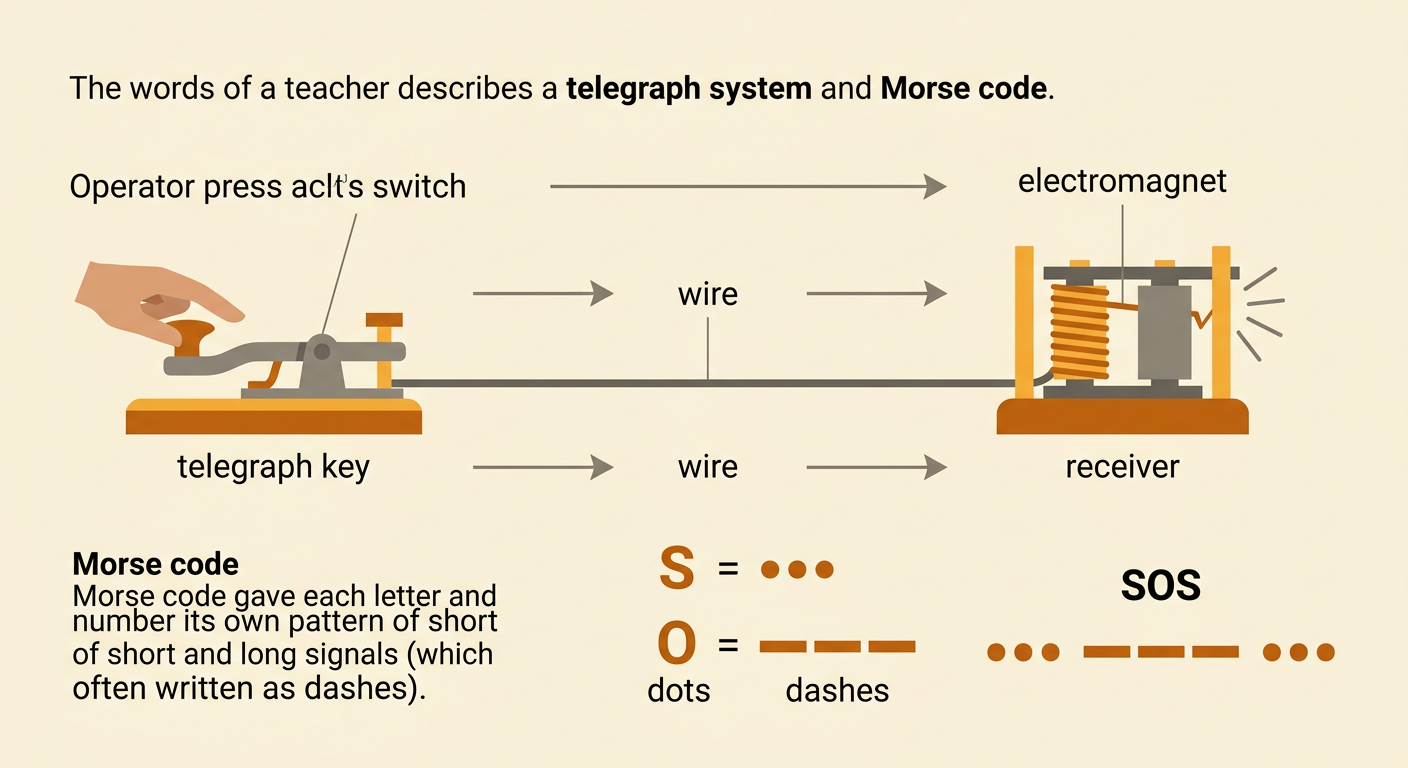
A telegraph changed a message into a pattern of electrical signals. An operator pressed a telegraph key to close an electrical circuit. Electric current then traveled through a wire to a receiver in another place. An electromagnet in the receiver produced marks or clicking sounds that an operator could interpret. Morse code represented letters and numbers with patterns of short and long signals, commonly written as dots and dashes. For example, the letter S is represented by three short signals, while O is represented by three long signals. Because each pattern had a meaning, operators could spell words one letter at a time. Like patterns of light flashes or drumbeats, the signal pattern transferred information even though a person’s voice did not travel through the wire.
Connecting Distant Communities
Telegraph companies built networks of wires that connected towns and cities across the United States. Many wires followed railroad tracks because the routes were already cleared and railroad stations provided useful locations for telegraph offices. Operators at stations sent, received, and sometimes relayed messages along the network. In 1861, the first transcontinental telegraph line connected the eastern and western parts of the country. Before that line, a message traveling between the coasts might take weeks by mail. With the telegraph, a message could cross the country in minutes, although operators might need to pass it through several stations. For example, a merchant in California could quickly send an order to a supplier in an eastern city instead of waiting weeks for a letter exchange.

The Telegraph’s Impact on American Life
The telegraph changed business, transportation, news, and daily life. Railroad workers used telegraph messages to help coordinate train schedules and report problems. Merchants learned prices in distant markets and made decisions more quickly. Newspapers received reports from faraway places without waiting for a mailed letter. For example, election results could be telegraphed to a city newspaper and printed much sooner than before. People also sent telegrams about births, deaths, travel plans, and emergencies. However, sending a telegram cost money, and messages were often kept short to reduce the price. Today, phones and the internet send words, sounds, pictures, and videos almost instantly. The telegraph was more limited, but it helped begin the shift toward rapid electronic communication across great distances.
