The Transcontinental Railroad: Expansion, Displacement, and Environmental Change
Students examine how the transcontinental railroad accelerated western settlement and economic integration while contributing to Indigenous displacement and major environmental changes.

Illustrations are auto-generated and may be placeholders. They can be refreshed to match the narration.
Motives for a Transcontinental Railroad
During the mid-1800s, national leaders and business owners wanted a railroad linking the Mississippi River region with the Pacific Coast. Supporters argued that it would shorten travel, carry mail and goods, strengthen trade with Asia, and help the United States control its western territory. The discovery of gold in California and the growth of Pacific ports increased economic pressure for a reliable route. During the Civil War, Congress passed the Pacific Railway Acts of 1862 and 1864. These laws authorized land grants and government loans for railroad construction. For example, the Union Pacific built west from Omaha, while the Central Pacific built east from Sacramento. When examining the laws, advertisements, and congressional speeches, students should identify specific evidence of economic, political, and military motives rather than assuming that all supporters shared one goal.

Construction, Labor, and Natural Barriers
Building the railroad required thousands of workers to cross difficult terrain under dangerous conditions. The Central Pacific employed many Chinese immigrants, who performed much of the demanding work through California’s Sierra Nevada. Crews drilled tunnels through granite, used explosives, built retaining walls, and constructed snow sheds. The Union Pacific relied heavily on Irish immigrants, Civil War veterans, and other laborers as it crossed the Great Plains and Rocky Mountain region. Rivers, steep grades, winter storms, and limited water supplies affected where and how tracks could be built. For example, Central Pacific workers constructed Summit Tunnel near Donner Pass through solid granite at high elevation. Despite unequal pay, discrimination, injuries, and deaths, workers completed the connection at Promontory Summit, Utah, on May 10, 1869. Labor records and worker accounts reveal experiences often missing from celebratory photographs.

Trade, Migration, and Western Settlement
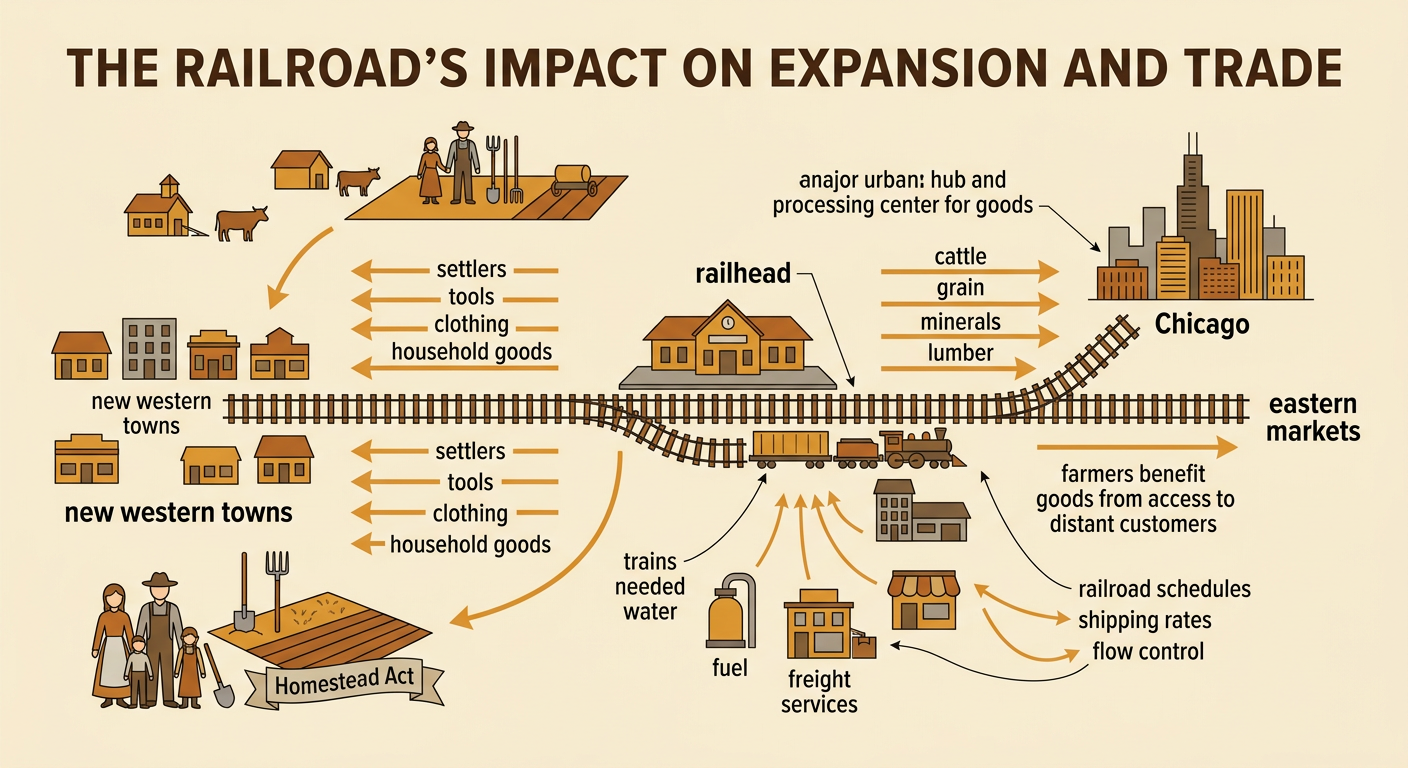
The completed railroad reduced the time and cost required to move people, raw materials, manufactured goods, and information across the country. Railroad companies advertised western land, while federal policies such as the Homestead Act encouraged settlers to establish farms and towns. New communities grew around stations where trains needed fuel, water, repairs, and freight services. Farmers and ranchers gained access to distant markets, but they also became dependent on railroad schedules and shipping rates. For example, cattle raised on the Great Plains could be driven to railheads and shipped to processing centers such as Chicago. Lumber, minerals, and grain traveled east, while tools, clothing, and household products traveled west. Maps, advertisements, freight records, and population data can be compared to show how transportation influenced migration, urban growth, and the economic integration of western regions.
Indigenous Displacement and Resistance
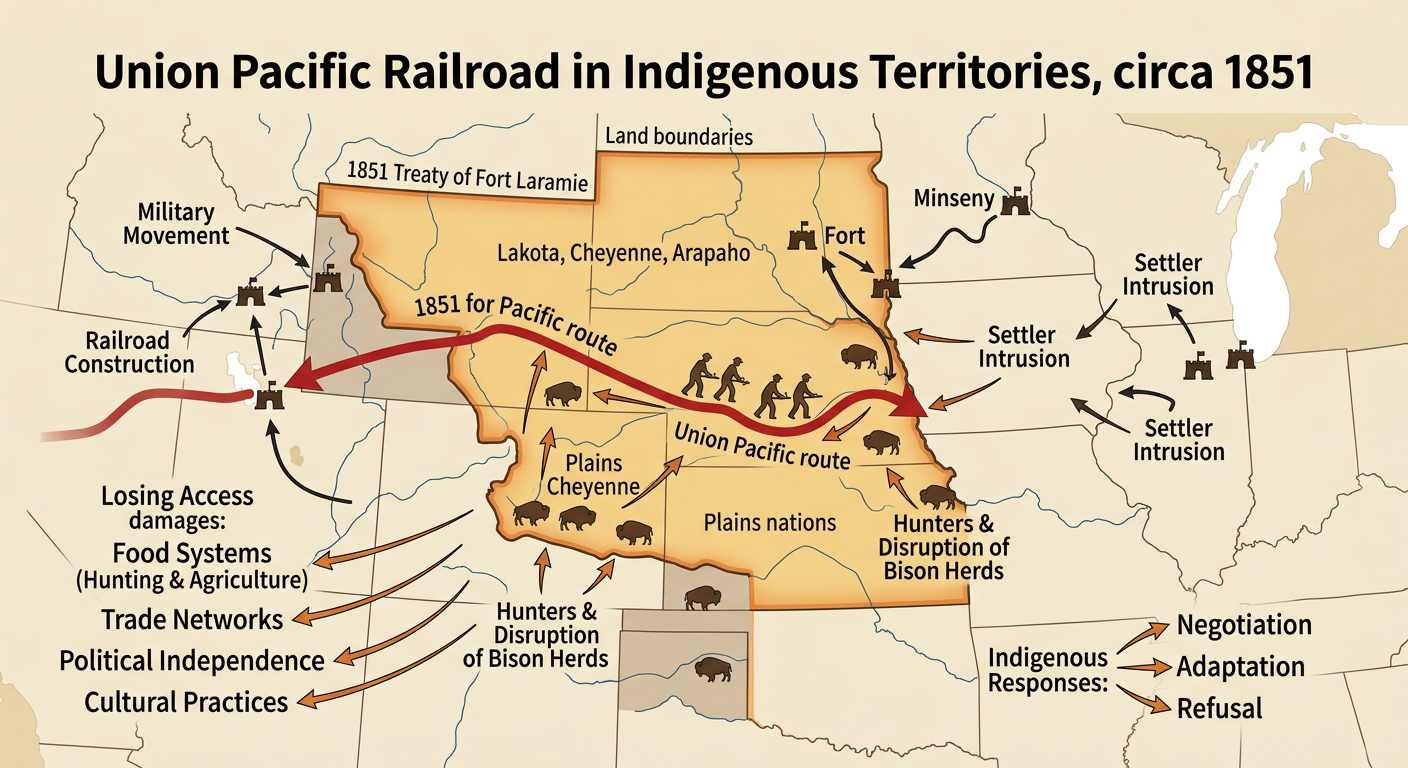
The railroad crossed lands that Indigenous nations used for homes, hunting, travel, trade, and cultural practices. Although treaties had recognized certain tribal territories, federal officials often changed boundaries, pressured nations to accept new agreements, or failed to prevent settler intrusion. Railroad construction brought workers, soldiers, hunters, and permanent settlers into the homelands of the Lakota, Cheyenne, Arapaho, Shoshone, and other peoples. It also disrupted bison herds and increased competition for water and grass. Indigenous communities responded in different ways, including negotiation, adaptation, refusal, and armed resistance. For example, comparing the Union Pacific route with maps of lands identified in the 1851 Treaty of Fort Laramie shows how the transportation corridor passed through regions claimed and used by Plains nations. Treaty texts, tribal accounts, and government reports should be examined together because they present different perspectives on the conflict.
Bison Decline and Environmental Change
The railroad contributed to rapid environmental change across the Great Plains, especially the destruction of bison herds. Trains gave commercial hunters access to remote grasslands and allowed hides and bones to be shipped quickly to eastern markets. Railroad companies also promoted hunting excursions, while expanding farms, ranches, fences, and towns changed bison habitat. Federal actions and military campaigns further weakened Indigenous control of hunting grounds. The railroad was therefore an important cause of bison decline, but it acted together with market demand, intensive hunting, settlement, drought, and competition from livestock. For example, large quantities of bison hides were collected near rail lines and transported east for industrial use. The decline harmed grassland ecosystems and threatened the food supplies, materials, economies, and cultural practices of many Plains nations. Environmental evidence and historical shipping records help explain these connected effects.

Evaluating the Railroad's Mixed Legacy
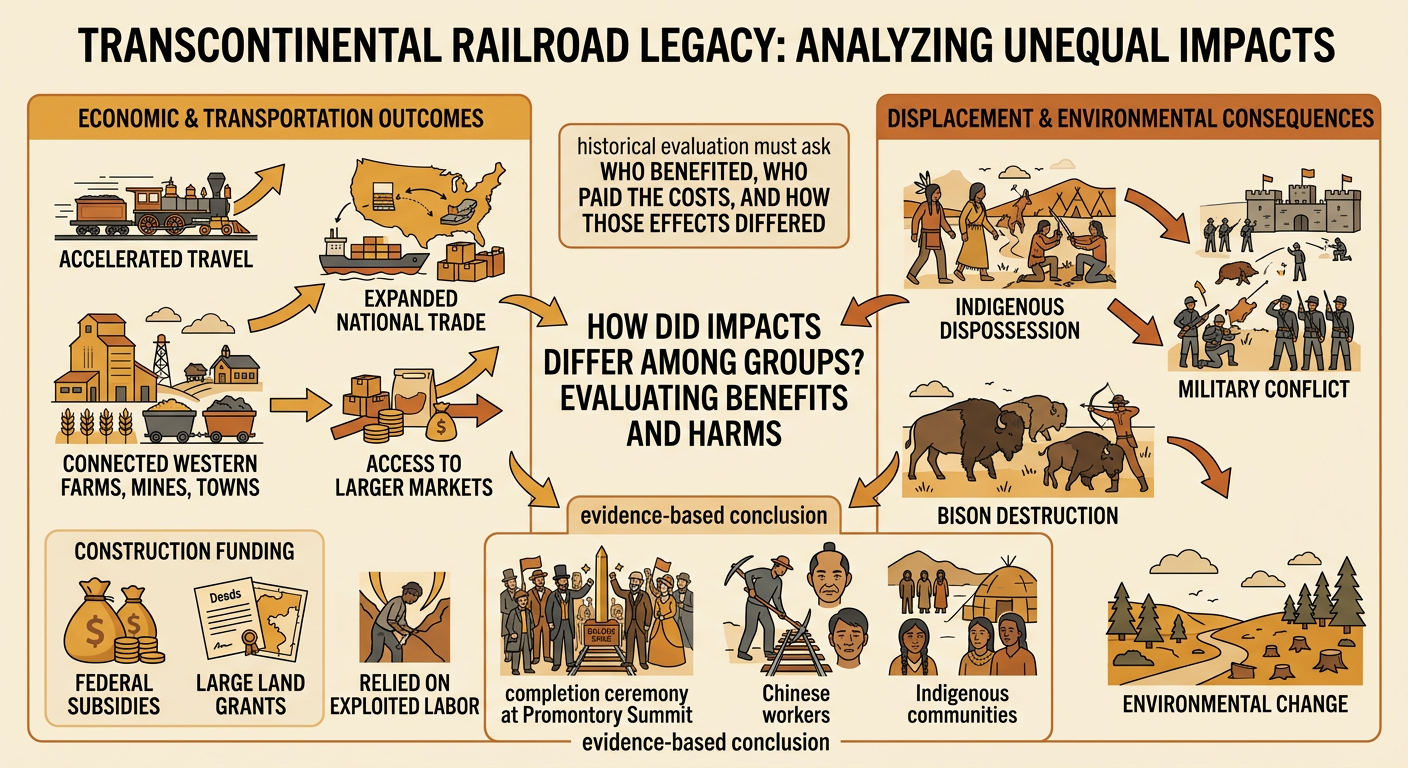
The transcontinental railroad produced benefits and harms that were distributed unequally. It accelerated travel, expanded national trade, supported new towns, and connected western farms, mines, and ports to larger markets. At the same time, construction depended on exploited labor, federal subsidies, and large land grants. Expansion contributed to Indigenous dispossession, military conflict, bison destruction, and lasting changes to grasslands and waterways. A strong historical evaluation does not simply label the railroad as progress or disaster. Instead, it asks who benefited, who paid the costs, and how effects changed over time. For example, the 1869 completion ceremony celebrated national unity, yet the famous photograph did not represent many Chinese workers whose labor helped finish the line or Indigenous communities whose lands were affected. Students can compare that image with payroll records, treaties, tribal accounts, maps, and environmental data to develop an evidence-based conclusion.