
The Water Cycle and Earth's Systems
Students trace water through evaporation, condensation, precipitation, runoff, infiltration, and storage while identifying the energy and forces that drive the cycle.

Illustrations are auto-generated and may be placeholders. They can be refreshed to match the narration.
Earth's Water Reservoirs
Earth’s water is stored in reservoirs, or places where water collects for a period of time. Oceans hold about 97 percent of Earth’s water. Most of the remaining water is frozen in glaciers and ice caps or stored underground as groundwater. Much smaller amounts are found in lakes, rivers, soil, living things, and the atmosphere. Water may stay in an ocean for many years but remain in the atmosphere for only days before falling as precipitation. Even when water changes location or state, the total amount of water on Earth remains nearly constant. For example, water stored in Lake Michigan can evaporate, become part of a cloud, and later fall as snow on land. The water cycle continually moves water among the hydrosphere, atmosphere, geosphere, and biosphere.

Evaporation and Transpiration
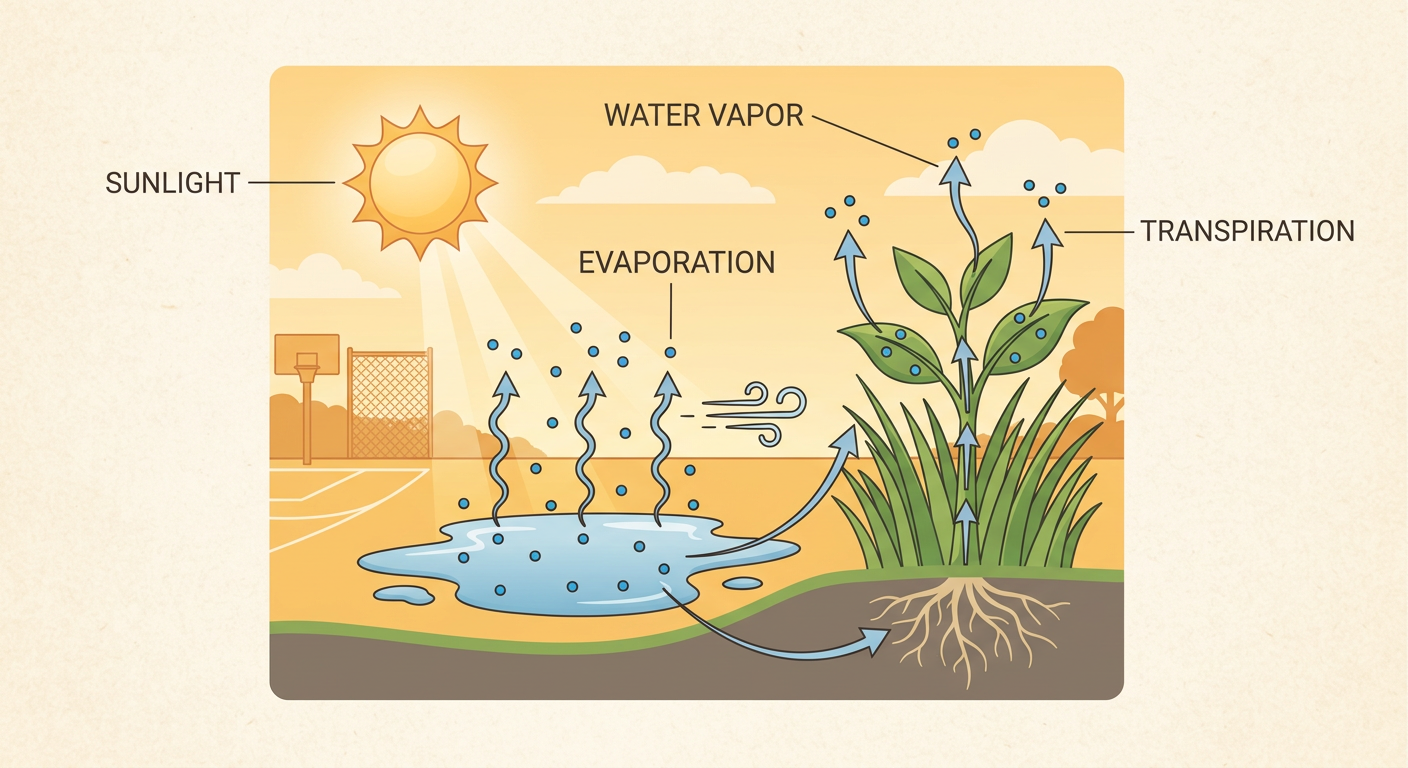
Evaporation occurs when liquid water gains energy and changes into water vapor, an invisible gas. Energy from sunlight warms the surfaces of oceans, lakes, rivers, puddles, and wet soil, causing some water molecules to escape into the atmosphere. Evaporation is usually faster when water is warmer, air is dry, or wind carries water vapor away. Plants also add water vapor to the air through transpiration. Plant roots absorb water from the soil, and the water moves through the plant before leaving through tiny openings in the leaves. Together, evaporation and transpiration are sometimes called evapotranspiration. For example, after sunlight warms a wet school playground, the puddles shrink. Some water evaporates directly, while nearby grass releases water vapor through transpiration.
Condensation and Clouds
Condensation is the change of water vapor from a gas into liquid water. As warm, moist air rises, it expands and cools. Cooler air can support less water vapor, so some vapor condenses onto tiny particles such as dust, salt, or smoke. Each particle becomes the center of a tiny water droplet. If the air is cold enough, ice crystals may form instead. A cloud is a visible collection of many tiny water droplets, ice crystals, or both. Condensation does not mean that a cloud is made of water vapor, because water vapor itself is invisible. For example, moist air rising over a mountain cools as it climbs. Clouds may form on the windward side when water vapor condenses into droplets around particles in the air.

Precipitation
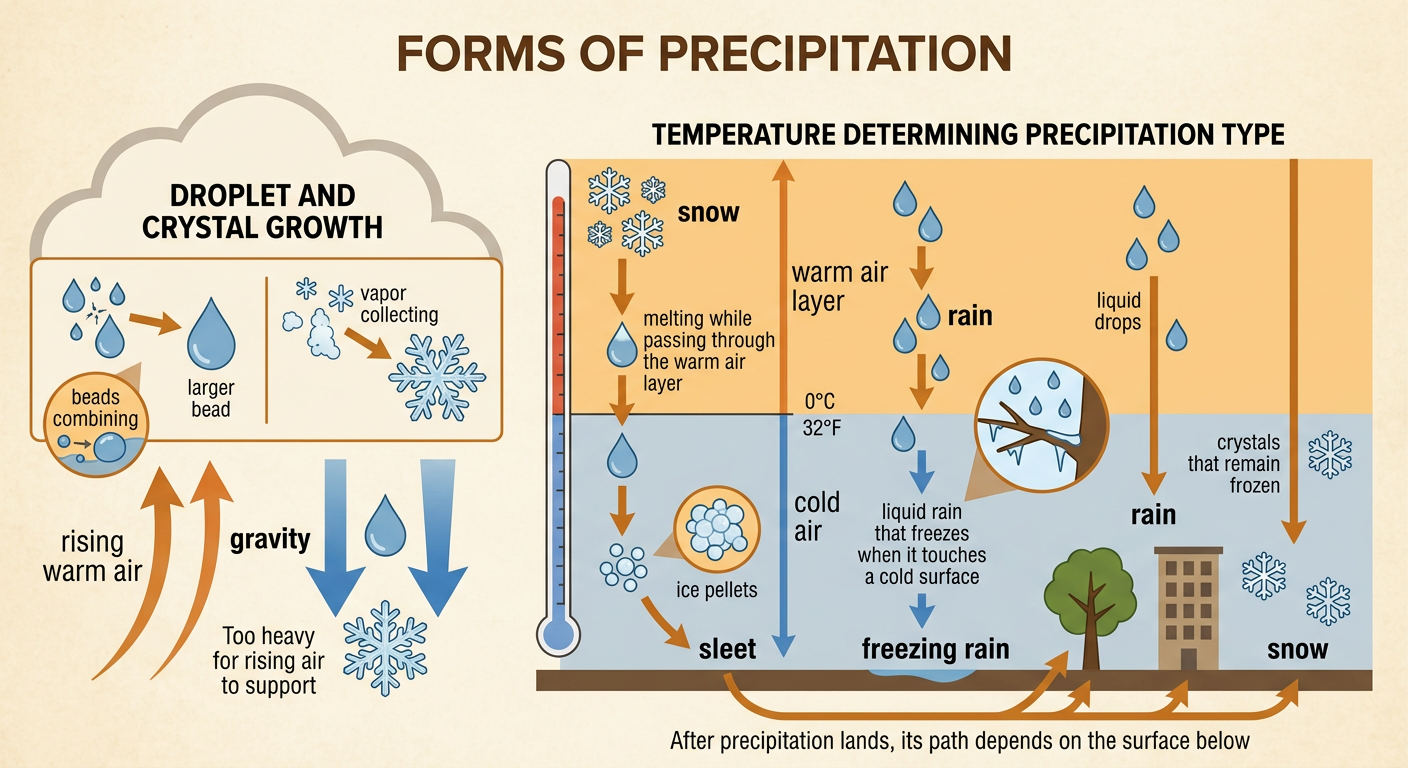
Precipitation is water that falls from clouds to Earth’s surface. Inside a cloud, tiny droplets collide and combine, while ice crystals may grow by collecting water vapor or other crystals. When droplets or crystals become too heavy for rising air to hold up, gravity pulls them downward. Air temperature determines the form that reaches the ground. Rain falls when drops remain liquid. Snow forms when ice crystals stay frozen as they fall. Sleet consists of ice pellets formed when melted snow refreezes, while freezing rain is liquid that freezes after touching a cold surface. For example, snow may begin high in a winter cloud, melt into rain while passing through a warm air layer, and then refreeze into sleet in cold air near the ground.
Runoff and Infiltration
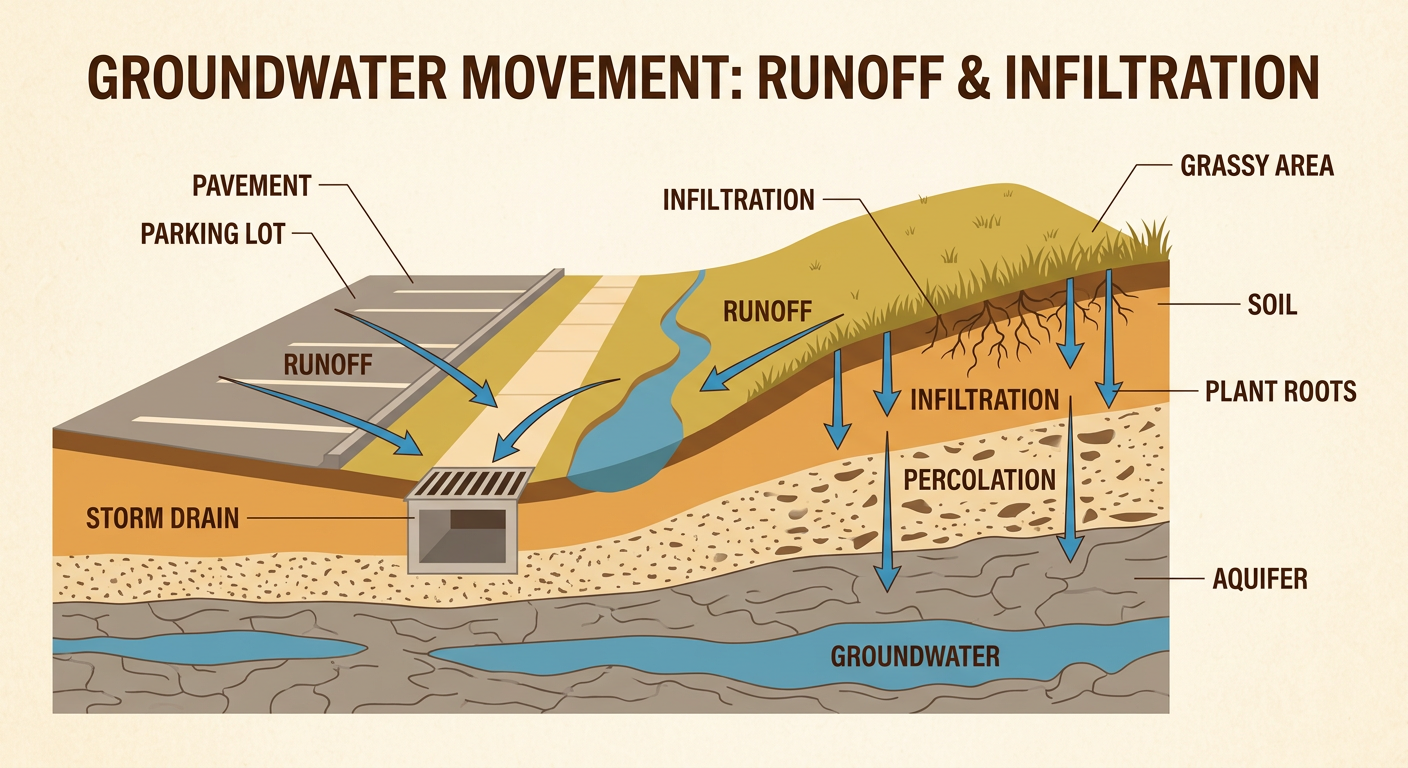
After precipitation reaches land, it can move across the surface or enter the ground. Runoff is water that flows downhill over land into streams, rivers, lakes, and oceans. Runoff increases when rain falls faster than soil can absorb it or when pavement blocks water from entering the ground. Infiltration is the movement of water into soil. Some infiltrated water is taken up by plant roots, while some moves deeper through spaces in rock and sediment. This deeper movement, called percolation, can recharge an aquifer, an underground layer that stores and carries groundwater. For example, rain on a parking lot may quickly run into a storm drain, but rain in a nearby grassy area can infiltrate the soil and slowly move toward the groundwater below.
Sunlight and Gravity
The water cycle is driven mainly by energy from the Sun and the force of gravity. Solar energy warms surface water and powers evaporation. It also supports transpiration by warming plants and the surrounding air. As water vapor rises and cools, it condenses into clouds. Gravity then pulls precipitation toward Earth and moves water downhill as runoff. Gravity also helps infiltrated water percolate through soil and rock, allowing groundwater to flow toward springs, rivers, lakes, or oceans. These processes connect the atmosphere, hydrosphere, geosphere, and biosphere in one continuous cycle. For example, sunlight can evaporate ocean water, winds can carry the vapor inland, and gravity can pull rain onto a mountain. The same water may then flow downhill in a river and return to the ocean.
