
Thermal Energy and Thermodynamics
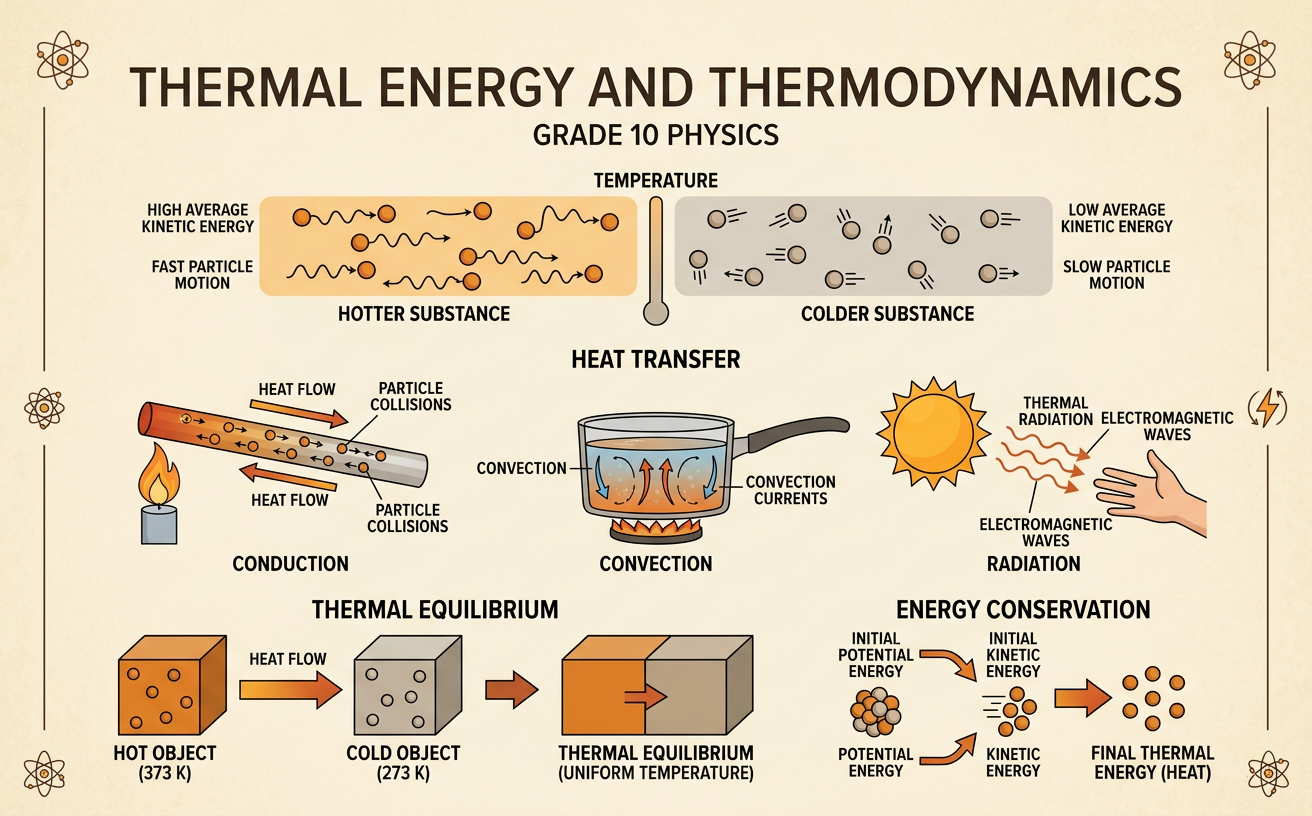
Students explain temperature, heat transfer, and thermal equilibrium through particle motion and energy conservation.
Illustrations are auto-generated and may be placeholders. They can be refreshed to match the narration.
Temperature and Particle Motion
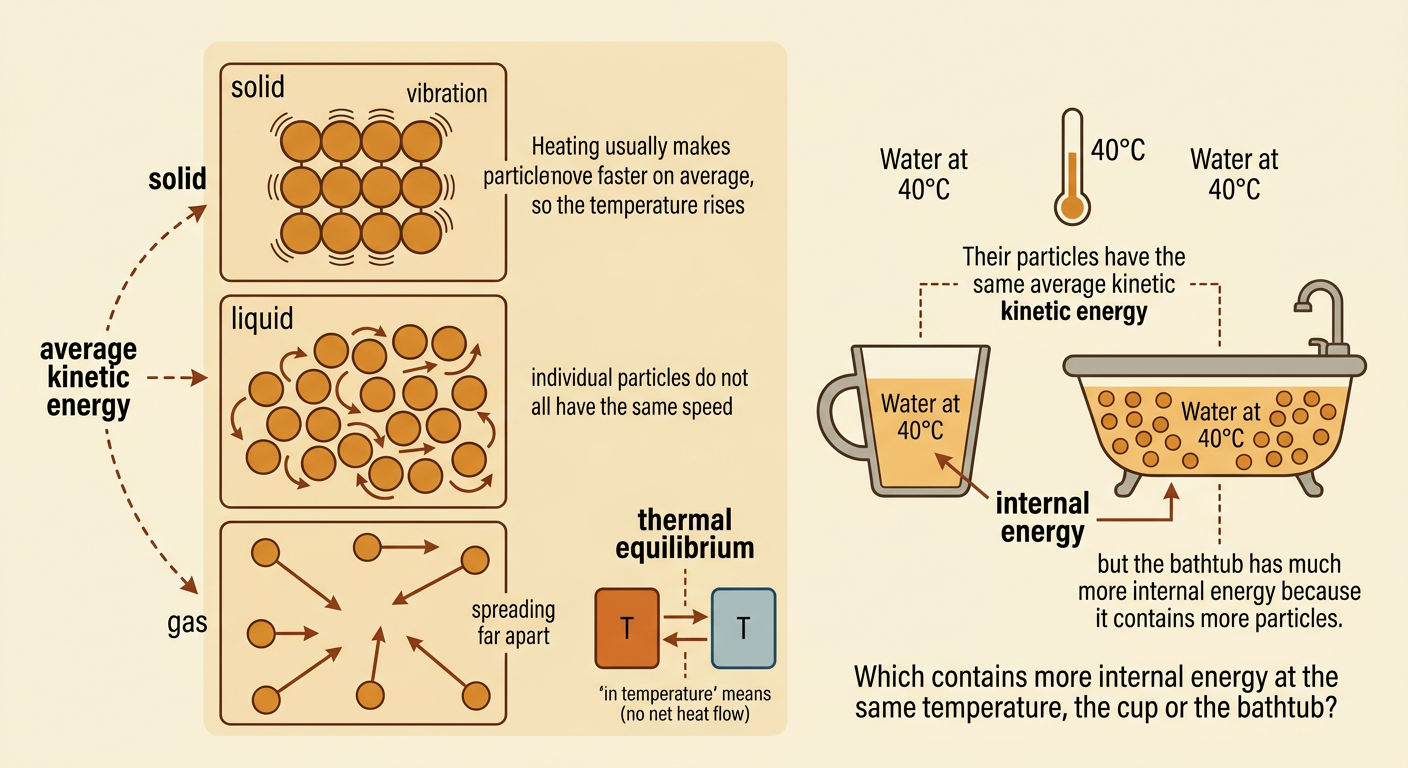
Temperature measures the average kinetic energy of the particles in a substance. In a solid, particles vibrate around fixed positions. In liquids and gases, particles move past one another, with gas particles generally spreading far apart. When a substance is heated, its particles move faster on average, so its temperature usually rises. Individual particles do not all move at the same speed; temperature describes the average of their motion. Temperature is also different from total thermal energy because the amount of matter matters. For example, a cup and a bathtub can both contain water at 40°C. Their particles have the same average kinetic energy, but the bathtub has much more internal energy because it contains many more particles. Thermometers measure temperature by reaching thermal equilibrium with the substance being tested.
Heat and Internal Energy
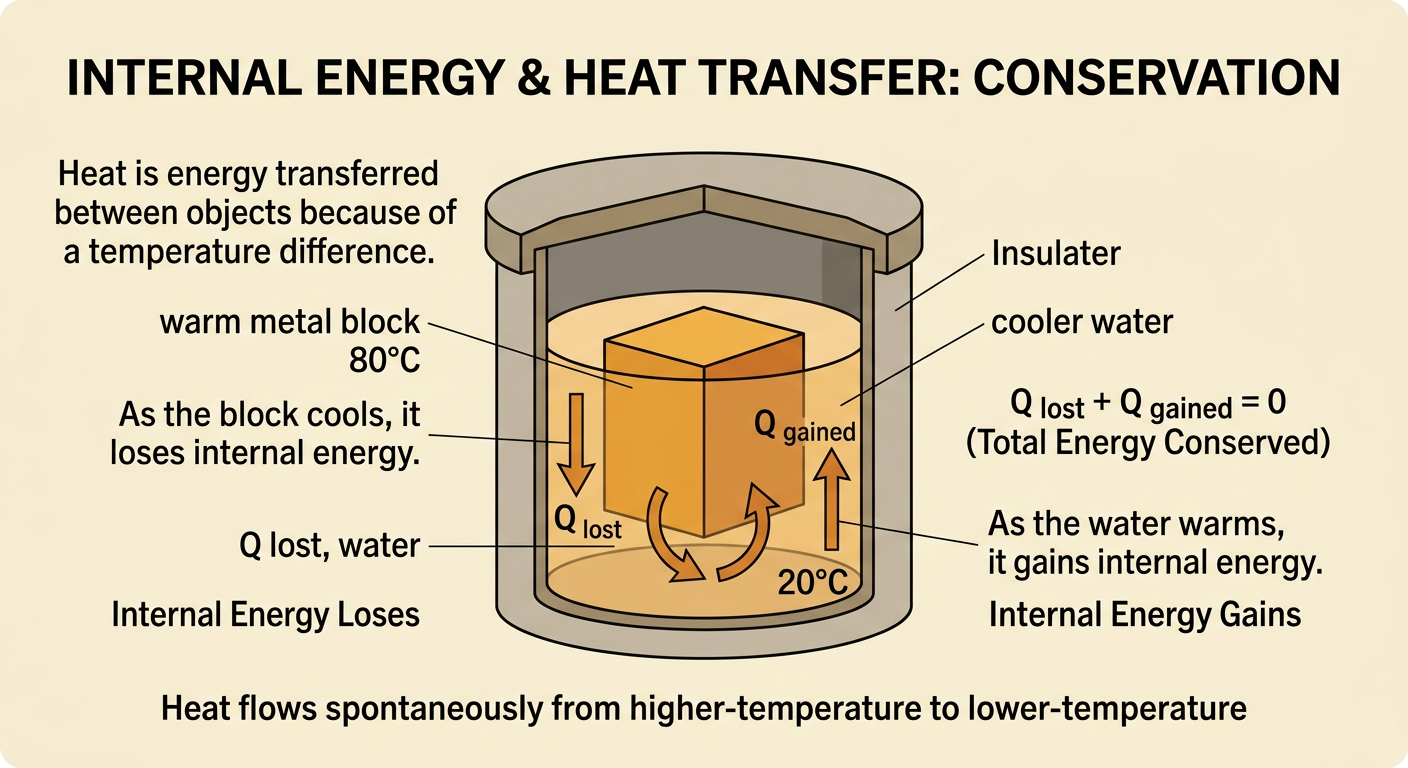
Internal energy is the total microscopic kinetic and potential energy of the particles in a system. Heat is energy transferred between objects because of a temperature difference; it is not a substance stored inside an object. Heat flows spontaneously from a higher-temperature object to a lower-temperature object. In an insulated closed system, energy transferred out of one part is gained by another, so total energy is conserved. For example, place a warm metal block into cooler water inside an insulated calorimeter. The block loses internal energy while the water gains internal energy. Ideally, Qlost + Qgained = 0. Students can investigate this transfer by measuring both initial temperatures and the final temperature. Their explanation should cite measured data, such as the metal’s temperature decrease and the water’s temperature increase, as evidence for energy conservation.
Conduction, Convection, and Radiation
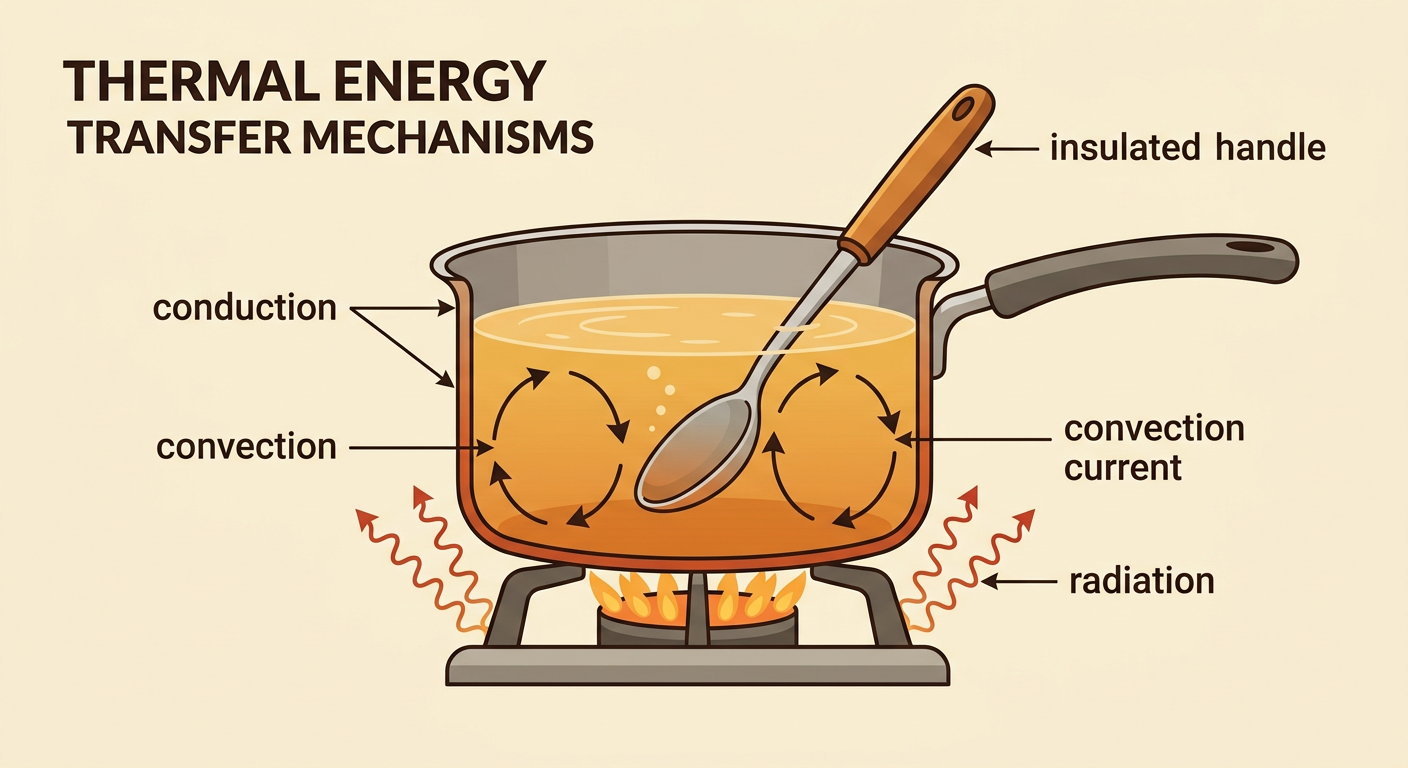
Thermal energy can be transferred by conduction, convection, or radiation. Conduction occurs through collisions and interactions among neighboring particles, especially in solids; mobile electrons make metals effective conductors. Convection transfers energy through the bulk movement of a fluid. Warmer, less-dense fluid rises while cooler, denser fluid sinks, producing a convection current. Radiation transfers energy through electromagnetic waves and does not require matter, which is how energy from the Sun reaches Earth. All three processes occur when water is heated in a metal pot. The burner transfers energy by radiation and contact, the metal conducts energy to the water, and circulating water distributes energy by convection. A metal spoon becomes hot by conduction, while its insulated handle slows the transfer. Identifying the mechanism helps engineers choose materials that improve safety and energy efficiency.
Specific Heat
Specific heat capacity is the energy needed to raise the temperature of one kilogram of a substance by one degree Celsius. The relationship is Q = mcΔT, where Q is transferred energy in joules, m is mass in kilograms, c is specific heat capacity, and ΔT is the temperature change. Water has a high specific heat capacity of about 4,180 J/(kg·°C), so it requires substantial energy to change its temperature. For example, heating 0.50 kg of water by 10°C requires Q = (0.50)(4,180)(10), or 20,900 J. Under the same conditions, a metal sample usually warms more because its specific heat is lower. This property helps explain why coastal temperatures change more slowly than inland temperatures and why water is useful in cooling systems. Experimental values can be found by measuring mass, energy input, and temperature change.

Thermal Equilibrium
Thermal equilibrium occurs when objects in thermal contact reach the same temperature and there is no net heat transfer between them. Energy still moves microscopically in both directions, but the average transfer in each direction is equal. The zeroth law of thermodynamics states that if object A is in thermal equilibrium with object C and object B is also in equilibrium with C, then A and B have the same temperature. This principle makes thermometers useful. As a concrete example, mix 200 g of water at 60°C with 200 g of water at 20°C in an ideal insulated container. Because the masses and specific heats are equal, the final temperature is 40°C. The warmer water’s energy loss equals the cooler water’s energy gain. In a real investigation, energy absorbed by the container may cause the measured result to differ slightly.
Laws of Thermodynamics
The laws of thermodynamics describe energy transfer and its limits. The zeroth law defines thermal equilibrium and temperature. The first law expresses energy conservation: a system’s internal energy changes when heat is transferred or work is done. The second law states that spontaneous thermal processes have a preferred direction and increase the total entropy of an isolated system; heat does not flow spontaneously from cold to hot. The third law states that a perfect crystal’s entropy approaches zero as its temperature approaches absolute zero. These laws also limit machine efficiency. A heat engine cannot convert all absorbed thermal energy into useful work because some energy must be released to a cooler reservoir. When comparing engines, furnaces, or power plants, students can calculate efficiency as useful energy output divided by total energy input. Citing reliable efficiency and energy-cost data supports economic decisions about fuel use and conservation.