
Thermal Energy in Physical and Chemical Processes
Students connect temperature to particle motion, trace thermal energy transfer, distinguish endothermic and exothermic processes, and interpret simple energy measurements and diagrams.
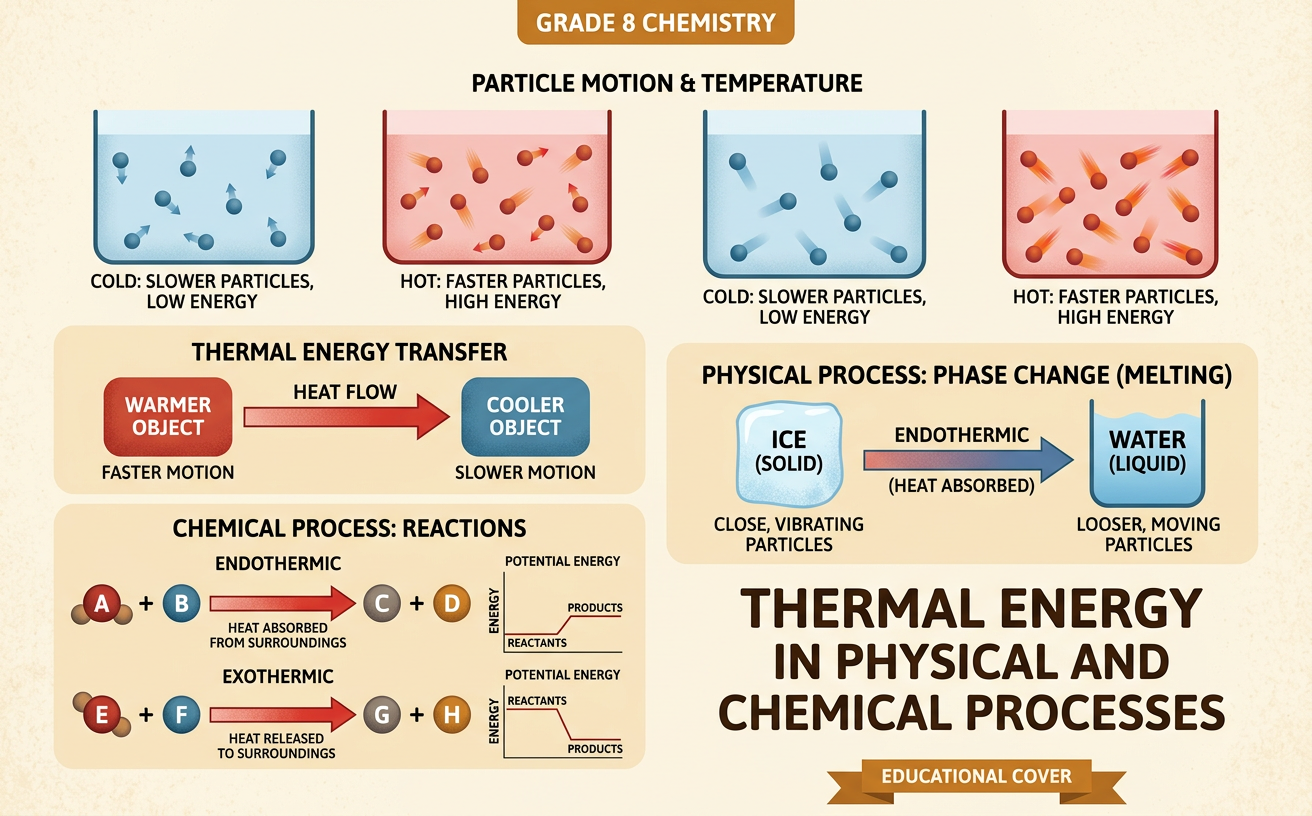
Illustrations are auto-generated and may be placeholders. They can be refreshed to match the narration.
Temperature and Thermal Energy
Temperature measures the average kinetic energy of the particles in a substance. Faster average particle motion corresponds to a higher temperature. Thermal energy is the total energy associated with all the particles in a sample, so it depends on both temperature and the amount of matter. A large bathtub of warm water can contain more thermal energy than a small cup of boiling water even though the cup has the higher temperature. This distinction is important when interpreting heating data. If equal heaters warm 50 milliliters and 200 milliliters of water, the smaller sample usually experiences a faster temperature increase. The same energy is distributed among fewer water molecules, so their average kinetic energy rises more quickly.
How Thermal Energy Transfers
Thermal energy moves from a region at higher temperature to a region at lower temperature until thermal equilibrium is reached. Conduction transfers energy through direct particle collisions, as when a metal spoon warms in hot soup. Convection transfers energy through the movement of fluids. Water heated in a pot rises as cooler, denser water sinks, creating a circulating current. Radiation transfers energy through electromagnetic waves and does not require matter. Sunlight warming a sidewalk is an example of radiation. Several transfer methods can occur together. Around a campfire, radiation warms a person's face, convection carries hot air upward, and conduction moves energy along a metal roasting fork. Insulators slow energy transfer but do not permanently stop it.
Endothermic and Exothermic Processes
An endothermic process absorbs energy from its surroundings, while an exothermic process releases energy to its surroundings. The system is the matter being studied, and everything outside it is the surroundings. In an instant cold pack, dissolving certain salts absorbs thermal energy, so the pack and nearby skin become cooler. Combustion is exothermic because it transfers energy to the surroundings as heat and often light. Temperature evidence must be interpreted from the correct viewpoint. If the temperature of the surrounding water rises during a reaction, the reaction system released energy and was exothermic. Melting ice is endothermic even though its temperature may remain constant, because energy is absorbed to overcome attractions between water molecules during the change of state.
Energy and Chemical Bonds
Chemical processes involve both breaking old bonds and forming new bonds. Breaking bonds requires energy, while forming bonds releases energy. A reaction is exothermic when forming the new bonds releases more energy than breaking the original bonds requires. It is endothermic when bond breaking requires more energy than bond formation releases. An energy diagram shows these changes from reactants to products. If the products are lower on the diagram than the reactants, the difference was released to the surroundings. Burning methane is an example in which strong bonds form in carbon dioxide and water, producing a net release of energy. The initial rise on an energy diagram represents activation energy, the minimum energy needed to begin the reaction.
Measuring Energy Changes
A simple calorimeter uses an insulated container and a measured amount of water to track energy transfer. Students record the starting temperature, allow a process to occur, and record the highest or lowest temperature reached. A temperature increase suggests that the process released energy to the water, while a decrease suggests that it absorbed energy. For example, if 100 grams of water warms from 20°C to 25°C, the 5°C change provides evidence of energy transfer. Fair comparisons require the same water mass, container, starting conditions, and measurement method. Some energy escapes to the air or container, so classroom measurements are estimates. Repeated trials and an average result reduce the influence of random measurement errors.