
Thermal Energy, Specific Heat, and Material Choice
Students investigate thermal energy transfer, use Q = mcΔT to compare specific heat capacities, and evaluate materials for a practical application.
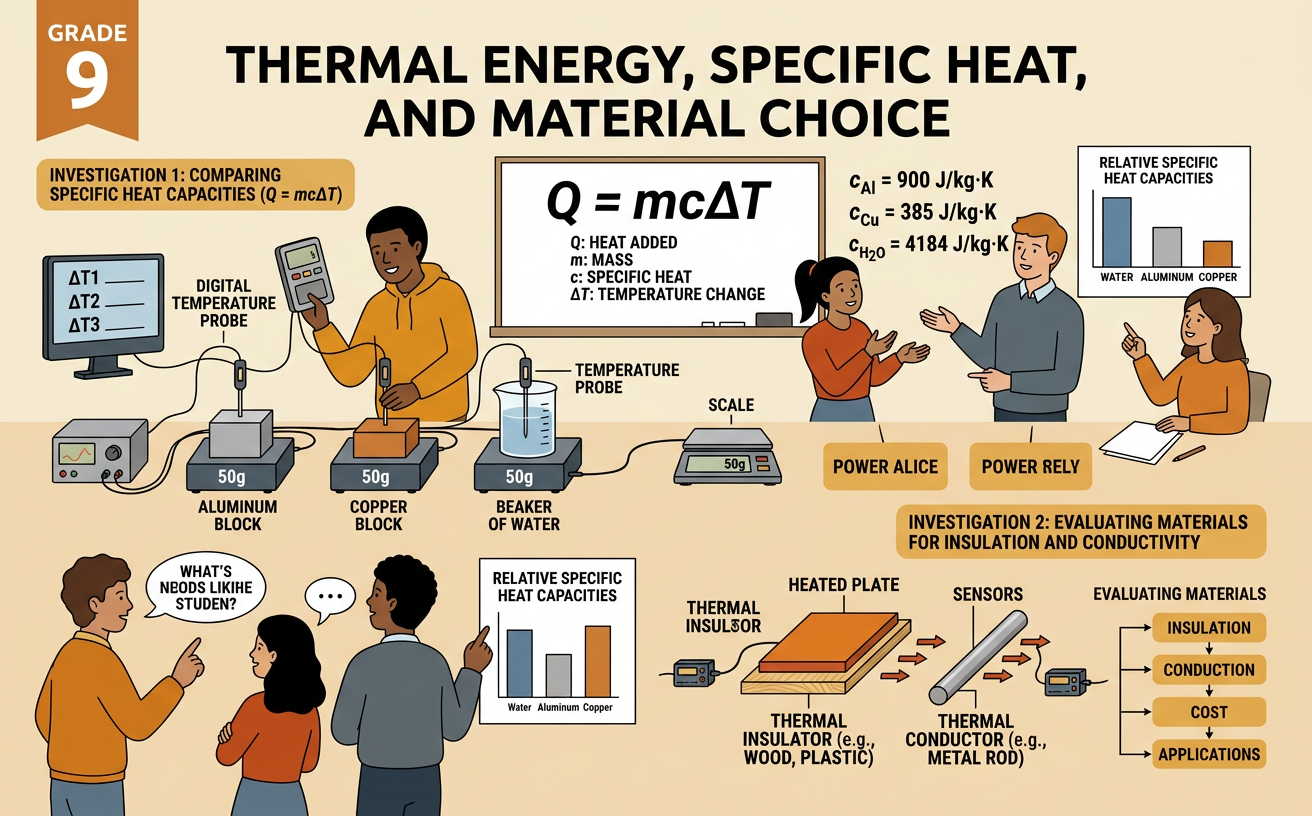
Illustrations are auto-generated and may be placeholders. They can be refreshed to match the narration.
Temperature Versus Thermal Energy
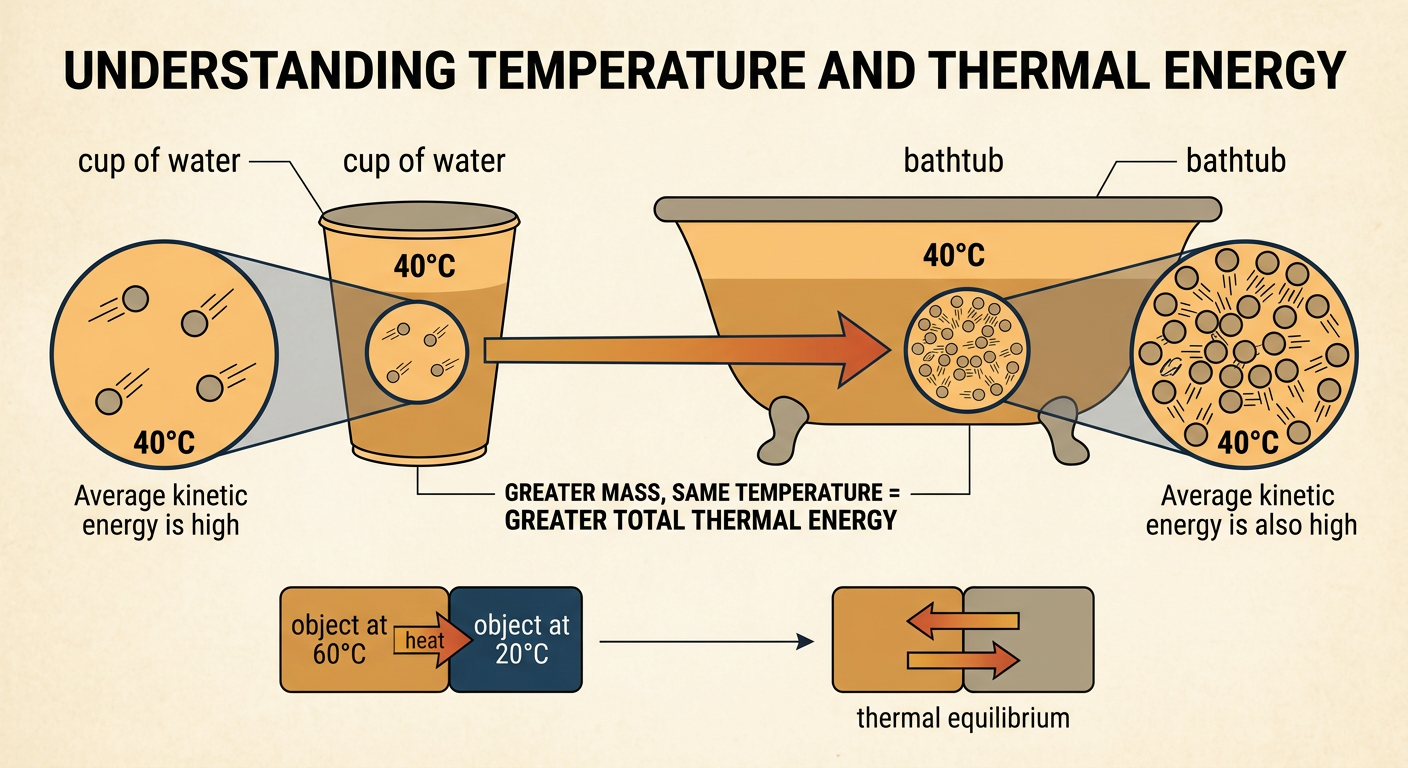
Temperature and thermal energy are related but different. Temperature measures the average kinetic energy of particles in a substance. Faster-moving particles generally mean a higher temperature. Thermal energy is the total energy associated with the motion and interactions of all the particles, so it depends on temperature, mass, and material. For example, a cup of water and a full bathtub can both be at 40°C. They have the same temperature, but the bathtub contains much more thermal energy because it has far more water. When objects at different temperatures touch, energy transfers as heat from the warmer object to the cooler object. The transfer continues until the objects reach thermal equilibrium, meaning they have the same temperature and no net heat transfer occurs between them.
Observing Heat Transfer
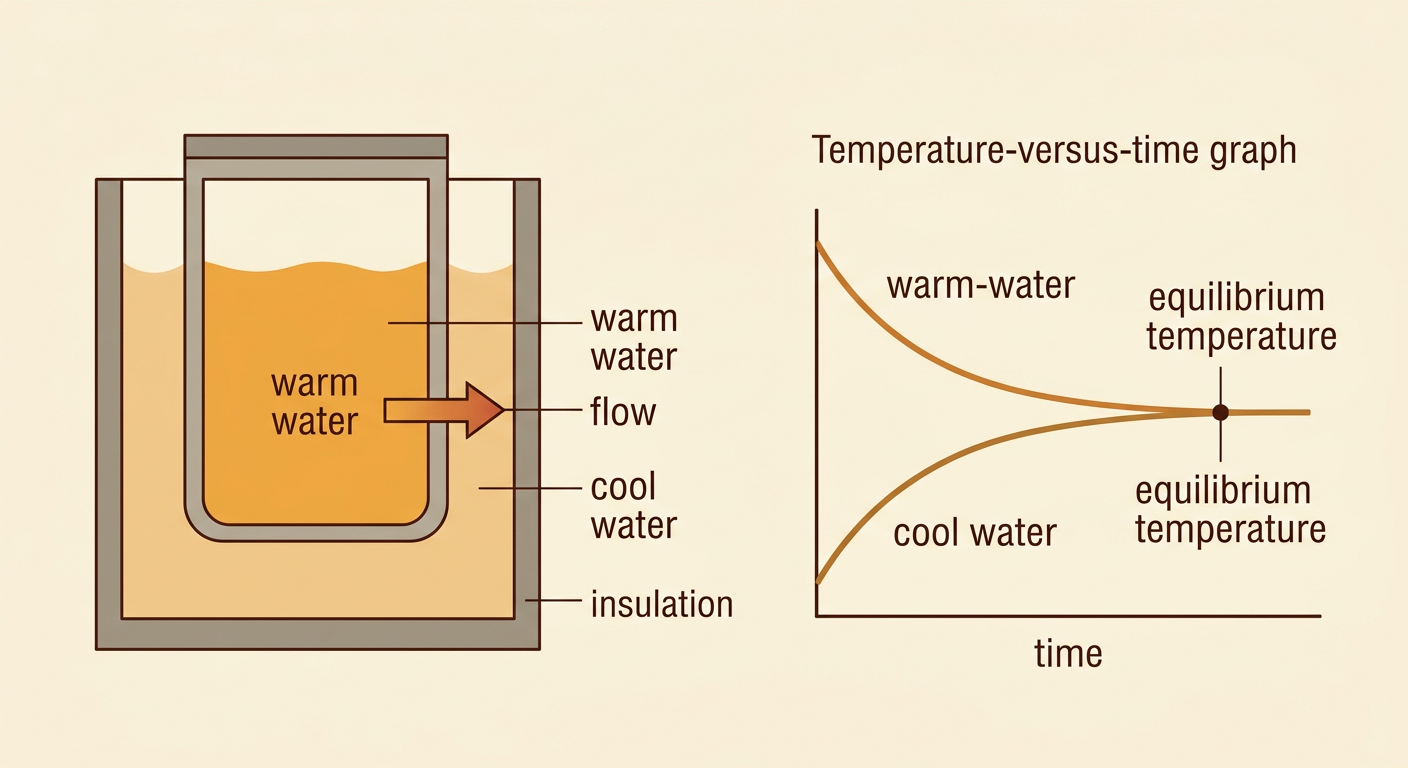
A closed-system investigation can show how thermal energy becomes more uniformly distributed. Place a sealed container of warm water inside an insulated container of cooler water without allowing the liquids to mix. Measure both temperatures at equal time intervals until they become nearly constant. Wear eye protection, handle warm water carefully, and keep the amounts of water and insulation unchanged between trials. At first, energy transfers from the warm water to the cool water through the container wall. The warm water’s temperature decreases while the cool water’s temperature increases. Ideally, the energy lost by one part equals the energy gained by the other, although real experiments may lose some energy to the surroundings. A temperature-versus-time graph should show the two curves approaching a shared equilibrium temperature.
Using the Specific Heat Equation
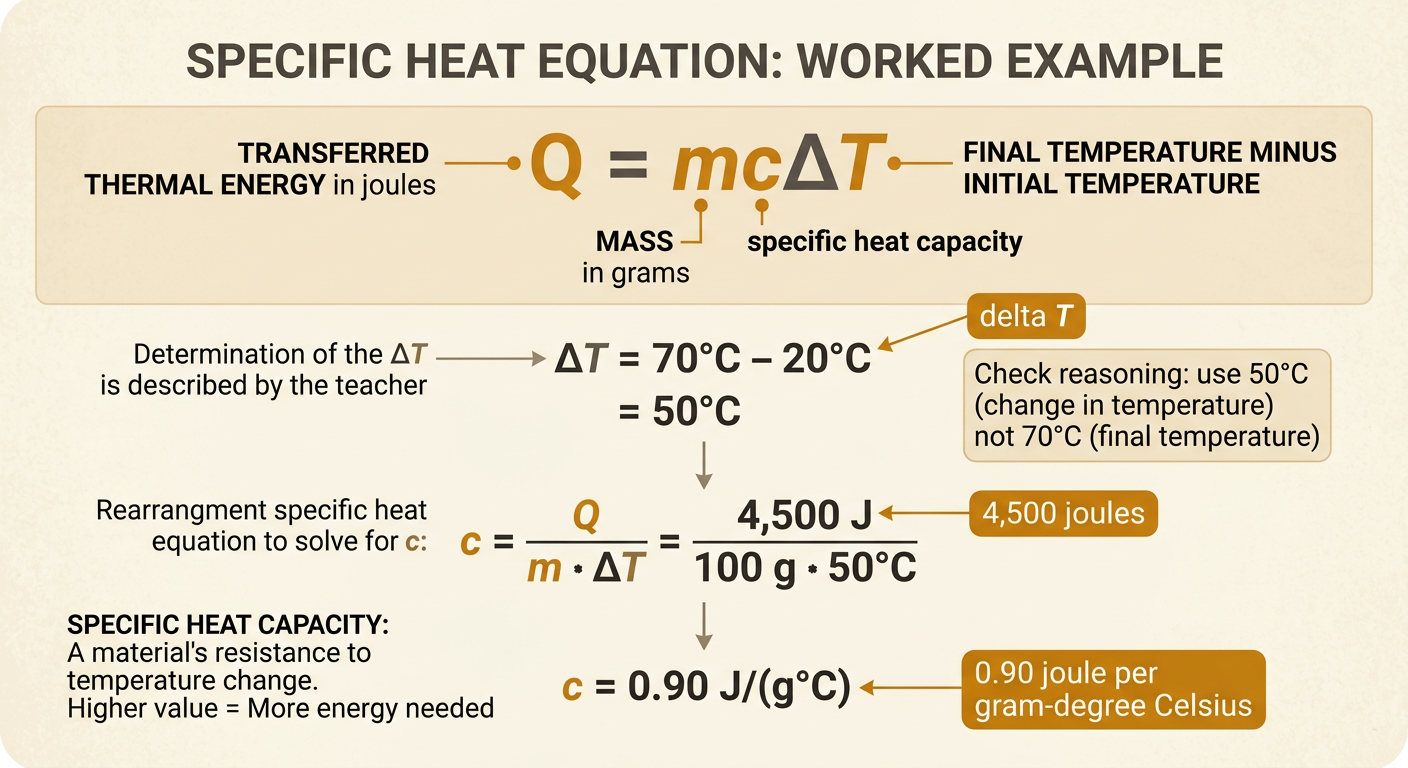
The equation Q = mcΔT describes thermal energy transfer when a material changes temperature without changing state. Q is transferred thermal energy in joules, m is mass in grams, c is specific heat capacity in joules per gram-degree Celsius, and ΔT is the temperature change, calculated as final temperature minus initial temperature. To highlight specific heat, rearrange the equation by dividing both sides by mΔT: c = Q divided by mΔT. Suppose 100 grams of a metal absorbs 4,500 joules and warms from 20°C to 70°C. Its ΔT is 50°C, so c = 4,500 divided by the product of 100 and 50. The result is 0.90 joule per gram-degree Celsius. A higher specific heat means more energy is required to produce the same temperature change.
Comparing Materials
Specific heat capacity helps predict how different materials respond to the same energy transfer. Consider equal 100-gram samples of aluminum and water that each absorb 900 joules. Aluminum has a specific heat of about 0.90 J/g°C, while liquid water has a specific heat of about 4.18 J/g°C. Using ΔT = Q divided by mc, aluminum warms by 10°C, but water warms by only about 2.2°C. Aluminum’s lower specific heat allows its temperature to change more quickly for the same mass and energy input. Water’s higher specific heat makes its temperature more stable. A fair comparison must keep mass, starting temperature, energy supplied, heating time, and container conditions controlled. Repeated trials improve confidence, and average results can be compared with accepted values to identify measurement error or heat loss.

Choosing a Material for a Real-World Use
Material choice requires balancing thermal performance, safety, durability, and cost. Imagine selecting the inner liner for a reusable food container that should heat quickly. Aluminum is a strong candidate because its relatively low specific heat allows rapid temperature change, and it conducts thermal energy well. However, it may cost more than some plastics, can become dangerously hot to touch, and may require insulation. A heat-resistant plastic may be cheaper and safer to handle, but it usually transfers thermal energy more slowly. Evaluate marginal benefits and costs by asking what is gained and sacrificed when one more dollar is spent or one more layer is added. For example, adding insulation may slightly increase manufacturing cost while greatly reducing burns and heat loss. A justified recommendation should use investigation data, specific heat calculations, price information, and the intended user’s needs.
