Thermal Energy Transfer and Insulation Design
Students use particle motion and temperature evidence to explain thermal energy transfer and evaluate an insulated-container design that reduces energy transfer.
Illustrations are auto-generated and may be placeholders. They can be refreshed to match the narration.
Temperature and Thermal Energy
Temperature and thermal energy are related, but they are not the same. Temperature measures the average kinetic energy of the particles in a substance. Faster average particle motion means a higher temperature. Thermal energy depends on temperature, the amount of matter, and the type of matter. For example, a full bathtub and a cup can both contain water at 40°C. Their temperatures are equal, but the bathtub has much more thermal energy because it contains many more water particles. When objects at different temperatures touch or interact, energy transfers from the warmer object to the cooler object. This transfer continues until the objects reach the same temperature, called thermal equilibrium. Temperature measurements provide evidence of the direction and amount of change during this process.

Particle Motion in Hot and Cold Matter
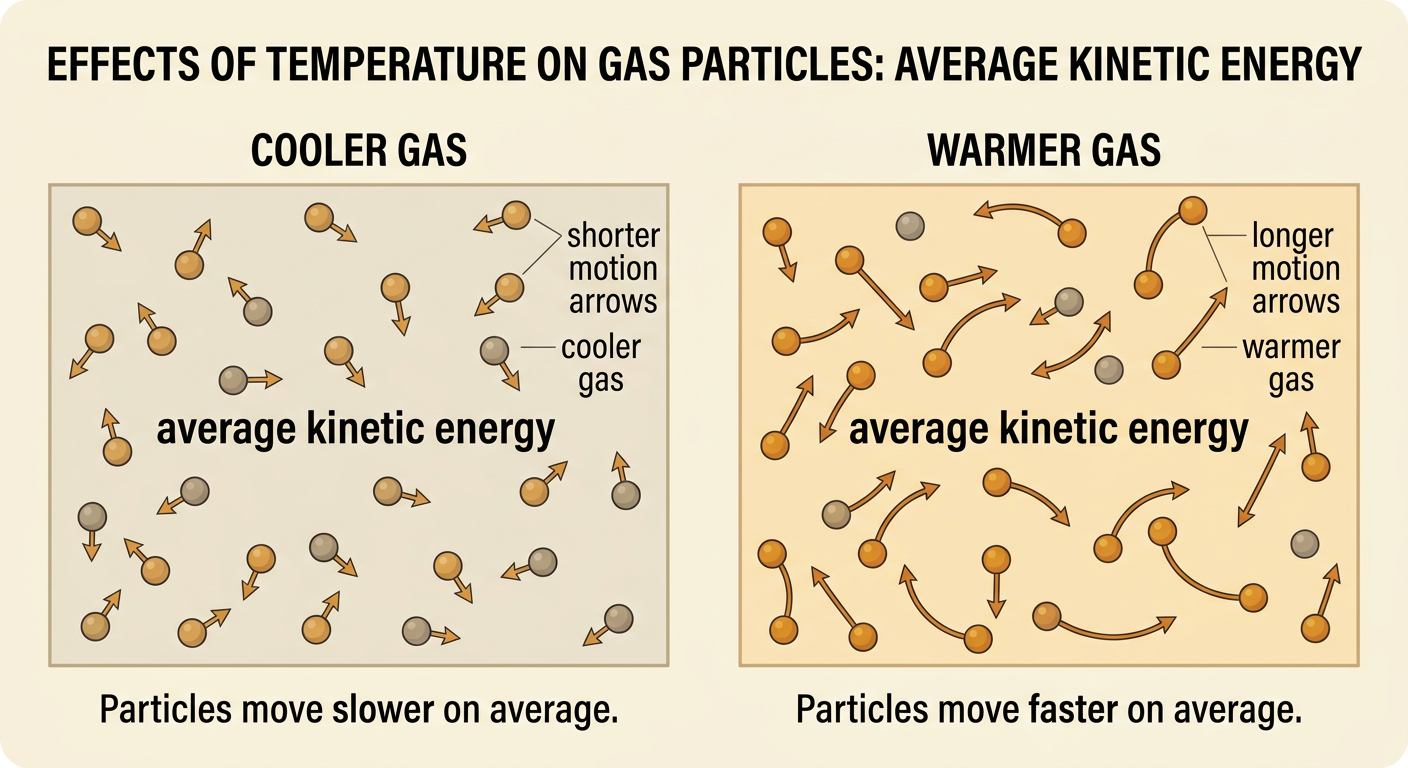
All matter is made of particles that are constantly moving. In a solid, particles vibrate around fixed positions. In a liquid, they remain close together but move past one another. In a gas, they move freely and spread throughout their container. Heating matter increases the average kinetic energy of its particles, so their motion becomes faster. Cooling matter decreases average kinetic energy, but the particles do not normally stop moving. Imagine two sealed containers holding the same amount of gas. In the warmer container, longer motion arrows represent faster average particle speeds. In the cooler container, shorter arrows represent slower speeds. Individual particles do not all move at exactly the same speed, so temperature describes the average motion of the large group rather than the motion of one particle.
Conduction, Convection, and Radiation
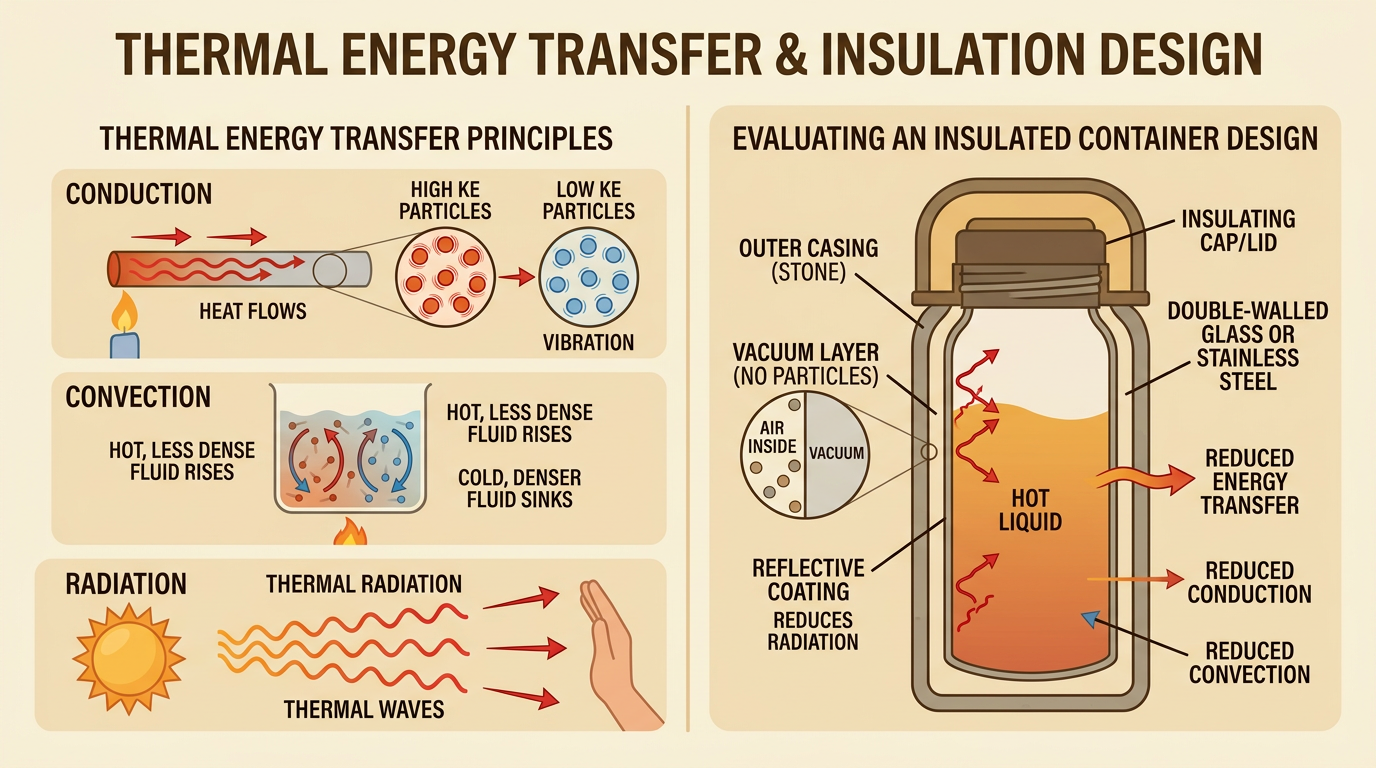
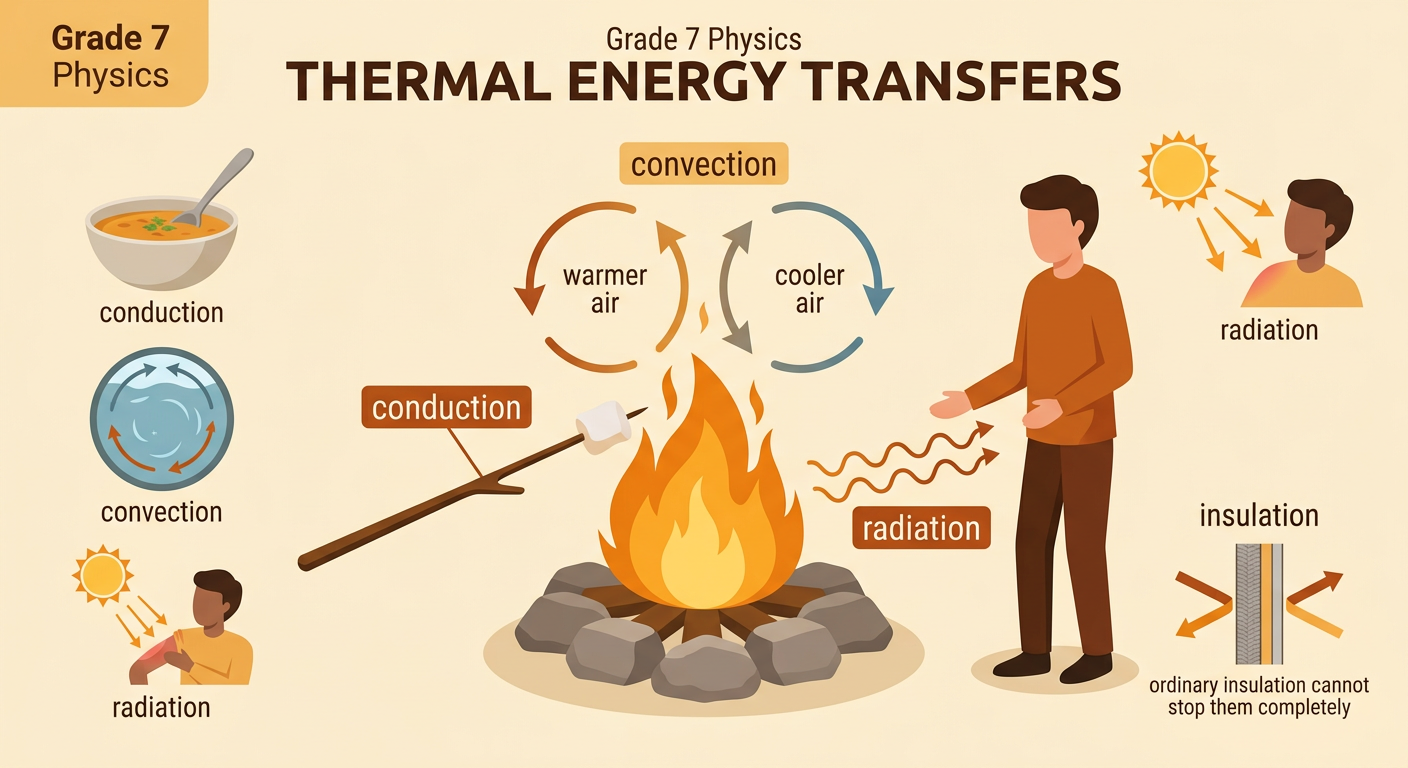
Thermal energy can transfer by conduction, convection, and radiation. Conduction occurs through direct contact as interacting particles pass energy to nearby particles. A metal spoon in hot soup becomes warm mainly by conduction. Convection occurs when warmer parts of a liquid or gas become less dense and rise while cooler, denser parts sink, creating a circulating current. Water moving in a heated pot is an example. Radiation transfers energy by electromagnetic waves and does not require matter. Sunlight warming your skin is radiation. More than one transfer process can occur at once. Near a campfire, radiation travels from the flames to your body, convection carries heated air upward, and conduction moves energy through a metal roasting stick. Insulation reduces these transfers, but no ordinary insulation stops them completely.
Investigating Temperature Change
A fair investigation changes one variable while controlling others. To test how mass affects temperature change, place 100 grams of water in one insulated cup and 200 grams in another identical cup. Begin both samples at the same temperature. Use identical heaters for the same amount of time so each sample receives approximately the same amount of energy. Measure and record each starting and ending temperature, then calculate temperature change by subtracting the starting temperature from the ending temperature. Repeat the test and average the results. If the 100-gram sample warms about twice as much as the 200-gram sample, the data support an inverse proportional relationship between mass and temperature change when transferred energy and material remain constant. A graph should place mass on the horizontal axis and temperature change on the vertical axis. Follow safety directions when handling heaters and hot water.

Designing Effective Insulation
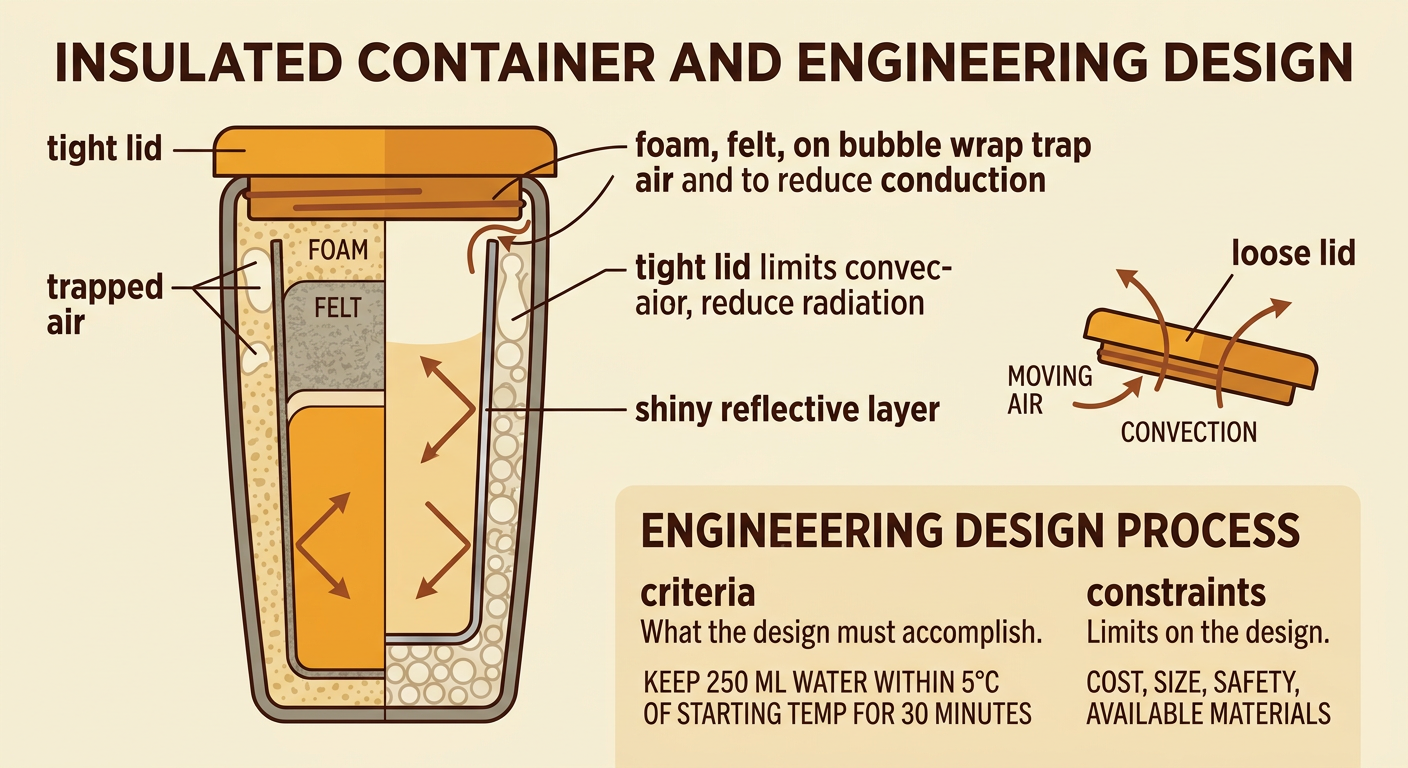
An insulated container is designed to reduce thermal energy transfer between its contents and the surroundings. Engineers first identify criteria, such as keeping 250 milliliters of water within 5°C of its starting temperature for 30 minutes. They also identify constraints, such as cost, size, safety, and available materials. Trapped air in foam, felt, or bubble wrap reduces conduction because air is a poor conductor when it cannot circulate freely. A tight lid limits convection caused by moving air, and a shiny reflective layer can reduce radiation. Students can build several containers, add equal amounts of water at the same starting temperature, and measure temperature every five minutes. The design with the smallest temperature change reduces energy transfer most effectively. Repeated trials, equal testing conditions, and careful measurements make the comparison more reliable. Test results should guide each redesign.
Energy-Saving Trade-Offs
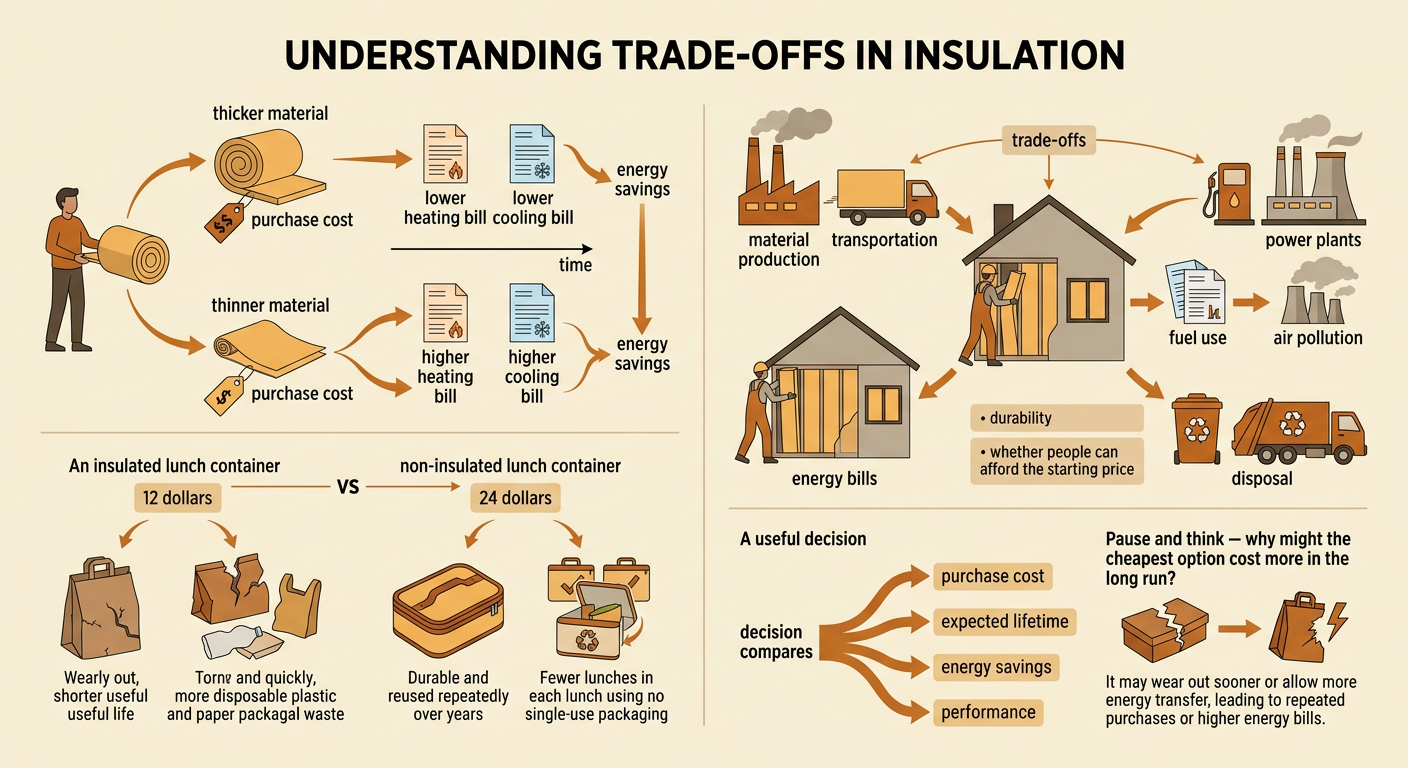
Choosing insulation involves economic and environmental trade-offs. A thicker or more effective material may cost more at first, but it can reduce the energy needed for heating or cooling over time. For example, an insulated lunch container may cost $24 instead of $12, yet it can be reused for years and may reduce the need for disposable packaging. For a building, improved wall insulation can lower utility bills and reduce fuel use, benefiting both households and society through lower air pollution and demand on energy systems. However, decision makers must also consider durability, material production, transportation, disposal, and whether families can afford the initial price. A useful comparison includes purchase cost, expected lifetime, energy savings, and performance. The best choice is not always the cheapest item; it is the option that meets the design need while balancing long-term costs and benefits.