
Thermal Energy Transfer and Insulation
Students analyze temperature data to explain how conduction, convection, and radiation transfer thermal energy and how insulation reduces energy transfer.

Illustrations are auto-generated and may be placeholders. They can be refreshed to match the narration.
Temperature and Particle Motion
All matter is made of particles that are constantly moving. Temperature measures the average kinetic energy of those particles. When a substance is heated, its particles generally move faster, and its temperature rises. Thermal energy depends on temperature, mass, and the type of matter. For example, a large pot of water and a small cup of water can have the same temperature, but the pot contains more thermal energy because it has more water. When a warm object touches a cooler object, energy transfers from the faster-moving particles to the slower-moving particles until their temperatures become closer. In an investigation, students can change one factor, such as the mass of water, while keeping the container and heat source the same. Temperature measurements then provide evidence about changes in average particle motion.

Three Methods of Thermal Energy Transfer
Thermal energy transfers by conduction, convection, and radiation. Conduction occurs when particles transfer energy through direct contact. A metal spoon becomes hot when it rests in a pot of hot soup because energy moves through the metal. Convection occurs in liquids and gases when warmer, less dense material rises and cooler, denser material sinks, creating a circulating current. Water moving inside the heated pot is an example. Radiation transfers energy by electromagnetic waves and does not require matter. You can feel radiation from a hot stove without touching it. In the pot example, radiation travels from the heating element, conduction moves energy through the metal pot and spoon, and convection circulates energy through the soup. More than one transfer method can occur at the same time in a system.

Comparing Insulating Materials
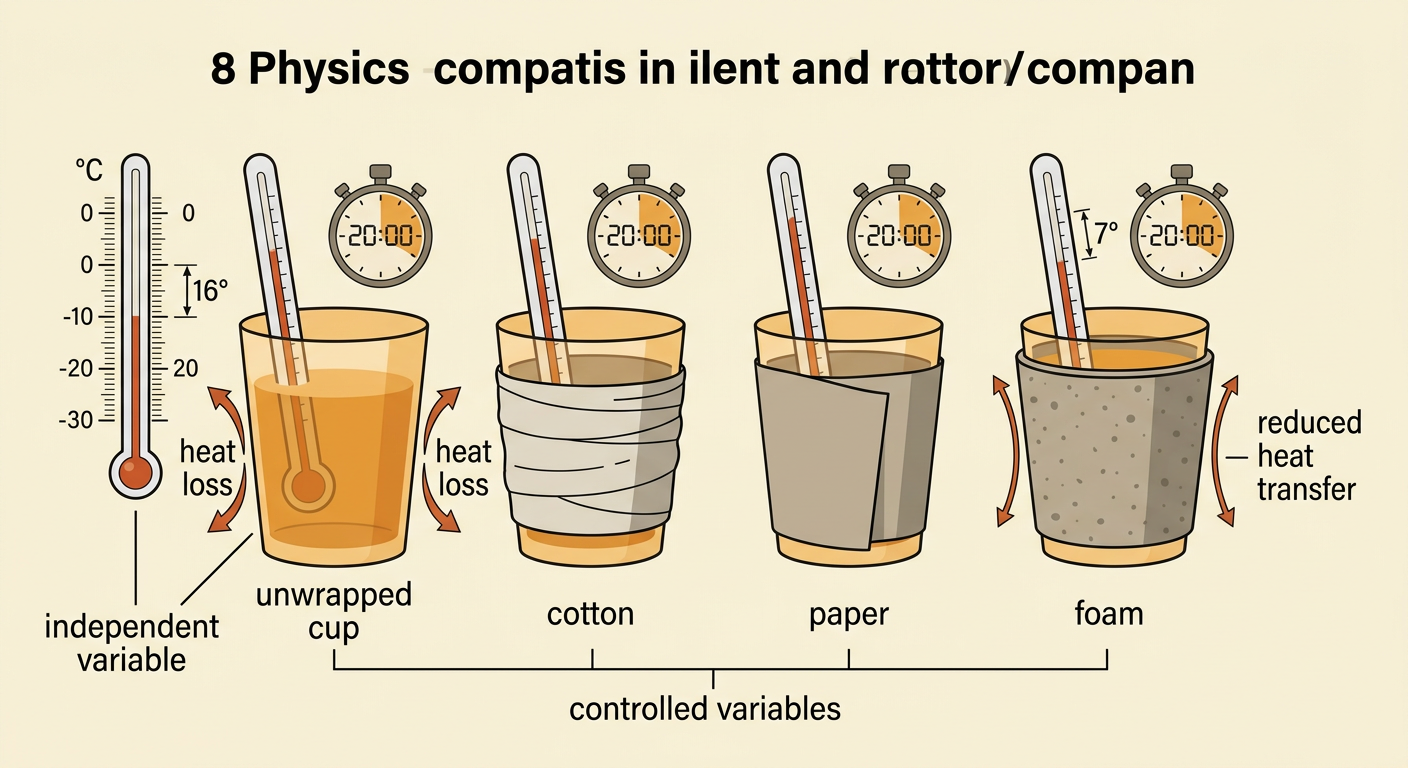
An insulator reduces the rate of thermal energy transfer. Students can compare materials by wrapping identical cups with equal thicknesses of cotton, foam, paper, or another safe material. Each cup should contain the same mass of water at the same starting temperature. The cups should also be placed in the same location and measured at equal time intervals. The independent variable is the insulating material, and the dependent variable is the water temperature. Cup size, water mass, starting temperature, and measurement time are controlled variables. After 20 minutes, suppose the unwrapped cup cools by 16°C while a foam-wrapped cup cools by 7°C. Under those test conditions, the foam reduced energy transfer more effectively. Repeated trials and average results make the conclusion more reliable and help reveal unusual measurements.
Graphing Temperature Change
A temperature-versus-time graph shows how quickly an object gains or loses thermal energy. Time is the independent variable on the horizontal axis, and temperature is the dependent variable on the vertical axis. Suppose uninsulated water measures 80°C at 0 minutes, 75°C at 5 minutes, 70°C at 10 minutes, and 65°C at 15 minutes. Over this short interval, the data follow the linear model T = -1t + 80, where T is temperature in degrees Celsius and t is time in minutes. The initial value, 80°C, is the starting temperature. The slope, -1°C per minute, is the rate of temperature change. A negative slope means cooling. Real cooling may not remain linear for a long time, but a line can model a limited interval. A flatter negative slope indicates slower cooling and more effective insulation.

Choosing an Energy-Efficient Insulator
Choosing insulation requires considering performance, price, durability, safety, and environmental effects. The material that slows energy transfer the most may not be the best choice in every situation. For example, suppose a school estimates that fiberglass insulation will cost $4,000 and save $900 in energy costs each year. A rigid foam option will cost $6,000 and save $1,100 each year. Fiberglass has the lower initial cost, while rigid foam provides greater estimated yearly savings. Decision makers should also compare useful life, maintenance, moisture resistance, fire-safety requirements, disposal, and impacts from manufacturing. Students can use experimental cooling rates as evidence of thermal performance and calculate long-term costs and benefits. School leaders, taxpayers, building workers, and students may be affected differently. A well-supported recommendation clearly identifies the chosen criteria and explains why the benefits outweigh the costs for the school and society.
