Thermal Energy Transfer and Specific Heat
Students analyze temperature changes in a closed system to explain how energy transfers between materials and how specific heat affects the resulting equilibrium temperature.

Illustrations are auto-generated and may be placeholders. They can be refreshed to match the narration.
Temperature Versus Thermal Energy
Temperature and thermal energy are related but are not the same quantity. Temperature measures the average kinetic energy of particles in a material. Thermal energy is part of a material’s internal energy and depends on temperature, amount of matter, and the type and state of the material. For example, a small cup of water and a full bathtub can both be at 40°C. Their particles have the same average kinetic energy, so their temperatures are equal. However, the bathtub contains many more particles and therefore has much more thermal energy. Similarly, equal masses of different materials at the same temperature can store different amounts of energy because their specific heats differ. Temperature predicts the direction of energy transfer: energy moves spontaneously from a higher-temperature object to a lower-temperature object until their temperatures become equal.

Heat Transfer in a Closed System
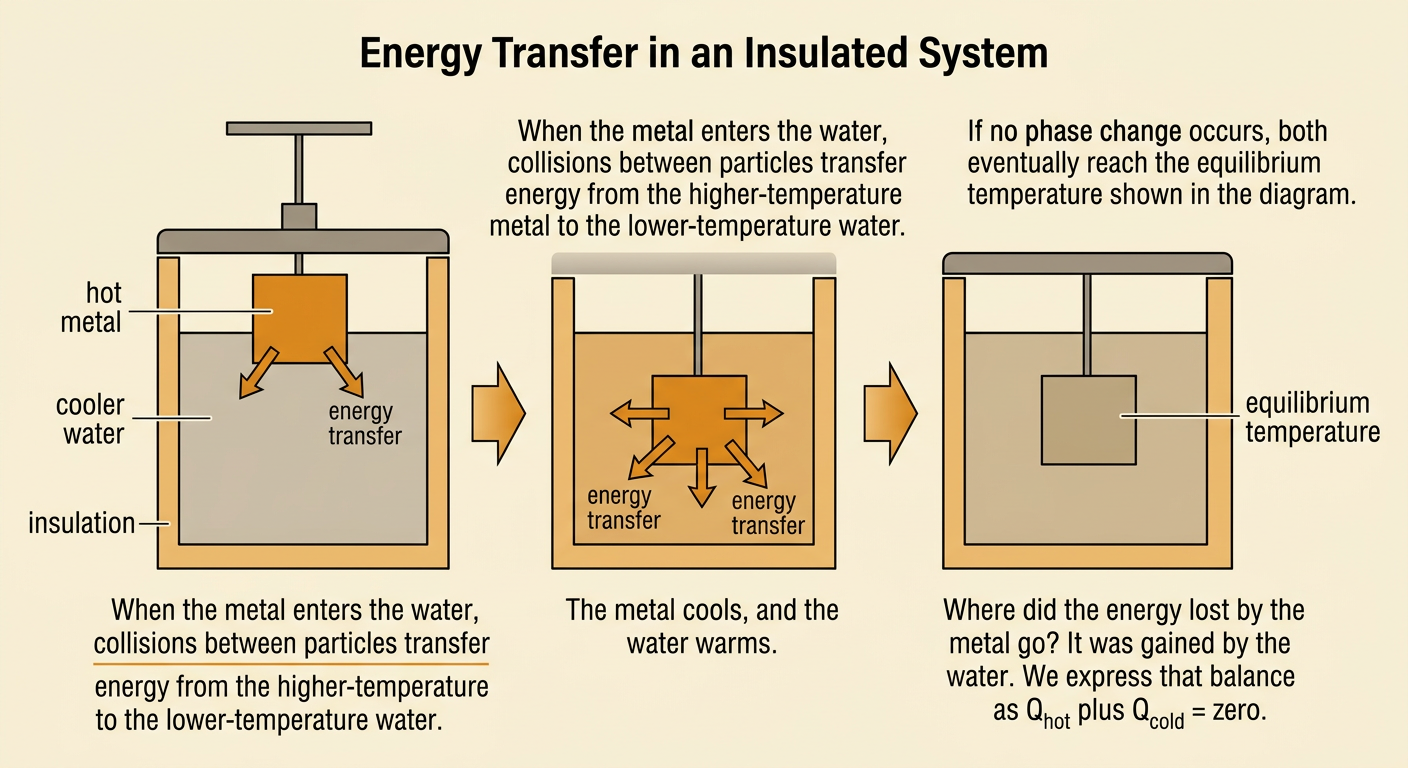
A closed system does not exchange matter with its surroundings. In an ideal insulated closed system, it also transfers negligible energy to the surroundings, so the system’s total energy remains constant. When a hot metal block is placed in cooler water inside an insulated container, energy transfers from the metal to the water through particle collisions. The metal’s temperature decreases while the water’s temperature increases. If no phase change occurs, both eventually reach the same equilibrium temperature. The energy lost by the hot component equals the energy gained by the cold component, which can be written as Qhot + Qcold = 0. Real investigations may show small differences because containers, thermometers, and surrounding air can absorb energy. Using a lid, insulation, and rapid measurements reduces these unwanted transfers and provides stronger evidence for energy conservation.
Using Q = mcΔT
The thermal energy transferred during a temperature change can be calculated with Q = mcΔT. In this equation, Q is energy transferred in joules, m is mass in kilograms, c is specific heat in joules per kilogram per degree Celsius, and ΔT = Tfinal − Tinitial. A positive Q indicates that a material gained energy, while a negative Q indicates that it lost energy. For example, heating 0.20 kg of aluminum from 20°C to 30°C, using c = 900 J/(kg·°C), requires Q = (0.20)(900)(10) = 1,800 J. The formula can be rearranged to highlight an unknown quantity: c = Q/(mΔT), m = Q/(cΔT), or ΔT = Q/(mc). These forms allow investigators to determine a material’s specific heat, required mass, or expected temperature change from measured data.

Predicting Thermal Equilibrium
An equilibrium temperature can be predicted by combining energy conservation with Q = mcΔT. Assume that 0.10 kg of copper at 100°C is placed in 0.20 kg of water at 20°C in a perfectly insulated container. Copper has a specific heat of about 385 J/(kg·°C), while water has a specific heat of about 4,186 J/(kg·°C). Set the copper’s energy loss plus the water’s energy gain equal to zero: mcopperccopper(Tf − 100) + mwatercwater(Tf − 20) = 0. Solving gives Tf ≈ 23.5°C. The result lies between the two initial temperatures, as expected. It is much closer to the water’s initial temperature because the water has a much larger total heat capacity, mc. This prediction assumes no phase changes and negligible energy absorption by the container or surroundings.

Evaluating Insulation and Energy Efficiency
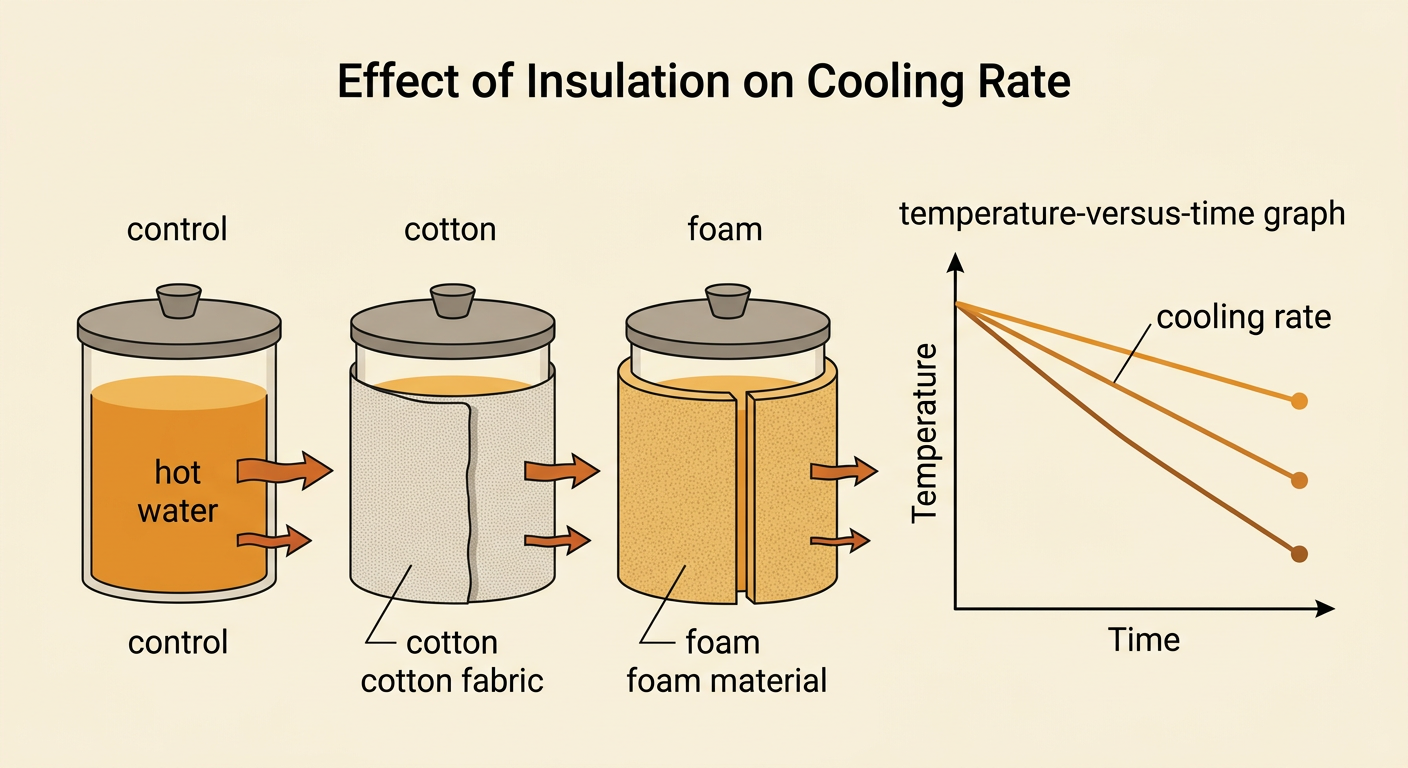
Insulation slows thermal energy transfer by reducing conduction, convection, and radiation. Students can compare insulating materials by placing equal amounts of hot water at the same initial temperature in identical covered containers. One container might be wrapped in foam, another in cotton, and a third left unwrapped as a control. Measuring temperature at regular time intervals reveals each cooling rate. The most effective insulation produces the smallest temperature decrease and the least steep temperature-versus-time graph. A fair test keeps water mass, container type, starting temperature, room conditions, and measurement times constant. Insulation can reduce energy use in homes, refrigerators, and transportation, but decisions also involve cost, durability, safety, environmental effects, and available space. Combining physics data with economic and environmental perspectives helps communities choose practical ways to reduce energy loss without assuming that the thickest or most expensive material is always best.