
Thermochemistry, Calorimetry, and Energy Transfer
Students use calorimetry data and energy diagrams to distinguish endothermic and exothermic processes, calculate heat transfer, and connect chemical energy changes to human energy choices.
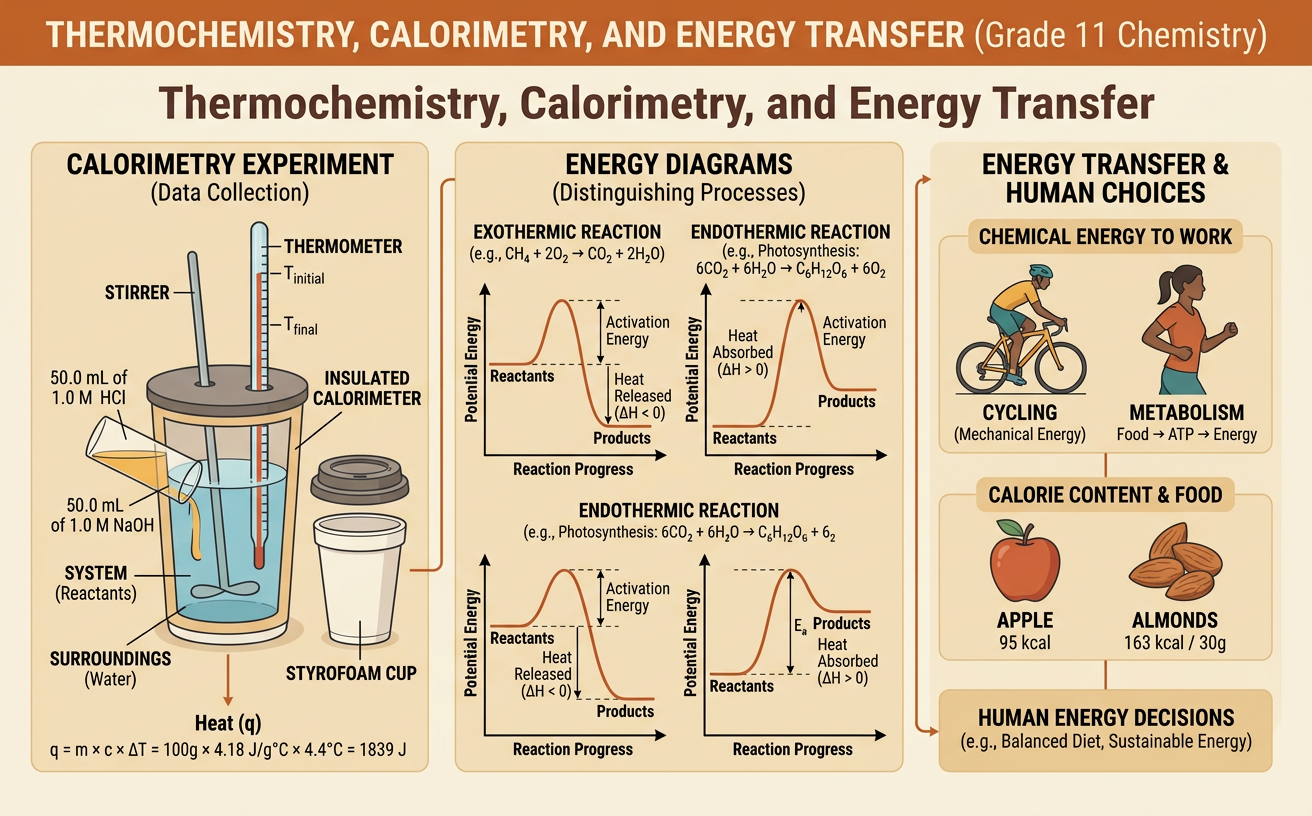
Illustrations are auto-generated and may be placeholders. They can be refreshed to match the narration.
Heat, Temperature, and System Boundaries
Temperature measures the average kinetic energy of particles, while heat is energy transferred because of a temperature difference. Heat naturally moves from a warmer object to a cooler one until they reach thermal equilibrium. To track this transfer, define a system, the matter or process being studied, and the surroundings, everything outside it. The boundary separates them and may allow energy, matter, or both to cross. For example, when a hot metal block is placed in cool water inside an insulated cup, the metal may be defined as the system. Energy leaves the metal as heat and enters the water, but ideally little energy escapes the cup. A clear system boundary prevents confusion about whether heat is entering or leaving and determines the sign assigned to energy change.

Endothermic and Exothermic Processes
An endothermic process absorbs heat from the surroundings, so the system has a positive heat value, q > 0. An exothermic process releases heat to the surroundings, so the system has a negative heat value, q < 0. During an instant cold-pack reaction, the dissolving chemicals absorb energy from the pack and a person’s skin, making the surroundings feel colder. This is endothermic. In contrast, a hand warmer often uses iron oxidation to release energy, so the pack and nearby skin become warmer. This is exothermic. A temperature increase in the surroundings usually indicates that the system released heat, while a decrease usually indicates that the system absorbed heat. Always identify the system before assigning a sign because the same transfer has opposite signs for the system and surroundings.

Reading Potential Energy Diagrams
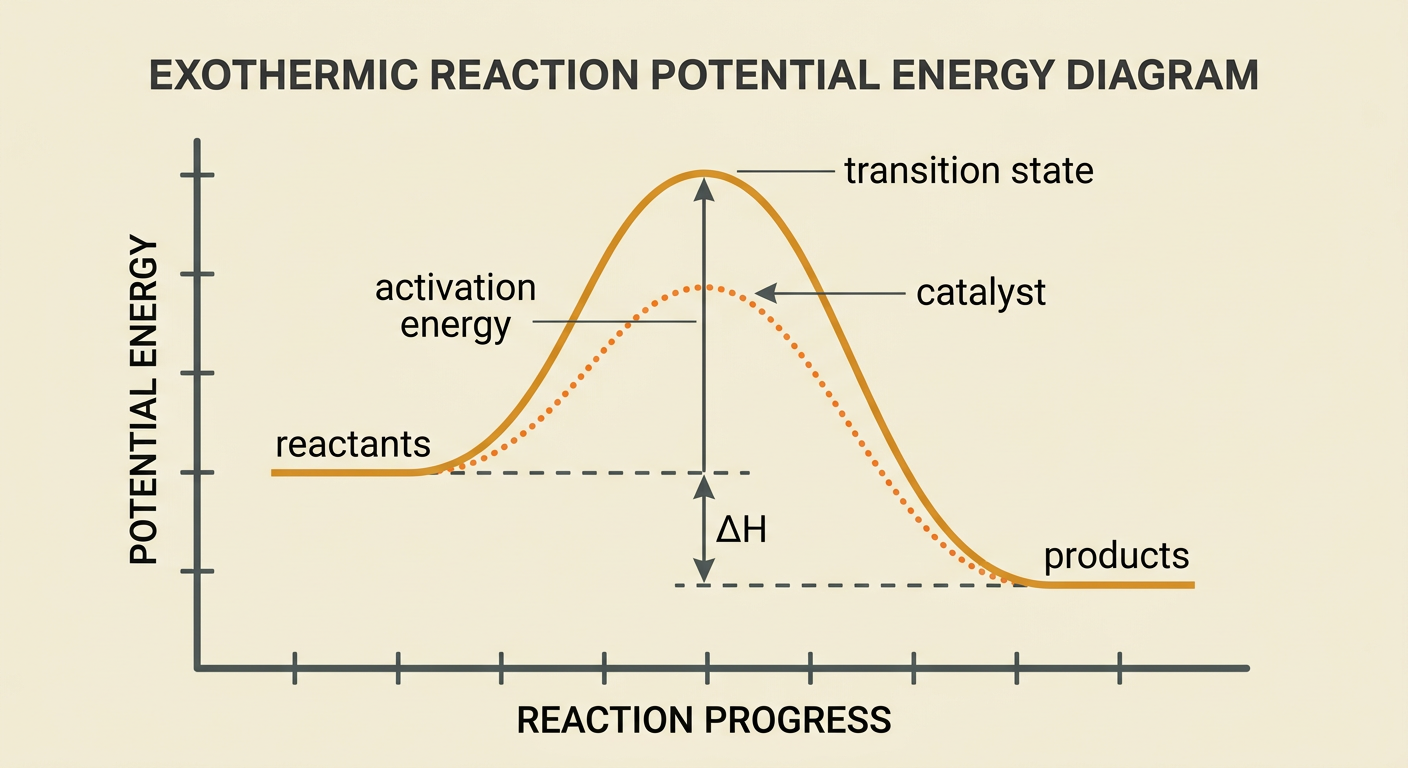
A potential energy diagram plots the system’s potential energy against reaction progress. Reactants appear on the left and products on the right. The vertical difference between them is the enthalpy change, ΔH. If products are lower than reactants, ΔH is negative and the reaction is exothermic. If products are higher, ΔH is positive and the reaction is endothermic. The curve’s peak represents the transition state, and the energy from the reactant level to the peak is the activation energy, Ea. For example, methane combustion has products at lower potential energy than its reactants and releases energy overall, but it still needs a spark to overcome its activation-energy barrier. A catalyst lowers the activation energy without changing the energies of the reactants, products, or ΔH.
Calorimetry and q = mcΔT
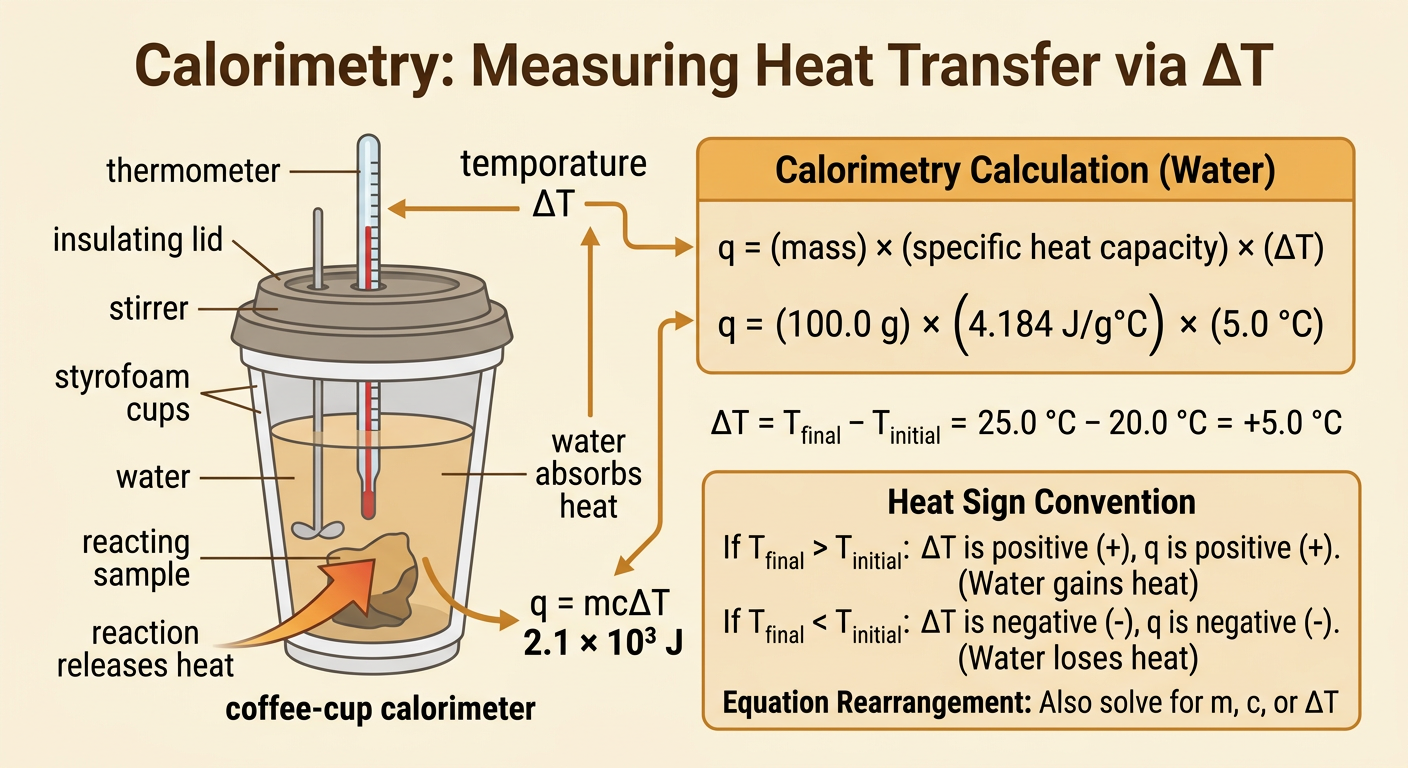
Calorimetry measures heat transfer by recording a temperature change in a substance with a known mass and specific heat capacity. The relationship is q = mcΔT, where q is heat in joules, m is mass in grams, c is specific heat capacity in joules per gram-degree Celsius, and ΔT = Tfinal − Tinitial. Suppose 100.0 g of water warms from 20.0°C to 25.0°C. Using c = 4.184 J/(g·°C), q = (100.0 g)(4.184 J/(g·°C))(5.0°C) = 2.1 × 10³ J. The water absorbs positive heat. The formula can be rearranged to highlight another unknown: c = q/(mΔT), m = q/(cΔT), or ΔT = q/(mc). Accurate results require careful temperature measurement and reduced heat exchange with the environment.
Energy Conservation Calculations
Energy conservation requires that energy lost by one part of an isolated system equals energy gained by another. In a calorimetry model, qsystem + qsurroundings = 0, so qsystem = −qsurroundings. Suppose a reaction warms 50.0 g of water from 22.0°C to 28.0°C. The water gains qwater = (50.0 g)(4.184 J/(g·°C))(6.0°C) = 1.26 × 10³ J. Therefore, the reaction loses the same amount: qreaction = −1.26 × 10³ J. If 0.0200 mol reacted, the molar energy change is (−1.26 kJ)/(0.0200 mol) = −63 kJ/mol. The negative sign indicates an exothermic reaction. Real calorimeters may also absorb heat, so a more complete model includes the calorimeter term: qreaction + qwater + qcalorimeter = 0.

Chemical Energy and Human Choices
Chemical fuels store energy that can be transferred during reactions, but useful energy, environmental effects, cost, and location all influence human choices. Burning gasoline is exothermic and powers transportation, yet it releases carbon dioxide and other pollutants. Batteries transfer chemical energy to electrical energy without combustion at the point of use, although mining, manufacturing, electricity generation, and recycling still require energy and resources. Hydrogen fuel cells produce electricity and water during operation, but hydrogen production may use fossil fuels or renewable electricity. A fair comparison can calculate energy delivered per unit mass, cost, or amount of carbon dioxide emitted. Geography also matters: sunny regions may support solar-powered charging, while communities near mines, refineries, or busy roads may experience environmental burdens. Human energy demand changes physical systems, and resource availability, climate, and landforms shape human decisions in return.
