Three Mile Island: Nuclear Energy, Public Risk, and Government Regulation
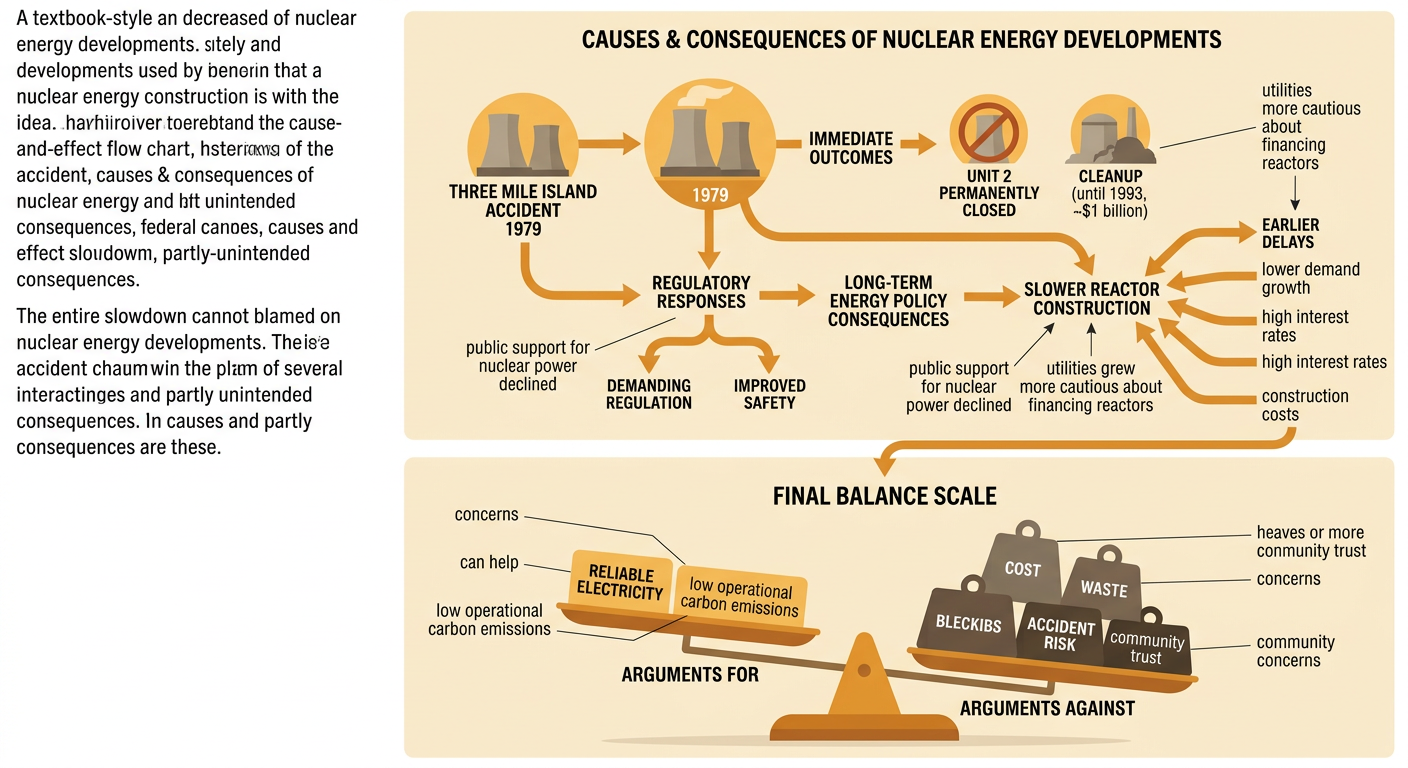
Students examine how the 1979 Three Mile Island accident shaped public perceptions of nuclear power, federal safety regulation, and debates over energy policy.
Illustrations are auto-generated and may be placeholders. They can be refreshed to match the narration.
Nuclear Power in the 1970s
During the 1970s, U.S. leaders promoted nuclear power as a way to meet rising electricity demand and reduce dependence on imported oil. Commercial reactors generated heat through nuclear fission, producing steam that turned turbines without directly burning fossil fuels. Supporters emphasized reliable electricity and low air pollution, while critics raised concerns about radioactive waste, reactor accidents, and high construction costs. The 1973 oil embargo strengthened arguments for developing domestic energy sources. At the same time, growing environmental activism increased public scrutiny of large technological systems. Federal oversight also changed: the Energy Reorganization Act of 1974 replaced the Atomic Energy Commission with separate agencies, including the Nuclear Regulatory Commission, which began operating in 1975. For example, separating nuclear promotion from safety regulation was intended to reduce conflicts of interest and strengthen public confidence.

What Happened at Three Mile Island?
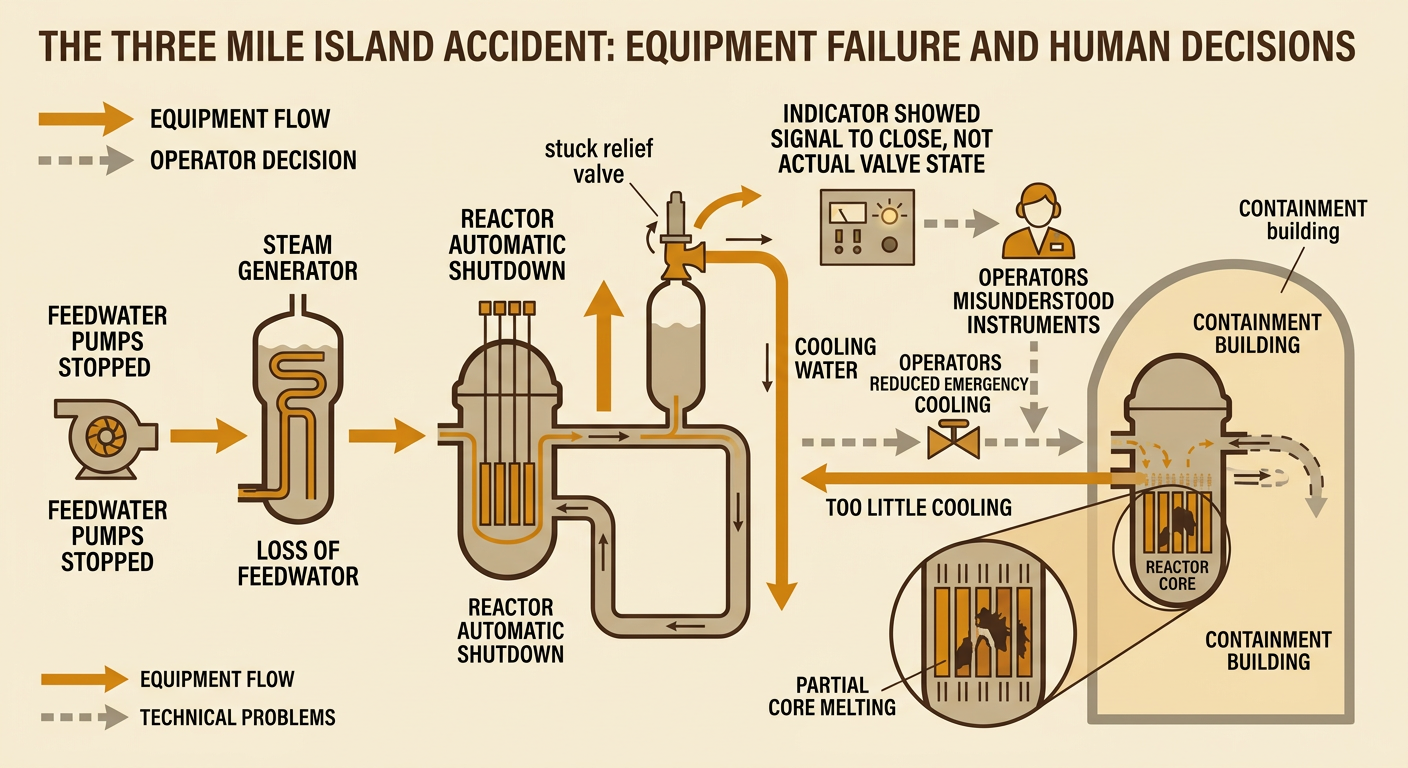
On March 28, 1979, a malfunction began at Three Mile Island Unit 2 near Harrisburg, Pennsylvania. After pumps stopped supplying water to the steam generators, the reactor shut down automatically. Pressure increased, causing a relief valve to open, but the valve became stuck open and allowed cooling water to escape. A control-room indicator showed that a signal had been sent to close the valve, not whether the valve had actually closed. Operators misread other instruments and reduced emergency cooling because they feared the reactor contained too much water. Without sufficient cooling, part of the reactor core melted. The containment building held most radioactive material, and the reactor did not explode like a nuclear weapon. The sequence illustrates how equipment failure, confusing controls, and human decisions combined to produce an unintended technological disaster.
Interpreting Radiation and Risk Data
Radiation risk must be interpreted using quantities, comparisons, and uncertainty. The Nuclear Regulatory Commission estimated that about two million nearby residents received an average additional dose of roughly 1 millirem from the accident. The estimated maximum dose to a person at the site boundary was less than 100 millirem above normal background exposure. For comparison, average natural background radiation in the United States is about 300 millirem per year, although it varies by location. Students can place these values on a bar graph, but they should not conclude that equal-sized doses always create identical risks; dose rate, exposure pathway, and uncertainty also matter. Major reviews found no immediate deaths or injuries from radiation and no clearly detectable increase in cancer attributable to the releases. This does not mean the accident had zero risk; it means any health effect was too small to separate confidently from ordinary variation.
Media Coverage and Public Trust
Three Mile Island became a national media event because officials, plant operators, scientists, and reporters sometimes provided incomplete or conflicting information. The accident occurred only 12 days after the release of The China Syndrome, a film about safety problems at a fictional nuclear plant, which made the real event seem especially alarming. On March 30, Pennsylvania Governor Dick Thornburgh advised pregnant women and preschool children within five miles of the plant to leave temporarily. Many other residents also departed voluntarily. News images of traffic, cooling towers, and worried families communicated fear even when measured radiation levels were low. Some uncertainty was unavoidable because experts were still learning what had happened inside the reactor. However, unclear explanations weakened trust. A useful source comparison might place an official statement, a television report, and a resident interview side by side to identify differences in evidence, tone, and claims.

Federal Regulation and Energy Policy
The accident led government and industry leaders to reconsider reactor design, operator training, emergency communication, and oversight. President Jimmy Carter appointed a commission led by John Kemeny to investigate the event. The Nuclear Regulatory Commission increased attention to human factors, strengthened operator licensing and training, expanded on-site inspection, and required improved emergency planning. Emergency planning zones generally covered about 10 miles for airborne exposure and 50 miles for possible contamination of food and water. The nuclear industry also created the Institute of Nuclear Power Operations to evaluate plant performance and share safety practices. These changes were intended to prevent accidents and improve responses if one occurred. They also increased operating costs and regulatory demands. For example, full-scale emergency exercises improved coordination among plants, state agencies, and local governments, but they required substantial staffing, planning, and public resources.

Evaluating the Accident’s Long-Term Impact
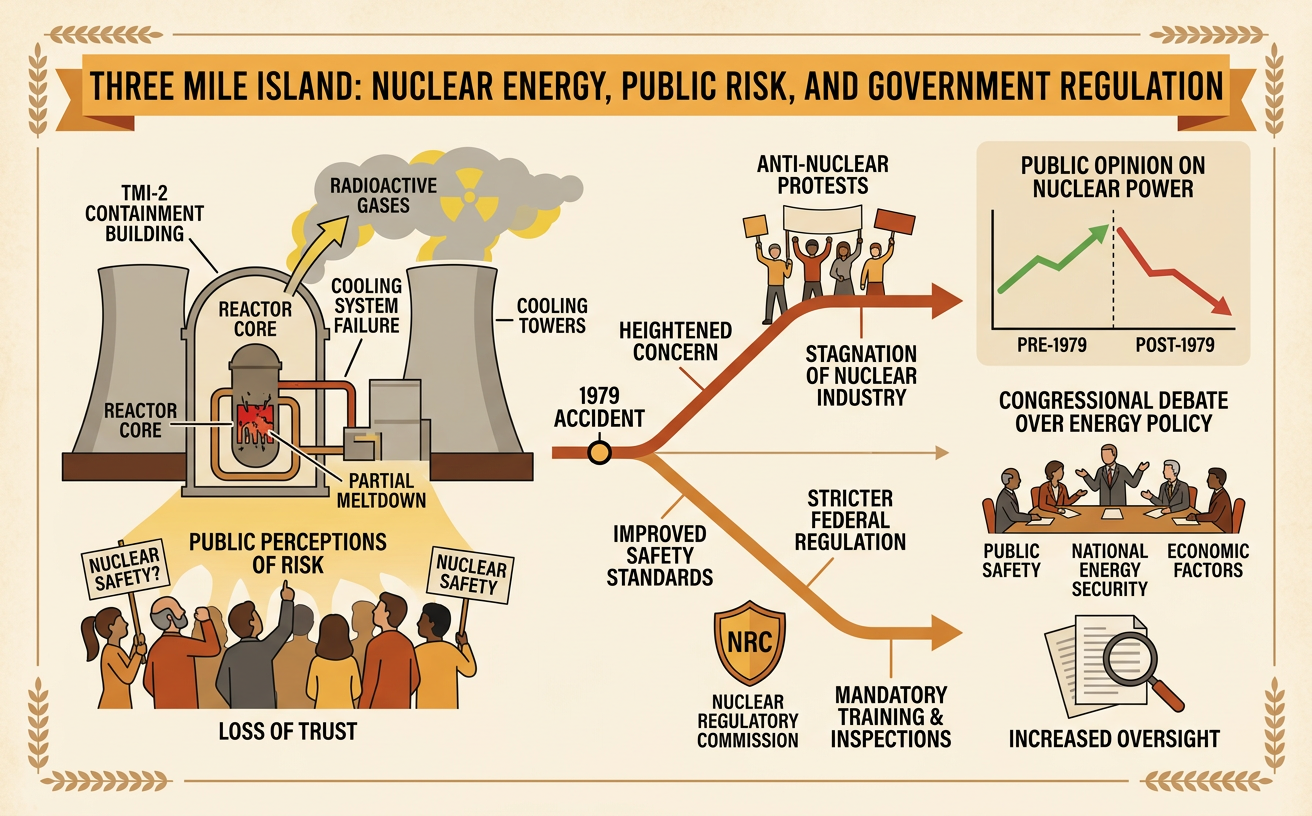
Three Mile Island had effects far beyond its limited radiation release. Unit 2 never reopened, and cleanup continued until 1993 at a cost of about $1 billion. Public support for nuclear power declined, regulation became more demanding, and utilities became more cautious about financing reactors. However, the accident was not the only reason new construction slowed. High interest rates, rising construction costs, lower electricity-demand growth, and earlier project delays also contributed. This distinction prevents a single-cause explanation of a complex historical change. Safety reforms were an intended result, while increased costs, canceled projects, and deeper public distrust were partly unintended consequences. Today, the event remains relevant to debates over climate change and energy policy. Nuclear plants produce low operational carbon emissions, but they require strong safety systems, secure waste management, and public oversight. Evaluating nuclear energy therefore involves balancing environmental benefits, economic costs, accident risks, and community trust.