Tracing Common Ancestry: Fossils, Anatomy, and DNA
Students compare fossil, anatomical, and molecular evidence to construct an evidence-based explanation of common ancestry among species.

Illustrations are auto-generated and may be placeholders. They can be refreshed to match the narration.
What Counts as Evidence of Common Ancestry?
Evidence of common ancestry is observable information that helps scientists test whether species inherited traits from shared ancestors. Important lines of evidence include fossils, homologous body structures, embryonic patterns, geographic distribution, and similarities in DNA and proteins. A single similarity is not always enough because unrelated species can independently evolve similar adaptations. A stronger explanation forms when several independent sources point to the same relationship. For example, modern whales have forelimb bones arranged like those of other mammals, carry DNA sequences similar to those of hoofed mammals, and appear after fossils showing gradual changes from land-dwelling mammals to aquatic whales. Each source has limitations: fossils are incomplete, structures can be modified, and DNA comparisons depend on the sequences studied. Scientists therefore compare evidence, methods, and alternative explanations before drawing conclusions.

Reading the Fossil Record
The fossil record preserves remains or traces of past organisms in layers of rock. In an undisturbed sequence, lower sedimentary layers are generally older than layers above them. Scientists combine this relative order with radiometric dating of nearby volcanic material to estimate numerical ages. Transitional fossils contain combinations of ancestral and more recently evolved traits. Tiktaalik, dated to about 375 million years ago, had fish traits such as scales and fins, but it also had a mobile neck, sturdy ribs, and limb-like bones inside its fins. These features help connect earlier lobe-finned fishes with later four-limbed vertebrates. However, fossils provide samples rather than a complete history. Many organisms never fossilized, rock layers can be disturbed, and missing fossils do not prove that an intermediate organism never existed. Conclusions must account for dating uncertainty and preservation bias.

Comparing Homologous Structures
Homologous structures share an underlying anatomical pattern because they were inherited from a common ancestor, even when they now perform different functions. The forelimbs of humans, cats, whales, and bats all contain a humerus, two forearm bones called the radius and ulna, wrist bones, and digits in the same basic order. Natural selection modified that inherited pattern for grasping, walking, swimming, or flying. Scientists compare the structures’ positions, connections, and development, not merely their outward shapes. This distinction helps separate homologous structures from analogous structures. A bird wing and an insect wing both enable flight, but their internal construction and evolutionary origins differ, so they are analogous as wings. Anatomy is strongest when evaluated with fossils and DNA because similar environments can sometimes produce similar-looking features in unrelated groups through convergent evolution.

Analyzing DNA Similarity Data
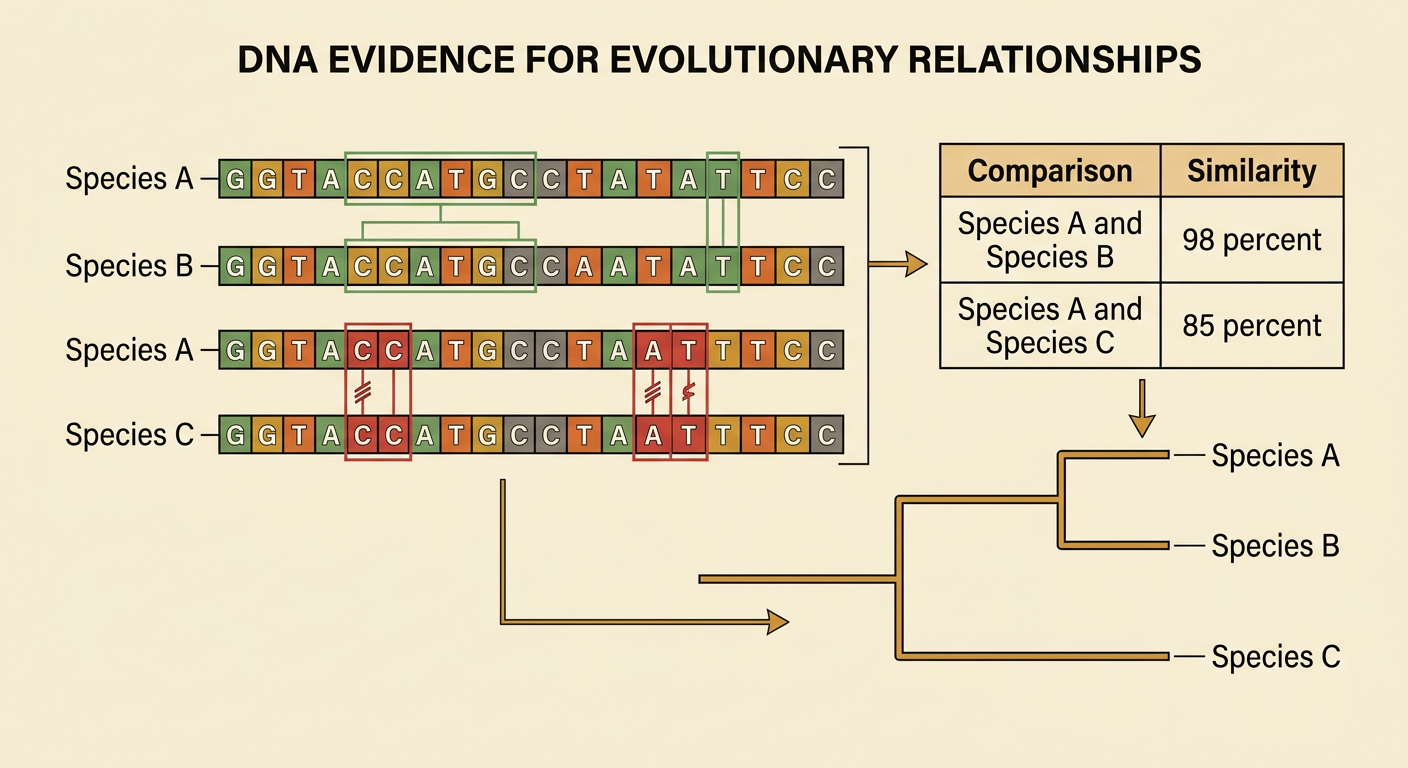
DNA provides quantitative evidence because related species inherit nucleotide sequences from common ancestors. Scientists align the same gene or genomic region and count positions that match or differ. For example, in a hypothetical 1,000-base aligned gene segment, Species A and B might match at 980 positions, giving 98 percent similarity, while Species A and C match at 850 positions, giving 85 percent similarity. This result supports a more recent common ancestor for A and B, assuming the sequences are comparable. Shared mutations can also identify branches on an evolutionary tree. However, percentages must be interpreted carefully. Different genes evolve at different rates, insertions and deletions complicate alignment, and a short sequence may not represent the entire genome. Scientists improve reliability by comparing many independent DNA regions, reporting methods, and checking whether molecular patterns agree with fossil and anatomical evidence.
Building an Evidence-Based Explanation
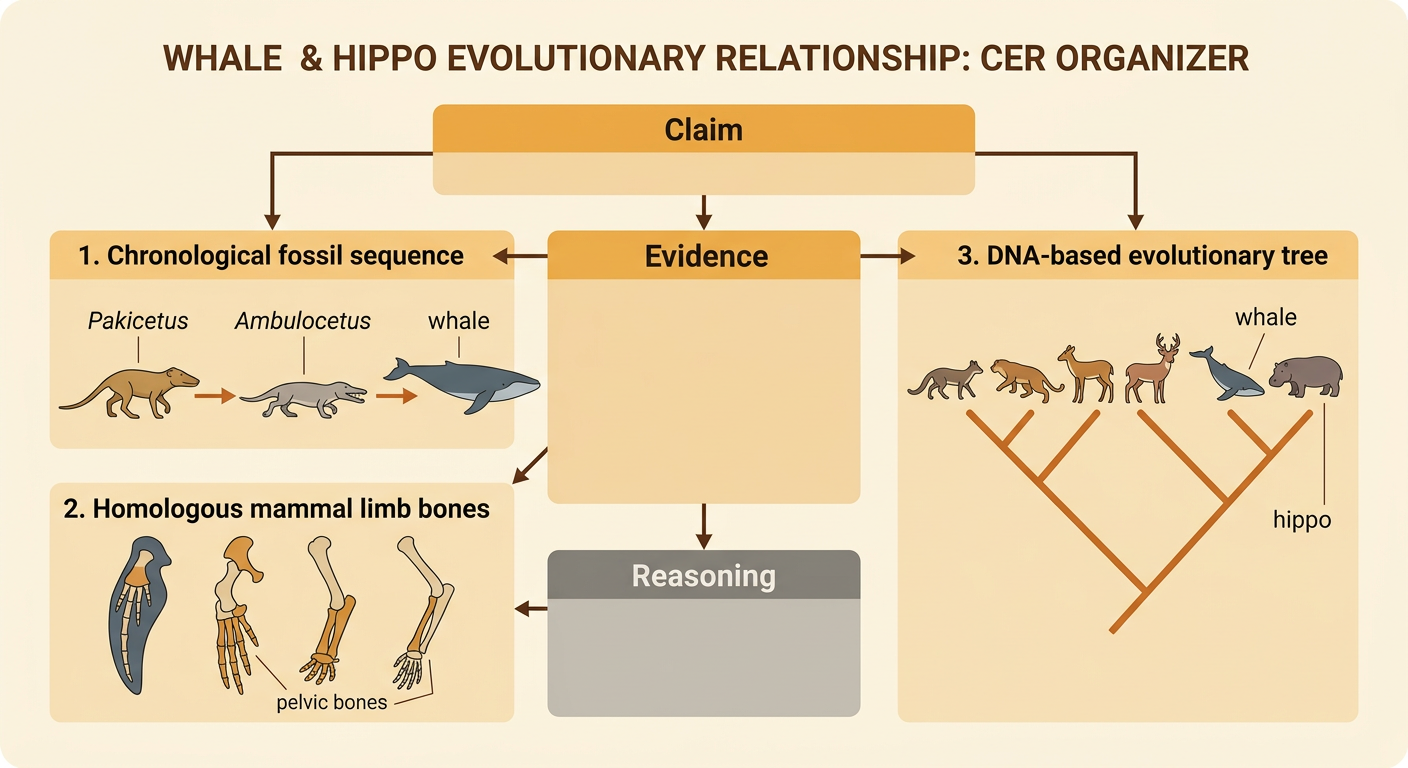
An evidence-based explanation includes a clear claim, relevant evidence, and reasoning that connects the evidence to evolutionary processes. Consider the claim that whales share a more recent common ancestor with hippos than with other living hoofed mammals. Fossils such as Pakicetus and Ambulocetus document stages in the transition from land-dwelling mammals toward aquatic whales. Whale flippers retain the homologous forelimb bones found in other mammals, and reduced pelvic bones reflect ancestry from animals with hind limbs. DNA comparisons independently group whales with hippos within the even-toed ungulate lineage. The reasoning is that inherited anatomical and molecular similarities, combined with fossils in chronological order, are expected if these groups share ancestors. A strong explanation also identifies limitations: the fossil record has gaps, individual traits may result from convergence, and molecular estimates vary by dataset. Comparing sources and acknowledging uncertainty makes the conclusion more credible, not weaker.