Tracing Theme and Its Development in Literature
Students analyze how a theme emerges and develops through key details in a Grade 12 literary text, then compose an objective summary.

Illustrations are auto-generated and may be placeholders. They can be refreshed to match the narration.
Define Theme and Central Idea
A theme is a complete statement about life, society, or human experience that a literary text develops. A topic is usually one or two words, such as freedom or marriage, while a theme expresses what the text suggests about that topic. For example, in Kate Chopin’s “The Story of an Hour,” freedom is a topic. A possible theme is that social restrictions can prevent a person from recognizing or expressing an independent identity. A central idea is a major insight or concept that shapes the text; the term may be used for both literary and informational works. Strong readers identify at least two possible themes and remain open to revising them. A theme should be supported by patterns in characterization, conflict, setting, imagery, and plot rather than by a single isolated quotation.

Read and Annotate the Passage
Read the text once to understand its plot, then reread it to mark details that may develop themes. Annotate repeated words, changes in a character’s emotions, conflicts, symbols, imagery, and moments of irony. In “The Story of an Hour,” Louise Mallard initially cries after hearing that her husband has died. Alone in her room, however, she notices patches of blue sky, fresh rain, and signs of spring. She then whispers, “free, free, free!” Marking this shift helps reveal that her response is more complex than ordinary grief. Beside the spring imagery, a reader might write, “New life mirrors Louise’s awakening.” Beside her whispered words, the reader might note, “Independence begins to overcome grief.” Annotations should explain why a detail matters instead of merely restating what happens.

Identify Key Supporting Details
After annotating, select details that form a meaningful pattern. A key supporting detail should reveal character, advance conflict, repeat or transform an image, or create a significant contrast. In Chopin’s story, Louise has heart trouble, yet the news of her husband’s death produces an unexpected sense of physical and emotional vitality. The open window and spring setting suggest possibility. Her repeated declaration of freedom reveals her private desire for self-direction. Later, Brently Mallard returns alive, and Louise dies as the freedom she imagined disappears. These details support the theme that denied independence can shape a person’s deepest emotional life. They also support a theme about mistaken appearances: Louise’s family and doctors interpret her from the outside, but the reader has witnessed thoughts they do not know. Avoid choosing minor details that do not contribute to such patterns.

Trace Interacting Themes
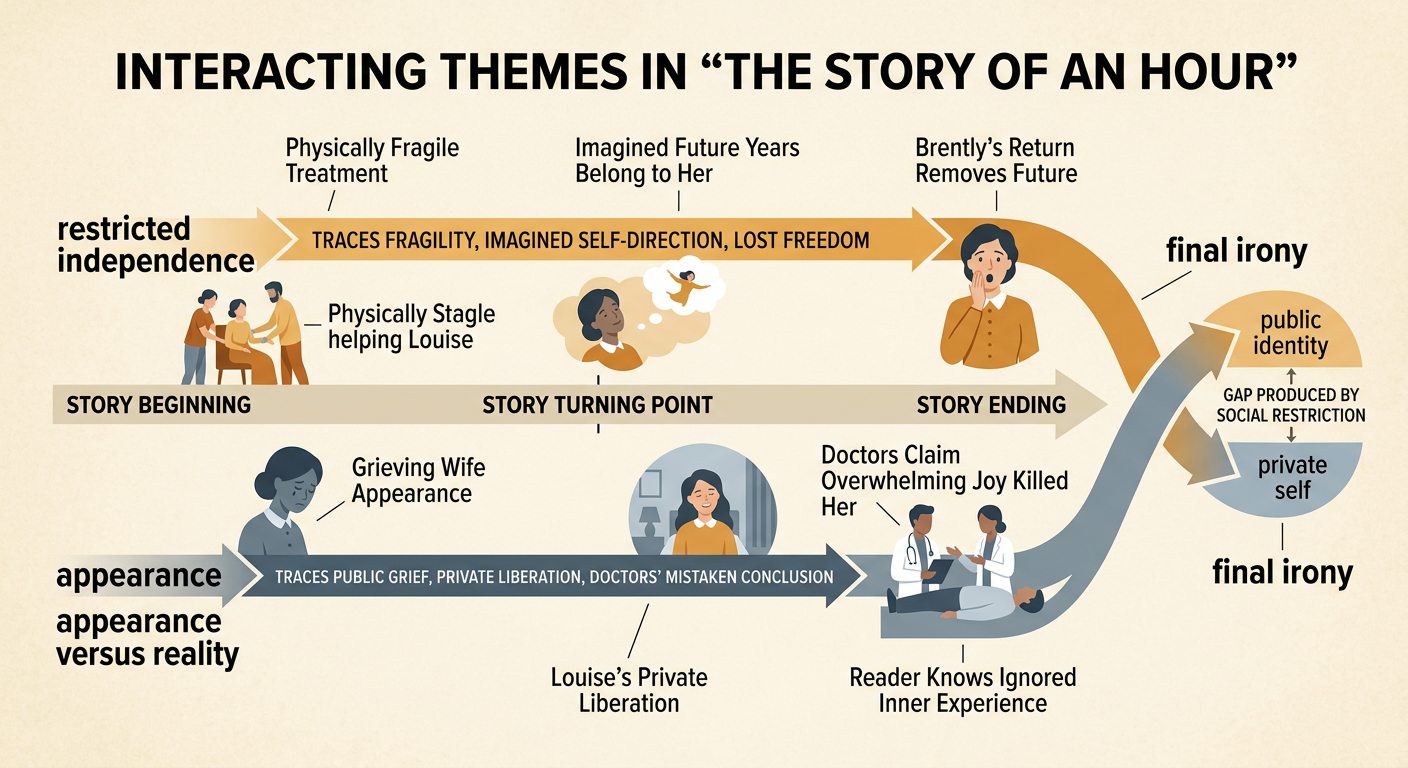
A theme develops as later details deepen, complicate, or challenge earlier ones. To trace two interacting themes, follow each theme from the beginning through the turning point and ending, then explain their relationship. In “The Story of an Hour,” the theme of restricted independence begins with Louise being treated as physically fragile. It develops when she imagines years that will belong to her, and it ends when Brently’s return abruptly removes that imagined future. At the same time, the theme of appearance versus reality grows because others see a grieving wife while Louise privately experiences liberation. The final irony joins the themes: the doctors claim that overwhelming joy killed her, but the reader knows that their explanation ignores her inner experience. Thus, social restriction helps produce the gap between Louise’s public identity and private self, creating a more complex account of her death.
Write an Objective Summary
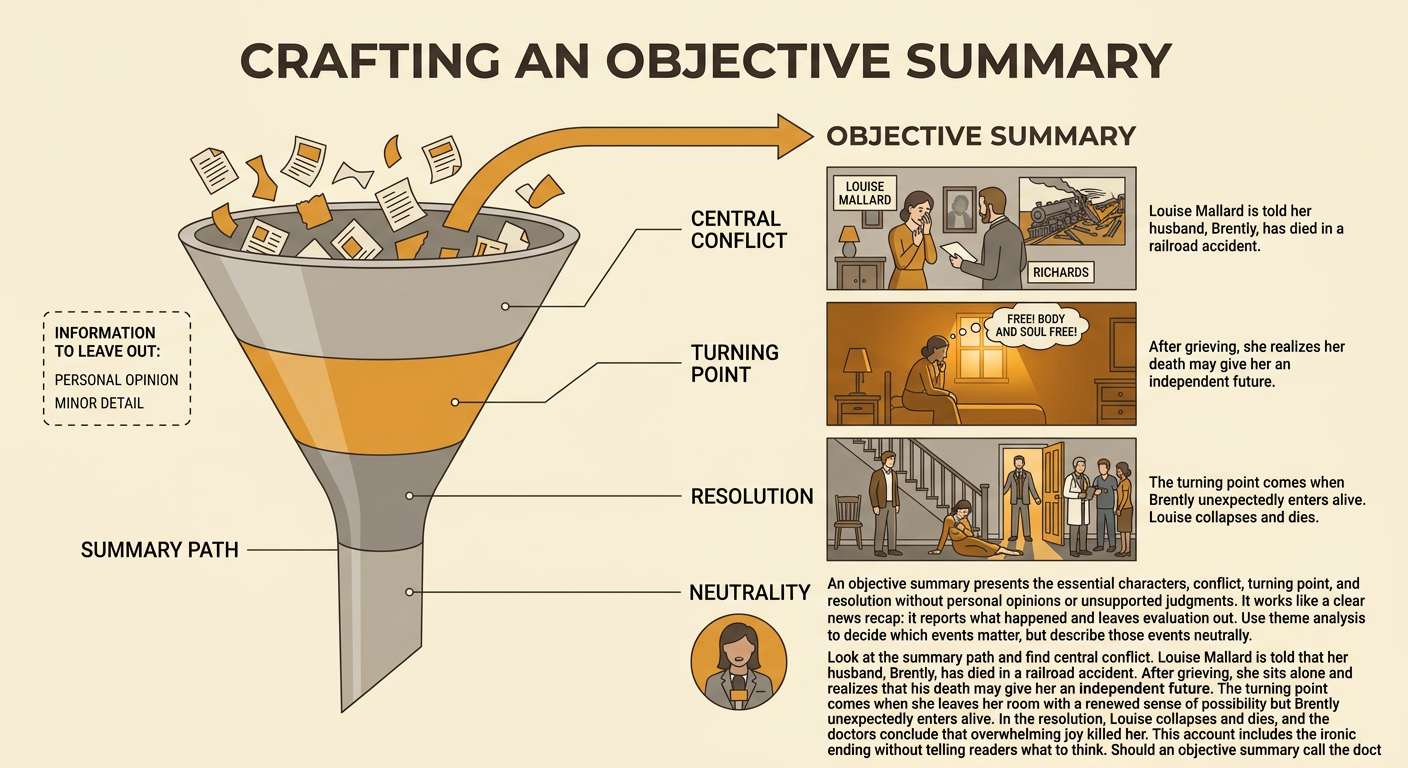
An objective summary presents the text’s essential characters, conflict, turning points, and resolution without inserting personal opinions or unsupported judgments. Use your theme analysis to decide which events are important, but report those events neutrally. Avoid evaluative phrases such as “I think,” “sadly,” or “the foolish doctors.” For example: In Kate Chopin’s “The Story of an Hour,” Louise Mallard is told that her husband, Brently, has died in a railroad accident. After grieving, she sits alone and realizes that his death may give her an independent future. She leaves her room with a renewed sense of possibility, but Brently unexpectedly enters the house alive. Louise collapses and dies, and the doctors conclude that she died from overwhelming joy. This summary includes the central conflict and ironic resolution while avoiding commentary about whether Louise, her marriage, or the doctors are right or wrong.