
Tracing Theme Development in a Short Story
Students identify a theme in a grade-level short story and analyze how characters, conflict, and key details develop it across the text.

Illustrations are auto-generated and may be placeholders. They can be refreshed to match the narration.
Theme and Topic Review
A topic is a broad subject, such as responsibility, friendship, or courage. A theme is a complete idea about that topic that the story develops. It expresses an insight rather than giving a one-word answer. Imagine a short story called “The Last Lantern.” Maya promises to keep a lighthouse lamp burning during a storm, but she wants to leave to attend a celebration. The topic might be responsibility. A possible theme is that honoring a commitment often requires giving up something personally important. This idea emerges from Maya’s promise, develops through her difficult choice, and becomes clear when she remains at the lighthouse. A theme should be supported by several details across the story. It should not be merely a plot fact, such as “Maya stays at the lighthouse,” or an overly broad moral, such as “Always be responsible.”

Close Reading of Key Passages
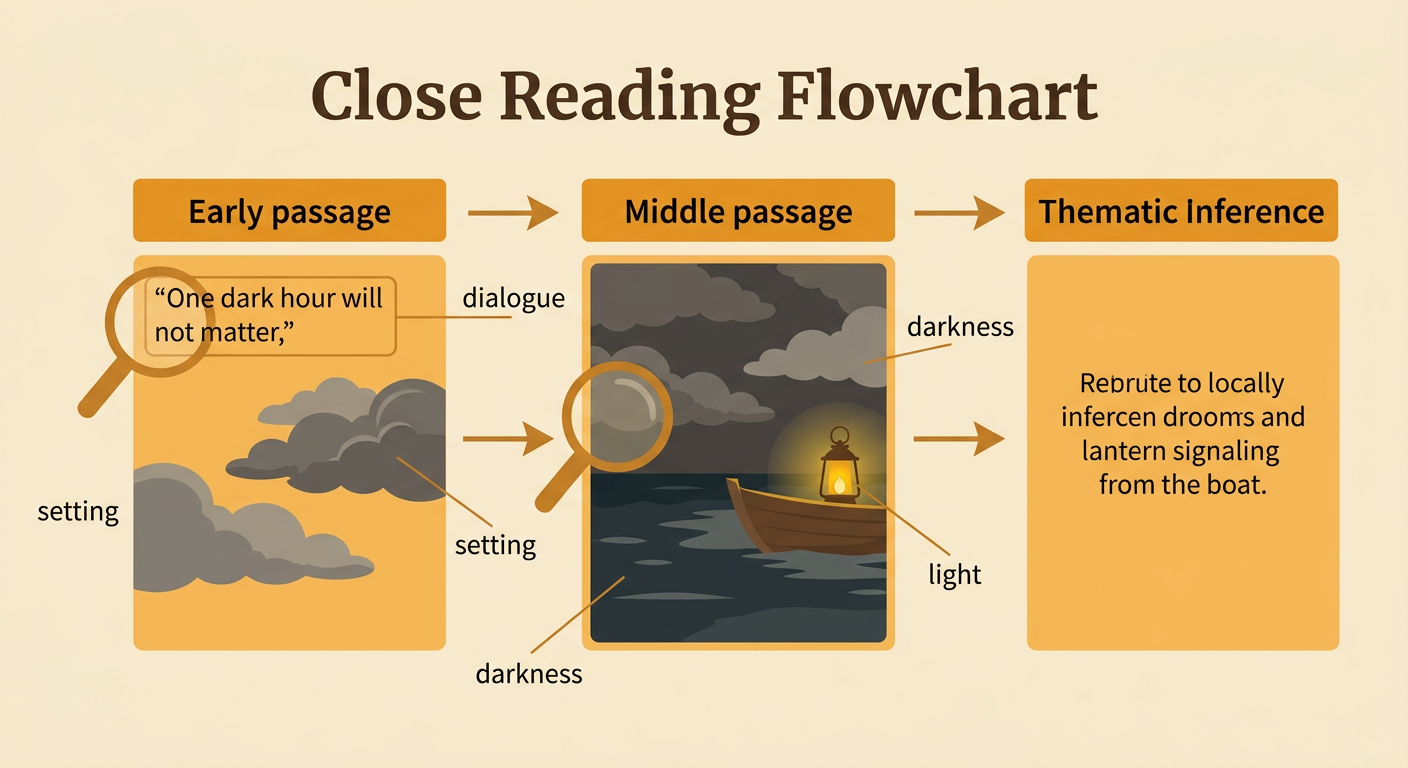
Close reading means examining important passages for details that reveal how a theme changes or becomes clearer. Read each key passage more than once. First, identify what happens. Next, notice word choice, imagery, dialogue, and contrasts. Finally, explain how those elements contribute to the theme. Early in “The Last Lantern,” Maya says, “One dark hour will not matter,” while the storm clouds gather beyond the window. Her words reveal that she initially treats her promise lightly, but the threatening setting suggests serious consequences. Later, she sees a fishing boat signaling from the dark water. The repeated images of darkness and light shift the lantern from an ordinary duty to a symbol of responsibility. By comparing these passages, a reader can explain how the theme emerges gradually instead of appearing only at the ending.
Tracking Character and Conflict
Characters and conflicts often drive theme development because choices made under pressure reveal values and consequences. Track what the main character wants, what stands in the way, how the character responds, and what changes. In “The Last Lantern,” Maya wants to attend the town celebration, but her promise requires her to remain at the lighthouse. This internal conflict places desire against duty. The approaching storm and endangered fishing boat add external conflict. At first, Maya complains and considers leaving. When she notices the boat’s signal, she understands that other people depend on her actions. She refuels the lamp and misses the celebration. Her change from resentment to purposeful action refines the theme: responsibility is not simply following a rule; it is recognizing how one person’s choices can affect a larger community.

Writing a Theme Statement
A strong theme statement names a meaningful insight, applies beyond the individual story, and avoids unsupported absolutes. Begin by identifying the main topic. Then ask what the protagonist learns or what the conflict suggests about that topic. Finally, write a complete sentence and test it against the beginning, middle, and end. For “The Last Lantern,” the topic is responsibility. A weak statement is “Responsibility,” because it is only a topic. Another weak statement is “People must always sacrifice everything for others,” because the word “always” makes an extreme claim the story does not prove. A stronger statement is “People come to understand responsibility when they recognize that their choices affect others.” Maya’s early carelessness, her response to the endangered boat, and her final decision all support this statement. Revise any theme statement that cannot be traced across the whole text.

Evidence-Based Analysis
Evidence-based analysis explains how specific details develop the theme instead of merely listing quotations. Begin with a claim, add relevant evidence, explain the connection, and show how the idea is shaped over time. For example: Maya’s view of responsibility changes when she realizes that the fishing crew depends on the lighthouse. Early in the story, she dismisses her duty by saying that one dark hour will not matter. Later, the boat’s signal proves that her absence could endanger others. This contrast develops the theme that people understand responsibility by recognizing the effects of their choices. Keep analysis separate from objective summary. An objective summary might state that Maya remains at the lighthouse during a storm and guides a boat safely toward shore. It reports central events without opinions, judgments, or unnecessary details. Analysis then interprets how those events create meaning.
