Tracing Theme Through a Story
Students identify a theme in a literary text and explain how characters, setting, and plot details develop it over the course of the story.

Illustrations are auto-generated and may be placeholders. They can be refreshed to match the narration.
Topic vs. Theme
A topic is a broad subject that a story explores, such as friendship, courage, family, or fairness. A theme is a message about that topic that the story develops. A theme should be written as a complete statement, not as one word. Imagine a story about Lena, who is afraid to perform in the school talent show. She practices with a friend, walks onto the stage despite her fear, and finishes her song. The topic is courage. One possible theme is, “Courage grows when people face their fears with support from others.” This statement expresses an idea that readers can apply beyond Lena’s situation. A theme is usually not stated directly. Readers infer it by studying the character’s choices, struggles, changes, and outcomes.

Finding a Theme Statement
To find a theme, first ask what challenge the main character faces and what the character learns or reveals through choices. Then consider how the conflict ends. Turn your conclusion into a complete sentence that makes a general claim about life or people. Avoid statements that are too broad, such as “Friendship is important,” or too specific, such as “Lena’s friend helps her sing.” In the talent-show story, Lena wants to quit, but her friend helps her practice and reminds her why she loves music. Lena eventually performs. A strong theme statement is, “Encouragement from a trusted friend can help a person overcome self-doubt.” Evidence from several parts of the story supports this idea. Remember that a reasonable theme must be supported by the text, even if another reader identifies a different valid theme.

Tracking Key Story Details
Theme develops across a story, so readers should track important details from the beginning, middle, and end. Focus on details connected to character, setting, conflict, decisions, and consequences. At the beginning of Lena’s story, the noisy auditorium makes her anxious, and she hides behind the curtain. In the middle, she practices in an empty music room with her friend and begins singing more confidently. Near the end, she hears the audience but chooses to step onstage and complete the song. These details form a pattern: fear, support and practice, then courageous action. A tracking chart can record each detail and explain how it connects to the theme. Include only meaningful evidence. A detail such as the color of Lena’s shoes does not matter unless the story connects it to her struggle or growth.

Analyzing Theme Development
Analyzing theme means explaining how story elements build and refine the message over time. Do not simply list events. Show how each event changes the reader’s understanding of the theme. In Lena’s story, the crowded auditorium setting first increases her fear, establishing the challenge. Her friend’s patient support during rehearsal shows that courage can grow through encouragement rather than appearing instantly. Lena’s decision to perform becomes the climax, where she applies what she has gained. The outcome develops the theme further: she still feels nervous, but she sings anyway. This detail suggests that courage does not require fear to disappear. A strong analysis uses cause-and-effect language, such as “because,” “therefore,” and “as a result.” It also connects details from different parts of the story to explain how the theme becomes clearer and more complete.

Writing an Objective Summary
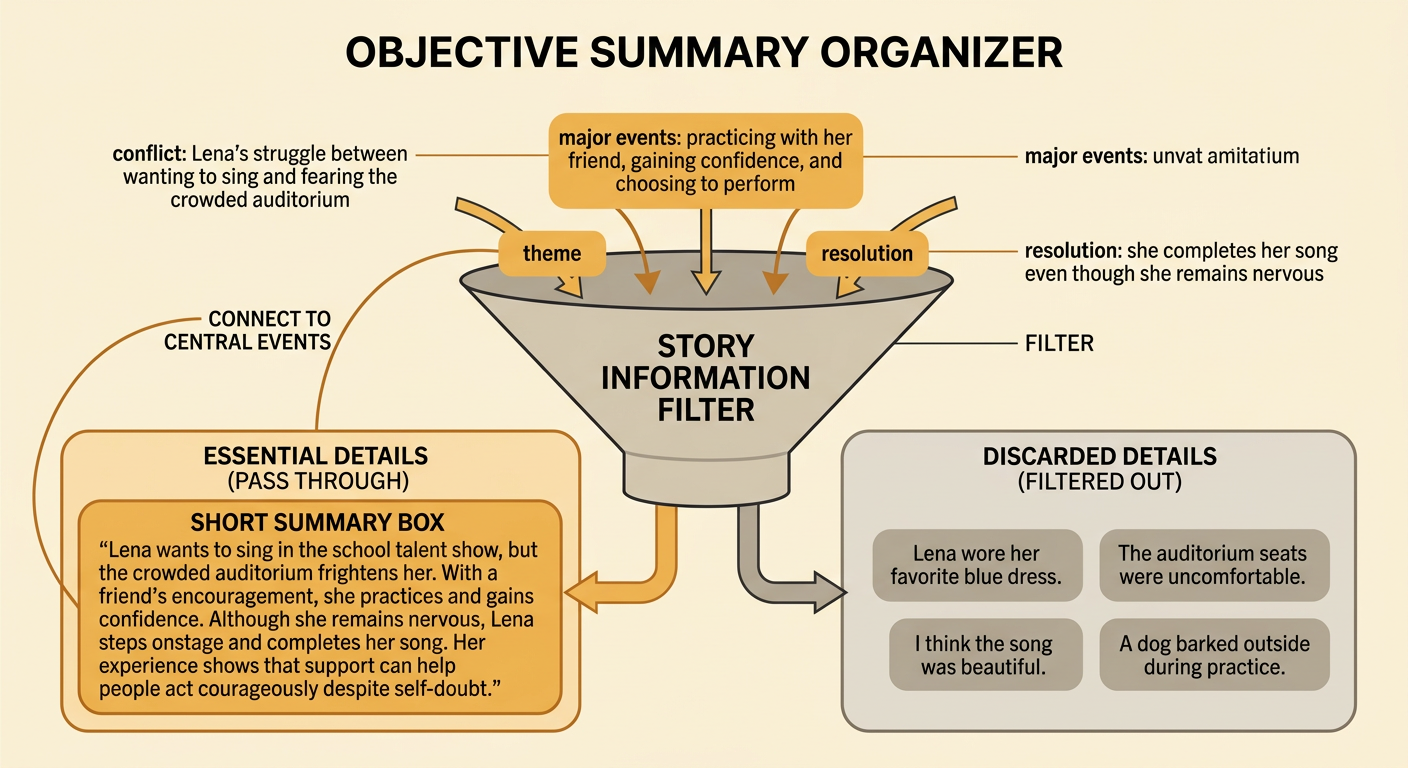
An objective summary briefly explains the text’s most important characters, conflict, major events, and resolution without including personal opinions or unnecessary details. Write in your own words and keep events in a logical order. Do not say, “I loved the ending,” or judge whether a character made a good choice. You may state the theme if the assignment asks for it, but support it with the story’s central events. For example: “Lena wants to sing in the school talent show, but she becomes frightened by the crowded auditorium. With a friend’s encouragement, she practices and gains confidence. Although she remains nervous, Lena steps onstage and completes her song. Her experience shows that support can help people act courageously despite self-doubt.” This summary identifies the conflict, key actions, resolution, and theme while leaving out minor details and personal reactions.