
Trait Detectives: Meet the Creature Families
Students play a matching game with imaginary parent and baby creatures to notice, sort, and respectfully discuss shared and different observable traits without introducing genes or DNA.
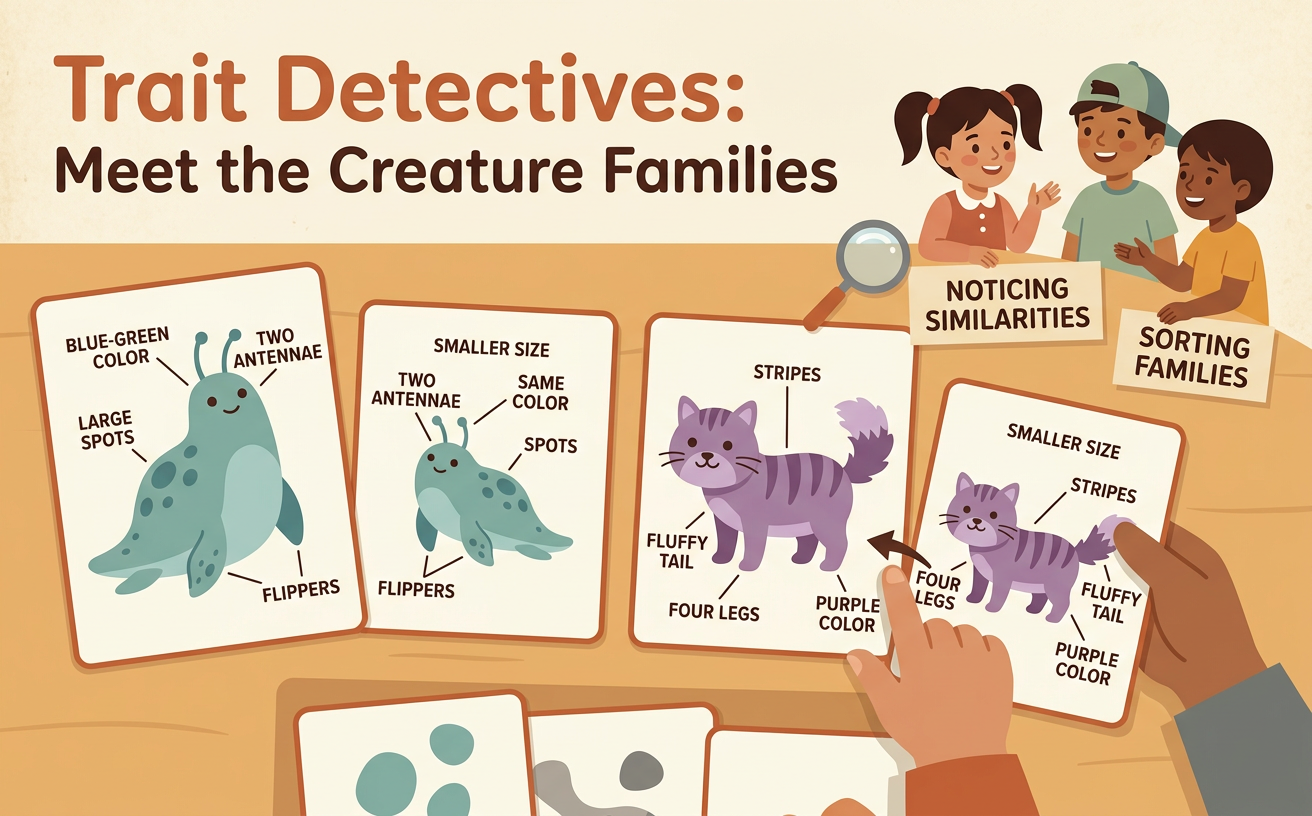
Illustrations are auto-generated and may be placeholders. They can be refreshed to match the narration.
Meet the Silly Creature Families
Today we are trait detectives. A trait is something we can observe about a living thing, such as color, body covering, number of legs, or ear shape. Our imaginary creature cards show grown-ups and babies. Look closely before you decide which creatures may belong in a family. For example, a purple grown-up and a purple baby might both have round ears and two striped tails. Those shared traits are helpful clues. They may also have differences, such as different sizes or spot patterns. During the game, take turns speaking and listening. You can say, “I notice both creatures have round ears.” A classmate may notice another clue. Different ideas are welcome when they are explained with observations. Like real animals, every creature also needs food and water to live and grow.
Spot Colors, Shapes, and Features
Detectives gather clues by looking carefully. First, name a color you see. Next, look for shapes and body features. A creature might have green skin, triangle-shaped ears, four legs, and a spotted tail. Count only what you can see on the card. Do not guess whether a creature is kind, fast, or brave, because a picture does not show those things. Compare two creatures using clear words. For example, say, “Both creatures have four legs, but one has spots and one has stripes.” Then listen while a partner describes the same pictures. Your partner may focus on the ears while you focus on the tails. Both observations can help. Observable traits help us describe and sort living things, but no color, shape, or feature makes one creature better than another.
Match Babies with Grown-Ups
Place the grown-up cards in one row and the baby cards in another row. Choose one baby and search for a grown-up with several shared traits. Use more than one clue before making a match. For example, a baby with yellow spots, square ears, and a curly tail may match a grown-up with yellow spots, square ears, and a curly tail, even if the baby is smaller. Explain your thinking by saying, “I matched these creatures because they both have square ears and yellow spots.” A partner may choose a different match. Listen to the partner’s evidence, compare it with yours, and decide whether another clue changes your idea. After matching, notice a survival pattern on the cards: every creature family needs food and water. Babies also need care and a safe place while they grow.
Sort and Count the Traits
Now sort the creature cards into categories. A category is a group whose members share a chosen trait. Pick one sorting rule at a time so every card has a clear place. You might sort by body pattern into spots, stripes, and no pattern. Place each card in the correct group, then count the cards in every category. For example, if 4 creatures have spots, 3 have stripes, and 2 have no pattern, the spots category has the most creatures. The no-pattern category has the fewest. Check the count by touching each card once as you say the numbers. Record the totals with numerals or tally marks. Then try a new rule, such as round ears and triangle-shaped ears. The same creature can belong to different categories when the sorting rule changes.
Share What Makes Each Creature Special
Gather in a circle and choose one creature to describe. Share two observable traits and one way the creature is different from another creature. You might say, “My creature has blue spots and round ears. It has two legs, but this other creature has four legs.” Speak about differences with respectful words. Different does not mean better or worse. After one person shares, another person can respond, “I noticed that too,” or, “I saw it another way because…” For example, one student may group a creature by its spots, while another groups it by its tail shape. Both points of view can be useful when the sorting rule is explained. Finish by naming something all the creature families need, such as food or water. Careful observations, kind listening, and clear reasons help everyone learn together.