
Trait Detectives: The Mystery of the Mixed-Up Creatures
Students investigate fictional creature families, identify inherited trait patterns, and use evidence to explain why offspring resemble—but are not identical to—their parents.
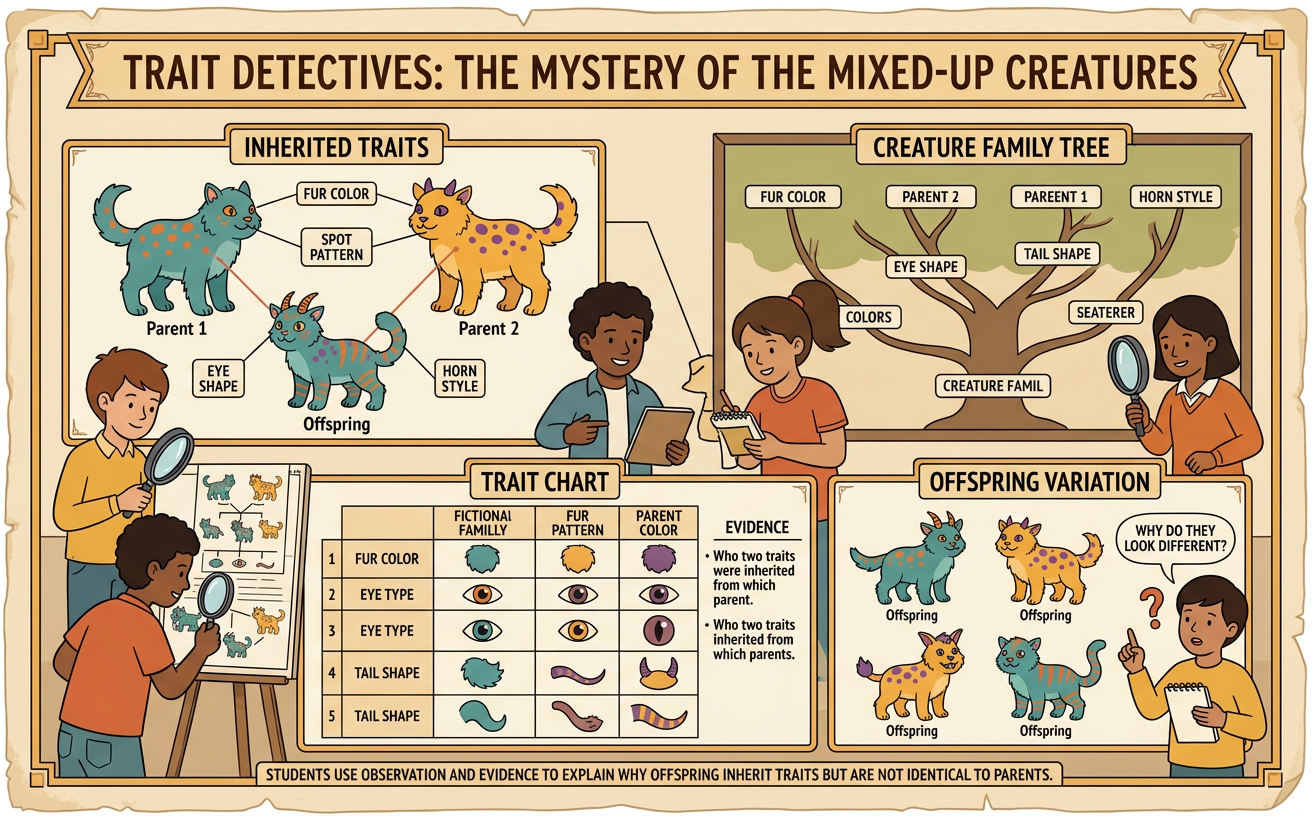
Illustrations are auto-generated and may be placeholders. They can be refreshed to match the narration.
Launch the Creature Family Mystery
A group of fictional creatures has become mixed up at the Creature Family Center. Your job is to study visible traits and look for family patterns. A trait is a characteristic of a living thing, such as eye color, number of horns, fur pattern, or tail shape. Begin with careful observations, not guesses. For example, two possible parents both have curled tails. One has spotted fur, and the other has striped fur. Their possible offspring has a curled tail and spotted fur. The shared traits are evidence that the creatures may belong to the same family. However, one matching trait is not enough to prove a relationship because unrelated creatures can also share traits. Record several traits in a data table, compare the creatures, and ask: Which traits appear in the parents and offspring, and which traits vary?
Explore Traits and Variation
Offspring often resemble their parents because many traits are inherited, or passed from parents to offspring. Members of the same kind of organism are similar, but they are not identical. These differences are called variation. Imagine a family of moon creatures. Both parents have two antennae and four legs. Their three offspring also have two antennae and four legs, but one has blue spots, one has purple spots, and one has no spots. The shared body features show a pattern of inherited traits, while the different spot colors show variation within the family. To analyze the pattern, organize the observations in a chart. Count how many family members have each trait. Then compare the numbers. A trait found in several related creatures can be evidence of inheritance, while differences among the offspring demonstrate variation.
Match Offspring Using Evidence
To match an offspring with possible parents, compare more than one trait and use a process of elimination. Suppose Offspring A has pointed ears, a short tail, green scales, and two horns. Parent Pair 1 includes pointed ears and short tails, and both adults have scales. Parent Pair 2 has round ears, long tails, and feathers. Offspring A shares several traits with Parent Pair 1, so that pair is the stronger match. Green scales may differ from the parents’ scale colors, but variation can occur among family members. Build a trait table with one row for each feature and one column for each creature. Mark whether each trait is present. Then state which match is best supported. The evidence suggests a likely family connection, but a small set of visible traits may not prove the relationship with complete certainty.
Inherited or Environmentally Influenced?
Not every characteristic is inherited in the same way. An inherited trait is passed from parents to offspring, such as a creature’s natural eye color or basic ear shape. Other characteristics result from experiences or surroundings. For example, a creature may get a scar after scraping its leg on a rock. Its offspring will not inherit that scar. Some traits are influenced by both inheritance and the environment. A creature may inherit the potential to grow large, but the amount of food, water, rest, and health care it receives can affect its final size. When sorting evidence, ask whether the characteristic was present because of information from the parents, because of an experience, or because both inheritance and the environment played a role. Avoid assuming that every similarity between a parent and offspring is inherited.
From Mendel to Modern Genetics
In the 1800s, Gregor Mendel investigated inheritance by growing pea plants. He carefully crossed plants with contrasting traits, such as purple or white flowers, and counted the traits that appeared in later generations. His work showed that traits can follow patterns across generations. Mendel did not know about DNA or genes, so he described inherited factors based on the evidence he observed. Today, scientists know that genes are sections of DNA that carry instructions connected to many traits. Modern researchers can use microscopes, computers, and DNA technology that Mendel did not have. Still, both Mendel and modern scientists collect data, look for patterns, and use evidence to explain inheritance. Comparing the two time periods shows how scientific knowledge and tools change while careful observation remains important.
Share a Trait Detective Claim
Complete the mystery by making a scientific claim about which creatures belong together. A strong explanation includes a claim, evidence, and reasoning. The claim answers the question. The evidence gives specific observations or data. The reasoning explains why the evidence supports the claim using what you know about inheritance and variation. For example: “Offspring B most likely belongs to Parent Pair 3. All three creatures have forked tails, two antennae, and spotted skin. These shared traits are evidence of inheritance. Offspring B has smaller spots, which is an example of variation within a family.” Include exact information from your trait table instead of saying only that the creatures look alike. You may also note the limits of your evidence. Finish by listening to another detective’s explanation and comparing how both of you used data.