
Transformations in the Coordinate Plane
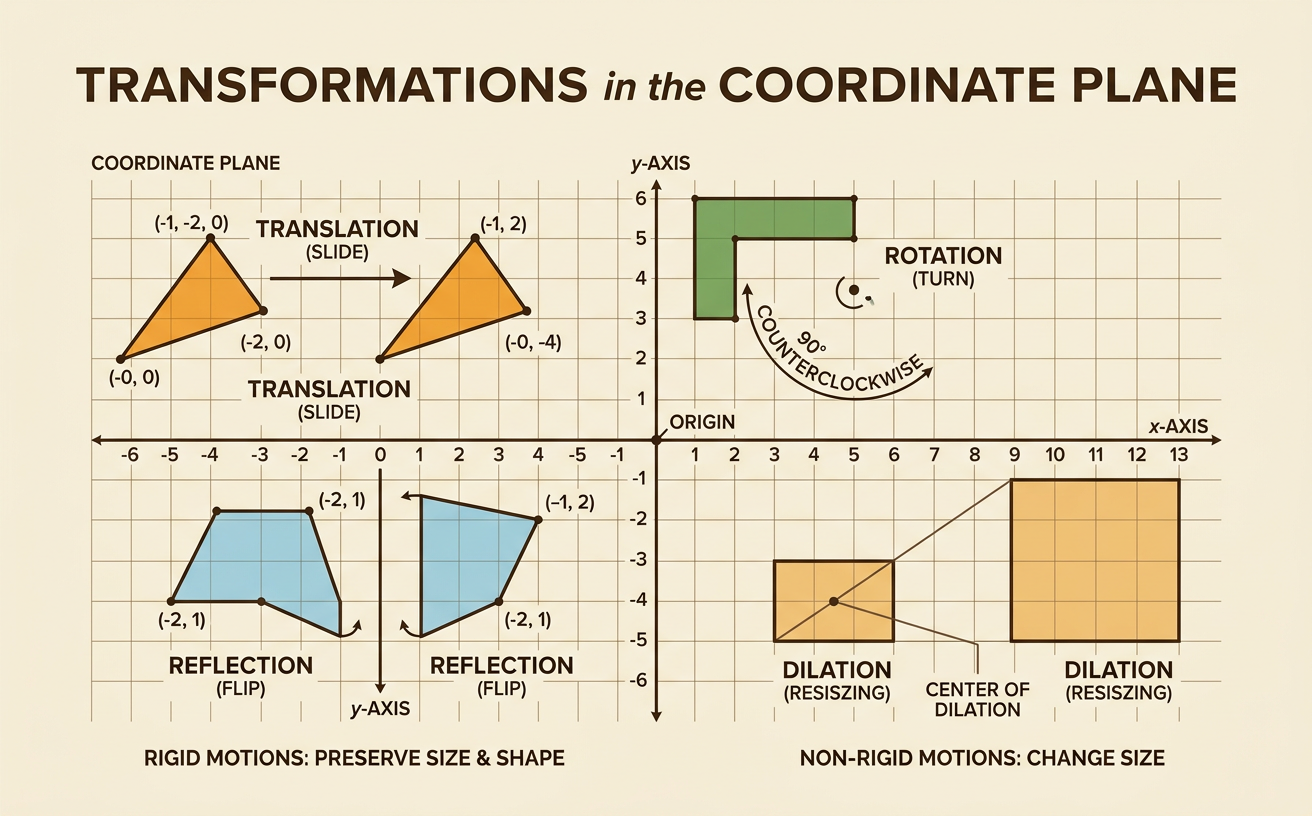
Students represent translations, reflections, rotations, and dilations on a coordinate plane and distinguish rigid motions from transformations that change size.
Illustrations are auto-generated and may be placeholders. They can be refreshed to match the narration.
Transformation Vocabulary
A transformation is a rule that takes every point in the plane as an input and assigns exactly one image point as its output. The original point or figure is called the preimage, and the transformed point or figure is called the image. Function notation can describe this rule. For example, T(x, y) = (x + 4, y − 2) moves every point 4 units right and 2 units down. If P(−2, 3) is the input, then T(−2, 3) = (2, 1), so P'(2, 1) is the output. Corresponding points, such as P and P', occupy matching positions in the two figures. Some transformations preserve measurements such as distance and angle measure, while others change one or more of these properties.
Translations and Reflections
A translation slides every point the same distance in the same direction. The rule (x, y) → (x + a, y + b) represents a translation by the vector ⟨a, b⟩. For triangle A(1, 1), B(3, 1), and C(2, 3), translating by ⟨2, −1⟩ produces A'(3, 0), B'(5, 0), and C'(4, 2). A reflection flips a figure across a line called the line of reflection. Points and their images are the same perpendicular distance from that line. Reflecting the original triangle across the x-axis follows the rule (x, y) → (x, −y), producing A'(1, −1), B'(3, −1), and C'(2, −3). Translations preserve orientation, while reflections reverse orientation. Both preserve side lengths and angle measures.
Rotations About the Origin
A rotation turns a figure through a given angle around a fixed point called the center of rotation. When the center is the origin, standard coordinate rules make rotations easy to represent. A 90° counterclockwise rotation follows (x, y) → (−y, x). For triangle A(1, 1), B(3, 1), and C(2, 2), the rotated vertices are A'(−1, 1), B'(−1, 3), and C'(−2, 2). A 180° rotation follows (x, y) → (−x, −y), while a 90° clockwise rotation follows (x, y) → (y, −x). During a rotation, each point stays the same distance from the center. Side lengths, angle measures, and orientation are preserved, so the image is congruent to the preimage.
Dilations and Scale Factors
A dilation changes a figure's size relative to a fixed center of dilation. With the origin as the center, the rule is (x, y) → (kx, ky), where k is the scale factor. For triangle A(1, 1), B(3, 1), and C(1, 2), a dilation with k = 2 produces A'(2, 2), B'(6, 2), and C'(2, 4). Every image point lies on the same ray from the origin as its corresponding preimage point, and its distance from the origin is doubled. If k is greater than 1, the image is an enlargement. If 0 < k < 1, the image is a reduction. Dilations preserve angle measures and proportional side lengths, but they do not preserve actual distances when k is not 1.
Rigid and Nonrigid Motions
A rigid motion preserves distances and angle measures, so the image is congruent to the preimage. Translations, reflections, and rotations are rigid motions. For example, translating a triangle with side lengths 3, 4, and 5 units produces an image with the same three side lengths and the same angle measures. A reflection also preserves these measurements, even though it reverses orientation. A nonrigid transformation changes at least one important measurement. A dilation with scale factor 2 changes the triangle's side lengths to 6, 8, and 10 units. The corresponding angles remain equal, so the figures are similar but not congruent. To classify a transformation, compare distances between corresponding pairs of points and compare corresponding angles. Equal distances and equal angles indicate a rigid motion; changed distances indicate a nonrigid transformation.