Understand Hundreds, Tens, and Ones
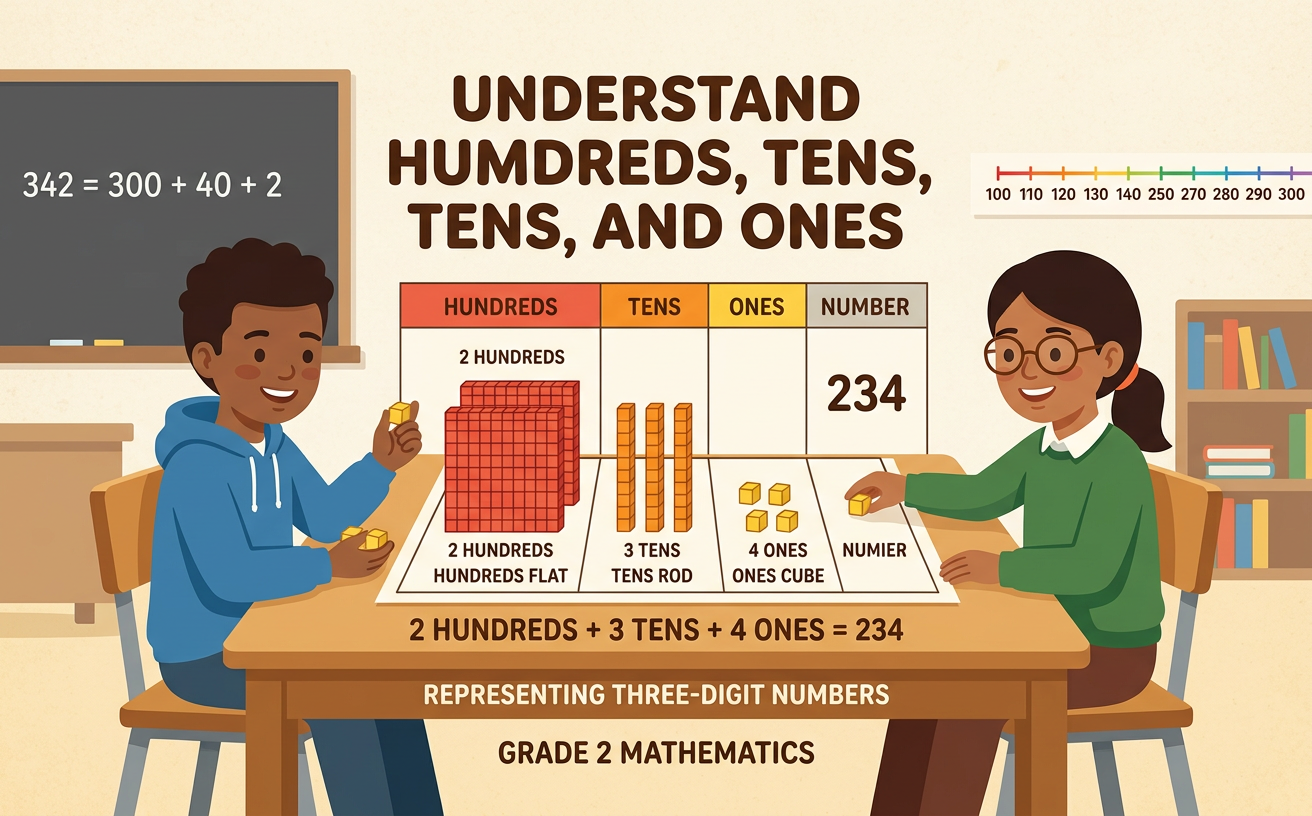
Students use base-ten blocks and place-value charts to represent three-digit numbers as groups of hundreds, tens, and ones.
Illustrations are auto-generated and may be placeholders. They can be refreshed to match the narration.
Review Tens and Ones
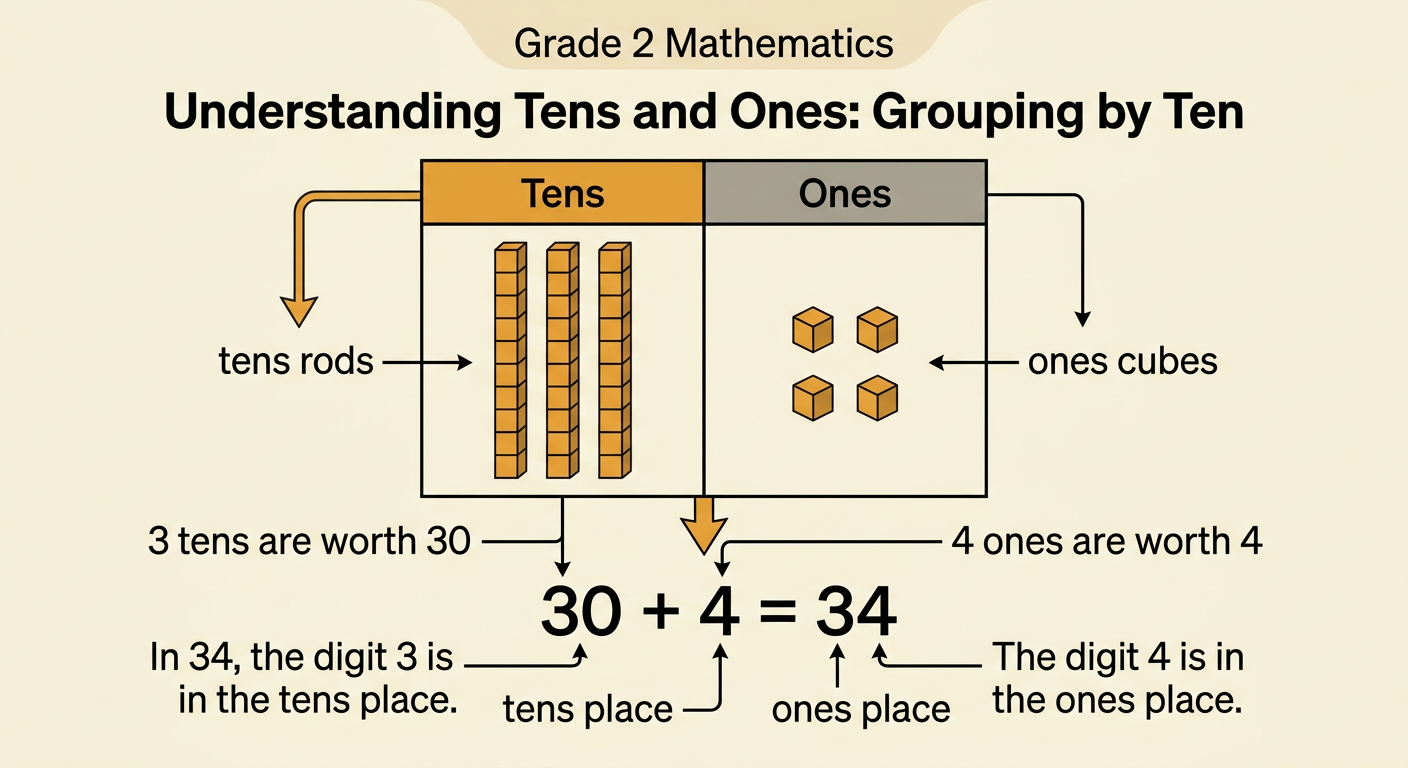
Our number system groups objects in tens and ones. A base-ten rod represents 1 ten because it is made of 10 small units. A single unit cube represents 1 one. To model 34, use 3 tens rods and 4 ones cubes. The 3 tens are worth 30, and the 4 ones are worth 4. Together, they make 34. In the number 34, the digit 3 is in the tens place, so it means 3 tens. The digit 4 is in the ones place, so it means 4 ones. You can check the model by counting by tens first: 10, 20, 30. Then count on by ones: 31, 32, 33, 34.
Build a Hundred
When we collect 10 tens, we can regroup them as 1 hundred. Ten base-ten rods have 10 units each, so they show 100 units in all. A hundreds flat also shows 100 units arranged in 10 rows of 10. This means 10 tens and 1 hundred have the same value. Imagine you have 9 tens, which is 90. If you add 1 more ten, you have 10 tens, or 100. You can trade the 10 tens rods for 1 hundreds flat without changing the total. This regrouping helps us understand why the number 100 has a 1 in the hundreds place, a 0 in the tens place, and a 0 in the ones place.

Model Three-Digit Numbers
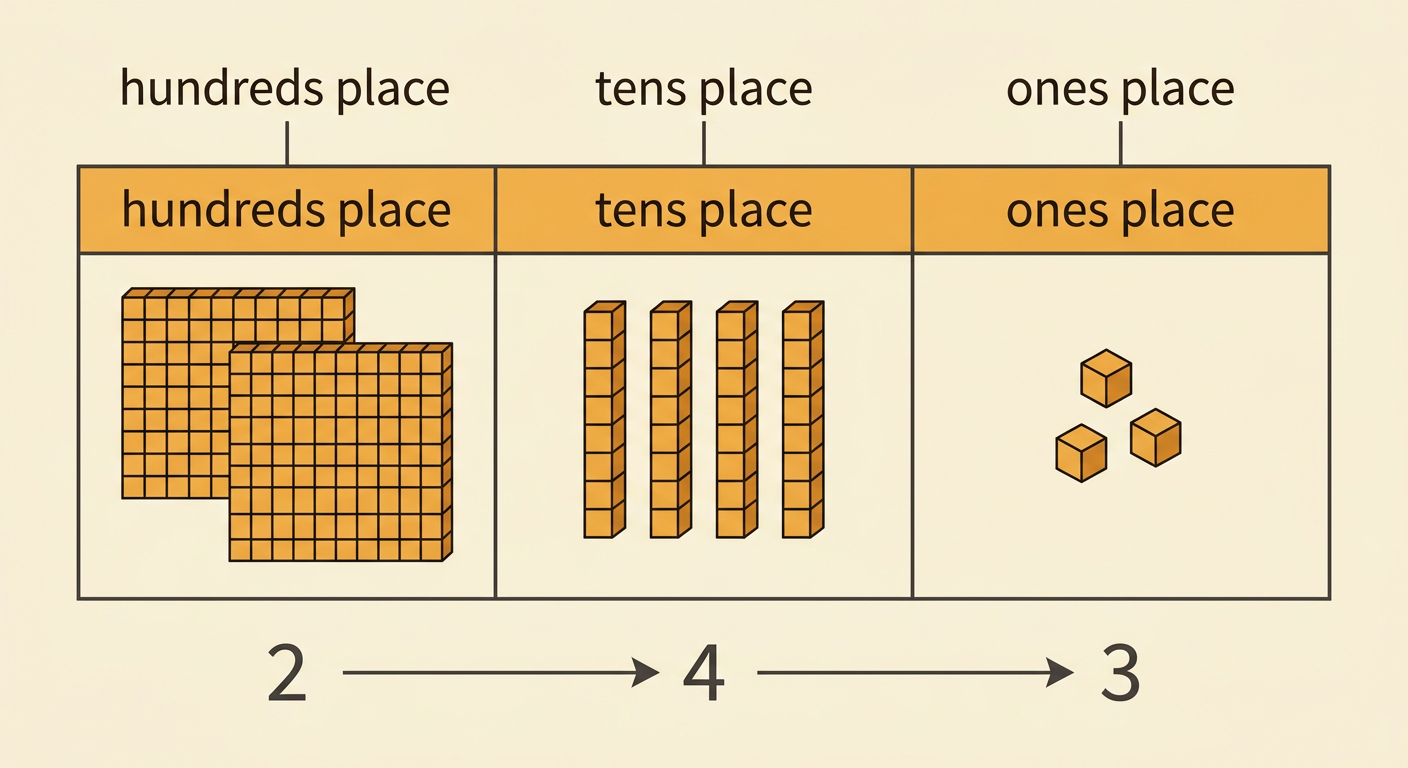
A three-digit number can be modeled with hundreds flats, tens rods, and ones cubes. Consider the number 243. The digit 2 is in the hundreds place, so it represents 2 hundreds, or 200. The digit 4 is in the tens place, so it represents 4 tens, or 40. The digit 3 is in the ones place, so it represents 3 ones, or 3. To build 243, place 2 hundreds flats, 4 tens rods, and 3 ones cubes on a place-value chart. Count the values: 200, then 40 more, then 3 more. The total is 243. Each digit gets its value from its place in the number, so moving a digit to another place changes its value.
Record Hundreds, Tens, and Ones
We can record a three-digit number in several connected ways. Suppose a model has 5 hundreds flats, 2 tens rods, and 6 ones cubes. In a place-value chart, write 5 under Hundreds, 2 under Tens, and 6 under Ones. The standard form is 526. The expanded form is 500 + 20 + 6 because 5 hundreds are worth 500, 2 tens are worth 20, and 6 ones are worth 6. We can also write the number in words: five hundred twenty-six. A zero is important when a place has no blocks. For example, 4 hundreds, 0 tens, and 7 ones make 407. The zero holds the tens place and shows that there are no tens.

Practice and Check
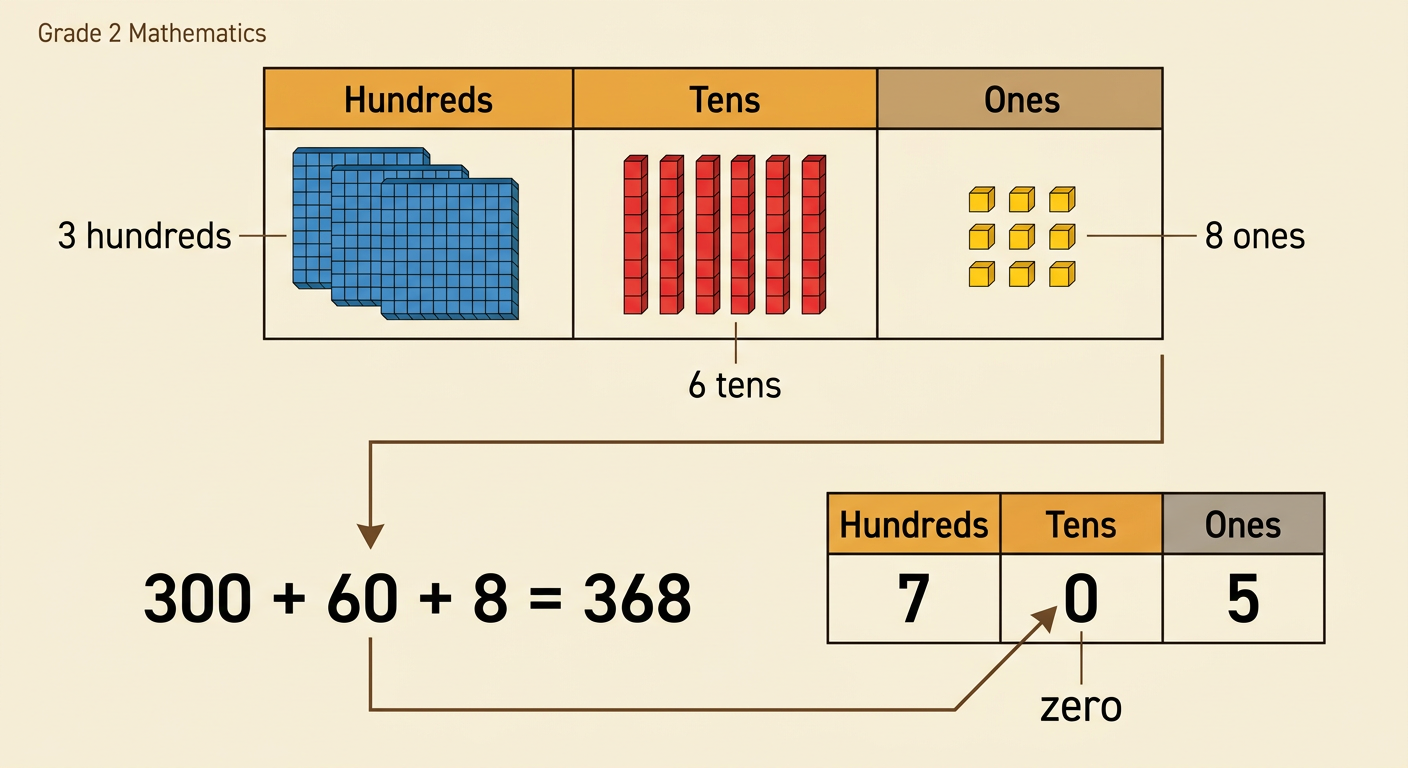
Use place value to find the number shown by 3 hundreds flats, 6 tens rods, and 8 ones cubes. First, record each amount: 3 hundreds, 6 tens, and 8 ones. Next, write the digits in place-value order to make 368. Check by finding the value of each group: 3 hundreds equal 300, 6 tens equal 60, and 8 ones equal 8. Add the parts: 300 + 60 + 8 = 368. You can also check that every block was counted once and placed in the correct column. Now try a number with an empty place: 7 hundreds, 0 tens, and 5 ones make 705. Remember to write a zero when no tens or no ones are present.