
Understanding Division as Equal Sharing
Students model division by sharing a set of objects equally and connecting the model to a division equation.
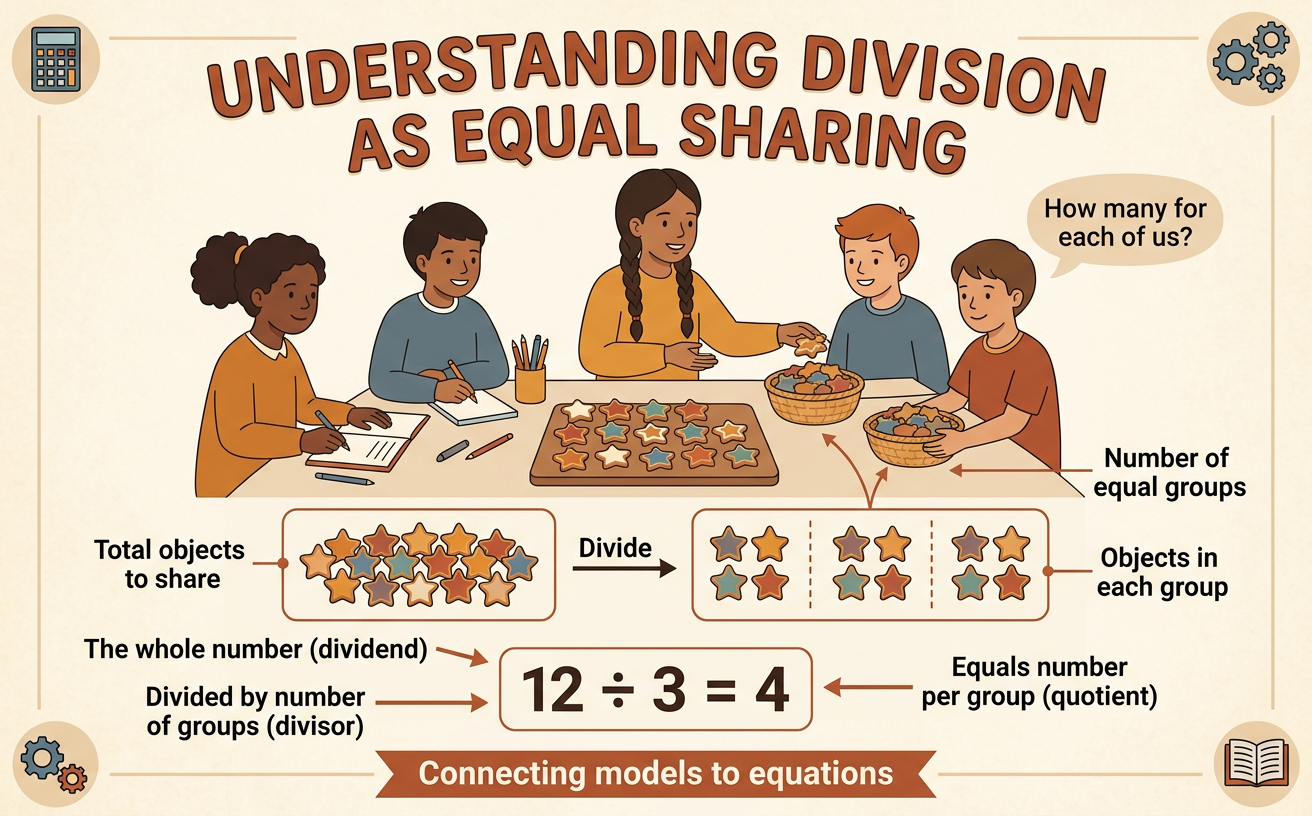
Illustrations are auto-generated and may be placeholders. They can be refreshed to match the narration.
Launch with a Sharing Problem
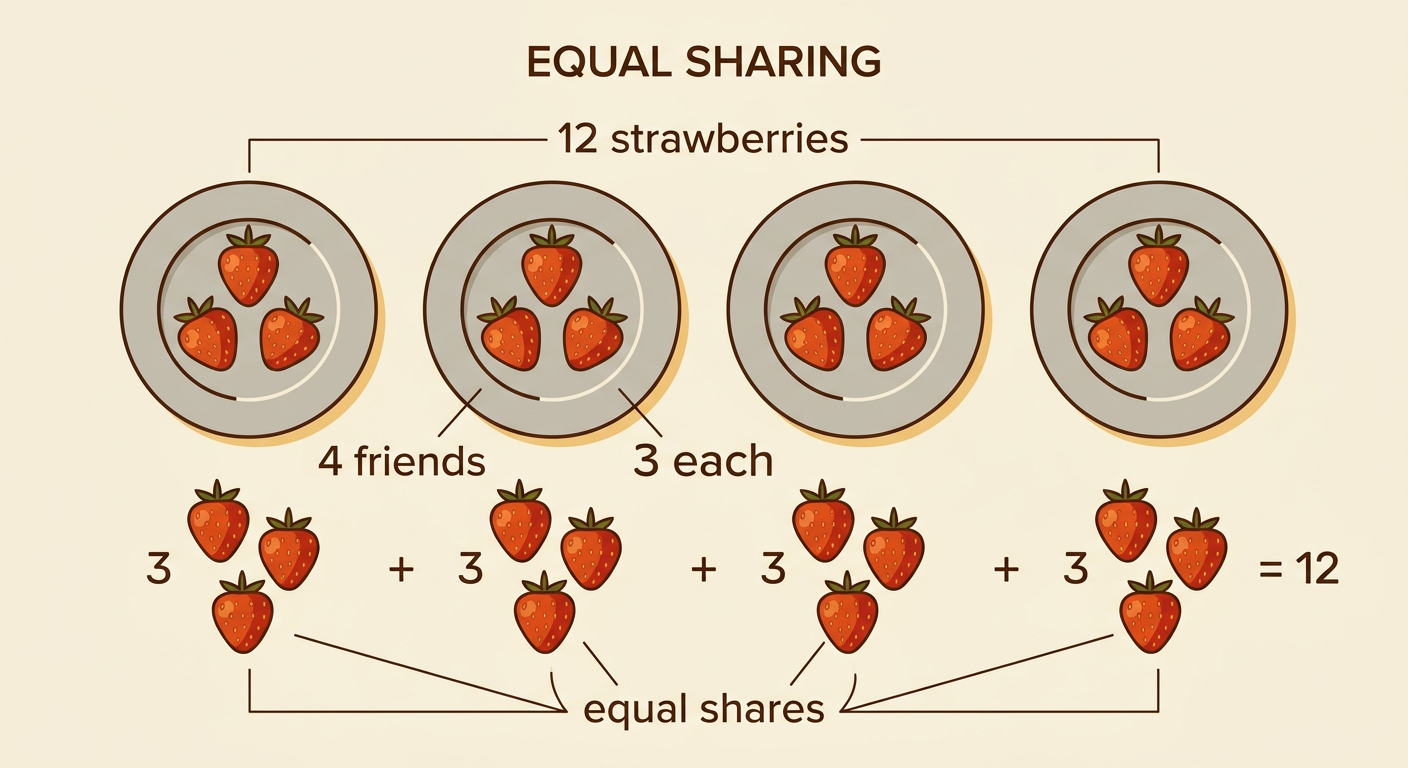
Imagine that 4 friends want to share 12 strawberries equally. Equal sharing means that every friend receives the same number. Give one strawberry to each friend, then keep giving one to each friend until all 12 strawberries have been shared. Count each friend’s strawberries. Each friend receives 3 strawberries because 3 + 3 + 3 + 3 = 12. No strawberries are left over. In this problem, 12 is the total number of objects, 4 is the number of equal shares, and 3 is the number in each share. Division helps us find the unknown number in each equal share. Before sharing, you can estimate whether each friend will receive more or fewer than 12 strawberries. Since the strawberries are split among several friends, each friend receives fewer than 12.
Model Equal Shares with Counters
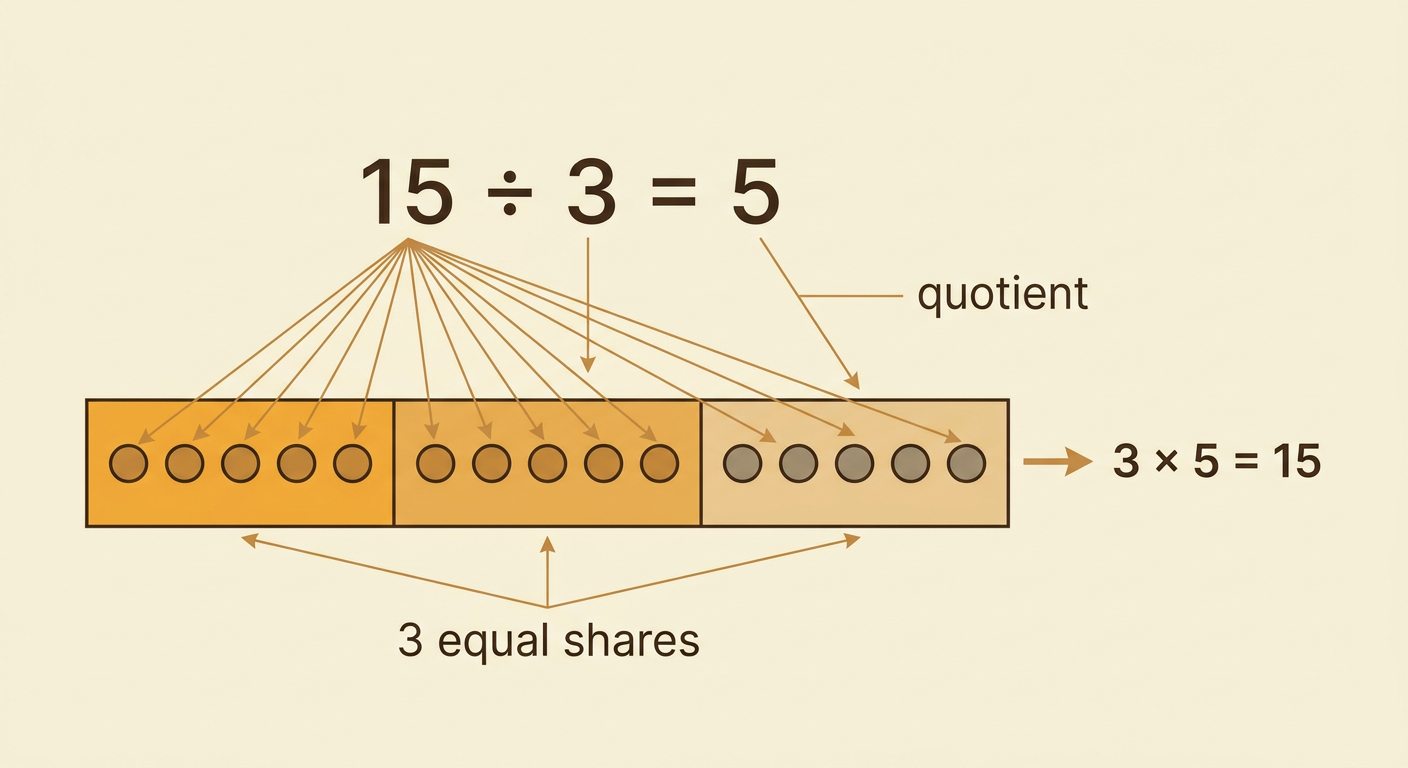
Use counters to model 15 buttons shared equally among 3 boxes. First, count out 15 counters. Draw or place 3 boxes to represent the three equal shares. Move one counter into each box, going in the same order each time. Continue making rounds until no counters remain. Now count the counters in each box. Each box has 5 counters, so the shares are equal. Check the model by adding: 5 + 5 + 5 = 15. You can also skip-count by fives: 5, 10, 15. If one box had more counters than another, the sharing would not be equal. Moving counters one at a time helps make sure that every box receives the same amount. The model shows both the total number and the number in each equal share.

Write the Division Equation
A division equation records what an equal-sharing model shows. For 15 counters shared equally among 3 boxes, write 15 ÷ 3 = 5. Read the equation as, “Fifteen divided by three equals five.” The number 15 is the total being shared. The number 3 tells how many equal shares are made. The quotient, 5, tells how many counters are in each share. Connect the equation to multiplication to check the answer. Since 3 × 5 = 15, the division equation is correct. The multiplication equation says there are 3 groups with 5 counters in each group. When you write a division equation, ask what each number means in the story. The symbols alone do not explain the situation, but the model and the words show that 5 is the number in each equal share.
Compare Sharing Strategies
Two students can share 18 cubes among 6 bags in different ways and still reach the same answer. Maya gives one cube to each bag during every round. After 3 rounds, each bag has 3 cubes. Leo places 2 cubes in each bag first. He has used 12 cubes, so 6 cubes remain. Then he places 1 more cube in every bag. Each bag again has 3 cubes. Both strategies work because all 18 cubes are used and every bag has the same number. The division equation is 18 ÷ 6 = 3. Maya’s one-at-a-time method can be easy to track. Leo’s method may be faster when he can share equal batches. No matter which method you choose, check that the shares are equal and that the total in all the shares is 18.

Complete an Exit Problem
Solve this problem: A teacher shares 20 pencils equally among 5 tables. How many pencils does each table receive? Draw 5 circles or boxes to represent the tables. Distribute 20 dots or counters among them so that each table receives the same number. You should place 4 pencils at each table, with none left over. Write the division equation 20 ÷ 5 = 4. Explain the meaning of the quotient: 4 is the number of pencils in each equal share. Check your answer with multiplication. Since 5 × 4 = 20, your model and equation are correct. Before finishing, ask yourself three questions: Did I use all 20 pencils? Did I make 5 shares? Does every share contain the same number? If all three answers are yes, you have modeled equal sharing correctly.
