
Understanding Division as Equal Sharing
Students use objects, drawings, and equations to interpret division as sharing a total equally among a known number of groups.
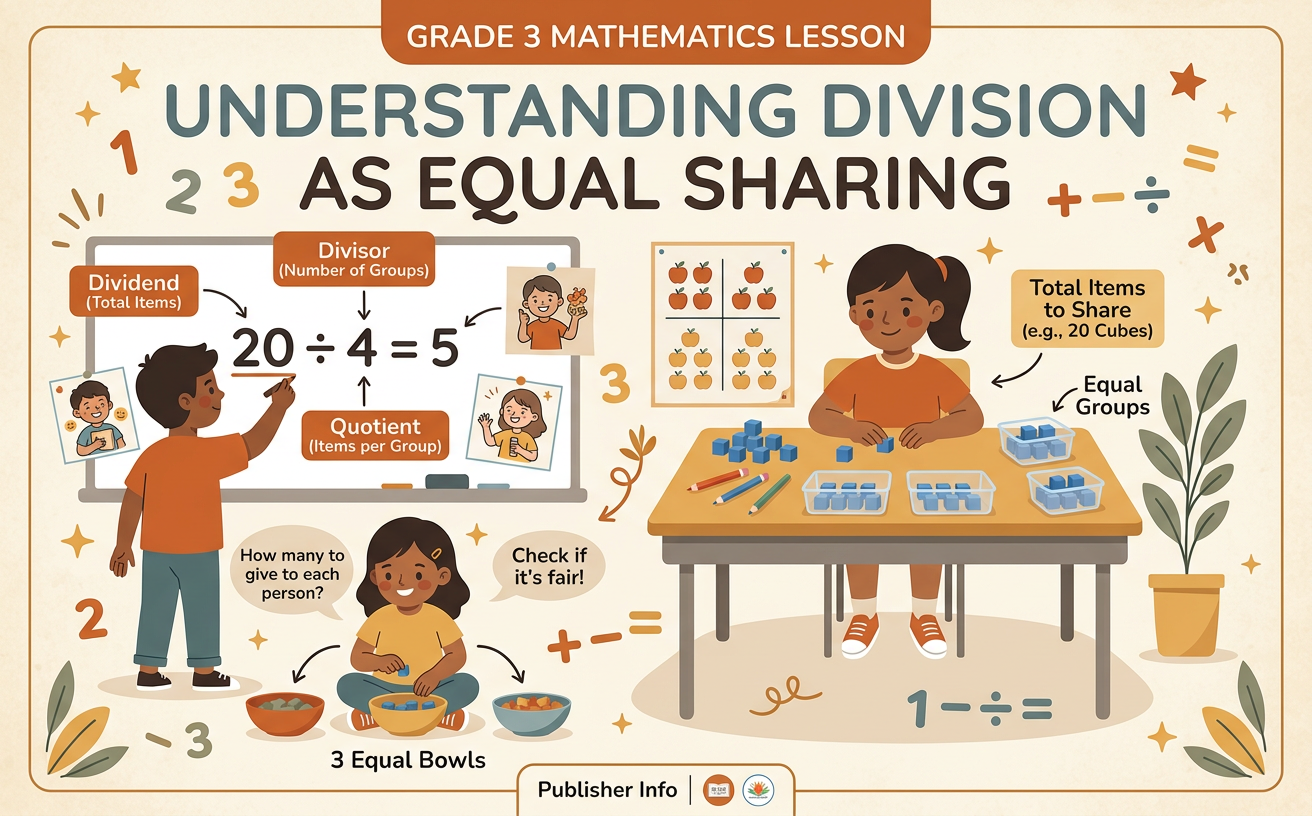
Illustrations are auto-generated and may be placeholders. They can be refreshed to match the narration.
Equal-Sharing Warm-Up
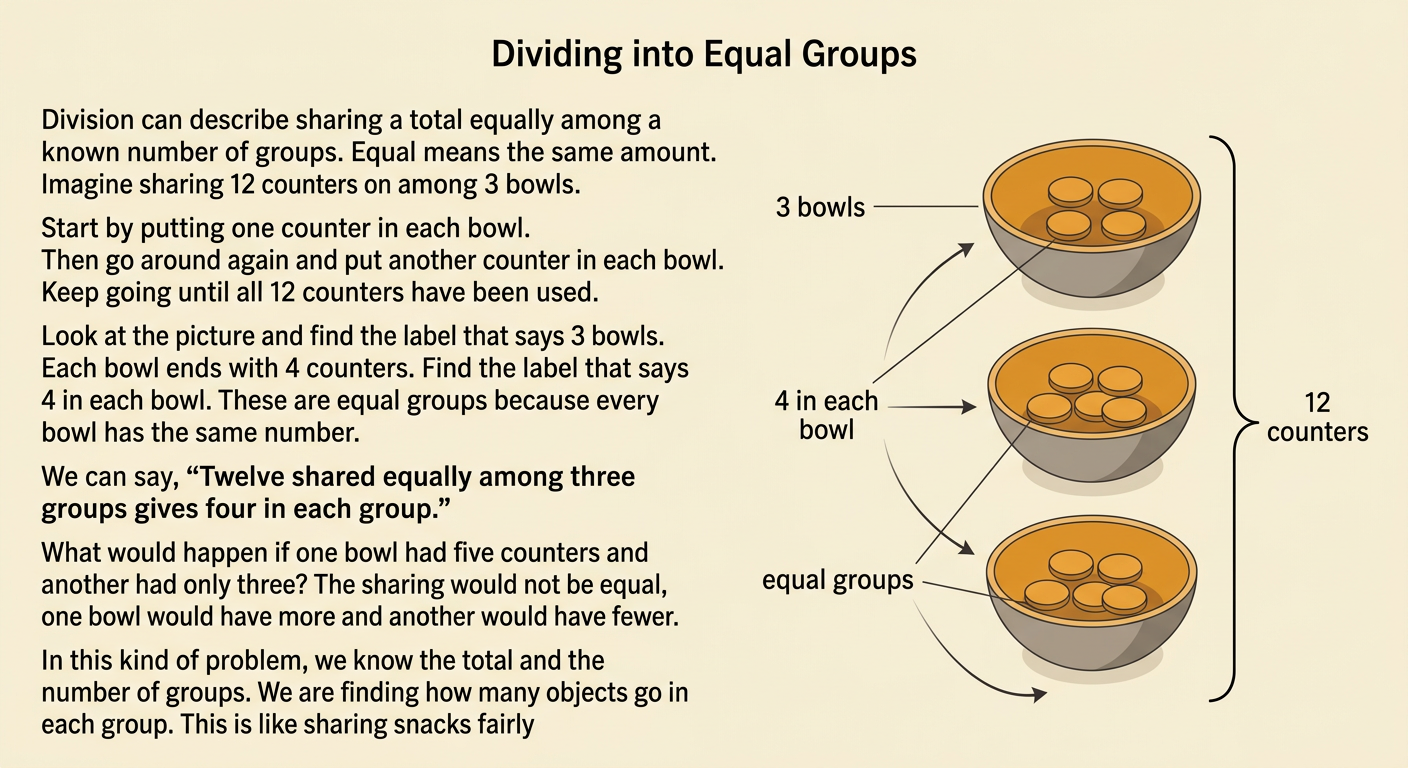
Division can describe sharing a total equally among a known number of groups. Suppose 12 counters are shared among 3 bowls. Place one counter in each bowl, then repeat until all 12 counters have been used. Each bowl will contain 4 counters. The groups are equal because every bowl has the same number. We can say, “Twelve shared equally among three groups gives four in each group.” In this kind of division problem, the total number and the number of groups are known. The question asks how many objects belong in each group. Equal sharing must be fair, so no group gets more or fewer objects than another group.
Model with Counters
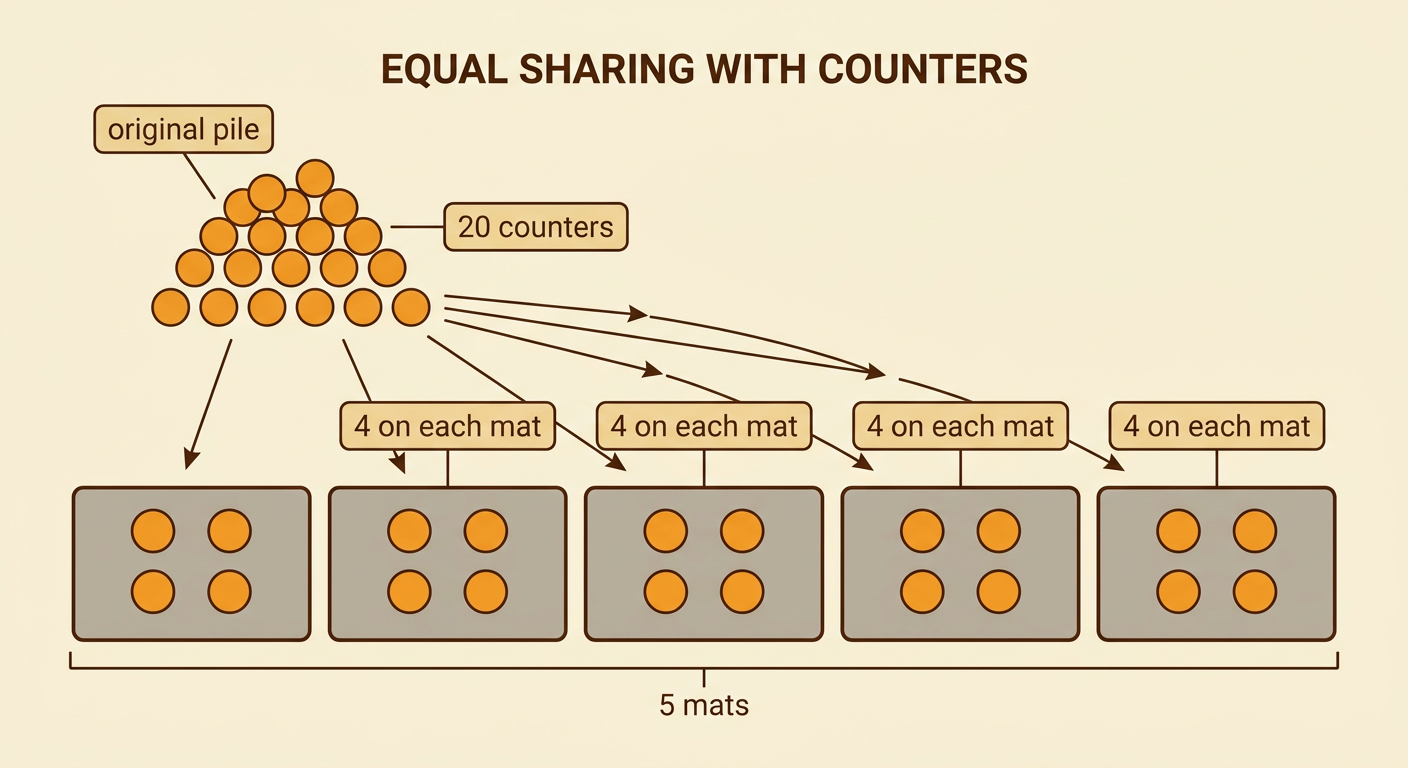
Counters help us act out an equal-sharing problem. Imagine that 20 counters must be shared equally among 5 mats. Start with all 20 counters in one pile. Move one counter onto each mat. Keep giving one counter to every mat in the same order. Stop when the original pile is empty. Count the counters on each mat. Every mat has 4 counters, so the sharing is equal. If one mat had a different number, you would need to rearrange the counters. This model shows that 20 shared among 5 groups gives 4 in each group. Distributing the counters one at a time helps make sure that every group receives a fair share.
Draw Equal Shares
A drawing can represent equal sharing when counters are not available. Suppose 18 stickers are shared equally among 6 friends. Draw 6 large circles, with one circle for each friend. Next, draw one sticker symbol in every circle. Continue adding one sticker to each circle until you have drawn all 18 stickers. Each circle will have 3 sticker symbols. Check that there are 6 groups, that every group has the same number, and that the total is 18. You can count by threes to check: 3, 6, 9, 12, 15, 18. The drawing proves that each friend receives 3 stickers. Neat groups make the equal shares easy to see and count.

Write Division Equations
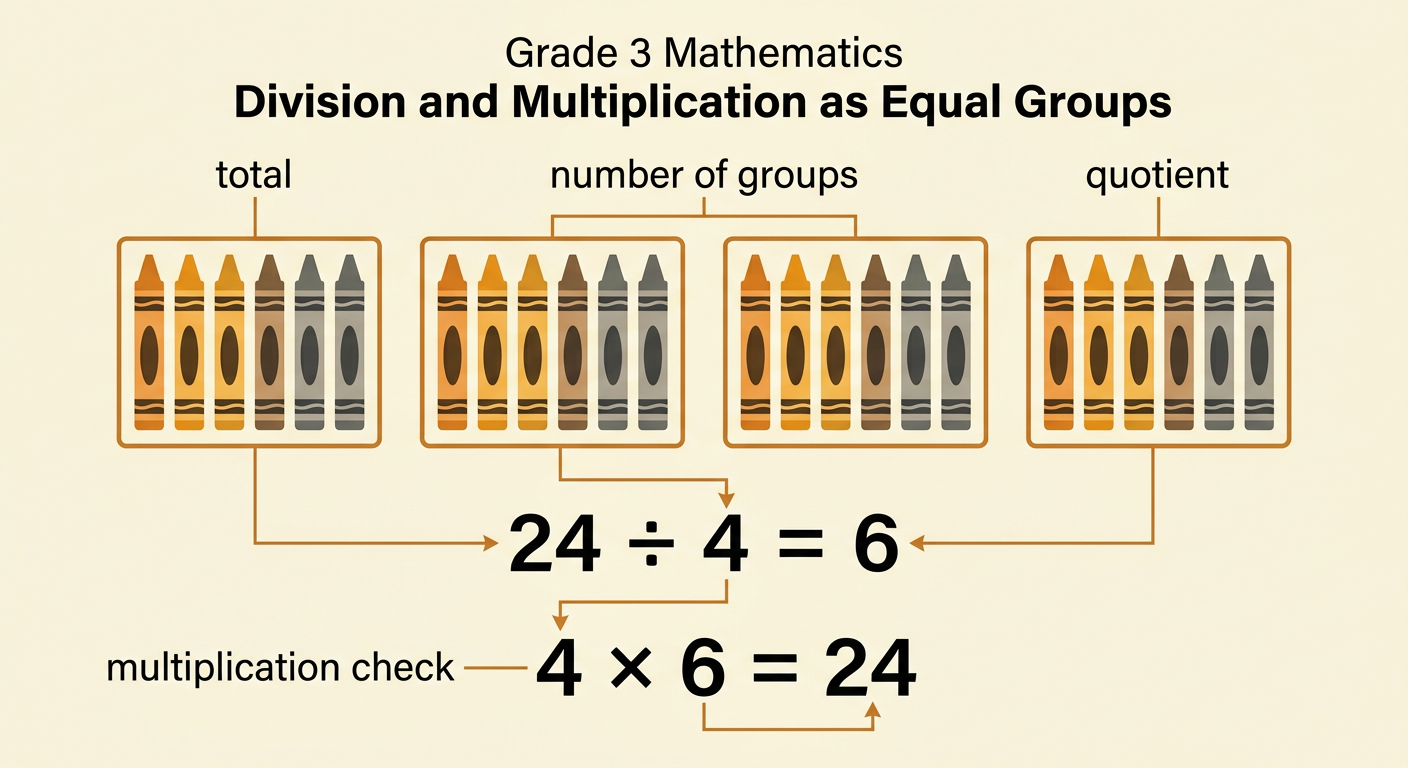
A division equation records an equal-sharing situation with numbers and symbols. If 24 crayons are shared equally among 4 students, write 24 ÷ 4 = 6. The number 24 is the total being shared. The number 4 tells how many equal groups to make. The quotient, 6, tells how many crayons belong in each group. Read the equation as, “Twenty-four divided by four equals six.” Multiplication can check the answer because 4 groups of 6 crayons make 24 crayons. Write 4 × 6 = 24. The division and multiplication equations describe the same groups. When writing a division equation, place the total first, the known number of groups second, and the number in each group after the equals sign.
Solve and Explain
To solve an equal-sharing problem, identify the total, the number of groups, and the unknown amount in each group. Consider this problem: A teacher shares 35 pencils equally among 7 tables. The total is 35 pencils, and the known number of groups is 7 tables. You can distribute drawings of pencils, use counters, or think of a multiplication fact. Since 7 × 5 = 35, each table receives 5 pencils. The division equation is 35 ÷ 7 = 5. Explain the answer by saying, “Thirty-five pencils shared equally among seven tables gives five pencils to each table.” Check that all 7 groups have 5 pencils and that 7 groups of 5 make the total of 35.
