
Understanding Division as Equal Sharing
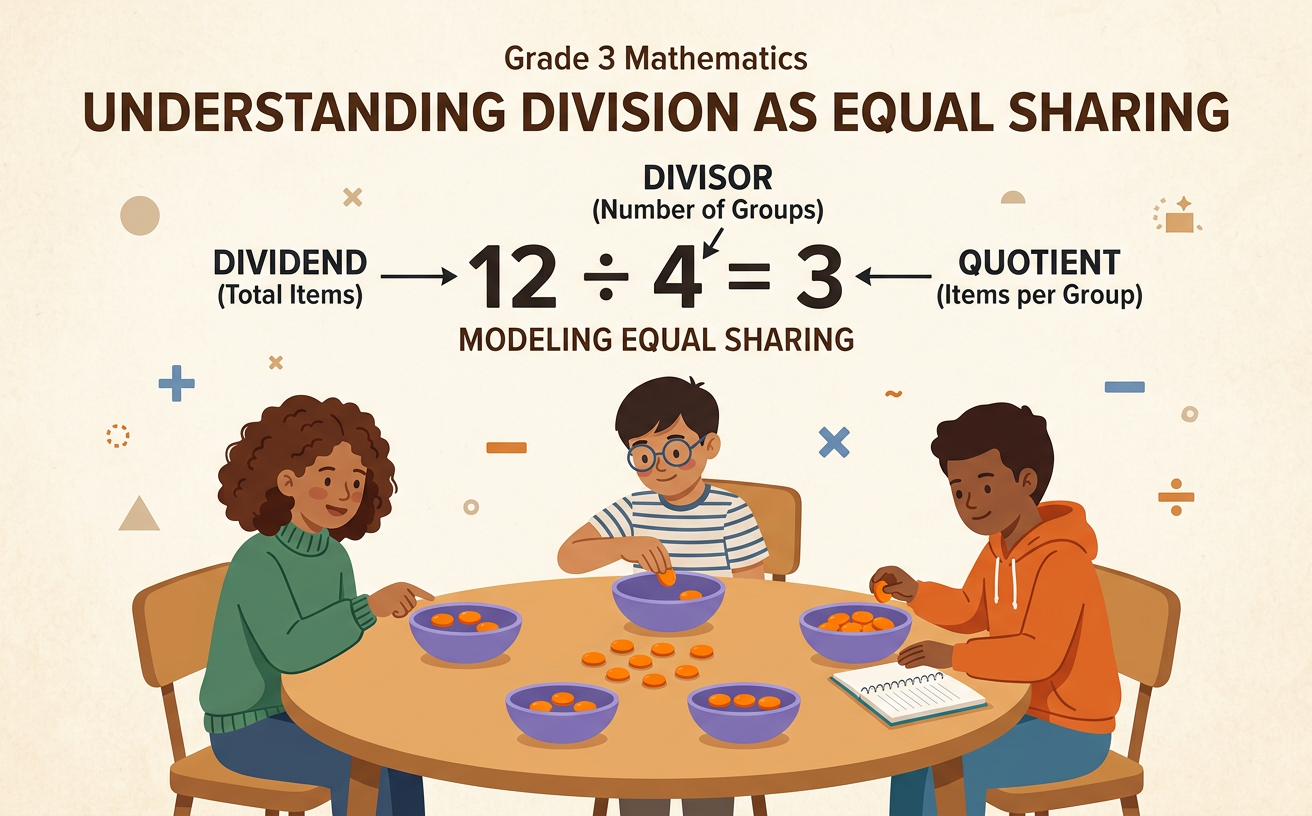
Students model division by sharing objects equally among groups and connect each model to a division equation.
Illustrations are auto-generated and may be placeholders. They can be refreshed to match the narration.
Equal-Sharing Warm-Up
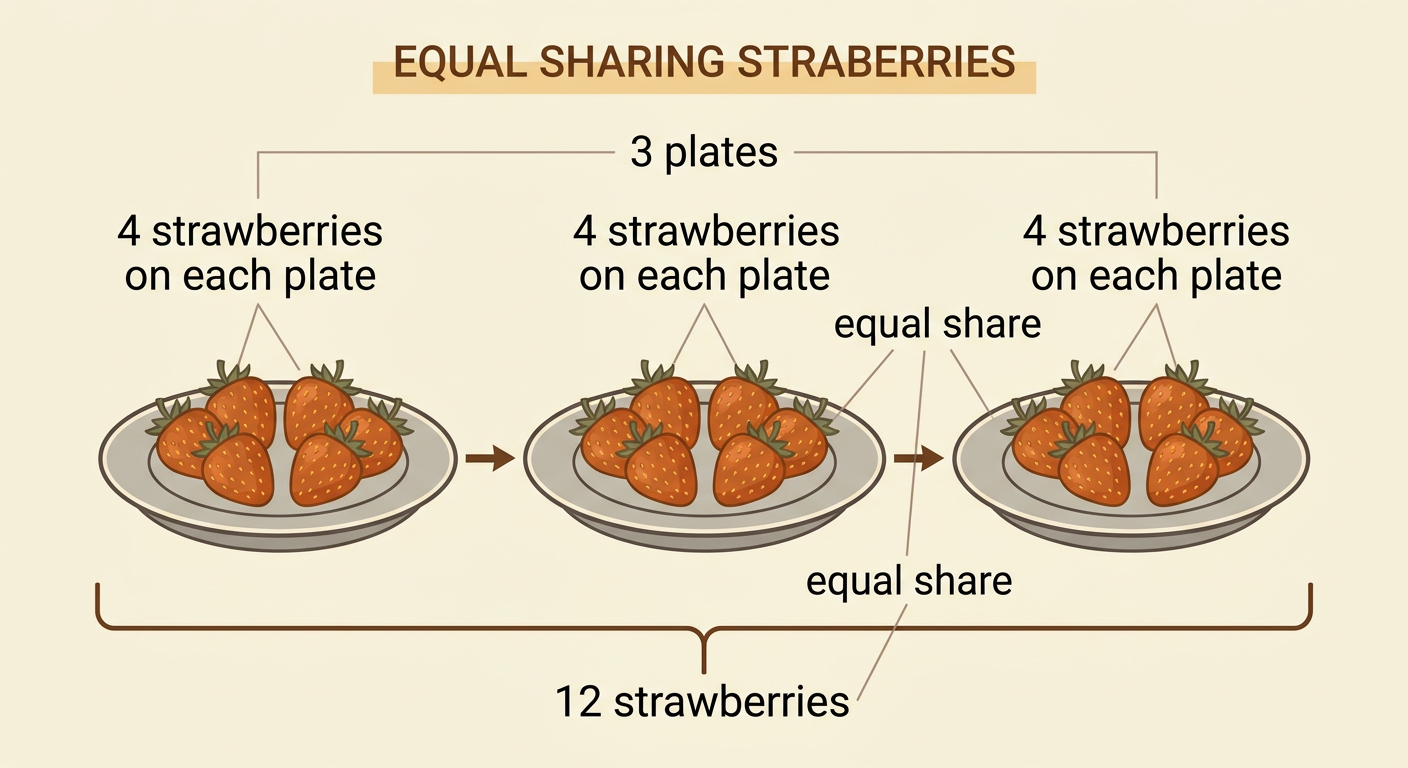
Equal sharing means putting the same number of objects in every group. Imagine that 12 strawberries are shared equally among 3 plates. Place one strawberry on each plate, then repeat until all 12 strawberries have been used. Each plate will have 4 strawberries. No strawberries are left over, and every plate has an equal share. We can describe the result by saying, “12 shared equally among 3 groups gives 4 in each group.” The total number of objects is 12, the number of equal groups is 3, and the number in each group is 4. Equal sharing is fair because each group receives the same amount.
Model with Counters
Counters can help us see equal sharing. Suppose we have 20 counters to share equally among 5 groups. Draw 5 large circles to represent the groups. Place one counter in each circle, moving from circle to circle in order. Continue making rounds until all 20 counters have been placed. Each circle will contain 4 counters. Count the counters in every circle to make sure the groups are equal. This model shows that when 20 objects are divided into 5 equal groups, there are 4 objects in each group. If one group had more or fewer counters, the sharing would not be equal, so the counters would need to be rearranged.

Write Division Equations
A division equation uses numbers and symbols to describe equal sharing. For example, share 18 pencils equally among 6 students. Each student receives 3 pencils, so the equation is 18 ÷ 6 = 3. The number 18 is the total number of pencils. The number 6 tells how many equal groups, or student shares, are made. The quotient, 3, tells how many pencils are in each share. Read the equation as “18 divided by 6 equals 3.” A sharing model and a division equation tell the same story in different ways. Look for the total, the number of equal groups, and the number in each group when writing an equation.

Solve a Sharing Problem
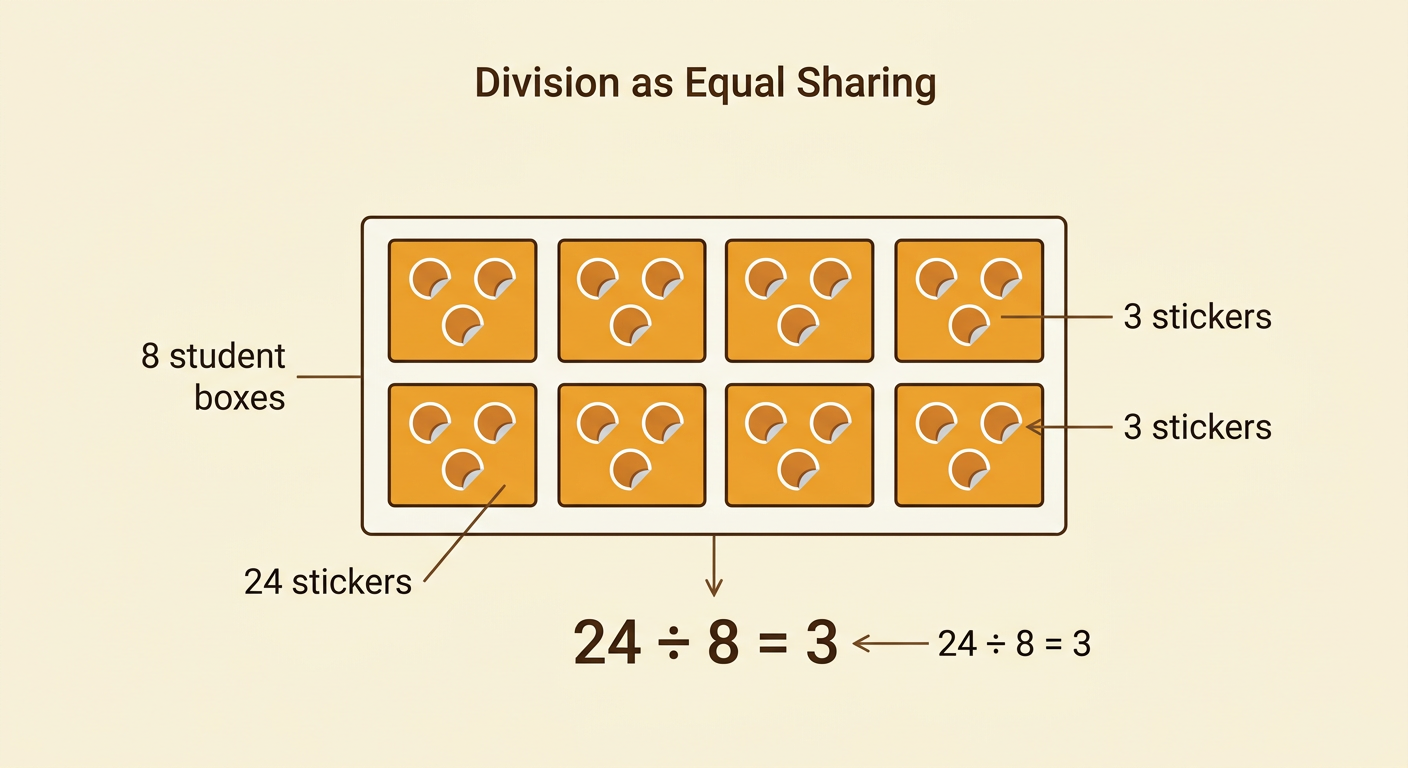
Read this problem: A teacher has 24 stickers and shares them equally among 8 students. How many stickers does each student receive? First, identify 24 as the total number of stickers and 8 as the number of equal shares. Draw 8 boxes, one for each student. Distribute the 24 stickers one at a time so that every box receives the same amount. After all the stickers are shared, each box has 3 stickers. Write the division equation 24 ÷ 8 = 3. Each student receives 3 stickers. Include the unit in the answer because the question asks about stickers, not just a number. The drawing, equation, and answer should all match the story.
Explain and Check
After solving a division problem, explain why the answer makes sense and check that the shares are equal. Suppose 28 toy cars are shared equally among 7 children. A model gives each child 4 cars, so 28 ÷ 7 = 4. Check by counting 7 groups with 4 cars in each group. You can also use multiplication: 7 × 4 = 28. Multiplication confirms that the equal groups contain all 28 cars. There should be no cars left over, and each child should have the same number. A clear explanation might say, “I made 7 equal groups. Each group had 4 cars. I checked because 7 times 4 equals 28.”
