
Understanding Functions and Function Notation
Students determine whether relationships are functions and use function notation to evaluate outputs for given inputs.

Illustrations are auto-generated and may be placeholders. They can be refreshed to match the narration.
Inputs, Outputs, and Relationships
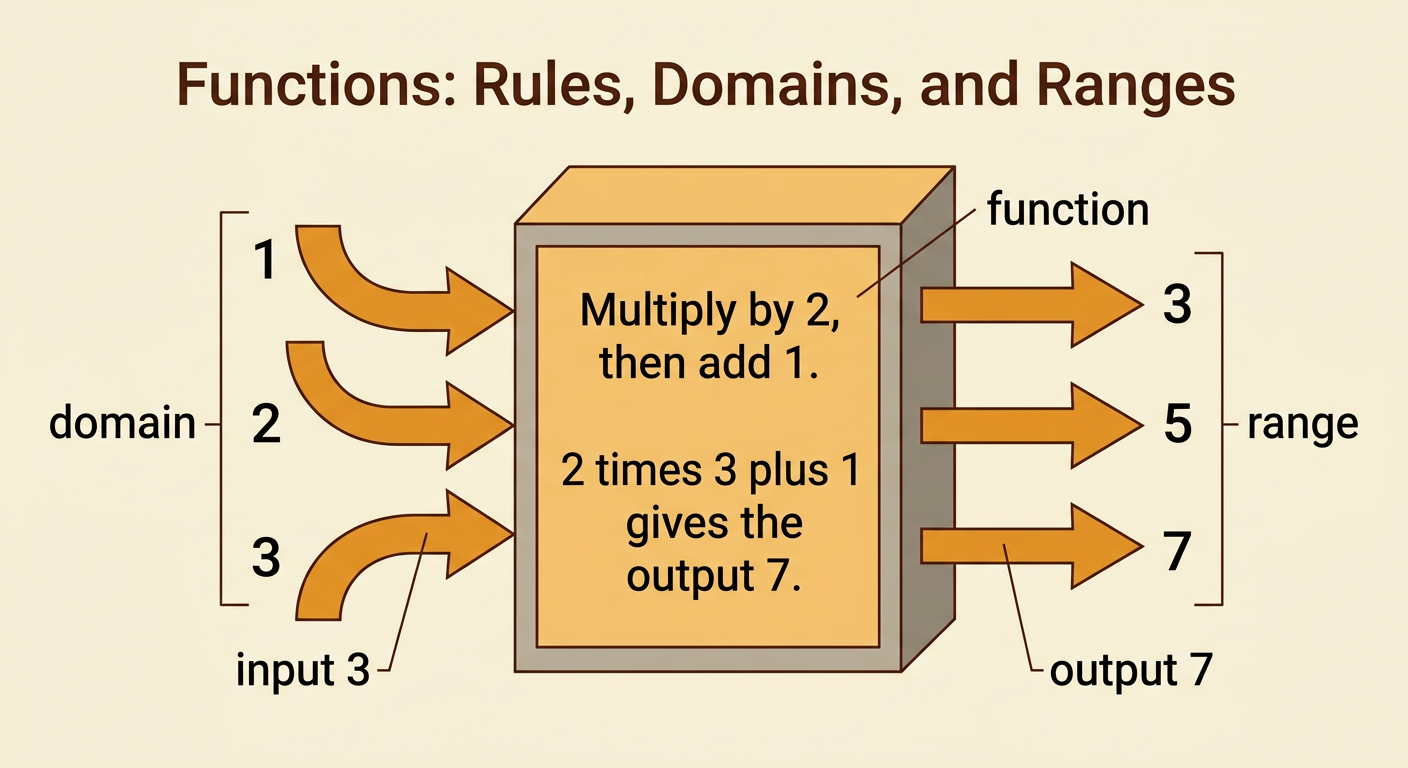
A relationship connects values from one set to values in another set. An input is a value that enters a rule or process, and an output is the resulting value. The set of possible inputs is called the domain. The set of resulting outputs is called the range. A function is a special relationship that assigns each input exactly one output. For example, suppose a machine follows the rule “multiply by 2, then add 1.” An input of 3 produces an output of 7 because 2(3) + 1 = 7. An input cannot produce two different outputs in the same function. Different inputs, however, may produce the same output. Think of each input as having exactly one destination, even when several inputs share that destination.
Identifying Functions from Representations
Relationships can be represented with mapping diagrams, tables, ordered pairs, equations, or graphs. To decide whether a representation is a function, check whether any input is paired with more than one output. In the ordered pairs (1, 4), (2, 5), and (3, 4), each x-value appears with only one y-value, so the relationship is a function. It is acceptable for inputs 1 and 3 to share the output 4. However, the pairs (1, 4) and (1, 6) do not form a function because input 1 has two outputs. On a graph, use the vertical line test. If any vertical line crosses the graph more than once, one x-value has multiple y-values, so the graph does not represent a function.

Introducing Function Notation
Function notation gives a name to a function and shows its input and output. The expression f(x) is read “f of x.” The letter f names the function, x represents an input, and f(x) represents the output associated with x. It does not mean f multiplied by x. For example, the rule y = 3x − 2 can be written as f(x) = 3x − 2. Writing f(4) asks for the output when the input is 4. In this notation, f(4) replaces both x symbols in the rule: f(4) = 3(4) − 2. Function notation makes it easy to describe several functions, such as f(x) and g(x), without confusing their rules.

Evaluating Functions
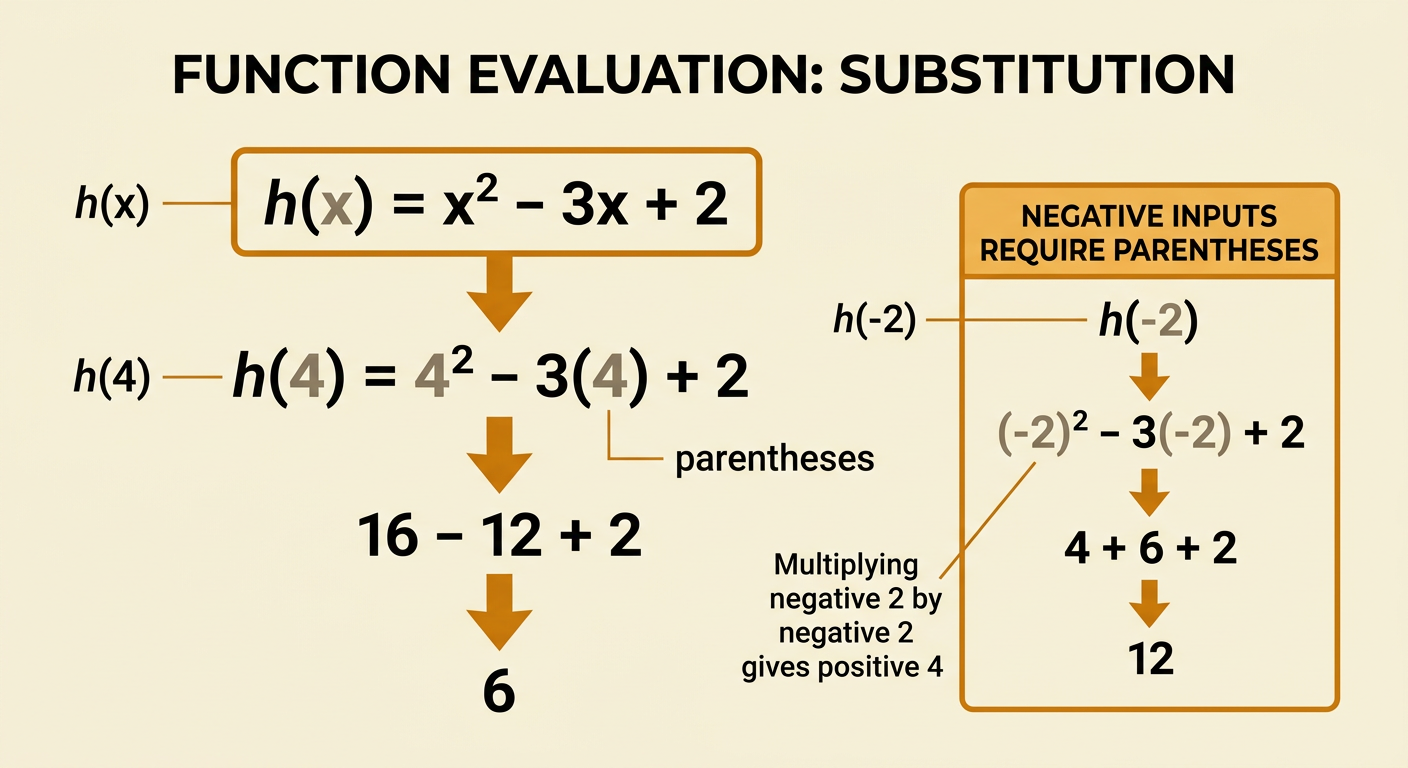
To evaluate a function, substitute the given input for every occurrence of the variable and simplify using the order of operations. Suppose h(x) = x² − 3x + 2. To find h(4), replace each x with 4: h(4) = 4² − 3(4) + 2. Then simplify to get 16 − 12 + 2 = 6, so h(4) = 6. Parentheses help show the substitution clearly, especially when the input is negative. For example, h(−2) = (−2)² − 3(−2) + 2 = 4 + 6 + 2 = 12. Be careful that (−2)² equals 4. Evaluating a function means finding its output, not solving an equation for the variable.
Domain and Range Check
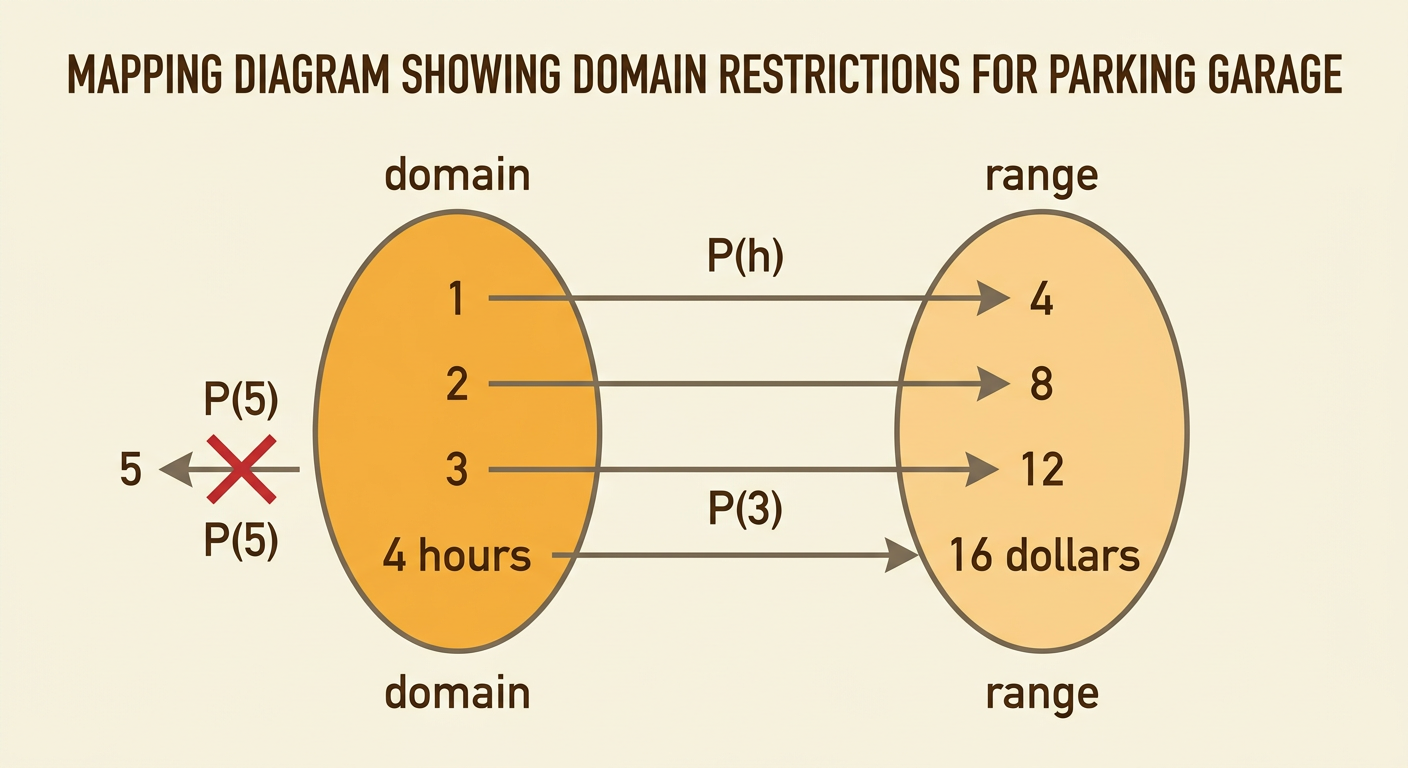
Before evaluating a function, check whether the requested input belongs to its domain. The domain includes all allowed input values, while the range includes the outputs the function actually produces. Consider a parking garage that charges P(h) = 4h for h hours, where h can be 1, 2, 3, or 4. The domain is {1, 2, 3, 4}, and the range is {4, 8, 12, 16}. Because 3 is in the domain, P(3) = 12 is defined. The input 5 is not allowed in this situation, so P(5) is not defined for the stated domain, even though substituting 5 into the formula would give 20. A formula alone does not always communicate every restriction; the context and stated domain also matter.
Independent Practice and Exit Ticket
Apply the definition of a function and show each substitution clearly. First, decide whether the pairs (0, 2), (1, 3), (2, 4), and (2, 5) represent a function. They do not because input 2 has two outputs. Next, let g(x) = 2x² + 1. Find g(3) and g(−1). Substitution gives g(3) = 2(3²) + 1 = 19 and g(−1) = 2((−1)²) + 1 = 3. For an exit ticket, answer these questions independently: Does the table with inputs 1, 2, 3 and outputs 5, 5, 7 represent a function? What is k(4) if k(x) = 6 − x? State why your input is permitted. Check that each input has one output and that 4 belongs to the stated domain of all real numbers.
