Understanding Integers
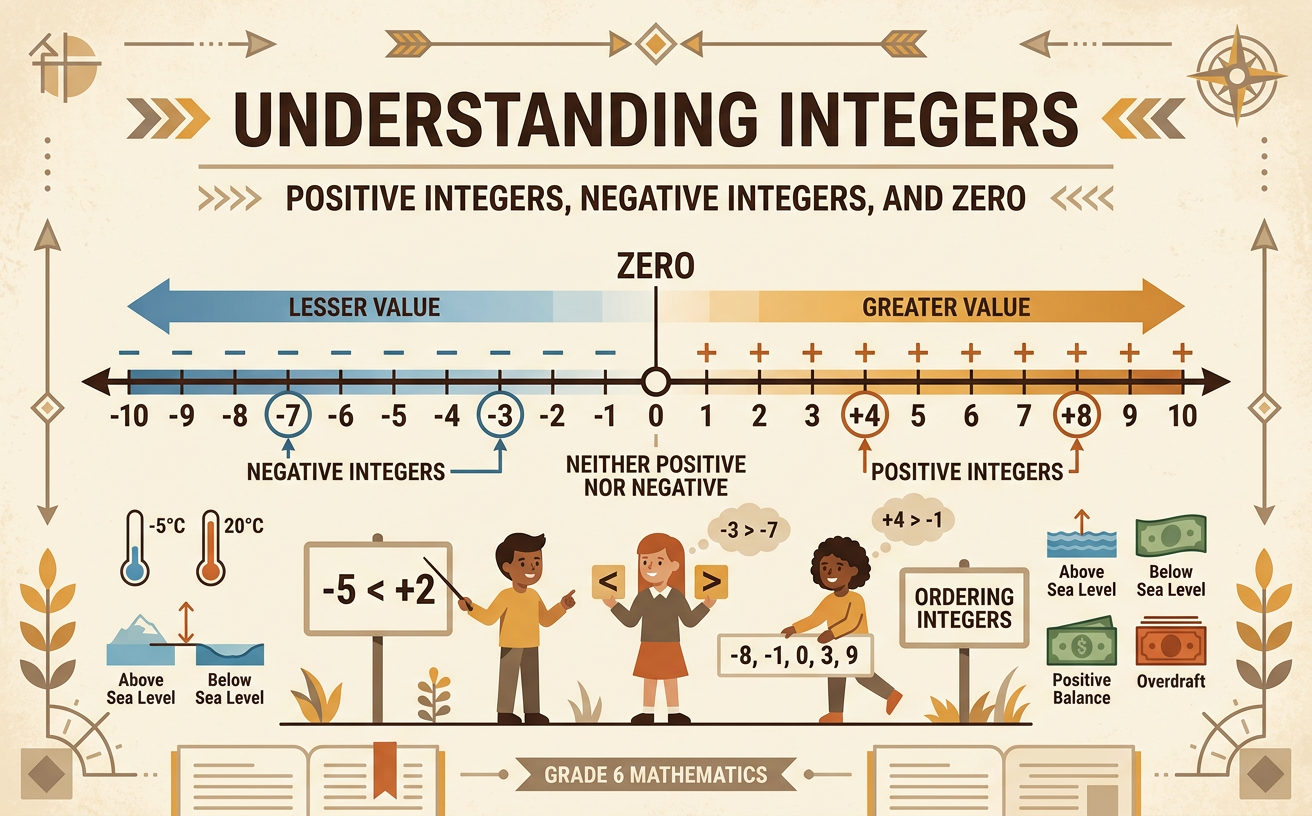
Students identify positive integers, negative integers, and zero, represent them on a number line, and compare and order them.
Illustrations are auto-generated and may be placeholders. They can be refreshed to match the narration.
Meaning of Integers
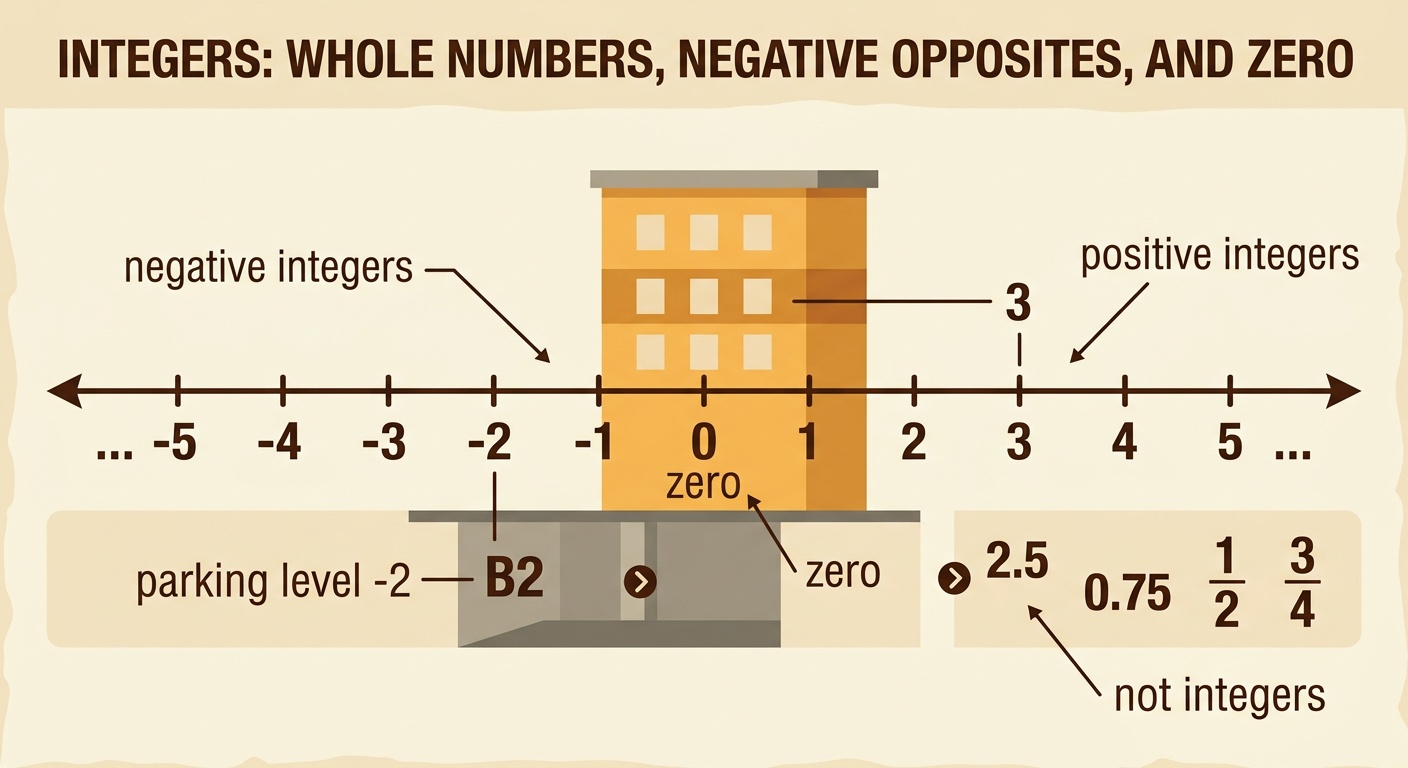
Integers are whole numbers, their negative opposites, and zero. They do not include fractions or decimals. Examples of integers are -8, -2, 0, 3, and 15. The dots in the set {..., -3, -2, -1, 0, 1, 2, 3, ...} show that integers continue forever in both directions. Integers help us describe amounts above and below a starting point. For example, if the ground floor is called 0, the third floor above it can be represented by 3, while a parking level two floors below it can be represented by -2. The numbers 3 and -2 are both integers, but 2.5 is not an integer because it is not a whole number.
Positive Integers, Negative Integers, and Zero
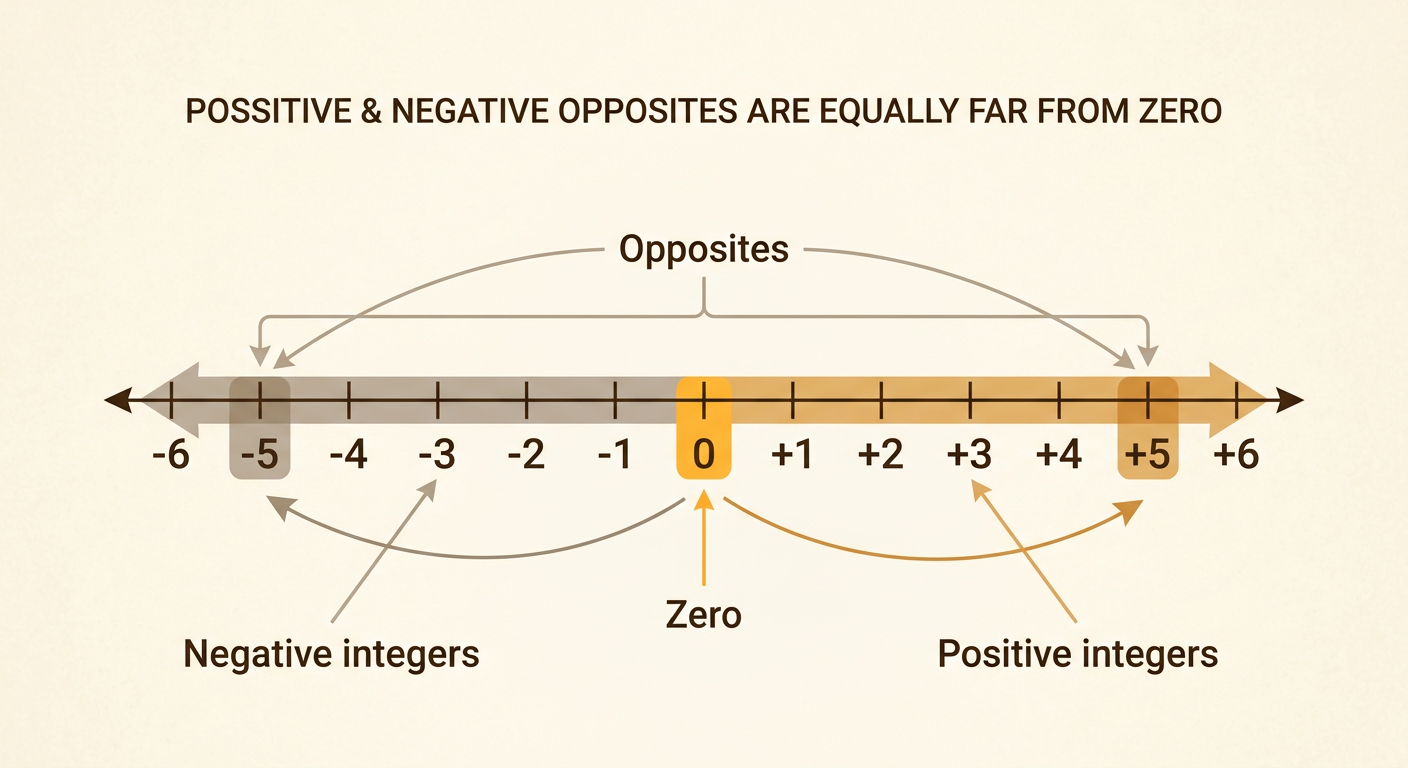
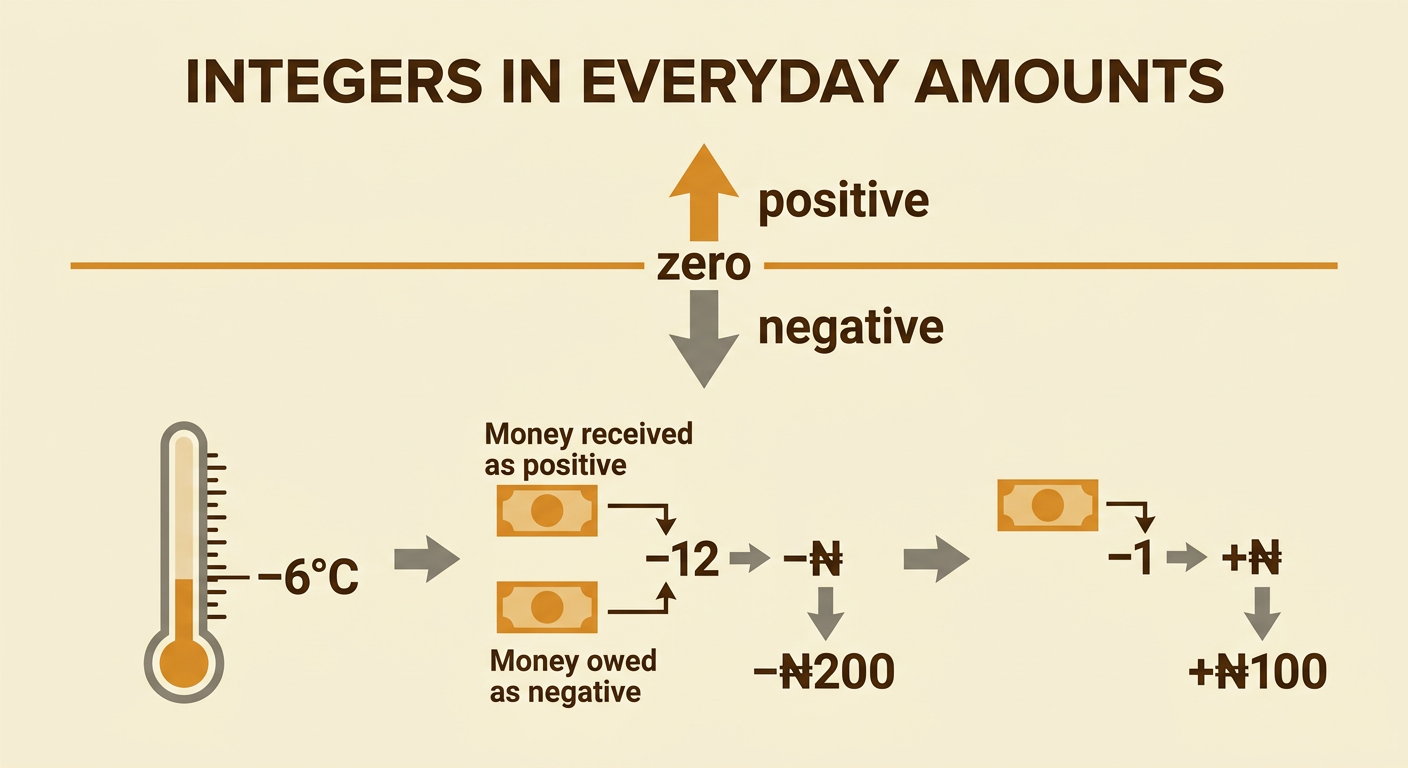
Positive integers are whole numbers greater than zero, such as 1, 6, and 24. A positive sign may be written, as in +6, but it is often left out. Negative integers are whole numbers less than zero, such as -1, -6, and -24. The negative sign must be written. Zero is neither positive nor negative; it separates the two groups. Numbers such as 5 and -5 are called opposites because they are the same distance from zero but lie on different sides of it. For example, gaining 5 points can be represented by +5, while losing 5 points can be represented by -5. The integer 0 represents no gain and no loss.
Integers in Everyday Situations
Integers are useful when quantities can move above or below a reference point. A bank deposit or money received may be positive, while a debt or withdrawal may be negative. Height above sea level is positive, and depth below sea level is negative. A temperature above 0°C is positive, while one below 0°C is negative. For example, suppose Ada has ₦500 but owes her brother ₦700. Her net amount is 500 - 700 = -200, so her financial position can be represented by -₦200. If she later receives ₦300, her position becomes -200 + 300 = 100, or +₦100. In each situation, first identify the reference point, then decide whether the quantity is above, below, gained, or lost.
Representing Integers on a Number Line
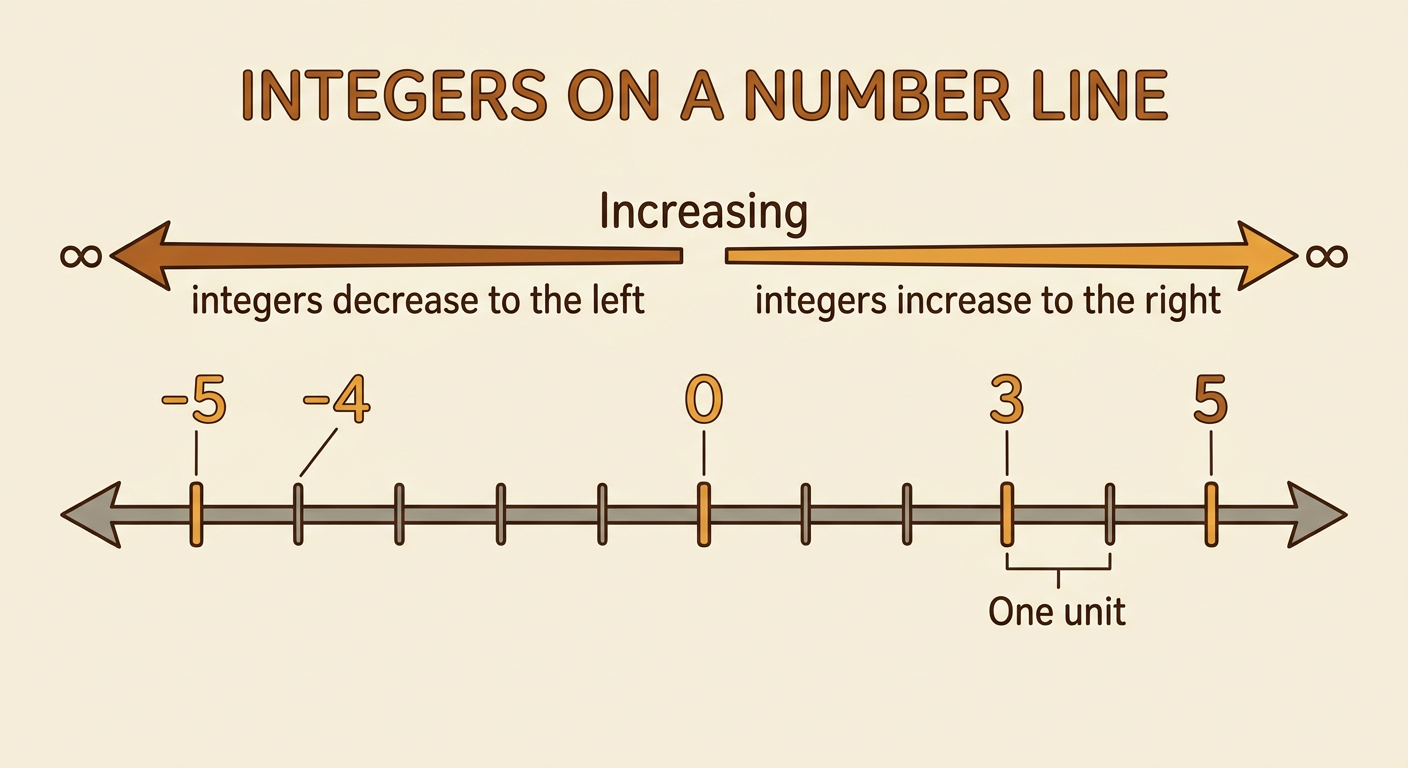
A number line shows integers in order using equally spaced marks. Zero is the reference point. Positive integers are placed to the right of zero, and negative integers are placed to the left. Each step between neighboring marks represents one unit when the scale is 1. To locate -4, begin at 0 and move four equal steps left. To locate 3, begin at 0 and move three equal steps right. Arrows at both ends show that the line continues without end. Numbers increase as you move right and decrease as you move left. For example, starting at -2 and moving five steps right lands on 3. Careful spacing is important because equal differences between integers must be shown by equal distances on the line.
Comparing and Ordering Integers
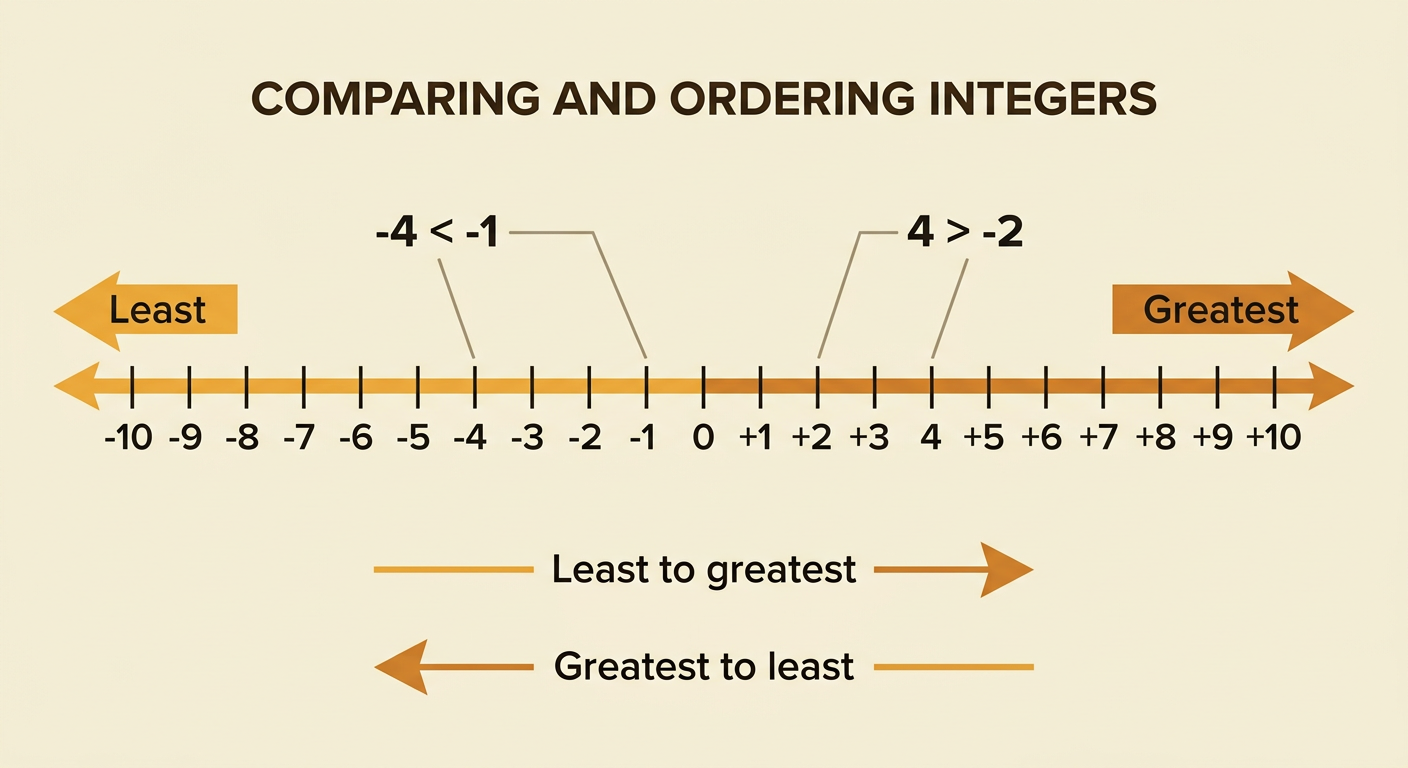
To compare integers, locate them on a number line. The integer farther to the right is greater, and the integer farther to the left is less. Use > for “greater than,” < for “less than,” and = for “equal to.” For example, 4 > -2 because 4 lies to the right of -2. Also, -7 < -3 because -7 lies farther left. Among negative integers, the number closer to zero is greater, so -2 is greater than -6. To order integers from least to greatest, read them from left to right on the number line. For the integers 5, -4, 0, -1, and 3, the correct order is -4, -1, 0, 3, 5. From greatest to least, reverse the order: 5, 3, 0, -1, -4.