Understanding Multiplication as Equal Groups
Students use objects, drawings, and equations to interpret multiplication as a total made from equal-sized groups.

Illustrations are auto-generated and may be placeholders. They can be refreshed to match the narration.
Introduce Equal Groups
Multiplication can describe a total made from equal groups. Equal groups have the same number of objects in every group. Imagine 3 plates with 4 strawberries on each plate. The groups are equal because every plate has 4 strawberries. You can find the total with repeated addition: 4 + 4 + 4 = 12. You can also write the multiplication equation 3 × 4 = 12. In this equation, 3 tells how many groups there are, 4 tells how many objects are in each group, and 12 is the total number of objects. If one plate had a different number of strawberries, the plates would not show equal groups. Before multiplying, check that every group has the same number.

Build Groups with Objects
You can use classroom objects to build equal groups. Place 5 paper cups in a row. Put exactly 2 connecting cubes into each cup. Count the cups to find the number of groups: there are 5 groups. Look inside one cup to find the number in each group: there are 2 cubes in each group. Now count all the cubes. You can count by twos: 2, 4, 6, 8, 10. There are 10 cubes altogether, so the model represents 5 × 2 = 10. Try moving the cups farther apart. The total does not change because there are still 5 equal groups with 2 cubes in each group. The arrangement can change, but the group size must stay equal.

Connect Models to Equations
A drawing of equal groups can be connected to a multiplication equation. Suppose a picture shows 4 circles with 3 dots inside each circle. First, count the circles. They represent 4 groups, so 4 is the first factor. Next, count the dots in one circle. Each group has 3 dots, so 3 is the second factor. Write 4 × 3 to mean 4 groups of 3. To find the product, add the equal groups: 3 + 3 + 3 + 3 = 12. Therefore, 4 × 3 = 12. The factors tell how the objects are grouped, and the product tells the total. When reading an equation in this lesson, say, “four groups of three equals twelve.” This connects the words, picture, repeated addition, and equation.

Solve a Multiplication Problem
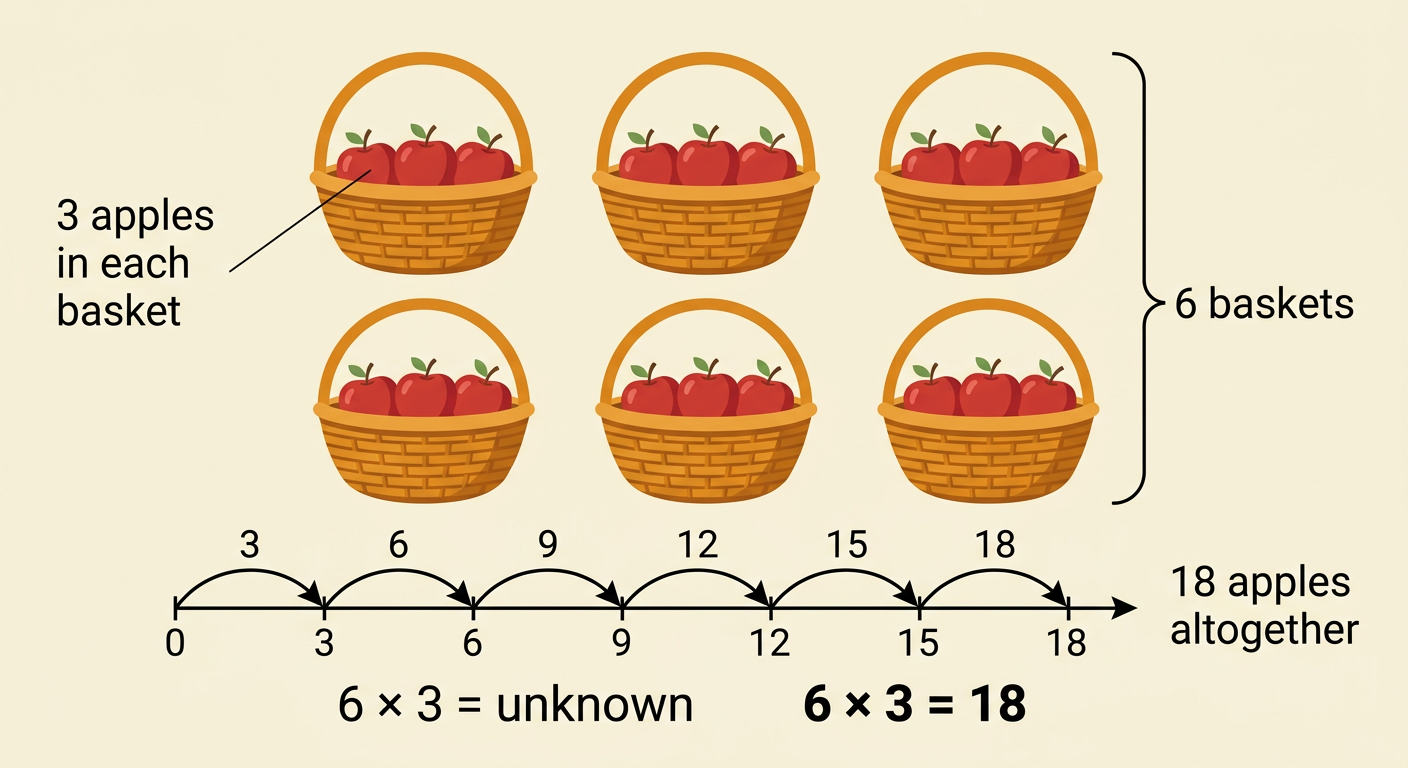
Read the problem and look for equal groups: Mia has 6 baskets. She puts 3 apples in each basket. How many apples does she have altogether? The 6 baskets are the groups, and the 3 apples are the number in each group. Draw 6 baskets and place 3 apple symbols in every basket. Then write the equation 6 × 3 = unknown. Count by threes to find the total: 3, 6, 9, 12, 15, 18. The product is 18, so 6 × 3 = 18. Mia has 18 apples altogether. Notice that the question asks for the total, not the number of groups or the number in each group. A multiplication equation is useful because it represents all the equal groups at once.
Explain and Check
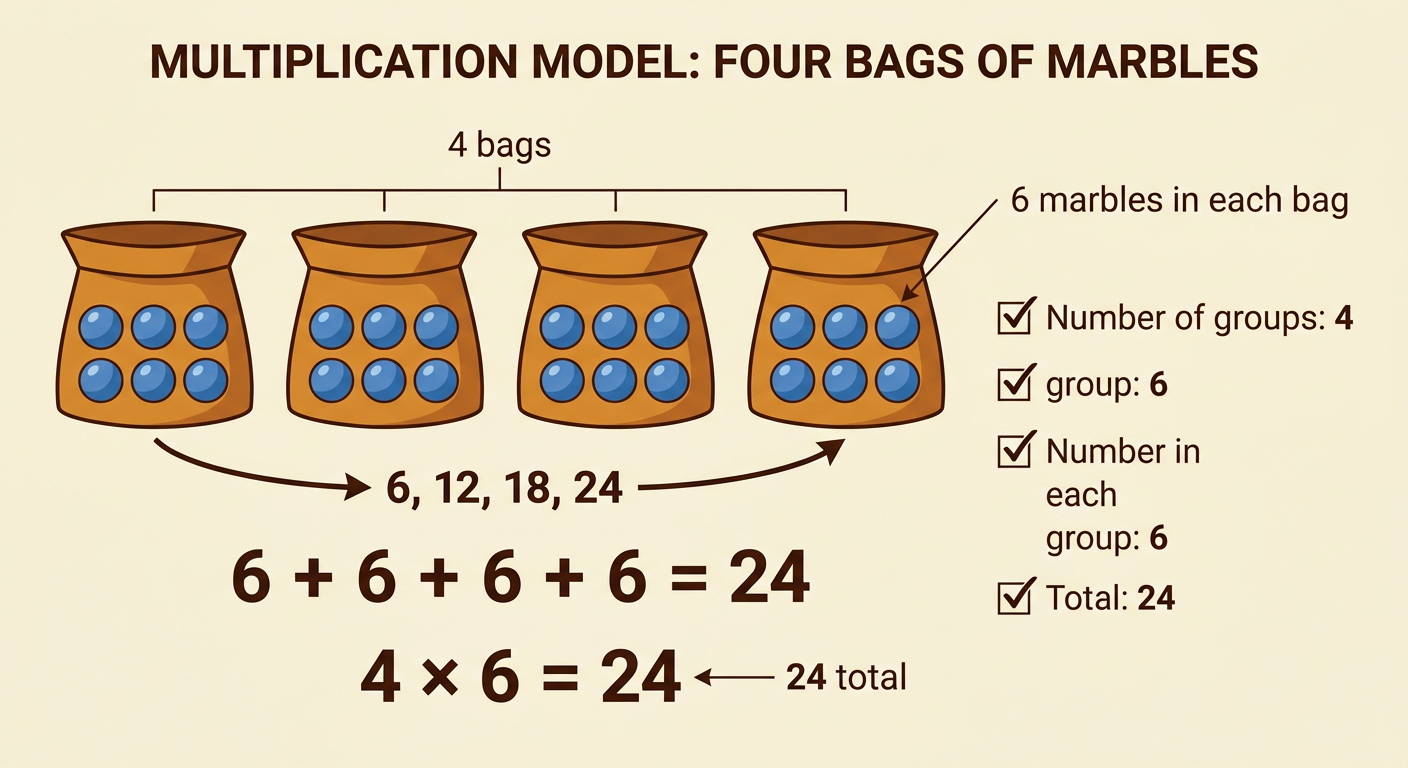
After solving, explain what each number means and check that the answer is reasonable. For example, 4 bags hold 6 marbles in each bag. The equation is 4 × 6 = 24. Explain: 4 is the number of bags, 6 is the number of marbles in each bag, and 24 is the total number of marbles. Check the answer by adding 6 four times: 6 + 6 + 6 + 6 = 24. You can also skip-count by sixes: 6, 12, 18, 24. Both checks give the same total. Finally, inspect the drawing. It should have exactly 4 groups, and every group should contain exactly 6 marbles. A clear explanation names the groups, the amount in each group, and the total.